Find us at booth #83, join us for a harbor side happy hour, or catch Gorish’s talk.

Sept, 16-18 > Learn more


Tamanna Mishra

February 20, 2026
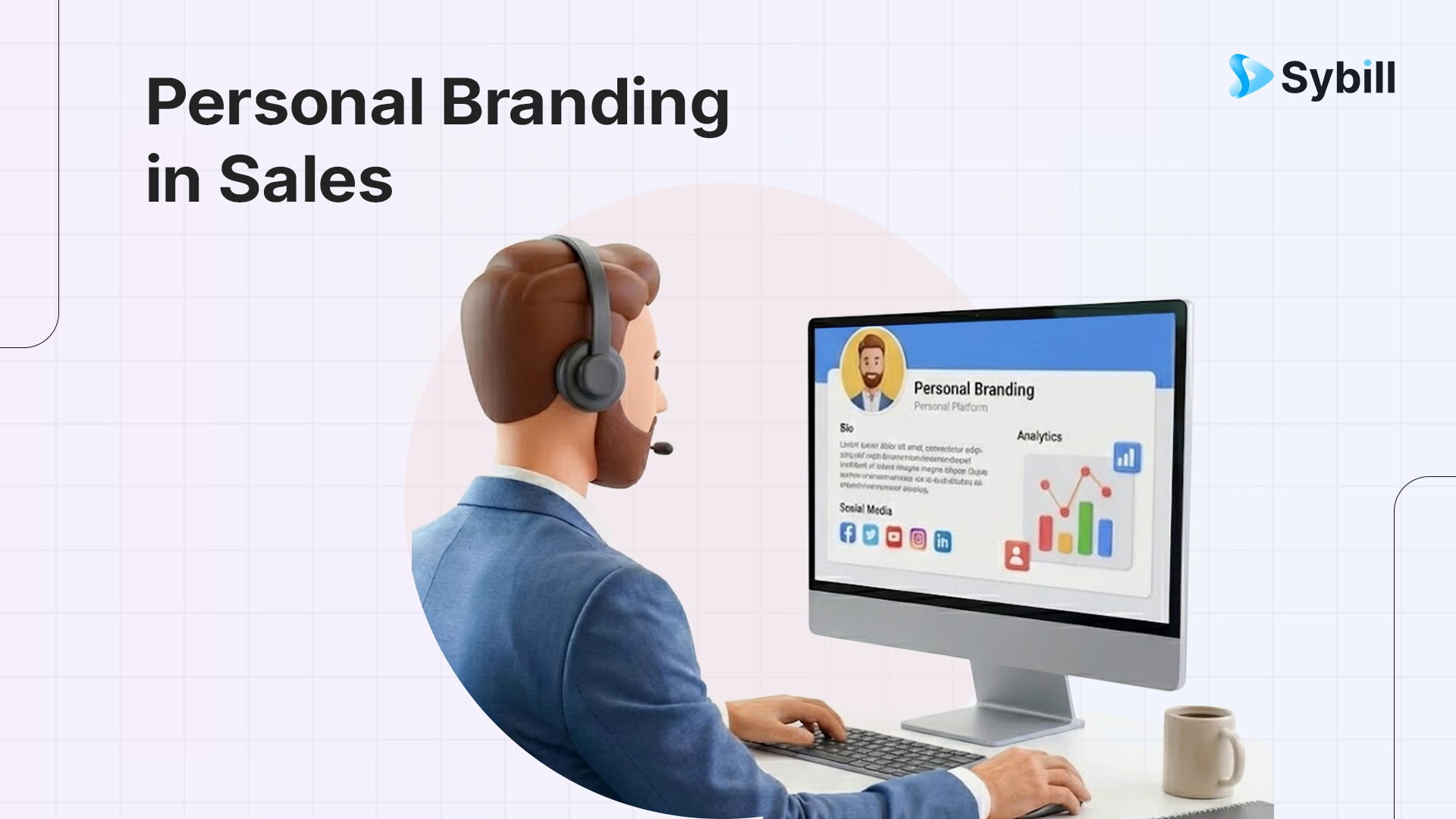
Your buyer is Googling you before the meeting. Not your company. You.
They check your LinkedIn. They scan your social posts. They look for clues.
Are you credible?
Are you thoughtful?
Are you just another rep copying and pasting product messaging?
This is where personal branding in sales quietly decides whether your call starts warm or cold.
Right now, most profiles read like résumés frozen in time. Job titles. Quotas. Generic buzzwords. That is not a personal brand in sales. That is a digital business card.
You do not want to be the extra in a Marvel movie. You want to be the character with a storyline. Someone buyers recognize. Someone with a perspective. Someone whose name triggers context and familiarity.
Here is the uncomfortable question: if your name disappeared tomorrow, would anyone notice?
Buyers trust people more than logos. And personal branding for sales reps is no longer optional. It is a competitive edge.
This blog is your blueprint for building a personal brand in sales that drives inbound interest, accelerates trust, and quietly feeds your pipeline.
We’re not here to talk about how every sales rep can become an influencer. We’re here to give you a playbook to be trusted before you even pitch.
Personal branding in sales is the deliberate positioning of your expertise, perspective, and credibility so buyers see you as a trusted advisor before they ever get on a call with you.
It is not about self-promotion. It is about signal.
That is very different from having an active social media presence. Posting regularly does not equal authority. Visibility without substance is noise. Real personal branding for sales professionals is intentional. It compounds over time.
1. Expertise clarity
You are known for something specific. Not “SaaS sales.” Not “enterprise solutions.” But a defined problem, industry, or outcome.
2. Consistent perspective
You do not echo trends. You interpret them. Buyers start recognizing your thinking style.
3. Visible proof
Case studies. Results. Lessons from real deals. Tangible credibility.
Here is the simple framework:
Brand = Perception x Repetition x Proof
Perception shapes how buyers see you. Repetition builds familiarity. Proof builds trust.
Miss one, and your brand weakens. Nail all three, and you stop being “just another rep.”
If you are not investing in personal branding for sales reps, you are voluntarily making your job harder.
Modern buyers are informed, skeptical, and busy. They are not waiting for your pitch. They are researching you first. That is where personal branding in sales quietly changes the game.
Trust in brands is fragile. Trust in individuals is stronger.
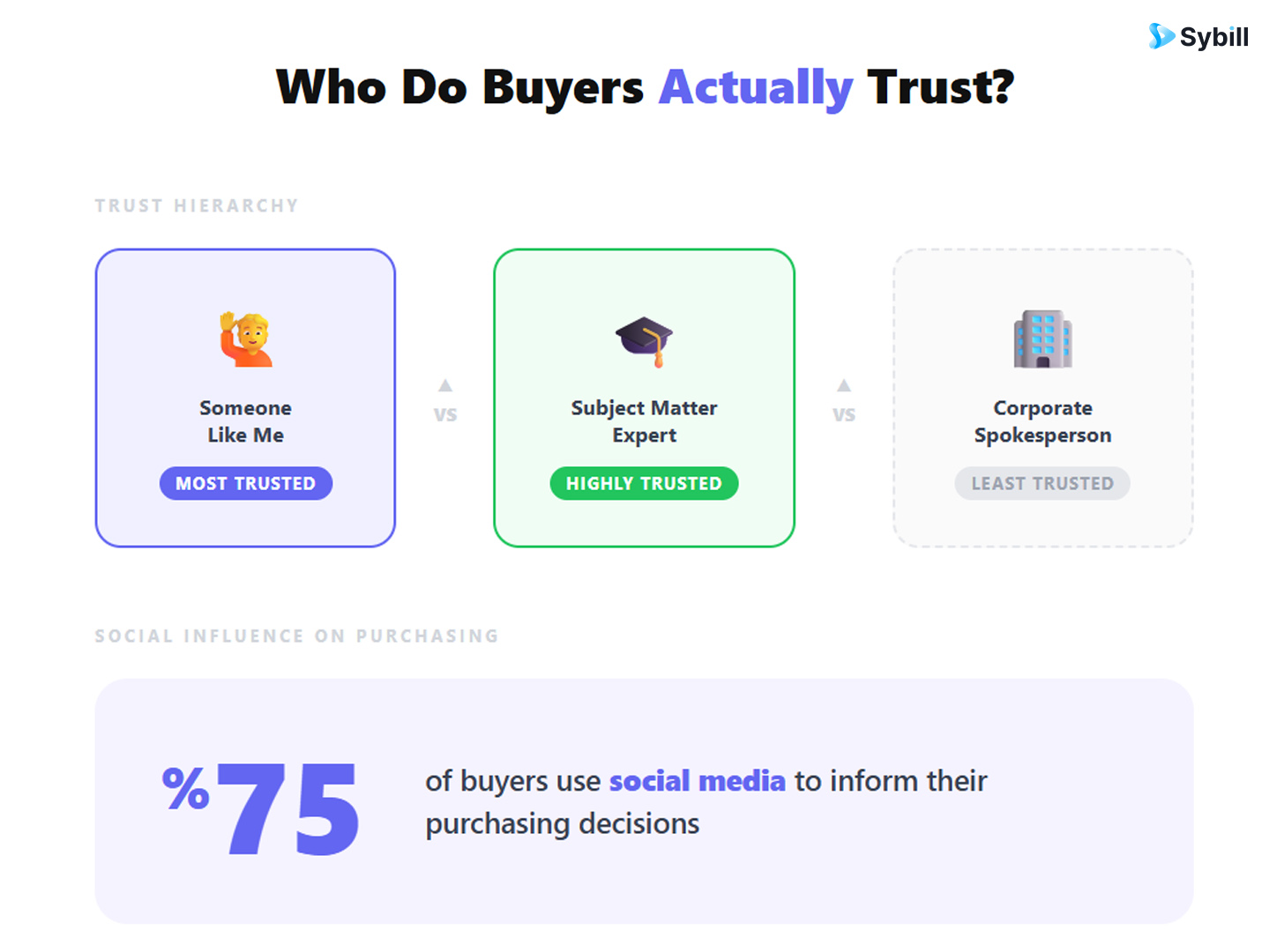
Research suggests that people consistently rate “someone like me” and subject matter experts as more trustworthy than corporate spokespeople. Further, 75 percent of buyers use social media to inform purchasing decisions. Most review a rep’s profile before engaging.
Buyers research reps before calls. They check your experience. Your content. Your comments.
Decision-making today is peer-influenced. Buyers ask colleagues, read posts, scan threads.
Your digital footprint either accelerates trust or raises doubt. Silence is not neutral. It is a signal.
A weak or generic personal brand in sales slows momentum before the first conversation even begins.
Cold demos are fading. Warm introductions and social proximity are rising.
Buyers often connect with reps on LinkedIn before booking demos. They follow posts. They observe tone. They assess whether you understand their industry.
Personal content builds familiarity. Familiarity reduces friction.
When a buyer feels like they already “know” you, objections soften. Meetings start at context, not at square one.
That is the leverage of personal branding in sales.
Careers are more fluid than ever. According to the U.S. Bureau of Labor Statistics, the average employee tenure in the United States is around four years, and turnover in sales roles is typically higher than the national average.
Sales professionals change companies frequently. Territories shift. Industries pivot.
A strong personal brand protects your career. It compounds independently of your employer.
Top performers build portable equity. Their audience, reputation, and network move with them.
If you rely only on company brand, you reset to zero every time you switch logos.
Trust reduces objections. Buyers question less when they perceive authority.
Authority reframes pricing discussions. Instead of defending cost, you are explaining value.
Proof-driven positioning changes how you are perceived. You are not “the rep trying to sell.” You are the specialist who understands this problem deeply.
Deals move faster when credibility is established before the pitch.
It all points to a single conclusion: If you do not define your brand, the market will define it for you.
If you think personal branding in sales is optional, you are playing defense.
Building a strong presence is no longer about vanity. It is about leverage.
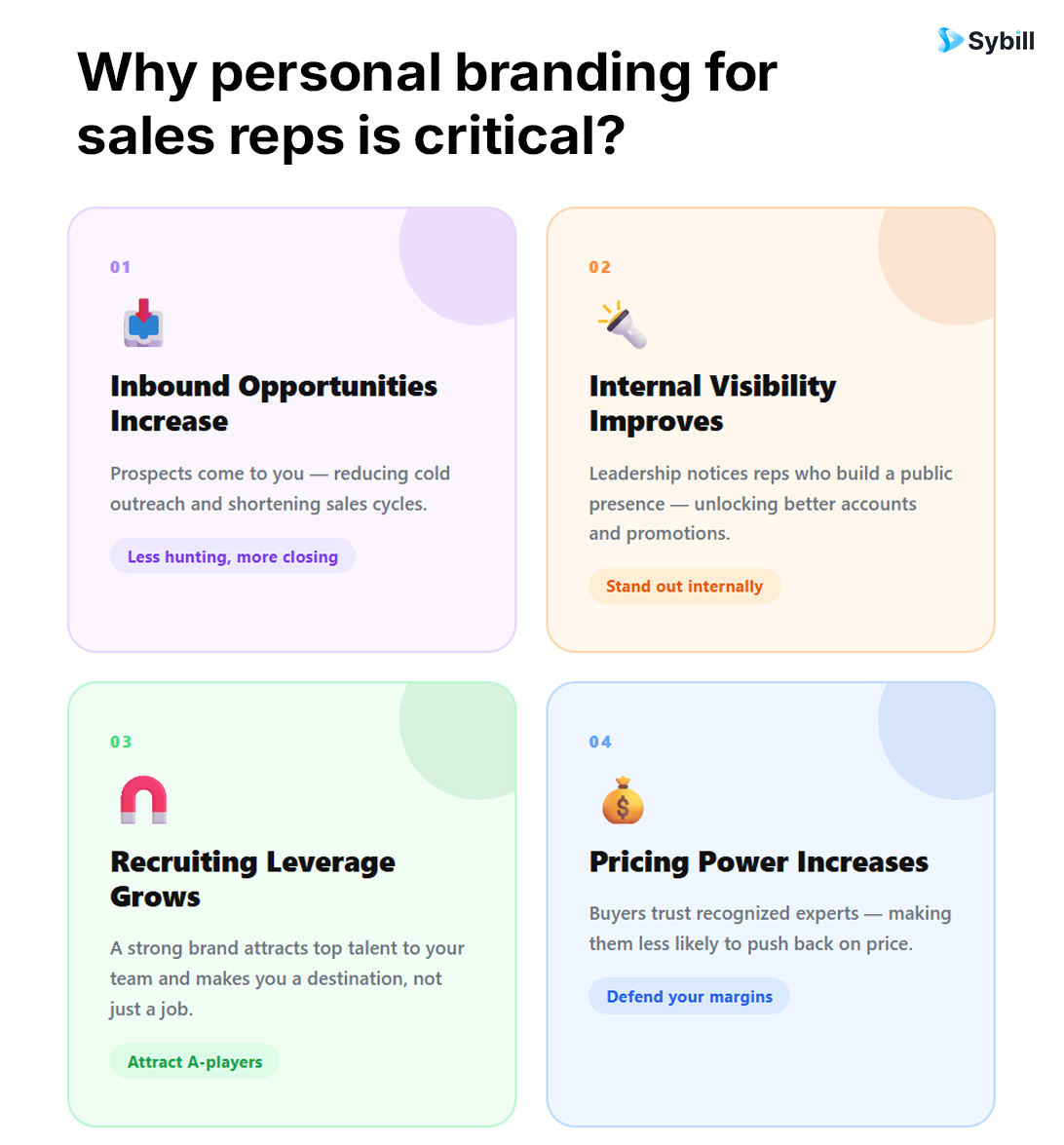
When people associate you with expertise, they come to you.
When your name consistently shows up with insight, you become a shortcut to credibility.
That is what smart personal branding for sales professionals does. It turns cold outreach into warmer conversations.
Leaders notice consistent voices.
When you share insights, trends, and customer learnings, you signal strategic thinking. You stop being “quota only” and start being seen as someone who understands the market.
That visibility compounds during promotions and leadership reviews.
Headhunters search for visible experts.
A documented perspective makes you discoverable. Silence makes you invisible.
Trusted advisors get more access. More influence. More patience from buyers.
When credibility is established upfront, pricing conversations shift from defensive to strategic.
Brand builds leverage. Leverage builds revenue.
Let’s get practical. Good intentions do not build a personal brand in sales. Systems do.
If you want real traction, these personal branding tips for sales reps are where you start.
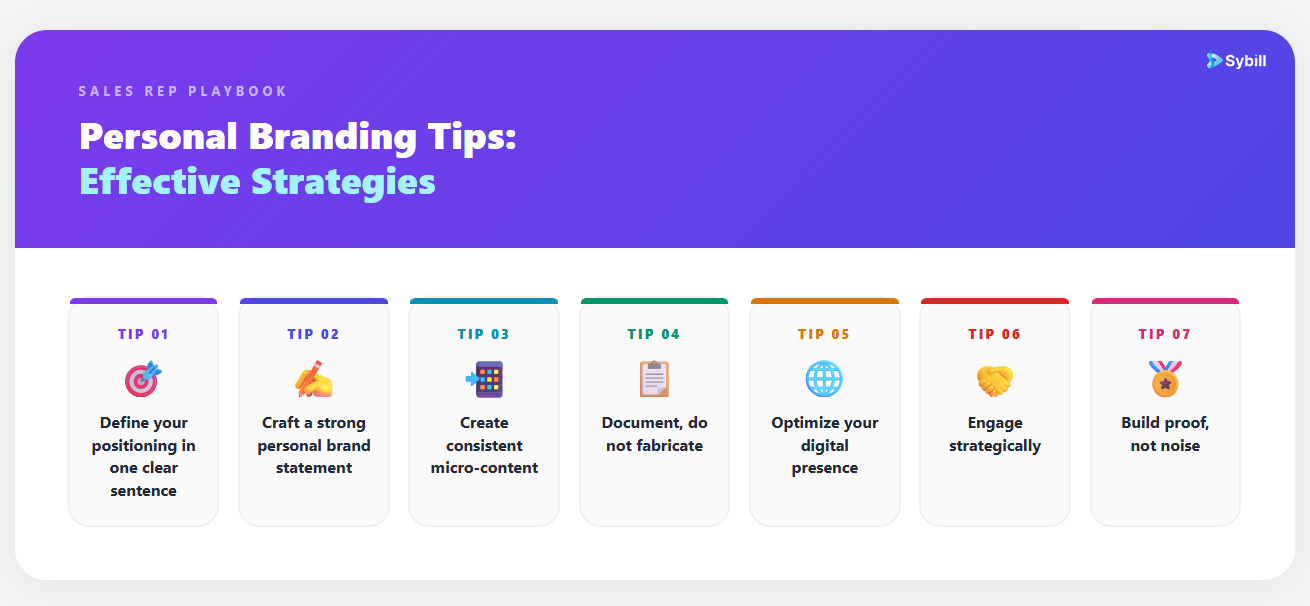
Clarity beats cleverness.
Before you post anything, answer three questions:
If you cannot answer this in one sentence, your brand will feel scattered.
Use this formula:
“I help [specific audience] achieve [specific outcome] without [specific friction].”
Example:
“I help mid-market SaaS founders reduce churn without discounting their product.”
That is positioning. That is memorable. That is strategic personal branding for sales reps.
Your headline and summary should communicate outcomes, not job titles.
Support keyword: personal brand statement examples for sales
A strong statement is:
Weak: “Enterprise Account Executive driving growth.”
Strong: “Helping healthcare IT teams modernize data workflows without disrupting patient operations.”
Focus on results. Avoid buzzwords. No one is impressed by “synergy” or “growth ninja.”
You do not need to post daily. You need to post intentionally.
Start with what you already experience.
Build around four content pillars:
Consistency builds recognition. Recognition builds trust.
The best personal branding in sales comes from real work.
You do not need to invent hot takes.
Turn everyday sales experiences into insights:
Share anonymized stories. Teach what you learn.
Authenticity compounds faster than theatrics.
Your profile is your storefront.
Audit it with ruthless honesty.
Your profile should reinforce the same narrative you share in content.
Posting is only half the equation.
Comment thoughtfully on industry conversations. Add value, not applause.
Build visible association with respected voices in your space. Over time, proximity signals credibility.
Start meaningful threads. Ask sharp questions. Invite discussion.
Visibility without engagement is broadcasting. Engagement builds community.
Attention is cheap. Proof is rare.
Share metrics and wins.
Showcase client impact.
Highlight testimonials.
When buyers see outcomes repeatedly attached to your name, your authority compounds.
That is how personal branding for sales reps turns from content into competitive advantage.
If you search for personal brand statement examples for sales, most results look the same. Generic. Title-heavy. Buzzword-stuffed.
That is not positioning. That is camouflage.
Strong personal branding for sales professionals starts with a sharp, outcome-driven statement. Below are role-specific examples, plus why they work and what makes them differentiated.
Bad example:
“Results-driven SaaS Account Executive helping companies grow.”
Good example:
“I help RevOps leaders eliminate blind spots in their pipeline without adding manual reporting.”
Why it works:
What makes it differentiated:
It focuses on a business problem, not a job title.
Bad example:
“Motivated SDR generating qualified meetings for high-growth tech companies.”
Good example:
“I help cybersecurity teams connect with CISOs by turning cold outreach into relevant conversations.”
Why it works:
What makes it differentiated:
It reframes the SDR role from activity-based to impact-based.
Bad example:
“Enterprise sales leader driving digital transformation.”
Good example:
“I help Fortune 1000 finance teams modernize reporting systems without disrupting legacy workflows.”
Why it works:
What makes it differentiated:
It acknowledges the complexity of enterprise buying, which signals experience.
Bad example:
“Channel sales professional building strategic partnerships.”
Good example:
“I help SaaS companies scale revenue through high-performing partner ecosystems, not one-off referrals.”
Why it works:
What makes it differentiated:
It subtly communicates a philosophy about partnerships.
Bad example:
“Dedicated account manager ensuring client satisfaction.”
Good example:
“I help B2B SaaS customers increase product adoption and renew with confidence.”
Why it works:
What makes it differentiated:
It ties role to revenue impact, not relationship management alone.
Bad example:
“Founder building innovative solutions for modern teams.”
Good example:
“I help mid-market HR leaders gain real-time workforce insights without investing in new ERP systems.”
Why it works:
What makes it differentiated:
It positions the founder as problem-obsessed, not product-obsessed.
Now it has:
That is how you move from generic to strategic.
The goal of strong personal branding in sales is not to sound impressive. It is to sound specific. Specific builds credibility. Credibility builds trust.
You do not need six months. You need focus.
If you are serious about personal branding in sales, here is a tactical 30-day plan. No fluff. Just execution.
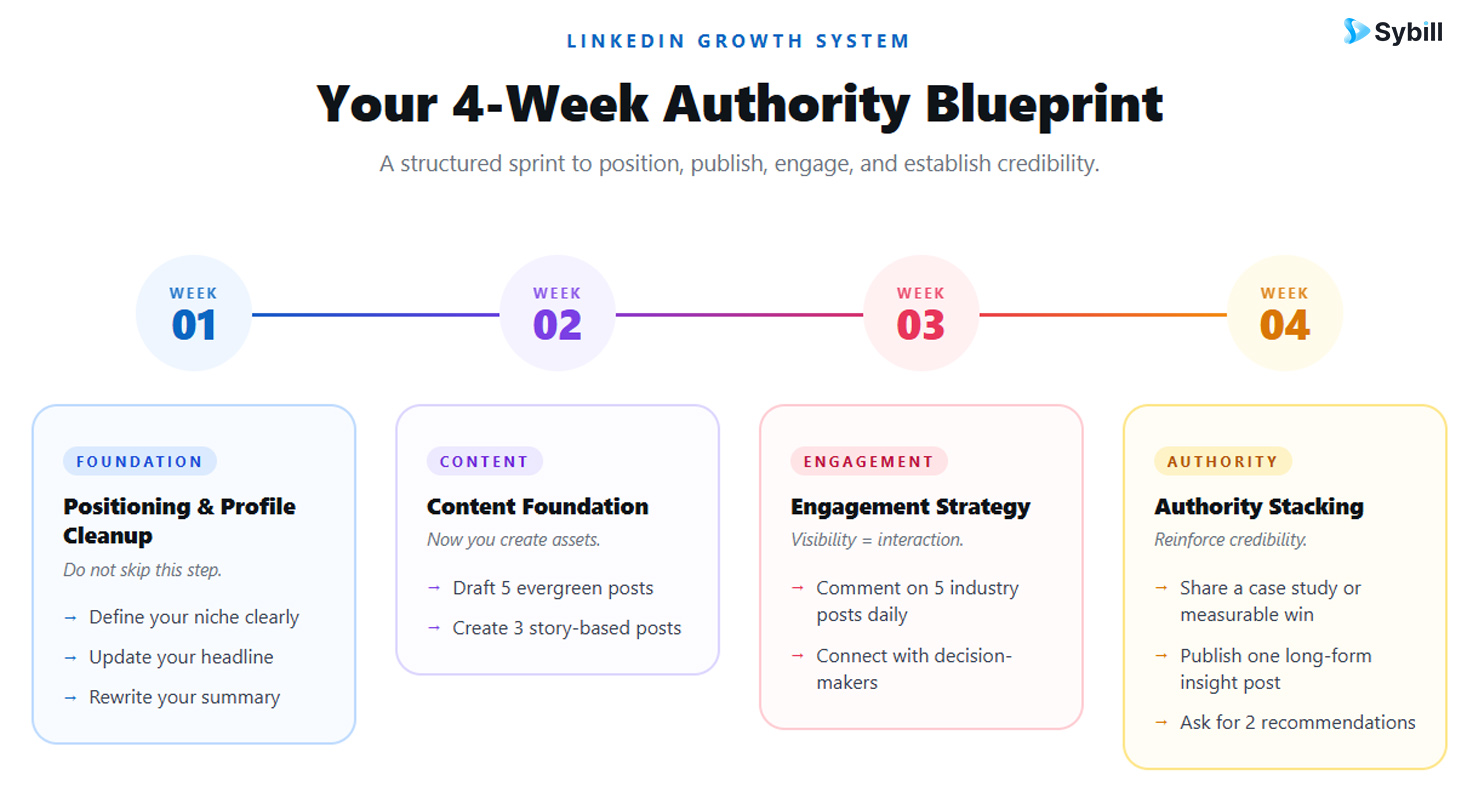
These are practical personal branding tips for sales reps you can start this week.
This is foundation work. Do not skip it.
1. Define your niche
Answer clearly:
Write your one-line positioning statement using the formula:
“I help [specific audience] achieve [specific outcome] without [specific friction].”
Refine it until it feels sharp.
2. Update your headline
Remove generic titles.
Instead of:
“Account Executive at XYZ Company”
Use:
“Helping manufacturing CFOs reduce reporting complexity without adding headcount.”
Make it outcome-led.
3. Rewrite your summary
Structure it like this:
Keep it clear. No jargon. No buzzwords.
Now you create assets.
1. Draft 5 evergreen posts
Topics can include:
Write them in advance. Keep them educational.
2. Create 3 story-based posts
Use real experiences:
Anonymize details. Focus on lessons.
You now have 8 pieces of content ready to publish over the next few weeks.
Visibility is not just posting. It is interaction.
1. Comment on 5 industry posts daily
This increases exposure without creating new content every day.
2. Connect with decision-makers
Each day:
Your goal is relevance, not volume.
Now you reinforce credibility.
1. Share a case study or measurable win
Outline:
Use real numbers if possible.
2. Publish one long-form insight post
Go deeper than usual.
Examples:
Position yourself as someone who thinks strategically.
3. Ask for 2 recommendations
Reach out to:
Request short, outcome-focused testimonials.
By the end of 30 days, you will have:
That is how personal branding in sales shifts from idea to asset.
Let’s connect this to what actually matters: numbers.
Strong personal branding in sales is not a vanity play. It is a revenue lever.
Here is how it shows up in your pipeline:
Track it like any KPI: response rate, meeting-to-opportunity conversion, sales cycle length, referral source revenue.
Brand influences perception. Perception influences behavior. Behavior drives revenue.
You cannot opt out of personal branding in sales.
If you are online, you have a brand. If you are silent, that silence becomes your brand. If your profile is generic, that generic positioning becomes your brand.
The only real choice is this: Do you design it intentionally, or do you let it form accidentally?
Strong personal branding in sales is not about ego. It is about clarity. It is about making it easy for buyers to understand what you stand for and why you matter.
Start small.
Refine your positioning.
Rewrite your headline.
Share one useful insight this week.
Momentum compounds faster than you think.
The best reps are not just activity-driven. They are insight-driven. They learn from real buyer conversations and sharpen their perspective continuously. Tools like Sybill help capture those buyer signals so your insights are not based on memory, but on patterns.
You are already a brand. Make sure it’s working for you.
Building a brand gives you leverage.
Trust builds faster when buyers already recognize your name. Career leverage increases when your expertise is visible beyond your company. Deal velocity improves when you are perceived as a specialist, not a generalist.
In a market where buyers research before responding, personal branding in sales shifts you from unknown to familiar. Familiar shortens sales cycles.
Buyer behavior has changed.
Most B2B buyers now research reps on LinkedIn and other platforms before booking or accepting meetings. Digital research is standard. Silence is interpreted as lack of authority.
Strong personal branding for sales reps creates competitive differentiation. When two vendors look similar, buyers often choose the rep who demonstrates insight and industry understanding publicly.
Personal branding is no longer optional. It is a response to how buyers evaluate credibility today.
Yes. And not in a vague way.
Trust compression: Buyers move from skepticism to credibility faster.
Higher conversion rates: Warm recognition improves response and meeting-to-opportunity ratios.
Stronger referral loops: Visible expertise increases inbound introductions.
Career growth multiplier: A recognized reputation attracts better territories, roles, and compensation over time.
Revenue does not just come from activity. It comes from perception. And perception is exactly what personal branding in sales controls.
Building a brand gives you leverage. Trust builds faster when buyers already recognize your name. Career leverage increases when your expertise is visible beyond your company. Deal velocity improves when you are perceived as a specialist, not a generalist. In a market where buyers research before responding, personal branding in sales shifts you from unknown to familiar. Familiar shortens sales cycles.
Buyer behavior has changed. Most B2B buyers now research reps on LinkedIn and other platforms before booking or accepting meetings. Digital research is standard. Silence is interpreted as lack of authority. Strong personal branding for sales reps creates competitive differentiation. When two vendors look similar, buyers often choose the rep who demonstrates insight and industry understanding publicly. Personal branding is no longer optional. It is a response to how buyers evaluate credibility today.
Yes. And not in a vague way. Trust compression: Buyers move from skepticism to credibility faster. Higher conversion rates: Warm recognition improves response and meeting-to-opportunity ratios. Stronger referral loops: Visible expertise increases inbound introductions. Career growth multiplier: A recognized reputation attracts better territories, roles, and compensation over time. Revenue does not just come from activity. It comes from perception. And perception is exactly what personal branding in sales controls.