Find us at booth #83, join us for a harbor side happy hour, or catch Gorish’s talk.

Sept, 16-18 > Learn more


Tamanna Mishra

September 3, 2026
%20(88).png)
A company can match your ideal customer profile perfectly and still be a terrible opportunity.
The business may be large enough. The industry may be right. The logo may look impressive in a sales deck. But if there is no credible problem, no funding path, no compelling event or no way to reach the people who will decide, the account is not ready for serious pursuit.
Target Account Selling exists to make that distinction.
It helps sales teams concentrate resources on high-value accounts without confusing attractive companies with winnable deals. The methodology brings account selection, opportunity qualification, competitive analysis, stakeholder mapping and coordinated execution into one disciplined sales process.
Target Account Selling, or TAS, is a structured B2B sales approach for selecting, qualifying and pursuing a finite set of high-value accounts. It is most useful for complex deals where multiple stakeholders, competitors, substantial sales resources and long decision cycles are involved.
The classic TAS opportunity assessment asks four questions:
The strongest TAS programs do not answer those questions once and file away the account plan. They continually update the answers as new buyer, competitor and commercial evidence appears.
Sales teams often use “target account” and “sales opportunity” as if they mean the same thing. They do not.
A target account is a company your team has chosen to pursue. An opportunity exists only when there is credible evidence that the company may buy.
That evidence could include:
This distinction protects sales capacity.
Target Account Selling requires more work per account than a volume-based motion. Reps may need to research business initiatives, coordinate internal specialists, engage several stakeholders, build a tailored value case and monitor competitors. Applying that effort to an account simply because it is famous or large is expensive wishful thinking.
A target account becomes an investable opportunity when the evidence justifies the pursuit.
Target account selling is a structured sales approach in which a team concentrates its research, relationship-building and deal resources on a finite list of high-value accounts. Sellers evaluate the opportunity, competitive position, buying organization and potential return before deciding how heavily to invest.
Today, the term is used in two related ways.
In general sales usage, target account selling means choosing a limited set of best-fit companies and creating account-specific plans to engage them.
In the classic TAS sales methodology, the process goes further. Sellers assess the opportunity, analyze competitors, map formal and informal influence, build relationship strategies, define customer milestones and execute a coordinated action plan.
Oracle’s documentation for the Siebel Target Account Selling methodology describes three core functions:
This makes TAS more than personalized prospecting. It is an opportunity-management system for complex accounts.
A volume sales motion looks for enough responses and conversions across a broad market. Target account selling accepts lower account volume in exchange for greater depth.
Neither approach is universally better. A self-service product with a low contract value may not justify deep account planning. A complex enterprise solution that involves finance, security, legal, procurement and several business units probably does.
A target account is a specific company that a sales organization has deliberately selected for focused pursuit because it matches the ideal customer profile and offers sufficient potential value.
The account may be an existing customer, a previous opportunity or a company with which the seller has no current relationship. It does not need to have demonstrated buying intent before being placed on the target account list.
That is why “target account” should not be confused with “qualified opportunity.”
Your sales ICP tells you what a strong customer typically looks like. A target account list applies that profile to specific companies. TAS then helps determine which of those companies contain opportunities worth pursuing and how the team should run each pursuit.
Target Account Selling overlaps with several account-focused approaches. The difference is primarily one of purpose and scope.
Account-based marketing uses coordinated marketing and sales activity to reach and engage selected companies. It may include advertising, content, events, website personalization and sales outreach.
TAS is more directly concerned with the sales opportunity. Once an account engages, TAS helps the seller determine whether a real deal exists, understand how the account will decide and create a strategy to win.
ABM can help create or accelerate interest. TAS helps sales convert that interest into a well-run opportunity.
Account-based selling is often used as an umbrella term for a sales motion focused on named accounts. Target account selling may be used synonymously in casual conversation, but the classic TAS methodology is more structured.
It includes specific opportunity, competitor, relationship and action-planning disciplines. In this guide, TAS refers to that more rigorous application.
Strategic account management focuses primarily on growing and protecting valuable customer relationships after the initial sale.
TAS can support a new logo pursuit or a new opportunity inside an existing customer. Strategic account management governs the broader, long-term customer relationship.
Similarly, Miller Heiman LAMP helps teams identify whitespace, plan expansion and grow large accounts over time. TAS is more tightly focused on assessing and winning a specific opportunity.
Target Account Selling is most useful when the potential value of the deal justifies considerable research, coordination and opportunity planning.
Consider TAS when:
The need for stakeholder planning has intensified as B2B buying groups have grown.
A 2025 Gartner survey of B2B buyers found that buying groups can include five to 16 people across as many as four functions. It also found that 74% of buyer teams experience unhealthy conflict during the decision process. “Fostering buying group consensus and minimizing conflict must be a key priority.”
That observation from Gartner analyst Delainey Kirkwood captures why organizational analysis matters. A salesperson is not simply convincing several individuals. They are helping a group with different priorities reach a defensible decision.
Forrester’s 2026 buyer research expands the picture further. It reports that a typical purchase decision now involves 13 internal stakeholders and nine external influencers, with larger networks involved in complex or strategic purchases.
A full TAS process will usually be excessive when:
The question is not whether every sales team should use TAS. It is whether the cost and complexity of a particular pursuit demand a more disciplined method.
The classic Target Account Selling methodology moves from assessment to strategy and then to execution.
It also treats the account plan as a working model. The plan should change when the seller learns something new about the buyer, competition, decision process or economics of the deal.
Begin by documenting what the team currently understands about the account and the potential opportunity.
A useful overview includes:
A compelling event deserves particular attention. It is not merely a desired purchase date. It is an event with consequences that makes maintaining the status quo less acceptable.
For example:
Without a meaningful event, a buyer may agree that the problem exists while continuing to postpone action.
The team then assesses its position using the four TAS questions:
These questions prevent a large pipeline number from being mistaken for a healthy deal. We will examine the full 20-point assessment in the next section.
Competition includes more than named vendors.
The seller should consider:
For each alternative, document:
The objective is not to create a generic battlecard. It is to understand why this account could prefer a particular alternative.
A formal organization chart reveals who reports to whom. It does not necessarily reveal who shapes the decision.
A TAS organization map should identify:
This is where multi-threading becomes a deliberate strategy rather than a vague instruction to “meet more people.”
The seller needs to know which stakeholders matter, what each one needs from the decision and how influence travels between them.
For every important stakeholder, document:
Personalization should serve the account’s shared business case.
A finance leader may need credible economics. A technical evaluator may need evidence of security and integration fit. An end user may need confidence that the solution improves daily work. Those messages should be relevant to each role while still supporting one coherent reason to buy.
TAS distinguishes buyer progress from seller activity.
Sending a proposal is seller activity. Completing the buyer’s security review is customer progress.
Useful milestones might include:
For each milestone, specify:
The resulting action plan should retrieve missing information, prove value, strengthen the team’s position and reduce competitive exposure.
TAS is not a one-time certification applied during discovery.
Reassess the deal when:
A deal can become stronger or weaker without moving to a different CRM stage. Continuous reassessment exposes those changes before they become forecast surprises.
Body image brief: Create a horizontal Target Account Selling workflow: “Opportunity overview → Opportunity assessment → Competitive analysis → Organization map → Relationship strategy → Customer milestones → Action plan → Reassessment.” Use Sybill brand colors and simple sales-planning icons.
Body image alt text: Target account selling methodology workflow from opportunity assessment to competitive strategy, stakeholder mapping and reassessment
The classic Target Account Selling assessment asks four questions:
These four questions are supported by 20 assessment criteria. They are not a discovery script to read to the buyer. They are questions the sales team must answer using buyer conversations, account research, CRM evidence and informed judgment.
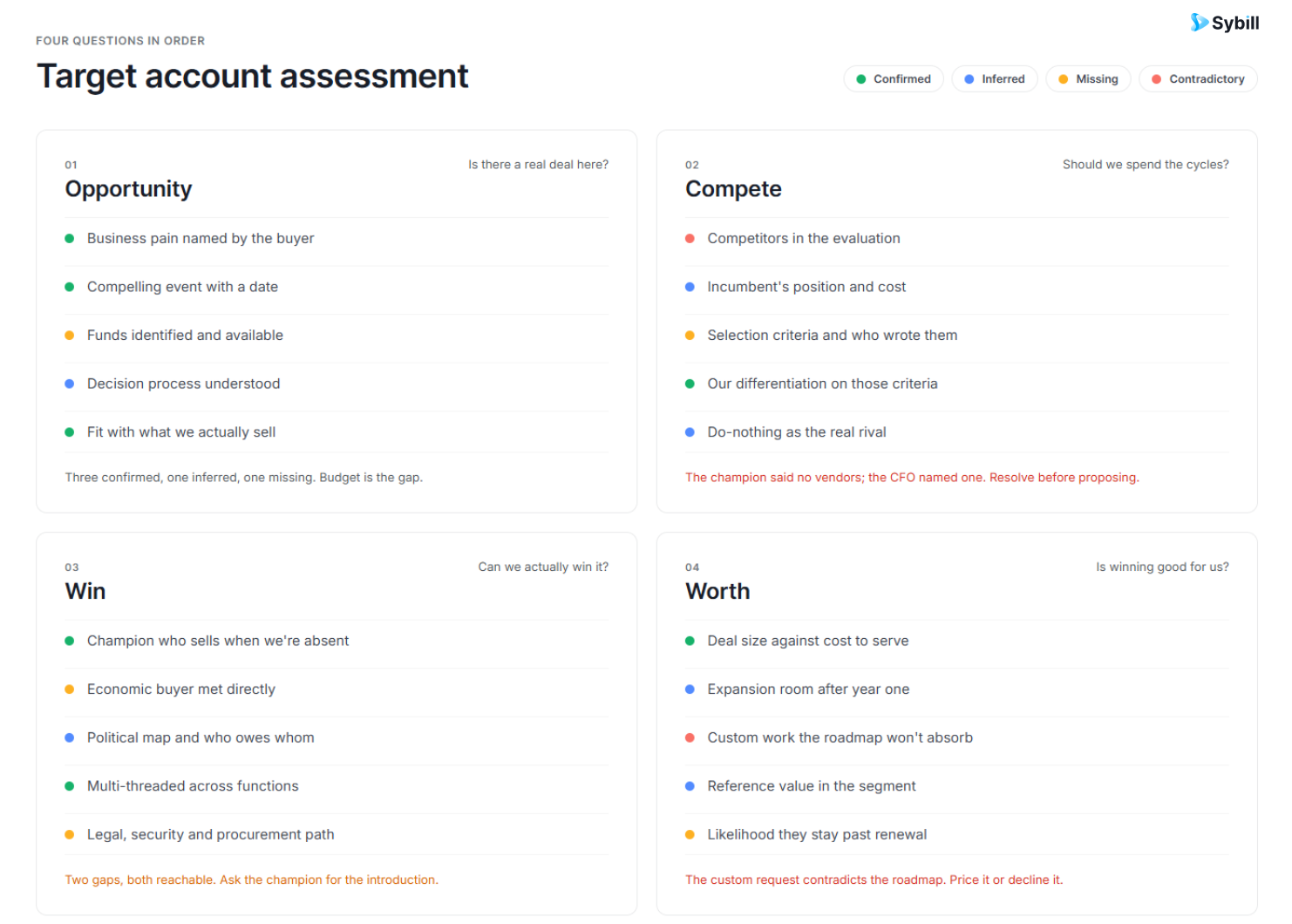
This first assessment asks whether the account contains a credible business initiative.
Can the team explain the problem, project, affected process and expected outcome in the buyer’s terms?
If the seller can describe only the product the account appeared interested in, the opportunity may still be speculative.
Consider the company’s business model, market position, growth, operational priorities and recent developments.
A company may match the general ICP while lacking the operational maturity, geographic presence or internal capability required for this particular solution.
This is broader than asking whether a budget line exists. The team should understand the organization’s financial condition and how the proposed initiative competes with other investments.
Budget may be allocated, reallocated or created when the business case is compelling enough. The important question is whether there is a credible funding path.
What will happen if the buyer acts? What will happen if they do nothing? Is there a date connected to either consequence?
A desired timeline without a business consequence is not a compelling event.
A genuine opportunity does not automatically mean the seller is equipped to compete for it.
Identify the documented requirements that will be used to compare options, such as:
The seller should also determine who defined those criteria and whether a competitor influenced them.
Assess both current fit and the cost of addressing any gaps.
A vague “we can handle that” is not sufficient. Strong fit is supported by product evidence, technical validation, implementation feasibility and customer agreement.
Complex pursuits can consume executive time, solutions consulting, legal support, security resources and implementation planning.
The team must decide whether those resources are available and proportionate to the value of the deal.
A seller may have enthusiastic end users while lacking access to executives, finance or procurement. Relationship strength must be judged against the people who can approve, influence or block the decision.
The value proposition should be specific to the account, measurable where possible and defensible against alternatives.
“Save time and increase efficiency” is not unique business value. A credible value case connects the buyer’s current problem, desired outcome, economic impact and confidence in delivery.
This assessment examines whether the seller has a believable path through the account’s decision network.
Inside support means more than having someone who attends meetings.
A strong internal supporter provides useful information, helps the seller understand internal priorities and advocates for the solution when the seller is absent.
Senior stakeholders must believe that the seller understands the business problem and can deliver the promised outcome.
Executive credibility is built through commercial insight, relevant proof, consistent follow-through and honest treatment of risk.
The buyer may evaluate whether the seller’s operating style, communication, implementation approach and decision-making behavior fit its own culture.
This can matter considerably when the two organizations will work together for several years.
Formal criteria appear in evaluation documents. Informal criteria live inside the organization.
Examples include:
Ignoring informal criteria is one of the easiest ways to misunderstand a complex deal.
Political alignment asks whether influential people inside the account benefit from, support or oppose the proposed change.
The goal is not manipulation. It is to understand how the decision affects different groups and help the buying team build enough shared value to move forward.
The final question forces the seller to consider the quality of the business, not simply the likelihood of obtaining a signature.
Estimate the immediate contract value and when it is likely to become realizable revenue.
Consider expansion potential across products, teams, regions and business units. Keep those estimates separate from the committed initial opportunity.
Revenue can look attractive while custom requirements, implementation effort, discounts and servicing costs erode the economics.
Assess:
A deal may create value beyond immediate revenue by opening a market, producing an important reference, strengthening a partnership or supporting a broader product strategy.
Strategic value should be explicit. It should not become an excuse for pursuing an unprofitable deal because the logo looks good.
A practical TAS review should classify each answer as:
This keeps the account team from presenting assumptions as facts.
A field can also include:
The result is a living opportunity assessment rather than a checklist completed from memory before a pipeline review.
A methodology becomes useful only when it changes how the team selects, reviews and advances deals.
These target account selling strategies turn the framework into an operating process.
ICP fit tells you whether a company resembles your best customers. It does not tell you whether the account should receive immediate one-to-one attention.
Prioritize accounts using three lenses:
Timing signals might include leadership changes, funding, regulatory deadlines, expansion, new hiring, poor performance, a contract renewal or active category research.
An account with excellent fit and no current timing may belong in a nurture tier. An account with strong intent but weak fit may create a fast opportunity that becomes an expensive customer.
Good account research should produce a point of view before the first conversation.
For example:
“Acme’s recent international expansion may be increasing the cost and inconsistency of manual CRM administration.”
That is a useful hypothesis. It creates a relevant opening and better discovery questions.
It is not yet a fact.
TAS teams should make the distinction visible:
This makes research a starting point for discovery, not a substitute for it.
Titles indicate formal authority. They do not reveal how the decision will actually move.
For each key stakeholder, determine:
Do not ask your champion for access to every executive without context. Explain how the additional conversation helps the champion build a stronger internal case.
For example:
“To make the proposal credible for finance, it would help us understand how your CFO evaluates investments like this. Could we include them in a short business-case review?”
The request supports the buyer’s process rather than appearing to bypass the existing contact.
Stakeholder relevance does not mean telling every person an unrelated story.
The account should have one shared business case:
Then adapt the supporting evidence for each role.
For example:
Gartner’s research found that content tailored to the buying group’s shared relevance positively affected consensus, while excessive individual-level relevance could deepen disagreement. TAS messaging should help stakeholders see how their priorities connect, not simply reinforce separate agendas.
A TAS assessment should produce an action, not just a score.
Disqualification does not mean the account can never become valuable. It means current evidence does not justify current investment.
Many account plans are updated before forecast calls rather than after material changes in the deal.
That reverses the priority.
Update the assessment when the buyer:
The buyer event should change the account plan. The internal review should inspect what changed.
Imagine a sales intelligence company targeting a 500-person B2B software business called AcmeCloud.
AcmeCloud matches the seller’s ICP:
That makes AcmeCloud a target account. It does not yet prove that an opportunity exists.
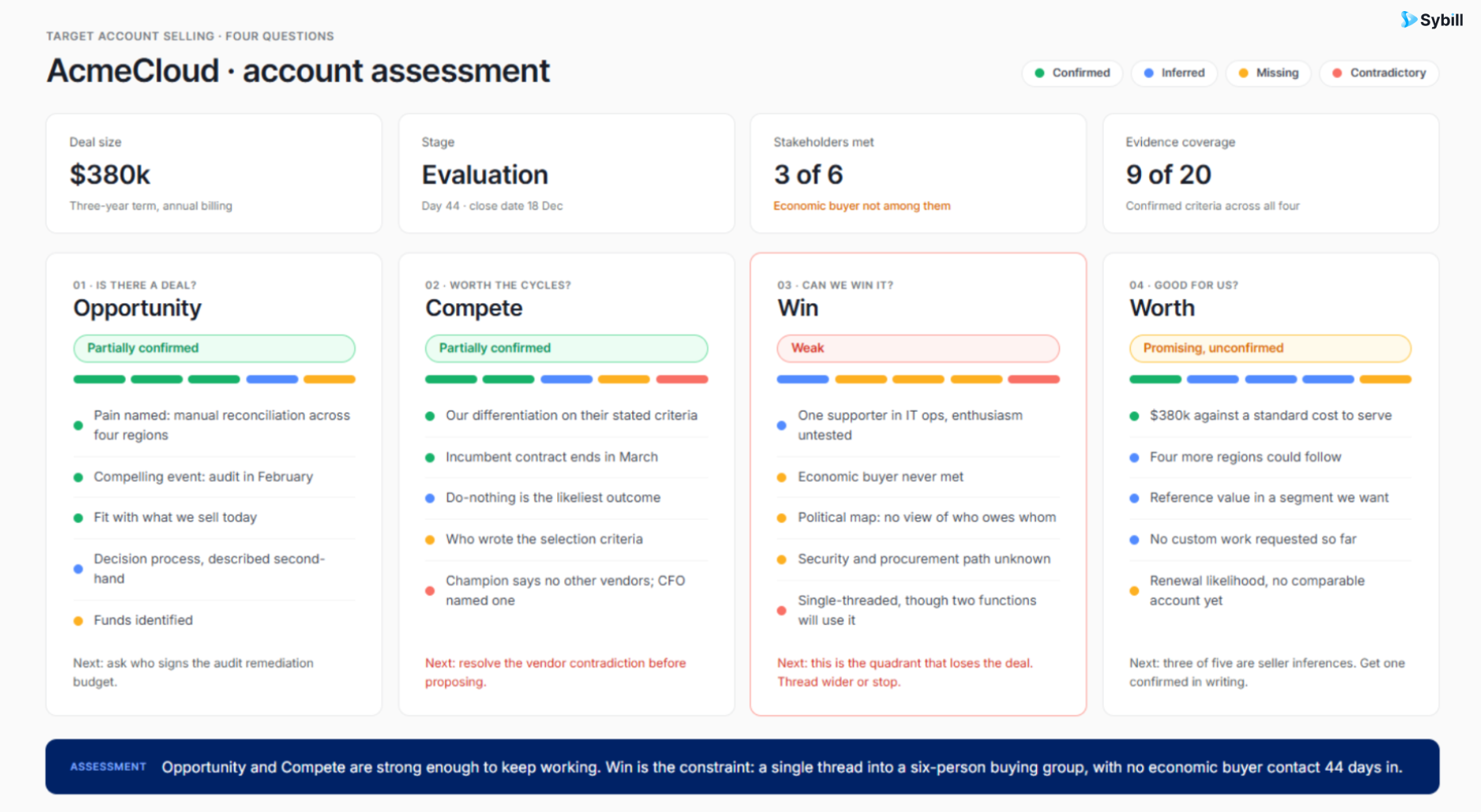
During discovery, AcmeCloud’s RevOps leader explains that CRM records are regularly incomplete because reps do not update qualification fields after calls.
Managers spend hours preparing for pipeline reviews, but the business has not yet quantified the cost. The CRO wants cleaner forecast inputs before the next financial year begins.
Current assessment:
Decision: Validate
The seller should not rush to a proposal. The next step is to confirm the business impact, funding path and consequences of missing the deadline.
AcmeCloud is considering its current call-recording platform, a CRM-native automation tool and a homegrown AI workflow.
The seller’s solution fits the CRM automation and deal-inspection requirements. However, the security team has not reviewed it, and the buyer has not confirmed how integration effort will be evaluated.
Current assessment:
Decision: Validate and expand stakeholder access
The RevOps leader supports the project but does not control the budget. The CRO is interested but has not attended a call. IT and finance are absent. The existing platform has an established executive relationship.
Current assessment:
Decision: Do not forecast aggressively
The seller needs to help the RevOps leader build a cross-functional case and secure access to the CRO, IT and finance.
The initial contract would be meaningful, with possible expansion across the sales organization. But AcmeCloud has requested several custom workflows, and their delivery cost is unclear.
Current assessment:
Decision: Continue, subject to delivery and profitability validation
This is what TAS adds. The framework does not merely tell the seller to personalize a pitch. It reveals exactly what the team knows, what remains uncertain and what must happen before the deal deserves more confidence.
Target Account Selling was built for a world in which account plans were assembled manually from meetings, notes and CRM records. The strategic questions remain relevant. The administrative model does not.
A static plan begins to decay as soon as:
AI can reduce that decay by capturing and organizing evidence from buyer interactions.
It is important to define the role accurately. Sybill is not a third-party prospecting database that produces an entire target account list. Teams may still use their CRM, market data, intent providers and sales intelligence tools to identify companies.
Sybill becomes most relevant once buyer and seller interactions begin. It helps the team keep its opportunity assessment connected to current evidence.
Ask Sybill lets sellers ask questions across calls, emails, CRM records, calendar activity and other deal context.
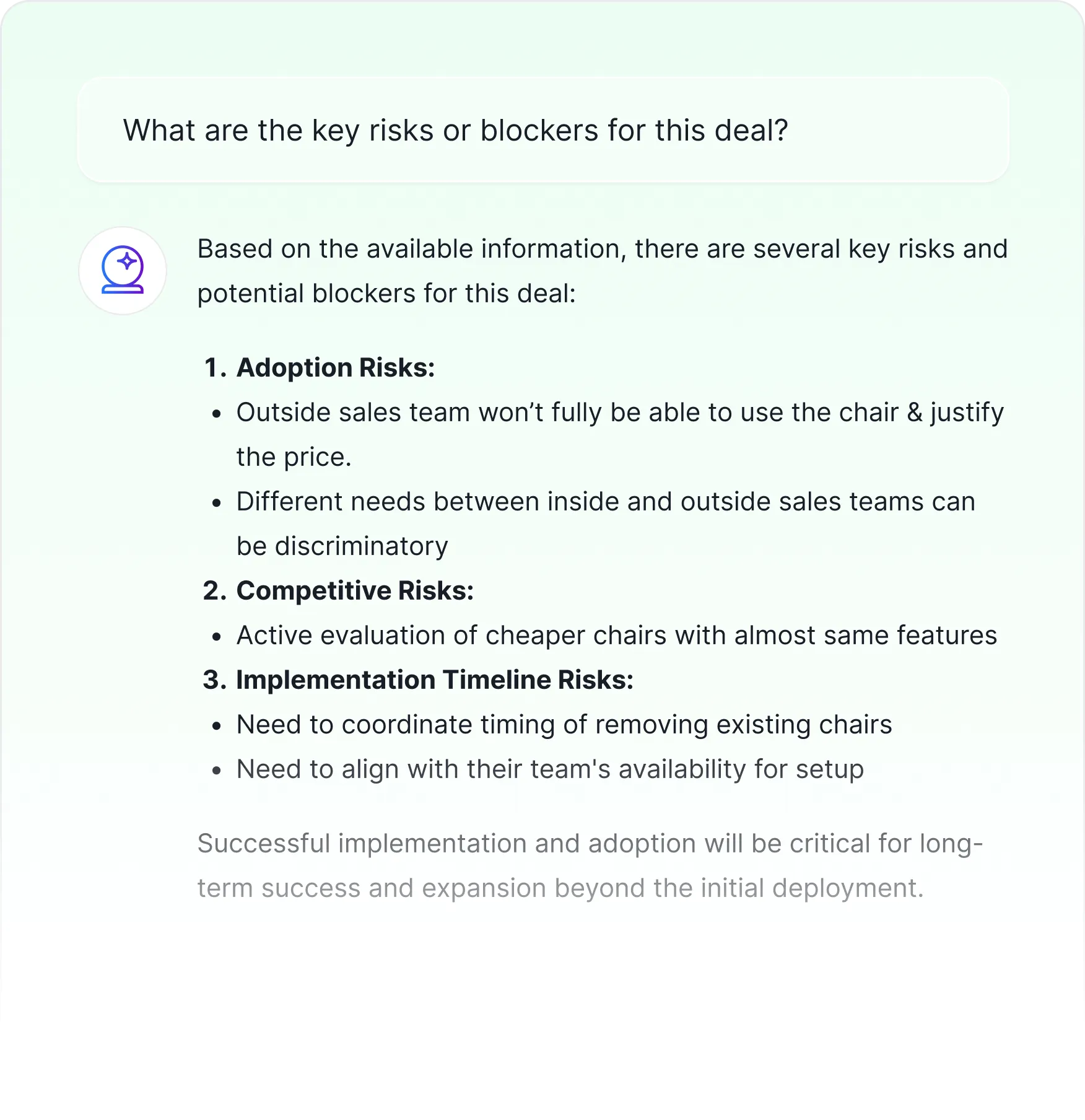
A rep could ask:
This does not remove human judgment. It makes the available evidence easier to retrieve and evaluate.
Deal Inspection helps teams examine qualification, engagement, internal alignment, momentum and risk without manually searching through every transcript.
That supports the continuous nature of TAS. When the buyer changes the timeline or a key stakeholder disengages, the opportunity assessment should change too.
Competitor analysis becomes more useful when it is grounded in what buyers actually say.
Sybill’s Competitor Intelligence can help teams retrieve:
The result is an account-specific competitive strategy rather than a generic list of competitor weaknesses.
Pre-meeting briefs bring together previous interactions, attendee information, company context, recommended talking points and relevant history.
That helps the rep prepare for the stakeholder in front of them without losing the broader account narrative.
CRM Autofill can update standard and custom CRM fields after calls and emails.
A team could configure fields for:
The value is not simply saving reps from data entry. It is keeping the opportunity record usable for strategy and inspection.
Sybill’s Deal Workspace brings together deal summaries, activity history, qualification evidence, next steps and custom properties.
Instead of maintaining a disconnected TAS worksheet, the account team can inspect the deal and act from the same workspace.
AI tasks and email follow-ups can then help turn strategy into execution.
The principle is simple:
TAS fails when the account plan becomes a static document. It becomes useful when every meaningful buyer interaction updates what the team knows and what it should do next.
Ready to run target account strategies on current buyer evidence instead of stale account-plan slides? Explore Sybill’s Deal Workspace.
TAS performance should be measured at account, opportunity, relationship and economic levels.
Avoid evaluating TAS only by the number of target accounts contacted. Activity can show whether the team is working. It cannot show whether the accounts are progressing, whether relationships are strengthening or whether the opportunities are becoming more valuable.
Target account selling is often reduced to a simple instruction: choose valuable companies and personalize the outreach.
That is only the beginning.
A serious TAS methodology helps sales teams decide:
It then connects that judgment to competitive analysis, stakeholder relationships, customer milestones and a coordinated action plan.
This makes TAS as much a method for saying “not yet” or “walk away” as a method for closing. That discipline is what protects sales capacity for the opportunities where focused effort can make a difference.
Modern AI can keep the plan current, retrieve missing evidence and reduce the CRM work required to operationalize the methodology. It cannot decide which risks your business should accept or whether a strategic opportunity is truly worth pursuing.
That decision remains human. The advantage comes from making it with better evidence.
Get started with Sybill to inspect deal evidence, track risks and turn your target account strategy into action.
Target account selling is a structured B2B sales approach in which teams focus their research, relationships and sales resources on a finite list of high-value companies. The classic TAS methodology includes opportunity assessment, competitive analysis, stakeholder mapping, relationship strategy and coordinated action planning.
A target account is a specific company selected for focused sales or marketing attention because it matches the ideal customer profile and offers sufficient potential value. Being a target account does not mean that the company has a current need, active budget or qualified sales opportunity.
The four Target Account Selling questions are: Is there an opportunity? Can we compete? Can we win? Is it worth winning? Together, they help the sales team evaluate customer need, solution and competitive fit, relationship strength, win probability, financial value and risk.
“Is there an opportunity?” asks whether the buyer has a defined problem or project, a business profile and financial condition that support the initiative, access to funds and a compelling event. It prevents sellers from treating interest or ICP fit as proof that a real deal exists.
Start by selecting accounts based on fit, potential value and timing. Research each account, validate your hypotheses through buyer conversations, assess the opportunity using the four TAS questions, map formal and informal influence, build a stakeholder-specific relationship strategy, define customer milestones and reassess the deal as new evidence appears.
No. Account-based marketing creates awareness and engagement within selected accounts through coordinated marketing and sales campaigns. Target account selling is a sales-led methodology for assessing and winning specific opportunities inside those accounts. The two approaches can operate together.
A target account is a company the sales team wants to pursue. An opportunity is a potential purchase supported by evidence of a customer problem, initiative, buying process and possible commercial transaction. One target account may contain no current opportunity or several separate opportunities.
TAS is best suited to complex, high-value B2B opportunities involving multiple stakeholders, substantial competition, long sales cycles or considerable pursuit costs. It is less suitable for low-value, transactional or self-service purchases where deep account planning would cost more than the potential return.
Yes. TAS provides the broader opportunity, competitor, relationship and account strategy. MEDDIC or MEDDPICC can provide deeper qualification around metrics, the economic buyer, decision criteria, decision process, pain, champions, procurement and competition. Teams can use TAS to run the pursuit and MEDDIC to maintain detailed qualification evidence.
Target account selling is a structured B2B sales approach in which teams focus their research, relationships and sales resources on a finite list of high-value companies. The classic TAS methodology includes opportunity assessment, competitive analysis, stakeholder mapping, relationship strategy and coordinated action planning.
A target account is a specific company selected for focused sales or marketing attention because it matches the ideal customer profile and offers sufficient potential value. Being a target account does not mean that the company has a current need, active budget or qualified sales opportunity.
The four Target Account Selling questions are: Is there an opportunity? Can we compete? Can we win? Is it worth winning? Together, they help the sales team evaluate customer need, solution and competitive fit, relationship strength, win probability, financial value and risk.