Find us at booth #83, join us for a harbor side happy hour, or catch Gorish’s talk.

Sept, 16-18 > Learn more

%20(1).avif)
Mamta Tainwala

July 29, 2026
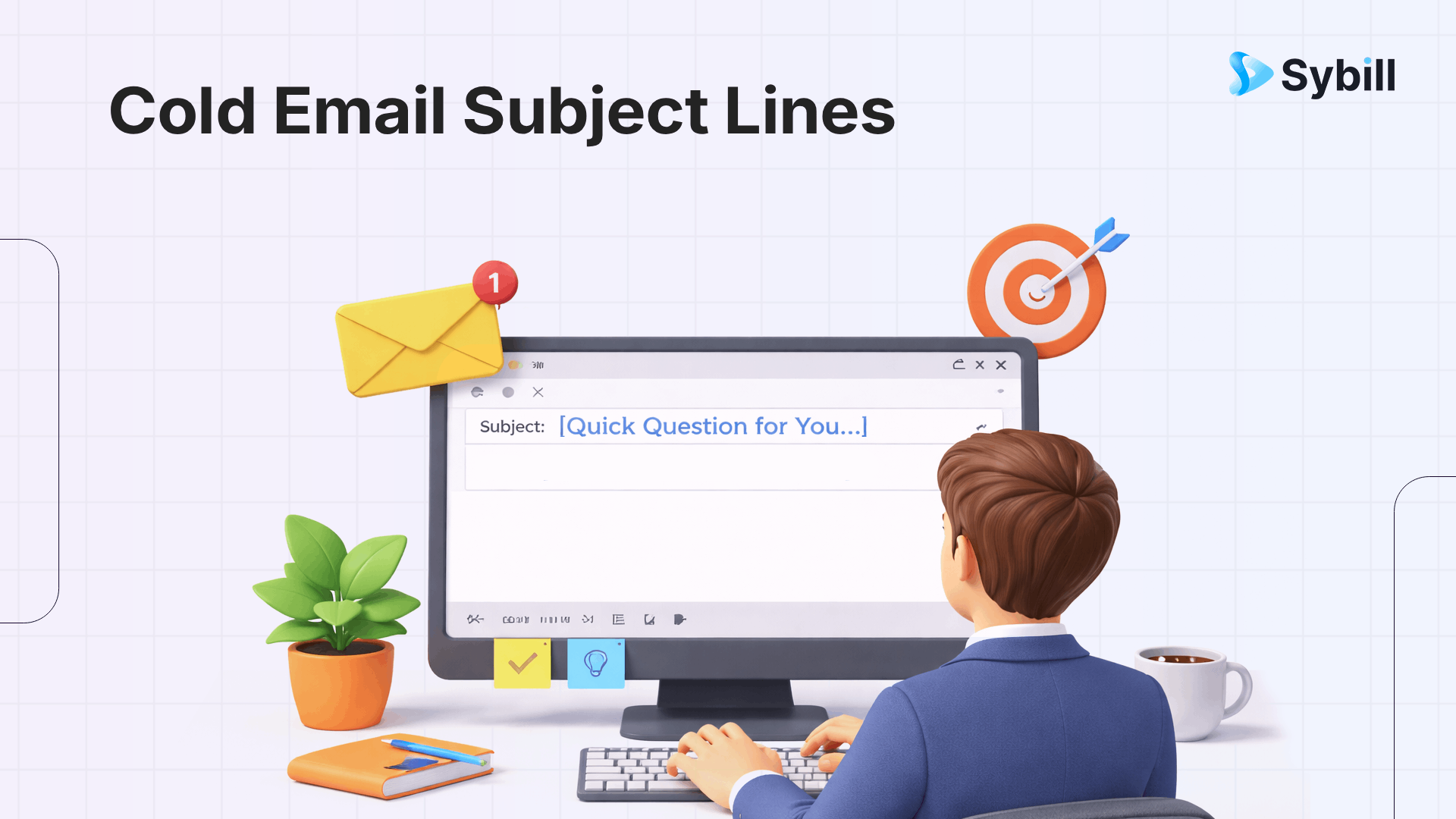

You know that scene in The Office where Michael Scott sends out a mass email with the subject line "URGENT: IMPORTANT BUSINESS MATTER" and everyone immediately knows it's about his improv show? Yeah, your prospects have developed that same sixth sense for bad cold emails. Except instead of just rolling their eyes, they're hitting delete before your message even loads.
Your carefully crafted cold email is competing with 121 other messages in your prospect's inbox this morning. That CFO you're trying to reach? They're not reading emails while sipping coffee and contemplating their problems. They're speed-deleting everything that doesn't immediately scream "this is relevant to me RIGHT NOW."
The most effective cold email subject lines in 2026 follow five proven patterns: curiosity hooks that reference a specific pain point without revealing the solution ("Your Q2 pipeline has a gap most teams miss"), personalized relevance using the prospect's company name or role ("Quick question about [Company]'s onboarding flow"), social proof with specificity ("How [Similar Company] cut ramp time by 40%"), direct value propositions under 6 words ("Cutting your CRM admin in half"), and timely triggers tied to a recent event or job change. Subject lines under 50 characters with lowercase formatting consistently outperform longer, title-case alternatives, and the highest reply rates come from follow-up emails drafted by AI tools like Sybill that reference actual conversation details rather than generic templates.
The subject line is your one shot. Not your opener. Not your value prop. Not your clever PS. The subject line. Get that wrong, and everything else you wrote might as well not exist.
But here's what makes cold email subject lines so frustrating: what worked six months ago is stale today. That "Quick question" line everyone's been using? Dead. The "Thoughts on [something]" approach? Your prospects have seen it 47 times this week. The break-up email everyone swore by? It's become the "Nigerian prince" email of B2B sales.
So how do you write subject lines that actually get opened in 2025? Not by copying templates from blog posts (yes, I see the irony). By understanding the psychology behind why people open emails, testing relentlessly, and adapting to your specific audience.
We've sent tens of thousands of cold emails at Sybill while building our AI sales assistant. We've A/B tested everything. Short vs. long. Personalized vs. generic. Problem-focused vs. solution-focused. Question-based vs. statement-based. And we've found some insights that contradict what most "cold email experts" will tell you.
In this guide, I'm sharing the real data from our experiments, the psychological principles that make subject lines work, and the specific formulas you can adapt (not copy) for your own outreach. Because the goal isn't to give you 50 subject lines to spam your prospects with. It's to teach you how to think about subject lines so you can create ones that actually resonate with your audience.
Before we get into what works, let's talk about why so much advice out there is setting you up for failure.
Walk into any sales leader's inbox right now and you'll see the same tired subject lines repeated over and over. "Quick question," "Thoughts on [X]," "Following up," "Re: [vague thing]." These lines worked once. Then every cold email course taught them. Then every sales rep used them. And now they're the email equivalent of someone starting a sentence with "To be honest..." You immediately know something sketchy is coming.
The problem with most "best cold email subject lines" articles is they give you fish instead of teaching you to fish. They hand you a list of 50 subject lines and say "use these!" So you do. And so do 10,000 other sales reps who read the same article. Your prospects start seeing the same subject lines dozens of times per day, and suddenly that "killer" line everyone promised would get 45% open rates is getting 3%.

Here's the thing most people miss: cold email subject lines are not one-size-fits-all. A subject line that crushes it for a freemium SaaS product selling to marketers might completely bomb for an enterprise security solution selling to CISOs. Why? Because those buyers have completely different psychologies, pain points, and BS detectors.
A CMO getting pitched social media tools all day has developed immunity to "Boost your engagement by 300%" type lines. But a CISO who rarely gets cold emails? They might actually be intrigued by a direct, specific line about a vulnerability in their tech stack.
Similarly, the subject line that works for your first email won't work for your third email. Your approach needs to evolve as the relationship (or lack thereof) develops.
And here's the part that'll make you want to throw your laptop: even if you find a subject line that works brilliantly for your audience today, it'll probably stop working in three months. Because your competitors will notice it working. They'll start using similar lines. And suddenly the thing that made your email stand out is making it blend in.
This is why understanding the why behind effective subject lines matters way more than having a list of templates. When you understand the psychological principles, you can keep adapting as the landscape changes. When you're just copying templates, you're always one step behind.
Let's establish the baseline. These aren't tactics or templates. These are the fundamental principles that separate subject lines that get opened from ones that get deleted.
Your subject line's job isn't to be witty or creative. It's to make the recipient think "This might be relevant to me" in the 0.3 seconds they spend glancing at it.
Clever puns? Cute metaphors? Pop culture references? They might get a smile, but they rarely get an open unless you've already established a relationship. Your cold email subject line needs to pass the "is this worth my time" test instantly, and cleverness doesn't communicate value fast enough.
This doesn't mean be boring. It means be clear. "3 ways to cut onboarding time" is less clever but more effective than "Onboarding shouldn't feel like herding cats" because the reader immediately knows what they're getting.
Everyone tells you to keep subject lines under 50 characters because mobile. And yeah, most emails are opened on mobile. But here's what the data actually shows: it's not about raw character count, it's about front-loading the value.
"Quick question" is short. It's also vague and useless. "Quick question about your Q1 forecasting process" is longer but immediately more relevant to a sales ops leader. The key insight: the important information needs to be in the first 40-50 characters because that's what shows on mobile. Everything after that is bonus context.
We've had subject lines with 80+ characters outperform 30-character lines when the first half contained the hook and the second half added specificity. The person opens because of the first part, but the second part makes them more likely to actually read once it's open.
Adding someone's first name to a subject line can boost open rates. Or it can make you look like every other mass emailer who thinks mail merge equals personalization.
Real personalization is "Noticed your team is [hiring/expanding/launching X]" or "Saw your post about [specific thing]." Fake personalization is "{{FirstName}}, I have a question" or "Special offer for {{Company}}."
The test: if you could send the same subject line to 100 different people by just changing the name/company, it's not real personalization. Real personalization requires actual research and can't scale to thousands of sends. Which is fine. You shouldn't be sending thousands of generic cold emails anyway.
Tools like Sybill's AI sales assistant can help here by automatically surfacing relevant context about prospects from their past interactions, social posts, and company news, making real personalization scalable without being creepy or generic.
This should be obvious, but you'd be shocked how often it's violated. If your subject line says "Thoughts on your webinar strategy?" your email better be about webinar strategy, not a generic pitch for your product.
Clickbait subject lines might get opens, but they destroy trust immediately. Your prospect opens the email, realizes the subject line was just a trick to get them to click, and now they've mentally categorized you as "manipulative salesperson to ignore."
Match the tone too. If your subject line is casual and friendly ("Hey, loved your article"), your email shouldn't open with "Dear Sir/Madam" and three paragraphs of corporate speak.
This is the meta-rule that matters more than all the others: what works for us might not work for you. Your industry is different. Your buyers are different. Your product is different. Your brand is different.
The only way to know what actually works for YOUR audience is to test. A/B test different approaches. Track not just opens but replies. Because a 40% open rate means nothing if you're getting zero responses.
Run tests with at least 100 emails per variation to get meaningful data. Test one variable at a time so you know what actually made the difference. And keep testing because what works today might not work next quarter.
Understanding why people open emails helps you create better subject lines than blindly following formulas. Here are the psychological triggers that consistently work.
Your prospect's brain is on autopilot when scanning their inbox. They're pattern-matching: "Marketing email, delete. Newsletter, delete. Internal email, scan for my name, delete if not there. Another cold email, delete."
An effective subject line interrupts that pattern just enough to make their brain go "Wait, what?" without triggering the "this is spam" alarm.
This doesn't mean being random or weird. It means being unexpected in a relevant way. If every sales email they get starts with "Quick question" or "Thoughts on," then something like "This probably isn't for you" or "Not pitching anything" interrupts the pattern.
But the key word is relevant. "Purple elephant riding a motorcycle" would definitely interrupt the pattern, but it's not relevant, so it just looks like spam or a mistake.
The curiosity gap principle says people want to close the gap between what they know and what they want to know. A good subject line opens a gap that the email body promises to close.
Bad curiosity gap: "You won't believe this..." (vague, clickbaity, no actual information)
Good curiosity gap: "The metric 83% of sales teams track wrong" (specific, relevant, creates genuine curiosity)
The difference? The good version gives you enough information to know whether you care while still leaving a question unanswered. The bad version is just manipulation.
Mentioning that you work with similar companies or have relevant expertise can increase opens, but only if it's genuine and specific.
"We work with companies like yours" does nothing. "We help 3 companies in [specific industry] with [specific problem]" is interesting because it signals you understand their world.
Reference dropping only works if the reference is actually impressive to your prospect. Don't mention working with Fortune 500 companies if your prospect is a startup founder who deliberately chose NOT to work at big companies. Know your audience.
People are more motivated by avoiding loss than gaining something equivalent. "Don't miss this opportunity" is less effective than "Stop losing deals to [specific problem]."
The key is being specific about what they're losing. "You're leaving money on the table" is vague. "Most teams lose 23% of pipeline to [specific issue]" makes the loss concrete and measurable.
But be careful with urgency-based loss aversion ("Last chance" / "Ending soon"). It works for transactional sales and events, but for complex B2B sales, fake urgency just makes you look desperate and your prospect rightfully suspicious.
Sometimes the best subject lines make prospects aware of a problem they've been experiencing but haven't articulated. "[Common situation] is harder than it needs to be" can work if the situation is genuinely familiar.
This is powerful but requires deep understanding of your prospect's world. You can't fake this one. You need to actually know what their day-to-day frustrations are.
When you nail it, the prospect opens thinking "YES, finally someone gets it." When you miss, they think "That's not actually a problem I have" and you've lost credibility.
Enough theory. Let's get into what we've actually tested with real cold emails to real prospects. These aren't templates to copy verbatim. They're frameworks to adapt.


The Test: We compared "[use case] for video calls" vs. just "[use case]"
The Winner: The shorter version by a significant margin (34% vs. 21% open rate)
Why It Works: In our case, we were targeting sales teams who already knew they had calls. The shorter version got to the value faster without wasting characters on obvious context. It's like the difference between "Food for hungry people" and just "Food" when you're standing outside a restaurant.
How to Adapt: Figure out what your prospect already knows or cares about. Then remove everything except the core value. "Help with hiring" becomes "Better hires." "Software for project management" becomes "Fewer missed deadlines."
The key is that the shortened version still needs to be specific enough to be interesting. "Better sales" is too vague. "More qualified leads" or "Shorter sales cycles" actually means something.
When This Fails: When your prospect doesn't already have context for what you're talking about. If you're introducing a genuinely new concept, you might need more words to set it up.
The Test: "Conversation intelligence is not enough" vs. "[Competitor] is not enough"
The Winner: The former got 28% higher opens
Why It Works: Directly calling out a competitor makes you sound petty and turns your email into "us vs. them" before you've earned the right. Calling out the broader category positions you as thoughtful about the market, not just another alternative fighting for attention.
Also, prospects who don't use that specific competitor will ignore the second line entirely. Everyone in the market cares about whether the category is enough.
How to Adapt: Think about the broader category or approach your product improves upon, not just your direct competitors. "CRM isn't enough for modern sales" is more interesting than "Salesforce isn't enough."
When This Fails: If you're genuinely unknown and need to position against a known brand to get attention. Sometimes "Better than [big name]" is your only in.
The Test: "[solution] for your team" vs. "AI platform to [solution] for your team"
The Winner: The problem-focused version crushed it (39% vs. 18% opens)
Why It Works: Nobody wakes up thinking "I need an AI platform today." They wake up thinking "I need to solve [problem]." Leading with the solution makes it about you and your product. Leading with the problem makes it about them and their needs.
The second version also uses more characters to say basically the same thing. "AI platform to" adds nothing except making it sound more sales-y.
How to Adapt: Remove any references to what your product IS and focus entirely on what it DOES for them. Not "Our analytics dashboard" but "See which deals are actually going to close." Not "Project management software" but "Stop chasing status updates."
When This Fails: When your prospect is actively researching solutions and using category terms in their searches. Sometimes "Best [category] for [use case]" is exactly what they want to see.
The Test: Adding "hope" to our subject lines
The Winner: Subject lines with "hope" got 15-20% better opens across multiple tests
Why It Works: Most cold emails feel like obligations or problems. "Hope" signals something positive without overselling. "Hope you're having a great Q4" or "Hope this helps with [thing]" feels human and friendly rather than transactional.
It's subtle positive framing that makes the reader feel like you're approaching them as a person, not a target.
How to Adapt: Use words that create positive associations without being fake-enthusiastic. "Excited to share," "Happy to help with," "Would love to." Balance is everything here. Too much and you sound like a used car salesman. Just right and you sound like a helpful human.
When This Fails: When you're reaching out to prospects who are dealing with serious, urgent problems where optimism feels tone-deaf. If their company just had layoffs, "Hope you're having a great week!" sounds clueless.
The Test: "Here's another gimmicky email [No, it's not]"
The Winner: This performed surprisingly well (31% open rate, 12% response rate)
Why It Works: It acknowledges the elephant in the room. Your prospect knows it's a cold email. They know you want something. Pretending otherwise insults their intelligence. Acknowledging it while immediately contradicting creates curiosity.
It's pattern interruption plus honesty. And for busy execs who are drowning in fake-friendly cold emails, something that just admits what it is can be refreshing.
How to Adapt: Acknowledge the awkwardness of cold outreach while signaling you're not like everyone else. "Not another 'quick question' email" or "This is a cold email (but hear me out)" can work. The key is following through. If your subject line says it's not gimmicky, your email better actually not be gimmicky.
When This Fails: This is high-risk. It can come across as trying too hard to be clever or self-aware. Test carefully and be ready to abandon if it doesn't land with your audience.
The Test: Subject line matched our blog post title: "3 ways to improve your sales demos"
The Winner: This got tons of opens AND replies thanking us
Why It Works: There's no catch. You're not asking for anything. You're just providing value. Even if the person doesn't end up reading the resource, they appreciate the gesture. And some percentage will read it, find it valuable, and remember you positively.
This is playing the long game. You're not booking a meeting from this email. You're establishing credibility and goodwill so when you DO reach out with an ask later, they actually pay attention.
How to Adapt: Share genuinely useful content without any ask attached. "Thought you'd find this useful: [specific valuable thing]" or "Here's the [guide/template/resource] for [their problem]."
The content needs to actually be good. Don't share generic blog posts. Share something specific, actionable, and relevant to their exact situation. That might mean you can only send this to 20 people instead of 2,000. That's fine.
When This Fails: When you need results now and can't afford to play the long game. Or when your content isn't actually that valuable and you're just hoping they'll be impressed by the gesture.
The Test: "Free tool for [value prop]" vs. "[value prop]"
The Winner: The value-first version by a huge margin (41% vs. 23% opens)
Why It Works: Leading with "free" makes it sound like the main benefit is the price, which immediately cheapens the offering. It also triggers spam alarms because "FREE!" is literally what Nigerian prince emails say.
People want to see the value first, then the price/offer. When you lead with value, "free" becomes a pleasant surprise in the email body rather than the reason to open.
How to Adapt: Structure your subject lines as [value/outcome] not [offer] for [value/outcome]. "Close deals faster" not "Free trial to close deals faster." "See which leads actually convert" not "Free tool to see lead conversion."
You can still mention the offer in the email body or even in a short PS in the subject line like "[Value thing] (no cost)" but don't lead with it.
When This Fails: For audiences where free trials/tools are expected and mentioning it upfront helps filter out people who aren't ready for that. Sometimes being explicit about "free" qualifies your leads better even if it lowers opens.
The Test: "[First name], congratulations! You've made it to the break-up email"
The Winner: This actually worked for follow-ups (18% response rate after 3-4 ignored emails)
Why It Works: It leverages FOMO and pattern interruption. Most prospects ignore cold emails not because they're uninterested but because they're busy. The break-up email makes them realize "Oh, I've been ignoring this person" and sometimes prompts them to finally look at the previous emails.
The playful tone also makes it clear you're not actually angry or passive-aggressive. It's a light-hearted acknowledgment that they haven't responded.
How to Adapt: This only works as a final follow-up, never as your first email. The whole point is you've tried several times and this is your "last attempt" (whether or not it actually is).
You can vary the tone from playful ("This is where I ride off into the sunset") to direct ("Sounds like this isn't a priority right now") to curious ("Is this just bad timing or is it not relevant?").
When This Fails: When used too early in the sequence, when used with prospects who never saw your other emails (deliverability issues), or when your previous emails were actually annoying. Also, this tactic is getting overused, so test carefully.
Here's the part where I tell you that obsessing over subject lines might be solving the wrong problem. Your subject line doesn't matter if:
You can have the world's best subject line, but if you're landing in spam or promotions, nobody will see it. Email deliverability is boring but critical. That means:
If you're seeing low open rates across the board, this might be your real problem. Tools that help with CRM hygiene and email tracking can help you identify deliverability issues before they tank your campaigns.
A great subject line sent when your prospect is on vacation or in the middle of their busiest season won't perform. Timing matters, sometimes more than the subject line itself.
General best practices: Tuesday through Thursday mornings tend to work best for B2B. But test this for YOUR audience. CFOs might be most responsive on different days than developers. Enterprise buyers have different rhythms than SMB buyers.
Also consider business cycles. Don't cold email prospects during their busiest season. Don't pitch annual planning software in October. Don't reach out to retailers in November and December.
People don't just look at subject lines. They look at who sent it. "[email protected]" screams automated spam. "Sales Team" isn't much better.
Using your actual name helps. Using your name + title can help even more if the title is relevant. "Sarah Chen, Sales" is fine. "Sarah Chen, helping revenue teams with forecasting" gives context that makes the subject line more relevant.
Some people even test using just their first name as the sender name because it feels more personal and less corporate.
The pre-header is that little preview text that shows up next to the subject line in most email clients. If you don't deliberately set it, it'll default to the first line of your email, which might be "View this email in your browser" or "If you can't read this email, click here" or some other nonsense that wastes prime real estate.
Use the pre-header to extend or complement your subject line, not repeat it. If your subject line is "3 ways to shorten your sales cycle," your pre-header could be "Most teams miss #2." This gives them more reason to open while maintaining consistency.
Sending five cold emails and deciding "cold email doesn't work" based on zero responses is bad statistics. You need volume to test effectively and overcome natural variation.
But sending 10,000 cold emails with no personalization using the same template is spam. It doesn't matter how good your subject line is. This approach tanks your deliverability, burns your domain reputation, and pisses off everyone who receives it.
The sweet spot for most teams is somewhere between sending a hundred highly personalized emails per week and sending thousands of generic ones. Focus on quality targeting and relevant personalization at scale rather than maximum volume.
Want to see how AI can help you personalize outreach at scale without sacrificing quality? Check out how Sybill's AI sales assistant analyzes your prospect conversations and suggests relevant talking points for each follow-up.
Enough examples and formulas. Here's how to systematically improve your own subject lines.
Pull data on your last 500-1000 cold emails. What were the open rates? Which subject line types performed best? Which got responses, not just opens?
Look for patterns. Were shorter lines better? Did personalization actually help? Were question-based lines more effective than statement-based? Did certain words or phrases correlate with better performance?
This gives you a baseline and helps you identify what's already working (and what definitely isn't).
Don't guess what your prospects care about. Talk to your current customers and ask what problems they were trying to solve when they bought. Read their LinkedIn posts and company blogs. Look at what they're commenting on and sharing.
The best subject lines reference problems your prospects already know they have, using language they actually use. Not marketing language. Their language.
A subject line that works for a VP of Sales won't necessarily work for a sales ops manager or an individual contributor. Different roles care about different things.
Create persona-specific variants that speak to each role's unique priorities. Test them separately. Don't assume one subject line will work for everyone.
Pick one variable to test at a time. Length. Personalization. Question vs. statement. Value proposition vs. problem. Run proper A/B tests with enough volume to get significant results (at least 50-100 emails per variant, ideally more).
Track not just opens but responses and ultimately conversions. An subject line that gets 50% opens but zero responses is worse than one that gets 30% opens and 10% responses.
Keep a testing log so you remember what you've tried and what worked. Building institutional knowledge about what resonates with your audience is more valuable than any list of templates.
What works today won't work in six months. Your competitors will copy your tactics. Your prospects will get used to patterns. The market will shift.
Set a reminder every quarter to review your subject line performance and experiment with new approaches. Don't change everything at once, but do keep evolving.
We've tested plenty of subject lines that bombed. Here's what doesn't work so you can skip those experiments.
"You've Been Selected" - Sounds like spam. Nobody believes they've been "selected" for anything from a cold email. This might work for consumer marketing but fails in B2B.
"Re: [something vague]" - The fake reply trick is manipulative and your prospects see through it immediately. It might get opens but destroys trust and gets zero responses.
"I tried calling you..." - Unless you actually did try calling (and left a voicemail), this is a lie. And even if you did call, most people don't care. Starting with "I tried to reach you" makes it about you, not them.
"You're leaving money on the table" - So vague it's meaningless. Which money? How much? From what? This promises insights but delivers nothing.
"[Company name] + [Your company name]" - The partnership implication falls flat. Nobody thinks your two companies are partnering just because you emailed them.
Excessive emojis or ALL CAPS - These scream spam or desperation. One carefully chosen emoji might work in specific contexts, but 🚀🔥💰 AMAZING OPPORTUNITY 💰🔥🚀 goes straight to delete.
"Can I pick your brain?" - This asks for their time without offering anything in return. Why would they let a stranger "pick their brain"? What do they get out of it?
"I have an idea for you" - Unless they know you and value your ideas, this is presumptuous. You're a stranger. Your "idea" for them is probably just your sales pitch.
Once you've nailed the basics, here are some advanced approaches to test.
Instead of positive promises, acknowledge potential negatives upfront. "This probably isn't for you" or "Not sure if this is relevant, but..." can work because it's unexpected honesty.
This works best when you're actually unsure about fit and want to qualify them. Don't use it as a fake humble-brag technique or prospects will see through it.
"Noticed your site has 43 case studies" is oddly specific in a way that makes prospects think "How did they know that?" It signals research without explicitly saying "I researched you."
The key is the number has to be something non-obvious that shows you actually looked at their stuff. Page count or team size from LinkedIn doesn't count as research.
If you deeply understand your prospect's world, referencing something only insiders would know can be powerful. This is high-risk because if you get it wrong or come across as trying too hard, it backfires.
But when it works, it immediately establishes credibility in a way generic subject lines never can.
"Would love 5 minutes to pitch you" is so straightforward it's almost refreshing. Most cold emails pretend they're not sales emails. Occasionally, just admitting it works.
This needs to be balanced with some value proposition or reason why they should give you those 5 minutes. But the honesty can cut through noise.
"Teams like yours see [X] result from [Y]" works when the data is specific and the "like yours" is actually accurate. This combines social proof with relevance.
The key is "teams like yours" needs to be genuinely similar, not just "B2B companies" or "sales teams." Industry, size, maturity, geography - something that makes the comparison meaningful.
You don't have to figure this all out from scratch. Here are resources that can help.
Your email tool's built-in analytics are fine for basic tracking, but for serious testing you want something that can track opens, clicks, responses, and conversions, then help you identify patterns.
Sales engagement platforms often have A/B testing built in. Use it. Most reps don't bother, which means you can get an edge just by testing systematically.
Writing personal subject lines for every prospect doesn't scale. But tools that can pull relevant information about prospects (recent company news, job changes, content they've shared) can help you personalize without spending hours on research.
AI conversation intelligence platforms like Sybill can also analyze your past successful cold outreach and identify patterns in what works, then suggest subject lines that match those patterns for new prospects.
If you're sending volume, you need to monitor your sender reputation and deliverability. Tools that check whether you're landing in spam, promotions, or primary inbox for major email providers can help you catch problems early.
Don't wait until your open rates tank to discover you've been landing in spam for the last 500 sends.
Following cold email experts on LinkedIn can expose you to new ideas. But remember: by the time a tactic is being shared publicly, it's probably already overused. Use these for inspiration, not direct copying.
Some people worth following: Will Allred (Lavender), Morgan J. Ingram (sales development thought leader), and any sales leaders who openly share their experiments with data.
Here's what nobody wants to hear: there is no perfect subject line formula that works for everyone forever. The companies crushing it with cold email aren't using secret templates. They're:
Your subject line is the hook, but the email body needs to deliver on the promise. Your targeting needs to be solid so you're reaching people who might actually care. Your offer needs to be valuable enough that people want to respond.
When all of those pieces come together, your subject lines become easier to write because you're reaching the right people with something genuinely useful. The subject line's job gets simpler: just communicate that value clearly without tricking or manipulating.
Start with understanding your audience deeply. Test systematically. Track not just opens but actual conversations and conversions. And be willing to abandon tactics that stop working, no matter how well they performed in the past.
That's how you write cold email subject lines that actually work in 2025. Not by copying templates from blog posts (even this one), but by understanding the principles and adapting them to your specific situation.
Now go test something new. Your prospects' inboxes are waiting, and "Quick question" isn't going to cut it anymore.
[Want AI-powered insights into which messaging resonates with your specific prospects? Discover how Sybill analyzes your sales conversations to help you craft follow-ups that actually get responses.]
The ideal length isn't about character count, it's about front-loading value. Your most important information needs to fit in the first 40-50 characters because that's what displays on mobile devices. After that, you can add specificity or context. So "Shorten your sales cycle" (26 chars) works, and so does "Shorten your sales cycle - most teams miss this" (53 chars) because the hook is upfront. What doesn't work is burying the point: "I wanted to reach out about something that could help shorten your sales cycle" puts 43 characters of fluff before getting to the point.
Real personalization (referencing specific things about their company, role, or situation) consistently outperforms generic lines. But fake personalization (just inserting their name or company) often performs worse than no personalization at all because it signals mass email. The key is scalable relevance. You don't need to write unique subject lines for each person, but you should have variants for different personas, industries, or situations. Tools that can automatically surface relevant details about prospects help you personalize meaningfully without manually researching every person. Quality targeting (sending to the right people) matters more than personalization depth in many cases.
Review your subject line performance quarterly and be ready to evolve your approach. But don't change everything at once based on one week of data. What you're looking for are sustained patterns over time. If a subject line type that used to work starts consistently underperforming over 4-6 weeks, that's a signal to try something new. Market saturation happens fast in cold email. Once competitors see something working, they copy it, and suddenly your differentiator becomes noise. The best approach is continuous small-scale testing of new variants while running your proven performers, so you always have fresh approaches ready when your current tactics start declining.