Find us at booth #83, join us for a harbor side happy hour, or catch Gorish’s talk.

Sept, 16-18 > Learn more

%20(1).avif)
Mamta Tainwala

March 30, 2026
Zendesk and Salesforce are both household names in the CRM space. They appear on the same shortlists. They get compared in the same procurement conversations. And yet, putting them side by side as if they are directly interchangeable misses something important about what each platform actually is.
Zendesk started as a customer support and ticketing platform. It is still, at its core, a service-first product. Zendesk Sell, its sales CRM, was added later and is best understood as an extension of that service ecosystem rather than a standalone sales platform competing head-to-head with Salesforce.
Salesforce started as a sales CRM in 1999 and has since grown into a full enterprise revenue operating system covering sales, marketing, service, analytics, and commerce. Salesforce Service Cloud is its customer support offering, built to serve the same enterprise buyer segment that Zendesk's suite targets.
This creates a genuinely useful comparison with two meaningful dimensions. If you are a sales team evaluating CRM platforms, the relevant comparison is Zendesk Sell vs Salesforce Sales Cloud. If you are a customer service organization evaluating support platforms, the relevant comparison is Zendesk Suite vs Salesforce Service Cloud.
This guide covers both, gives you the specific feature, pricing, and fit breakdown you need, and answers the question that most comparisons skip: whichever platform you choose, what happens to the intelligence from your actual customer conversations?
Zendesk was founded in 2007 in Copenhagen and now serves over 100,000 customers globally. Its flagship product, Zendesk Suite, is a customer service platform covering ticketing, live chat, email, phone, social messaging, and self-service knowledge bases. It is purpose-built for support teams and is widely regarded as one of the fastest-deploying customer service platforms in the market, with 90% of customers delivering value within eight weeks of implementation.
Zendesk Sell is the company's sales CRM, acquired through the purchase of Base CRM in 2018. It offers a clean visual pipeline, contact and deal management, email tracking, built-in calling through Zendesk Voice, AI-powered prospecting, and native integration with Zendesk's service platform. Its strongest use case is for companies that already use Zendesk for support and want their sales and service teams operating from the same customer data.
Zendesk Sell is best understood as a midmarket sales CRM with a user-friendly interface and tight service integration, rather than a feature-complete enterprise CRM competing with Salesforce's full depth.
Best for: SMBs and mid-market teams that already run Zendesk for customer support and want their sales pipeline connected to the same customer record, without the cost and complexity of an enterprise CRM.
Founded in 1999, Salesforce controls roughly 23.8% of the global CRM market and is used by more than 80% of Fortune 500 companies. Salesforce Sales Cloud is the core product: a highly configurable pipeline management, forecasting, and revenue intelligence platform that can be customized to mirror virtually any sales process.
Salesforce Service Cloud is its customer support offering, designed for enterprise service operations: omnichannel case management, AI-powered routing, a knowledge base, field service, and customer self-service portals. It competes directly with Zendesk Suite at the enterprise level.
Both Salesforce products share the same Salesforce data model and AppExchange ecosystem, meaning a single-platform organization can have sales, service, and marketing teams working from the same customer record. The tradeoff is the complexity and cost that comes with that depth.
Best for: Enterprise organizations that need the deepest CRM customization, the broadest analytics capabilities, and a unified platform across sales, service, and marketing without managing multiple vendor relationships.
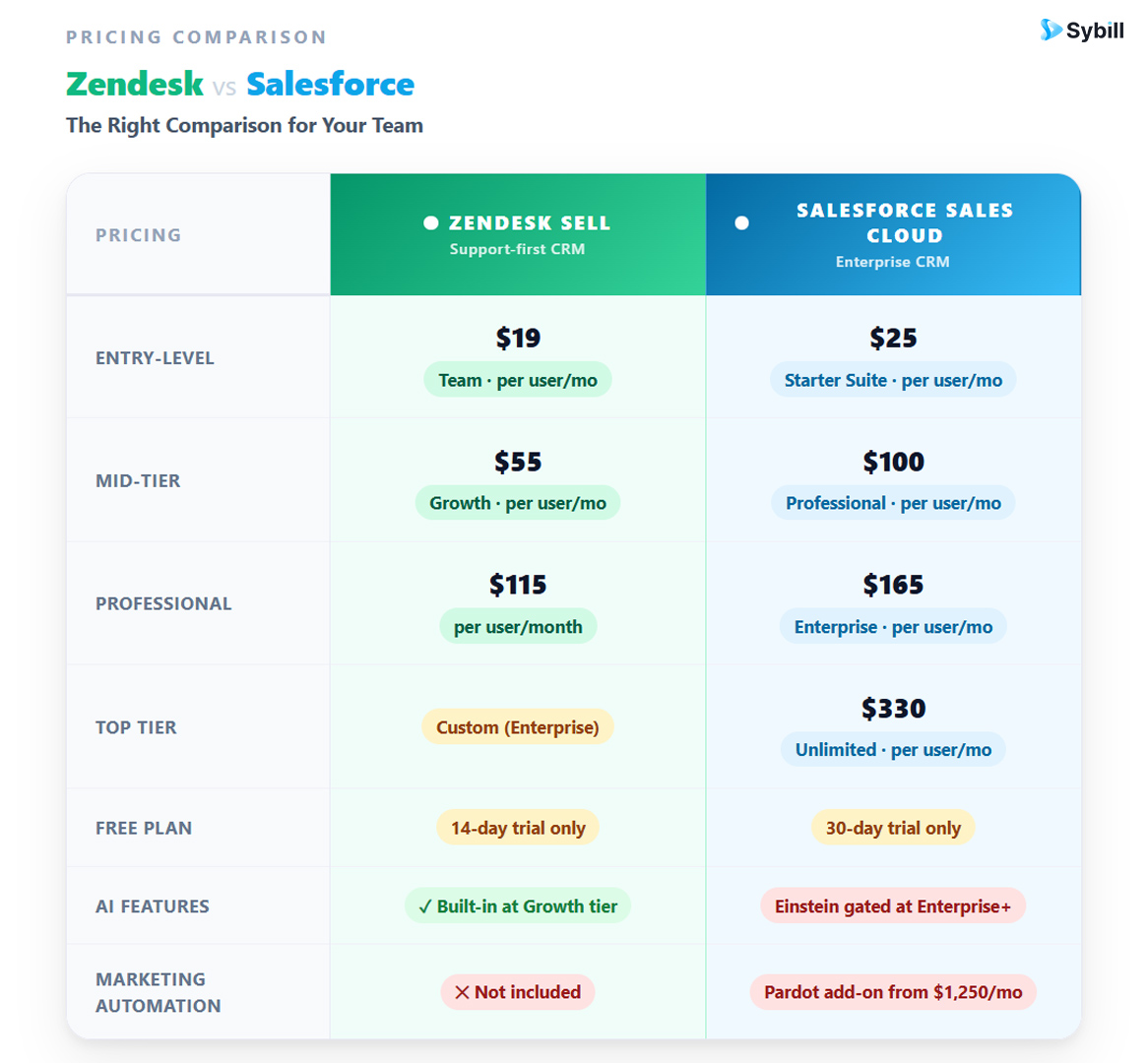
Zendesk Sell is meaningfully cheaper at the entry and mid tiers. The Growth plan at $55/user/month covers the practical sales needs of most SMB teams and includes basic automation, email sequences, and smart lists. Salesforce Professional at $100/user/month includes more advanced pipeline management and analytics but gates AI and full automation behind the Enterprise tier at $165/user/month.
The more significant pricing gap is in implementation. Zendesk Sell typically deploys in a matter of days for small teams. Salesforce implementations for a mid-market team routinely cost $5,000 to $100,000 in professional services in year one. For organizations evaluating total cost of ownership rather than license fees, this gap is substantial.
Zendesk Sell's pipeline is built around a clean visual board with drag-and-drop stage management, deal tracking, and activity scheduling. It is intuitive for reps without formal training and covers the daily workflow of managing contacts, logging calls, tracking emails, and progressing deals through stages. The mobile app is a particular strength, rated highly for field sales teams who need full CRM functionality off-desktop.
Salesforce Sales Cloud's pipeline management is analytically richer. AI-powered pipeline inspection, opportunity health scoring, forecast category management, and Einstein's next-best-action recommendations give revenue leaders a granular view of deal health across large teams and territories. The depth comes with configuration overhead. What a Salesforce rep sees depends entirely on how the instance was built and maintained.
For small and mid-market sales teams whose primary need is clear pipeline visibility and activity tracking, Zendesk Sell delivers a better out-of-the-box experience. For enterprise teams managing complex, multi-stage deals across territories with AI-guided rep activity, Salesforce's capabilities are unmatched.
Zendesk Sell's automation covers workflow triggers, email sequences, lead scoring, and smart prospecting lists. Its AI capabilities have expanded in recent releases with contact enrichment, lead prioritization, and email sentiment detection available at mid-tier plans. These are practical features for sales teams that want automation without a dedicated CRM admin to configure it.
Salesforce's automation is the deepest available in any commercial CRM. Flow Builder, approval processes, Einstein AI for predictive scoring and next-best-action recommendations, and Agentforce for deploying custom autonomous AI agents give enterprise teams automation flexibility that Zendesk Sell does not approach. The limitation is that accessing Salesforce's full automation depth requires Enterprise or Unlimited tier access and meaningful configuration investment.
For CRM automation that teams actually configure and use in their daily workflow, Zendesk Sell's lighter automation layer is frequently more consistently used by smaller teams than Salesforce's more powerful but harder-to-activate equivalent.
Salesforce's AppExchange has over 7,000 applications, the largest CRM integration ecosystem available. For enterprise teams with complex, multi-vendor technology stacks, Salesforce connects to virtually everything.
Zendesk Sell's integration story has a specific and genuine strength: Zendesk Suite. If your organization uses Zendesk for customer support, the native connection between your sales pipeline and your support tickets is immediate and maintains a unified customer record across both teams. For companies that measure customer health using both sales activity and support interaction history, this integration is more useful than any AppExchange connector. Outside the Zendesk ecosystem, Zendesk Sell connects with standard tools through the Zendesk Marketplace and via Zapier.
Zendesk Sell consistently outperforms Salesforce on ease of use and time to value. The interface is clean, the navigation is straightforward, and most teams get productive without formal training. Salesforce's learning curve is steep and well-documented. A well-implemented Salesforce instance can be excellent to use. A poorly implemented one drives reps back to spreadsheets, which is why Salesforce adoption is a standing RevOps agenda item in most enterprise organizations.
Zendesk Sell is the stronger choice for teams already in the Zendesk ecosystem, smaller sales organizations prioritizing fast setup and high rep adoption, and companies whose primary need is connecting sales and service on a shared customer record. Salesforce is the stronger choice for complex enterprise sales operations with multi-territory pipeline management, dedicated CRM administrators, and the budget and timeline for a proper implementation.
For teams evaluating all sales CRM options simultaneously, the Salesforce competitors guide covers how Zendesk Sell stacks up against HubSpot, Zoho, Pipedrive, and others in the same evaluation.
This is the clearest differentiator in the service platform comparison, and it shapes every other decision point.
Zendesk was designed for customer service from day one. Its AI, workflows, data models, and automation logic are built on nearly two decades of real support requests and ticket resolutions. Features like automatic ticket categorization by customer intent, skills-based agent routing, and built-in quality assurance tools work out of the box without customization. Zendesk reports that 90% of customers achieve measurable value within eight weeks of implementation.
Salesforce Service Cloud was built by extending the Sales Cloud data model outward into service use cases. It is exceptionally powerful and highly configurable, but it approaches customer service from a CRM-centric architecture rather than a support-centric one. Teams using Service Cloud frequently encounter complexity fatigue: long implementation cycles, high administrative overhead, and ongoing developer reliance before the platform delivers what a Zendesk deployment provides on day one.
The practical implication: organizations that want to be operational in weeks rather than months, with AI that works without extensive training data or configuration, consistently choose Zendesk. Organizations that need service deeply integrated into a broader Salesforce CRM, analytics, and commerce ecosystem, and are willing to invest the implementation time, choose Service Cloud.
Zendesk Suite provides omnichannel coverage across email, live chat, phone, SMS, WhatsApp, social media, and self-service portals. Critically, many of these channels are included in standard plans rather than priced as add-ons. The Zendesk AI layer applies across all channels simultaneously, routing tickets and suggesting responses based on unified context from every prior customer interaction.
Salesforce Service Cloud also covers email, chat, phone, and social channels, but some channels that Zendesk includes natively (WhatsApp, SMS) are positioned as add-ons or require higher tier access. This pricing model frustrates service teams that consider omnichannel coverage a baseline expectation rather than a premium feature.
Zendesk's AI is purpose-built for service resolution. It auto-classifies incoming tickets by intent, routes to the right agent based on skills and availability, suggests knowledge base articles to agents during live conversations, and resolves common issues autonomously without agent involvement. Because Zendesk's AI is trained on real support interactions from its entire customer base, it delivers useful predictions without requiring organizations to build their own training datasets.
Salesforce Einstein for Service Cloud is powerful and configurable. Organizations with large, well-structured historical support data can build sophisticated AI models for case deflection, sentiment analysis, and next-best-action recommendations. The tradeoff is the investment required to reach that capability. Einstein's service AI typically requires meaningful configuration and historical data before it delivers value comparable to Zendesk's out-of-the-box models.
Zendesk Suite pricing starts at $55/user/month for the Suite Team plan, with Suite Professional at $115/user/month and Suite Enterprise at custom pricing. Salesforce Service Cloud pricing starts at $25/user/month for the Starter Suite, stepping to $100/user/month for Professional, $165/user/month for Enterprise, and $330/user/month for Unlimited.
Salesforce's entry price is lower, but its total cost of ownership at comparable feature levels is higher once customization, administration, and implementation are factored in. Zendesk's pricing is more predictable because the features teams actually need for service operations are included at lower tiers without the add-on structure that inflates Salesforce's effective cost.
Zendesk Suite is the stronger choice for service-first organizations that want fast deployment, out-of-the-box AI that works immediately, transparent pricing, and the best omnichannel support tooling available without customization overhead. Salesforce Service Cloud is the stronger choice for enterprises already running Salesforce Sales Cloud that want service and sales on a unified data model, and for organizations whose service operations require the same depth of customization that makes Salesforce the enterprise CRM standard.
Here is what Zendesk Sell and Salesforce Sales Cloud have in common, and it matters more than any feature comparison: both platforms depend on what your reps choose to enter after each call, email, and meeting.
The specific objection raised on a demo call. The procurement stakeholder mentioned once in passing. The competitor name that came up in context. The pricing concern the prospect described in a way that would have shaped every follow-up message. None of that makes it into either system automatically, because neither platform was in the conversation.
This is the root cause of the CRM data quality problem that costs sales organizations an estimated 12% of annual revenue in wasted time, inaccurate forecasts, and missed opportunities. It is why switching CRM platforms frequently improves the interface experience without improving the underlying data problem. And it is why AI CRM use cases that capture conversation intelligence at the source are where the real pipeline accuracy improvements are being built in 2026.
Get started for free with Sybill and see what your CRM data looks like when it comes from what was actually said, not from what was remembered.
Sybill integrates natively with Salesforce and connects with Zendesk Sell via Zapier, which means it works on top of whichever platform you choose. It is not a CRM replacement. It is the conversation intelligence and automation layer that fills the data gap both platforms leave open
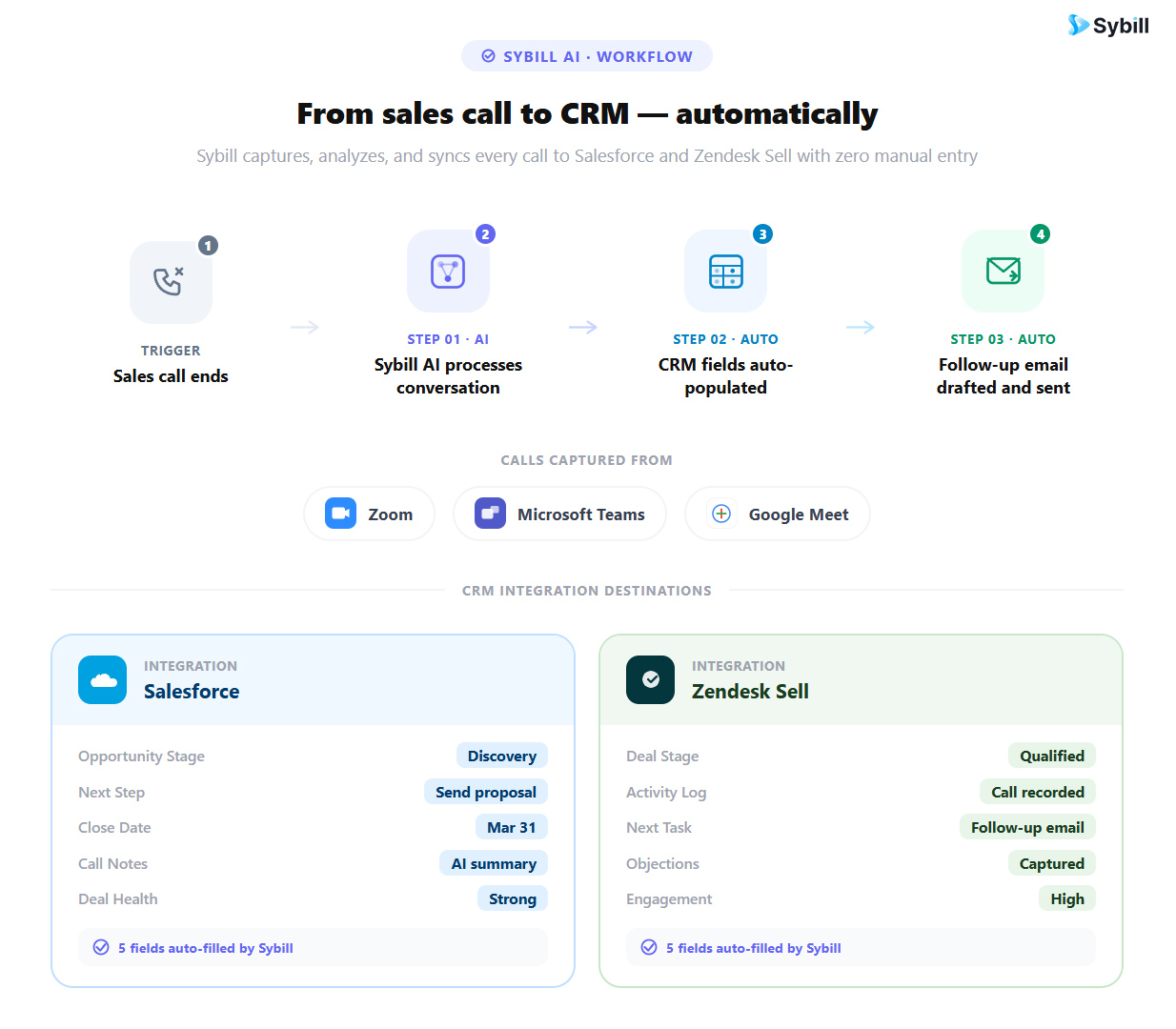
After every call and email, Sybill extracts what actually happened and writes it directly into your CRM fields. Pain points, objections, budget signals, decision-maker identity, MEDDPICC and BANT criteria, next steps, and competitor mentions: all populated automatically, field by field, in human-sounding language, without the rep touching the CRM.
CRM Autofill eliminates post-call admin regardless of which platform sits underneath. Sybill auto-discovers your CRM fields, including custom ones, and populates them from the actual conversation. AEs on Sybill report saving four to six hours per week on CRM updates alone.
Magic Summary delivers a structured call debrief within minutes of every call ending. Outcome, buyer pain points, objections raised, next steps, and engagement signals are all structured and delivered to the rep's inbox before they write their first follow-up word. Sales call transcripts stop being recordings nobody reviews and become decision-ready action plans.
Ask Sybill is a natural-language querying interface across all your deals, calls, emails, and CRM data. Ask which accounts have gone quiet after the proposal stage. Ask which deals have raised a security concern in the last 30 days. Ask which reps are consistently strong at discovery. Structured answers in seconds, not after a report build. This is conversation intelligence software turning every meeting into searchable, structured deal intelligence.
Non-Verbal AI Analysis tracks body language and engagement signals on video calls, identifying which stakeholders in a multi-person meeting are genuinely bought in and which are passive. For complex B2B deals with multiple decision-makers, this shapes the follow-up strategy before the email is written.
Pre-Meeting Briefs are auto-generated before every call using full deal history, previous call summaries, and CRM context. Reps walk in prepared without 20 minutes of pre-call tab navigation.
AI Follow-Up Emails are one-click drafts in the rep's own voice, written specifically from what was discussed on the call. Not templates. Contextual emails that reference the actual conversation, delivered in seconds.
For sales managers, Sybill generates rep-level coaching briefs, deal health snapshots, and automated pipeline reviews. The AI agents for sales managers use case is especially valuable for MEDDPICC or BANT-driven teams where field completeness directly drives forecast confidence, whether the underlying CRM is Salesforce or Zendesk Sell.
This directly addresses the top challenges RevOps teams report across both platforms: incomplete pipeline data, unreliable forecasts, and excessive rep admin. Sybill solves all three simultaneously by automating the data layer that both platforms depend on but cannot collect themselves.
For teams evaluating the best AI sales tools to layer on top of their CRM investment, Sybill delivers the post-call execution that makes any platform actually reflect deal reality.
Get started for free with Sybill and connect it to Salesforce or Zendesk Sell today.
What is the main difference between Zendesk and Salesforce?
Zendesk is a customer service and support platform first, with a sales CRM (Zendesk Sell) added to its product suite. It is purpose-built for service teams, deploys quickly, and is strongest when sales and service teams share the same Zendesk customer record. Salesforce is a sales CRM platform first, with a customer service offering (Service Cloud) built on the same data model. It offers deeper customization, more powerful analytics, and a broader enterprise ecosystem, but requires significantly more implementation investment and technical expertise to operate effectively. The right choice depends primarily on whether your primary use case is sales CRM or customer service, and how much implementation complexity your team can absorb.
Is Zendesk Sell a good alternative to Salesforce for small businesses?
Yes, specifically for small businesses already using Zendesk for customer support. Zendesk Sell's entry-level pricing at $19/user/month, fast setup, intuitive interface, and native integration with Zendesk Suite make it a practical and affordable choice for teams where the sales-to-service customer lifecycle is the primary management challenge. For small sales teams without existing Zendesk infrastructure, alternatives like Pipedrive, HubSpot, or Zoho CRM may offer more sales-specific functionality at comparable price points. See the best CRM software for small businesses for a full comparison.
Which is better for customer service: Zendesk or Salesforce Service Cloud?
Zendesk is the stronger choice for most customer service organizations evaluating the two in isolation. It deploys faster, its AI works out of the box without extensive configuration, and its omnichannel channel coverage is broader at lower price points. Salesforce Service Cloud is the stronger choice for enterprises that already operate Sales Cloud and need service and sales on a unified data model, or for organizations whose service complexity requires the same deep customization that makes Salesforce the enterprise CRM standard. The practical test is implementation timeline: Zendesk's median time to value is weeks, Salesforce Service Cloud's is months.
How does Zendesk Sell compare to Salesforce on pricing?
Zendesk Sell is meaningfully more affordable at entry and mid-tiers. The Sell Team plan starts at $19/user/month, and the Growth plan at $55/user/month covers automation, email sequences, and AI-powered prospecting. Salesforce's first genuinely capable plan for mid-market sales teams is the Professional plan at $100/user/month. However, Salesforce's pricing gap narrows when comparing total cost of ownership rather than license fees: Zendesk Sell typically deploys in days without consulting costs, while Salesforce implementations for mid-market teams regularly cost $5,000 to $100,000 in year one. Read more about how CRM data quality affects total cost of ownership regardless of the platform.
Can Zendesk and Salesforce be used together?
Yes, and many enterprise organizations run both: Zendesk for customer service and support, and Salesforce for sales CRM and revenue operations. The native Salesforce-Zendesk integration syncs contact records, account data, and support ticket history between the two platforms, giving both sales reps and support agents visibility into the full customer relationship. This combination is particularly common in organizations where service and sales teams operate with different tooling preferences but need shared customer context. AI sales tools that work across both platforms provide an additional intelligence layer regardless of which system holds the primary record.
Does Sybill work with Zendesk Sell?
Yes. Sybill connects with Zendesk Sell via Zapier, enabling automatic CRM field updates after every sales call and email. Deal stage, next steps, qualification criteria, stakeholder identification, objections, and more are captured from the conversation and written into your Zendesk Sell records without manual entry. Sybill also integrates natively with Salesforce for teams on that platform. Reps save four to six hours per week on CRM admin, and pipeline data reflects what actually happened in deals rather than what was remembered and typed in later. Learn more about how AI conversation intelligence improves CRM accuracy for both Zendesk and Salesforce users.
Which CRM gives better sales forecasts: Zendesk Sell or Salesforce?
Salesforce delivers materially more sophisticated sales forecasting at Enterprise and Unlimited tiers, particularly for large organizations with complex territory structures, multi-product pipelines, and extensive historical deal data. Zendesk Sell's forecasting covers the practical needs of most SMB and mid-market sales teams with pipeline reports, goal tracking, and team performance dashboards. For both platforms, the reliability of forecasts depends entirely on the completeness of the underlying CRM data. AI-powered sales forecasting that incorporates real conversation signals and buyer intent data consistently outperforms models built on manually entered pipeline stages, regardless of which platform generates the forecast.
Whichever platform you choose, the data inside it is only as good as what gets captured after every customer conversation. Get started for free with Sybill and connect it to Salesforce or Zendesk Sell today.
Zendesk is a customer service and support platform first, with a sales CRM (Zendesk Sell) added to its product suite. It is purpose-built for service teams, deploys quickly, and is strongest when sales and service teams share the same Zendesk customer record. Salesforce is a sales CRM platform first, with a customer service offering (Service Cloud) built on the same data model. It offers deeper customization, more powerful analytics, and a broader enterprise ecosystem, but requires significantly more implementation investment and technical expertise to operate effectively. The right choice depends primarily on whether your primary use case is sales CRM or customer service, and how much implementation complexity your team can absorb.
Yes, specifically for small businesses already using Zendesk for customer support. Zendesk Sell's entry-level pricing at $19/user/month, fast setup, intuitive interface, and native integration with Zendesk Suite make it a practical and affordable choice for teams where the sales-to-service customer lifecycle is the primary management challenge. For small sales teams without existing Zendesk infrastructure, alternatives like Pipedrive, HubSpot, or Zoho CRM may offer more sales-specific functionality at comparable price points. See the best CRM software for small businesses for a full comparison.
Zendesk is the stronger choice for most customer service organizations evaluating the two in isolation. It deploys faster, its AI works out of the box without extensive configuration, and its omnichannel channel coverage is broader at lower price points. Salesforce Service Cloud is the stronger choice for enterprises that already operate Sales Cloud and need service and sales on a unified data model, or for organizations whose service complexity requires the same deep customization that makes Salesforce the enterprise CRM standard. The practical test is implementation timeline: Zendesk's median time to value is weeks, Salesforce Service Cloud's is months.