The best sales follow-up emails are fast, specific, useful, and based on what the buyer actually said.
Bad follow-ups ask for attention. Good follow-ups earn it with context, value, and a clear next step.
Manual follow-ups break at scale because reps lose details, delay sending, and fall back on generic templates.
AI-powered tools like Sybill help sales teams draft personalized follow-up emails from call, CRM, and deal context, so every buyer gets a sharper next step faster.
The First Sales Email Opens the Door. The Follow-up Decides Whether Anyone Walks Through It.
That is where most deals get weird.
A prospect takes a call, nods at the right moments, asks sharp questions, says, “Send me the details,” and then disappears into the corporate fog like a character written out of a streaming show with no explanation.
Most sales follow-up emails do not fail because the buyer is uninterested. They fail because the follow-up is late, vague, generic, or completely disconnected from what the buyer actually said.
“Just checking in” is not a strategy. It is a cry for help with a subject line.
Good sales follow-up emails do something more useful. They preserve momentum. They prove the rep was listening. They make the next step obvious. And increasingly, they are supported by AI tools that help reps move faster without sounding like a sad template factory.
That is where Sybill comes in. Sybill’s Personalized Emails turn real sales conversations into ready-to-send follow-ups using meeting context, buyer pain points, objections, and next steps. With Magic Summary, CRM Autofill, AI Tasks, Ask Sybill, and Deal Workspace working together, reps are not just sending better emails. They are executing the next move before the deal goes cold.
What Is a Sales Follow-Up Email?
A sales follow-up email is a message sent after a sales interaction to continue the conversation and move the deal forward. That interaction could be a cold email, discovery call, demo, proposal, referral, no-show, event conversation, or a previous follow-up that got no response.
At its best, a sales follow-up email does four things:
It reminds the buyer why the conversation matters.
It captures what was discussed.
It adds something useful.
It gives the buyer one clear next step.
At its worst, it says, “Just checking in,” and then dies in the inbox next to shipping updates and software renewal reminders.
A good follow-up is not a nudge for the sake of nudging. It is a continuation of the sales conversation. It should feel like the rep picked up the thread exactly where the buyer left it.
Why Sales Follow-Up Emails Matter More Than Reps Think
Sales follow-up emails matter because buying decisions rarely happen in one clean moment.
The buyer may be interested, but they are also busy. Their CFO wants numbers. Their team wants proof. Their current vendor is suddenly being extra nice. Their Slack is on fire. Their calendar looks like a Tetris board designed by someone with a grudge.
Your follow-up keeps the deal alive in that chaos.
A strong sales follow-up email helps you:
Keep momentum after a live conversation.
Show that you understood the buyer’s pain points.
Address concerns before they become deal blockers.
Share useful resources at the right time.
Clarify next steps across stakeholders.
Stay top of mind without becoming background noise.
The real job of a follow-up is not to remind the buyer that you exist. That is bare minimum behavior. The real job is to make the next action easier than doing nothing.
Why Most Sales Follow-Up Emails Fail
Most sales follow-up emails fail for four painfully predictable reasons.
They say nothing new
“Just checking in.”
“Bumping this up.”
“Following up again.”
These lines do not help the buyer. They only announce that the rep wants a response.
Every follow-up should justify its place in the inbox. Add a new insight. Answer a question. Share a relevant case study. Recap a specific pain point. Offer a useful comparison. Clarify the decision process.
If the email gives the buyer nothing new, the buyer owes it nothing back.
They arrive too late
The best follow-up window is when the conversation is still fresh.
After a discovery call or demo, waiting a full day can quietly drain momentum. The buyer forgets the sharp point they made. The rep forgets the nuance behind an objection. The next step gets fuzzy.
A fast follow-up tells the buyer, “I heard you, I understood the priorities, and here is exactly what happens next.”
Speed is not about rushing. It is about preserving context before it evaporates.
They sound like templates
Buyers can smell generic outreach from three inboxes away.
A template is not automatically bad. A dead template is.
The problem starts when every follow-up sounds like it could have gone to any buyer in any industry after any call.
Great sales follow-up emails reference something real: a business goal, a timeline, a stakeholder concern, a metric, a competitor, a compliance requirement, a quote from the call, or a specific question the buyer asked.
Specificity is what makes the email feel human.
They are impossible to scale manually
Here is where the “just write better emails” advice falls apart.
Writing one thoughtful follow-up is easy.
Writing thoughtful follow-ups across 20 open deals, eight demos, five proposals, three no-shows, and a manager asking why CRM is not updated? That is where good intentions go to die.
Manual follow-ups break because reps are busy. Context is scattered across notes, call recordings, Slack threads, CRM fields, and memory. By the time the rep sits down to write, the best details are already gone.
The Follow-Up Email Framework That Actually Gets Replies
Forget cleverness for a second. A good sales follow-up email needs structure.
Use this four-part framework.
Start with a specific reason for writing
Do not open with “just checking in.”
Open with context.
Try:
“On our call, you mentioned that your team is trying to reduce manual CRM updates before Q2 planning.”
“I was thinking about your question on onboarding timelines.”
“You asked whether this would work for a multi-region sales team, so I pulled together the relevant details.”
A specific opening tells the buyer this is not a copy-paste follow-up. It is tied to their world.
Add something the buyer did not have before
Every follow-up should give the buyer a reason to keep reading.
That could be:
A case study from a similar team
A pricing clarification
A product walkthrough
A comparison sheet
A short answer to an objection
A relevant benchmark
A recap of agreed next steps
A resource for another stakeholder
The goal is not to dump content. The goal is to make the buyer’s next decision easier.
Reference real buyer context
This is where most follow-ups either win or collapse.
Use details like:
Their pain point
Their current process
Their timeline
Their objections
Their buying committee
Their success criteria
Their exact words from the call
For example, “You mentioned your reps are spending Friday afternoons cleaning up CRM notes” is stronger than “I know productivity is important.”
One sounds like listening. The other sounds like a brochure wearing shoes.
End with one clear CTA
One email, one ask.
Not three links, two meeting options, a pricing doc, a white paper, and a “let me know your thoughts” floating around like a confused balloon.
Use a direct next step:
“Would Thursday at 2 PM work for a 20-minute walkthrough?”
“Should I send the security details to your RevOps lead?”
“Is Maya the right person to include in the next conversation?”
“Would it help if I shared the implementation plan before your internal meeting?”
A strong CTA reduces effort. The buyer should know exactly what to do next.
Manual vs Template-Based vs AI-Powered Sales Follow-Up Emails
Not all follow-up systems are equal.
The future is not “AI sends everything while reps nap.”
The smarter model is this: AI drafts the follow-up using real context, the rep reviews and sharpens it, and the buyer receives a message that actually reflects the conversation.
That is the sweet spot. Fast enough to scale. Personal enough to work.
How Sybill Helps Reps Send Better Follow-Up Emails Faster
Sybill’s Email Follow-Up feature is built for the post-meeting scramble.
The buyer just shared three important details. The next step needs to go out fast. The rep has another call in seven minutes. This is where follow-ups usually become rushed, vague, or painfully generic.
Sybill fixes that.
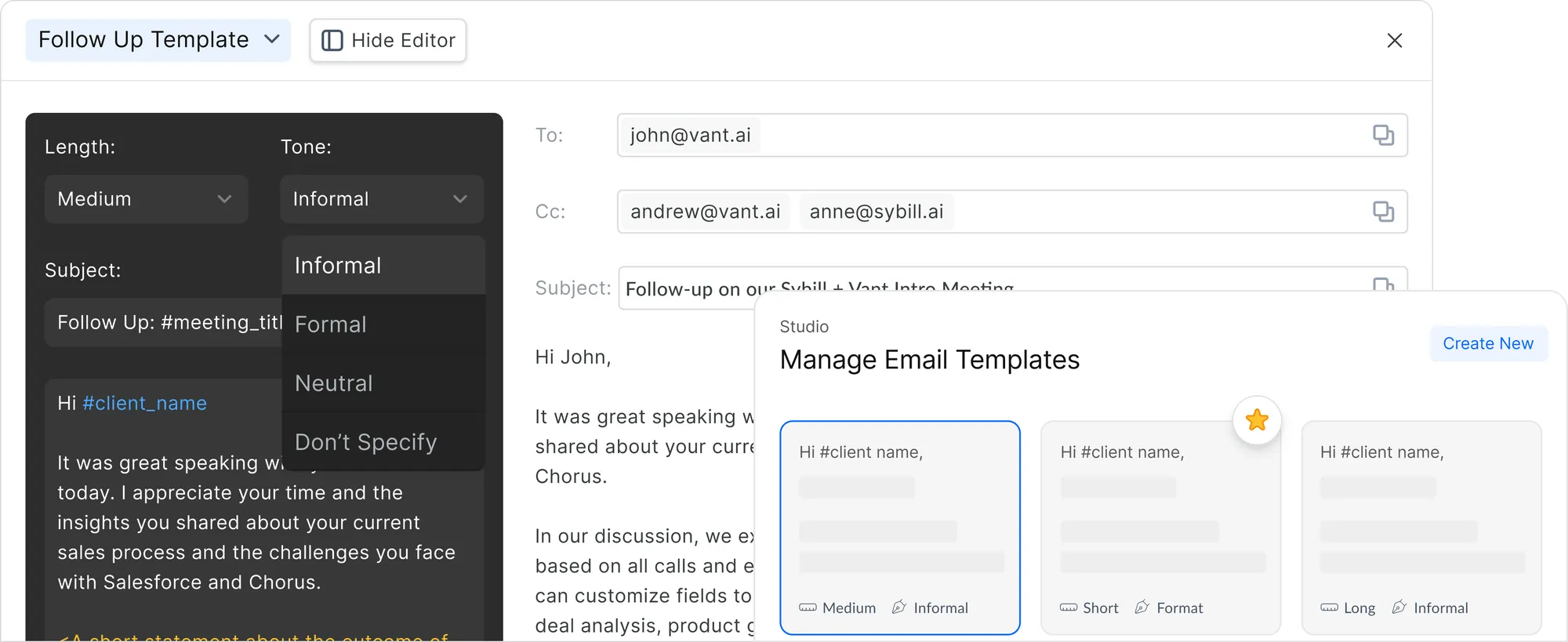
It automatically creates personalized follow-up emails based on the call context and the rep’s writing style. So instead of starting from a blank compose window, reps get a ready-to-edit email that already reflects what happened in the meeting.
Here’s what Sybill’s Email Follow-Up feature does:
Sybill’s follow-up emails start with a contextual acknowledgment, summarize key discussion points, and include open items from the conversation. That means the email feels like a continuation of the meeting, not a random “great chatting today” note.
Reps can also customize the email’s length, tone, subject line, and body. Need a short executive recap? Done. A warmer post-discovery note? Easy. A more detailed follow-up after a technical demo? Also covered.
It can clone the rep’s writing style from past emails and help create reusable templates for different deal stages. So your best follow-up style does not stay trapped in one rep’s sent folder. It becomes repeatable across the team without sounding robotic.
Sybill also captures action items from the meeting, so commitments do not disappear into the “I’ll remember” graveyard. If a buyer asked for a security document, pricing clarification, or pilot success plan, the follow-up can reflect that clearly.
In plain English: Sybill helps reps send follow-ups that are fast, contextual, personalized, and useful. Not just faster emails. Better next steps.
Its follow-up emails are powered by multimodal intelligence and a Sales-RAG system, which blends sales context with company and deal specifics for more relevant outputs.
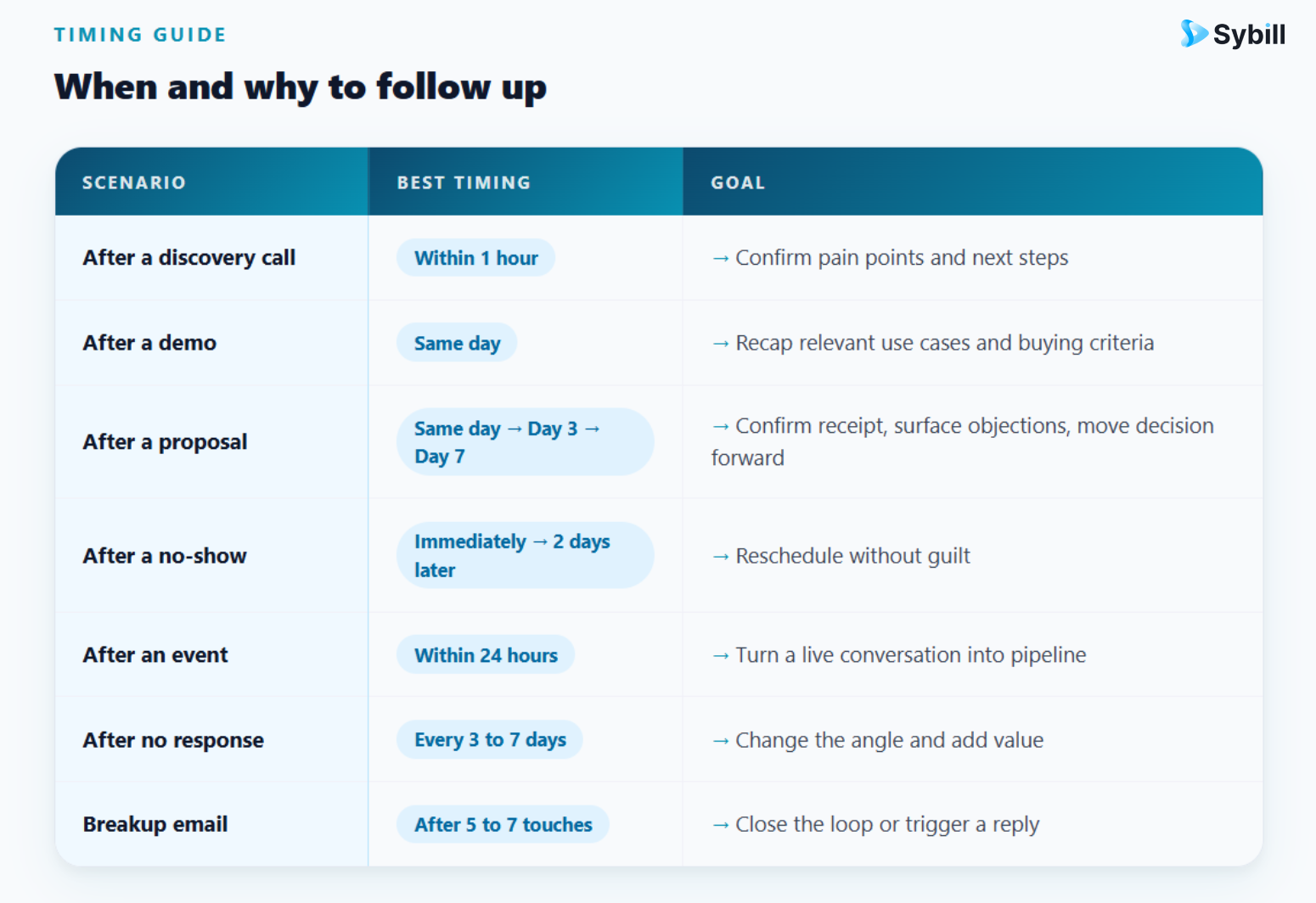
Best Timing for Sales Follow-Up Emails
Timing does not need to be mystical. You do not need to consult the moon, your caffeine level, or a LinkedIn guru with a ring light.
You need to match the follow-up to the stage of the conversation.
The rule is not “follow up constantly.”
The rule is “follow up with relevance.”
A thoughtful email after three days beats a lazy bump after one. But after a call or demo, speed matters because the buyer’s memory is fresh and the next step is still emotionally available.
Sales Follow-Up Email Examples by Scenario
Use these as starting points. The best follow-ups should still reflect the actual conversation.
Follow-up email after a discovery call
Subject: Next steps from today's call
Hi [Name],
Thanks for walking me through how your team is handling [specific process]. The two challenges that stood out were [pain point 1] and [pain point 2], especially with [team or timeline context].
Based on that, I think the next useful step is to show how [solution] would support [specific goal] without adding more admin for your reps.
Would Thursday at 2 PM work for a focused walkthrough?
Best, [Your Name]
Follow-up email after a demo
Subject: Recap from the demo
Hi [Name],
Thanks for joining the demo today. I wanted to recap the parts that seemed most relevant to your team: [feature or workflow 1], [feature or workflow 2], and the ability to address [specific concern].
You also asked about [objection or question], so I'm including a quick note on how that works: [short answer].
Would it make sense to bring [stakeholder] into the next conversation so we can cover implementation and rollout?
Best, [Your Name]
Follow-up email after sending a proposal
Subject: Proposal follow-up
Hi [Name],
I wanted to confirm you received the proposal I sent over for [specific initiative].
The sections most tied to your priorities are [section 1] and [section 2], especially given your timeline around [timeline or decision event].
Happy to walk through the numbers and answer questions. Would tomorrow afternoon or Thursday morning work?
Best, [Your Name]
Follow-up email after no response
Subject: Thought this might help
Hi [Name],
I know things get busy, so I wanted to share one quick resource related to your point about [specific challenge].
This covers how teams typically approach [problem] when they are trying to [goal], which sounded close to what your team is evaluating.
Should I send over a shorter summary for your internal discussion?
Best, [Your Name]
Breakup email
Subject: Should I close the loop?
Hi [Name],
I do not want to keep filling your inbox if this is not a priority right now.
Should I close the loop for now, or would it still make sense to revisit [specific topic] later this quarter?
Best, [Your Name]
How to Write Sales Follow-Up Subject Lines That Get Opened
The best follow-up subject lines are clear, specific, and tied to the conversation. You do not need to be mysterious. You are not launching a Netflix true crime trailer.
The subject line should make the email feel relevant before the buyer opens it.
How to Follow Up Without Sounding Pushy
The problem is not persistence. The problem is persistence without value.
Pushy follow-ups repeat the same ask. Helpful follow-ups change the angle.
Instead of saying, “Can we schedule a call?” for the third time, try:
“I found a customer example related to the workflow you described.”
“You mentioned security review might be a blocker, so I’m sharing the relevant details.”
“Your team’s Q2 timeline made me think this rollout plan might be useful.”
“Would it help if I sent a shorter version you can forward internally?”
Also, give the buyer room to say no. A low-pressure close often gets more replies than a desperate one.
Try:
“Should I close the loop for now?”
“Is this still worth revisiting?”
“Would next quarter be better timing?”
A confident follow-up does not beg. It creates clarity.
What to Look for in Sales Follow-Up Email Software
If you are evaluating sales follow-up email software, do not get distracted by shiny template libraries alone.
Templates are useful. But if the tool does not understand the buyer conversation, it cannot create truly relevant follow-ups.
Look for these capabilities.
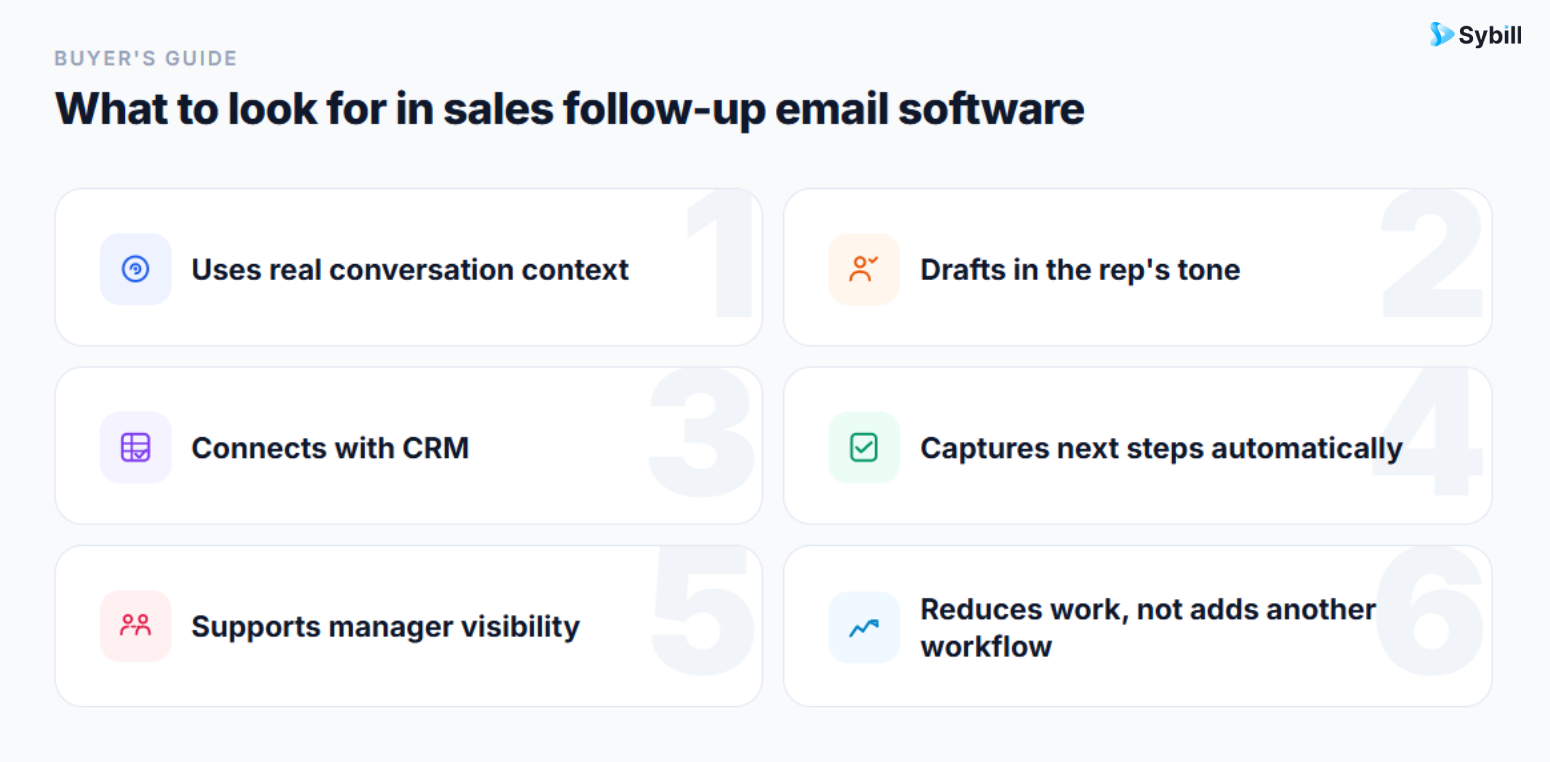
It should use real conversation context
The tool should pull from calls, meetings, emails, CRM records, and deal notes.
Merge tags are not personalization. “Hi [First Name]” is not exactly Shakespeare.
Real personalization comes from knowing what the buyer said, what they care about, what they objected to, and what they need next.
It should draft in the rep’s tone
AI-generated follow-ups should not sound like a compliance memo accidentally joined a sales team.
The best tools let reps review, adjust, and send emails that still sound like them.
It should connect with CRM
If follow-up emails and CRM updates live in separate worlds, reps still do double work.
Look for software that updates CRM fields, captures next steps, logs activity, and keeps deal records clean.
That is where Sybill’s CRM Autofill becomes especially useful. It turns conversation context into structured CRM data, so the follow-up and the deal record stay aligned.
It should capture next steps automatically
The most dangerous phrase in sales is “I’ll remember.”
No, you will not. Not reliably. Not across dozens of deals.
A strong AI follow-up tool should capture promised resources, next meetings, stakeholder asks, objections, and pending tasks.
It should support manager visibility
Sales leaders need to know whether follow-ups are happening fast enough, whether the message quality is strong, and whether reps are addressing buyer concerns.
Great follow-up software is not just a rep productivity tool. It is a coaching and pipeline execution tool.
It should reduce work, not create another workflow
The tool should not become one more tab reps resent.
The best follow-up automation fits into the rep’s existing motion and removes friction from the work they already have to do.
This is where Sybill is strong. It connects meeting summaries, personalized follow-ups, CRM updates, AI tasks, and deal context in one workflow.
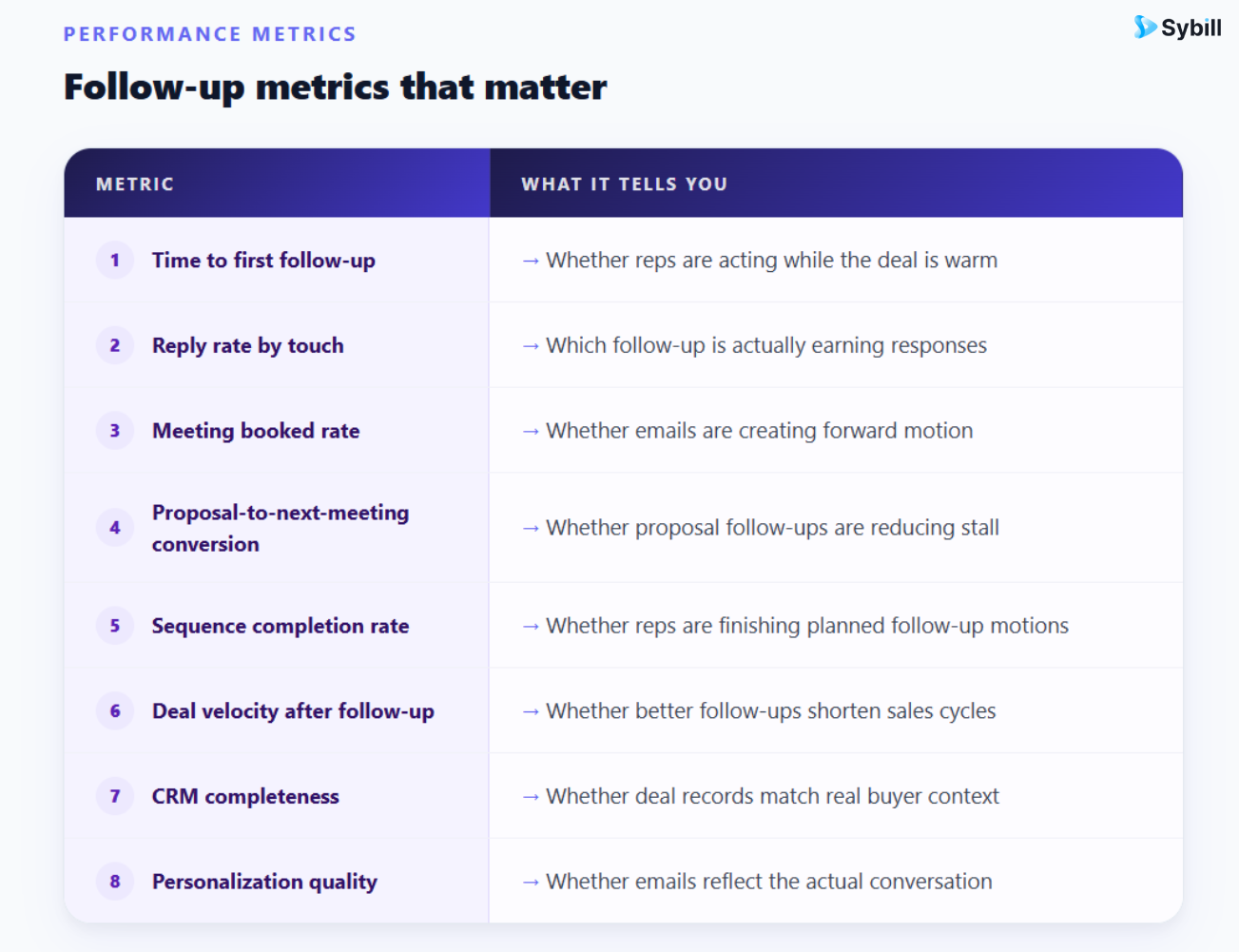
How to Measure Sales Follow-Up Email Performance
You cannot improve follow-ups if you only measure whether reps “sent something.”
Measure quality and momentum.
Track these metrics:
Open rates are useful, but they are not the prize.
A beautiful open rate with no replies is just vanity wearing a nice jacket.
The better question is: did the follow-up create a next step?
The Real Follow-Up Problem Is Not Writing. It Is Execution.
Sales teams do not need another folder of “perfect follow-up templates.”
They need a system that helps reps execute consistently when the calendar is packed, the pipeline is noisy, and every buyer expects relevance.
That means capturing the call. Summarizing the key points. Drafting the follow-up. Updating CRM. Creating tasks. Preserving deal context. Helping reps and managers see what should happen next.
That is the bigger follow-up problem.
Sybill solves it by connecting Email Follow Ups with actual conversation intelligence. The result is not just better email copy. It is cleaner deal execution.
Because the best sales follow-up emails do not just sound good.
They move the deal.
Ready to stop panic-writing follow-ups between calls? See how Sybill helps reps send faster, sharper, more personalized sales follow-up emails using real conversation context.
FAQs About Sales Follow-Up Emails
What is a sales follow-up email?
A sales follow-up email is a message sent after a sales interaction to continue the conversation and move the buyer toward the next step. It can be sent after a cold email, discovery call, demo, proposal, event meeting, referral introduction, or no-response situation.
How do you write a good sales follow-up email?
To write a good sales follow-up email, start with a specific reason for reaching out, reference the previous interaction, add something useful, and end with one clear call-to-action. Keep it short, relevant, and tied to the buyer’s actual priorities.
What is the best time to send a sales follow-up email?
After a sales call or demo, the best time to send a follow-up email is within one hour. For cold outreach or no-response sequences, spacing follow-ups three to seven days apart usually works better than sending repeated daily nudges.
How many follow-up emails should you send?
For active sales conversations, send five to seven thoughtful follow-ups before closing the loop or moving the buyer into longer-term nurture. The key is to change the angle and add value with each touch, not repeat the same ask.
What should I say instead of just checking in?
Instead of “just checking in,” reference something specific from the last interaction. For example: “You mentioned your team is trying to reduce manual CRM updates, so I wanted to share a quick workflow that may help.” This gives the buyer a reason to engage.
Can AI write sales follow-up emails?
Yes. AI can write sales follow-up emails, but the best results come from tools that use real sales context, not generic prompts. Sybill drafts Personalized Emails based on call summaries, buyer pain points, objections, CRM context, and agreed next steps.
What is the best AI tool for sales follow-up emails?
The best AI tool for sales follow-up emails should draft messages from actual conversation context, support CRM updates, capture next steps, and help reps move faster without losing personalization. Sybill is built for this workflow with Personalized Emails, Magic Summary, CRM Autofill, AI Tasks, Ask Sybill, and Deal Workspace.
How do you follow up after a sales call?
After a sales call, send a follow-up email that thanks the buyer, summarizes the main pain points, confirms agreed next steps, includes promised resources, and asks for one clear action. The email should feel like a useful recap, not a generic thank-you note.
How do you follow up after no response?
If a buyer does not respond, change the angle. Share a relevant resource, answer a likely objection, reference a business priority, or ask if timing has changed. Avoid sending the same “any update?” message repeatedly.
What should sales follow-up email software include?
Sales follow-up email software should include AI drafting, call and meeting context, CRM integration, next-step capture, tone customization, task creation, manager visibility, and performance tracking. The goal is to help reps send better follow-ups faster while keeping the deal record accurate.
Get started with Sybill
Accelerate your sales with your personal assistant
Oops! Something went wrong while submitting the form.
Frequently Asked Questions
What is a sales follow-up email?
A sales follow-up email is a message sent after a sales interaction to continue the conversation and move the buyer toward the next step. It can be sent after a cold email, discovery call, demo, proposal, event meeting, referral introduction, or no-response situation.
How do you write a good sales follow-up email?
To write a good sales follow-up email, start with a specific reason for reaching out, reference the previous interaction, add something useful, and end with one clear call-to-action. Keep it short, relevant, and tied to the buyer’s actual priorities.
What is the best time to send a sales follow-up email?
After a sales call or demo, the best time to send a follow-up email is within one hour. For cold outreach or no-response sequences, spacing follow-ups three to seven days apart usually works better than sending repeated daily nudges.





.png)
.png)
.png)
.png)
.png)