
Find us at booth #83, join us for a harbor side happy hour, or catch Gorish’s talk.

Sept, 16-18 > Learn more


Tamanna Mishra

April 27, 2026
What if your sales coaching templates are stuck in 2016 in the 2026 universe?
Sales coaching today often feels like rewatching an old sitcom on cable. Familiar. Predictable. Comforting. Also wildly out of touch with reality.
Reps sell on Zoom, Slack, and async demos. Buyers ghost faster than dating apps. AI surfaces insights reps never thought to ask for. And yet, coaching can sometimes still rely on vague feedback like “ask better questions” or “control the call.”
The five essential sales coaching templates for 2026 are the 1:1 coaching template (structured weekly skill development), the call review template (systematic conversation analysis), the deal strategy template (opportunity-level coaching on next steps and risks), the skill gap template (targeted competency development), and the pipeline review template (forecast accuracy and deal health inspection). Modern templates work best when powered by AI conversation data from tools like Sybill rather than rep self-reporting, turning coaching from subjective gut-feel feedback into evidence-based development that references specific call moments, buyer reactions, and measurable behavior changes.
In the AI world, sales coaching templates are operating systems. They structure conversations, make feedback repeatable, and turn gut-feel coaching into performance leverage.
This blog breaks down five sales coaching templates built for modern SaaS teams, explains when and how to use them, and shows how AI quietly upgrades every single one.
But first…
Before we get into the nuts and bolts of sales coaching templates in 2026, let’s get one thing out of the way. Sales coaching templates are not bureaucracy. They are not busywork. And they are definitely not something sales managers use to feel productive.
That belief is exactly why most sales coaching fails.
Most coaching today is improvisation dressed up as leadership. A manager remembers a call. A rep vaguely recalls what happened. Feedback is given based on instinct, personality, or whatever deal feels loudest that week.
It works when teams are tiny. But the moment you scale, it all comes down like a house of cards.
Not because managers are bad. But because memory does not scale. Opinion does not scale. Vibes definitely do not scale.
A sales coaching template is a repeatable decision framework for coaching conversations.
At its best, a sales coaching template does four things consistently:
Good sales coaching templates structure the conversation. They create guardrails so coaching stays focused on improvement.
This is why strong sales teams use templates even when their managers are excellent coaches.
Most teams assume coaching problems are people problems. They are system problems.
Traditional coaching breaks because:
The result is inconsistency. Some reps get world-class coaching. Others get generic advice. Performance gaps widen. Managers burn out trying to keep up.
No amount of motivation fixes that.
AI removes the biggest lie in sales coaching.
“I remember how that call went.”
In an AI-powered environment:
Sales coaching templates finally work the way they were meant to. Not as static documents, but as living frameworks powered by real selling behavior.
In the AI world, sales coaching templates stop being process overhead. They become performance infrastructure.
Related read: How to use AI in sales coaching
Now, let’s dive straight into sales coaching templates suitable for 2026.
If your 1 on 1s feel like polite pipeline interrogations, this template fixes that fast.
This is not the meeting where reps read out deal updates you can already see in the CRM. It is the meeting where selling skills actually get sharper.
The AI-powered 1 on 1 sales coaching template works best for:
A strong 1 on 1 sales coaching template is deliberately narrow. Fewer sections. More depth.
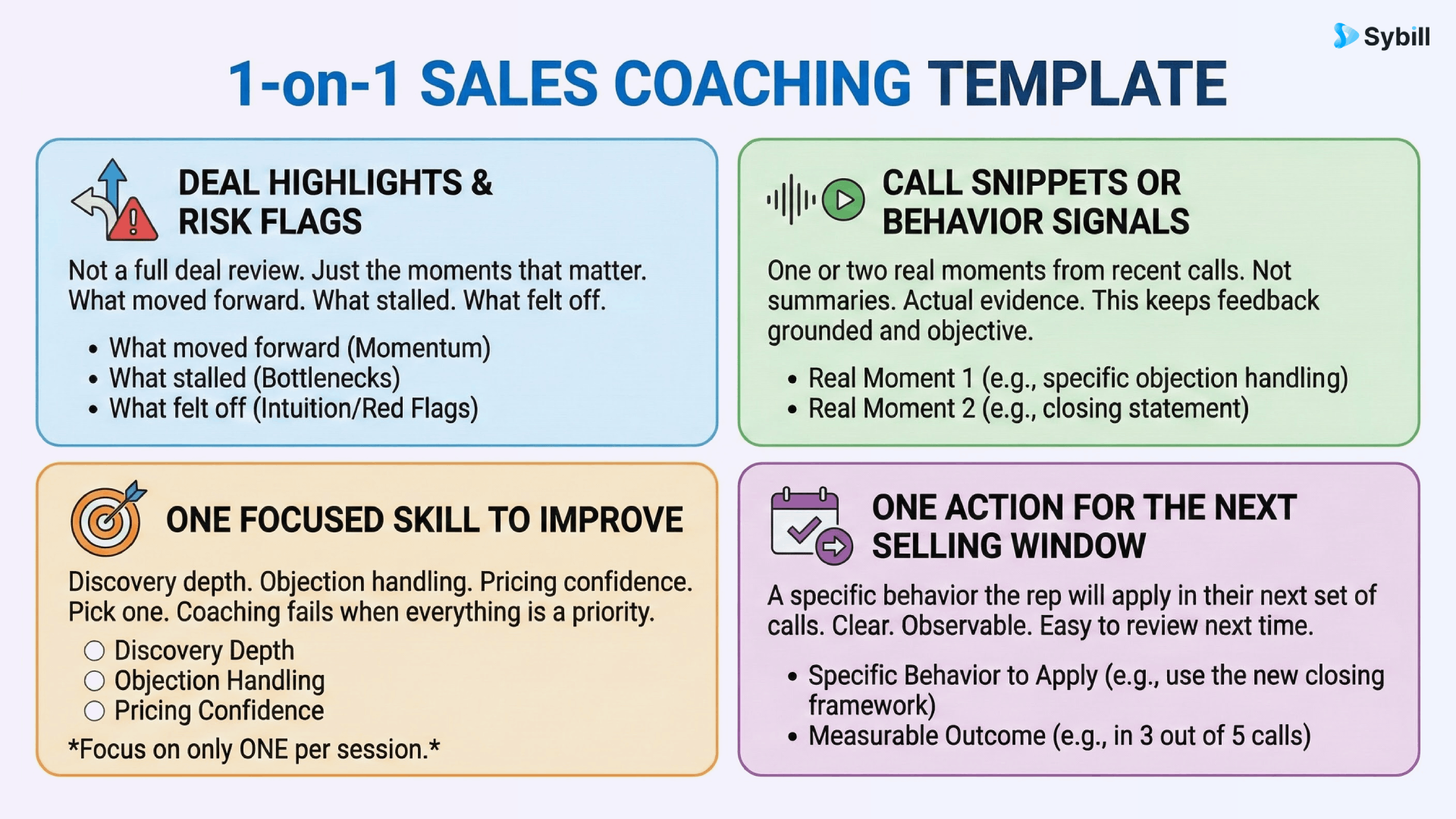
Deal highlights and risk flags
Not a full deal review. Just the moments that matter. What moved forward. What stalled. What felt off.
Call snippets or behavior signals to review
One or two real moments from recent calls. Not summaries. Actual evidence. This keeps feedback grounded and objective.
One focused skill to improve
Discovery depth. Objection handling. Pricing confidence. Pick one. Coaching fails when everything is a priority.
One action for the next selling window
A specific behavior the rep will apply in their next set of calls. Clear. Observable. Easy to review next time.
That is the entire template. Anything more is noise.
Generic 1 on 1s drift. This one does not.
This template:
Over time, reps stop dreading 1 on 1s. Managers stop overpreparing. Coaching becomes lighter and more consistent.
This is where the template really earns its keep.
AI enhances the 1 on 1 sales coaching template by:
Instead of scrambling to remember what happened, managers walk into 1 on 1s with clarity. Reps trust the feedback because it is grounded in reality, not recollection.
This template exists for one specific moment - when a deal looks healthy on paper but something feels off in the room.
Every sales team knows this feeling. The forecast says commit. The CRM says green. The rep sounds confident. And yet, nobody would bet their bonus on it.
That is exactly when deal-based coaching matters.
This sales coaching template is designed for:
This is not a weekly ritual. It is a precision tool for moments that can move revenue or quietly lose it.
Deal-based coaching works only when it strips away optimism and surfaces reality.
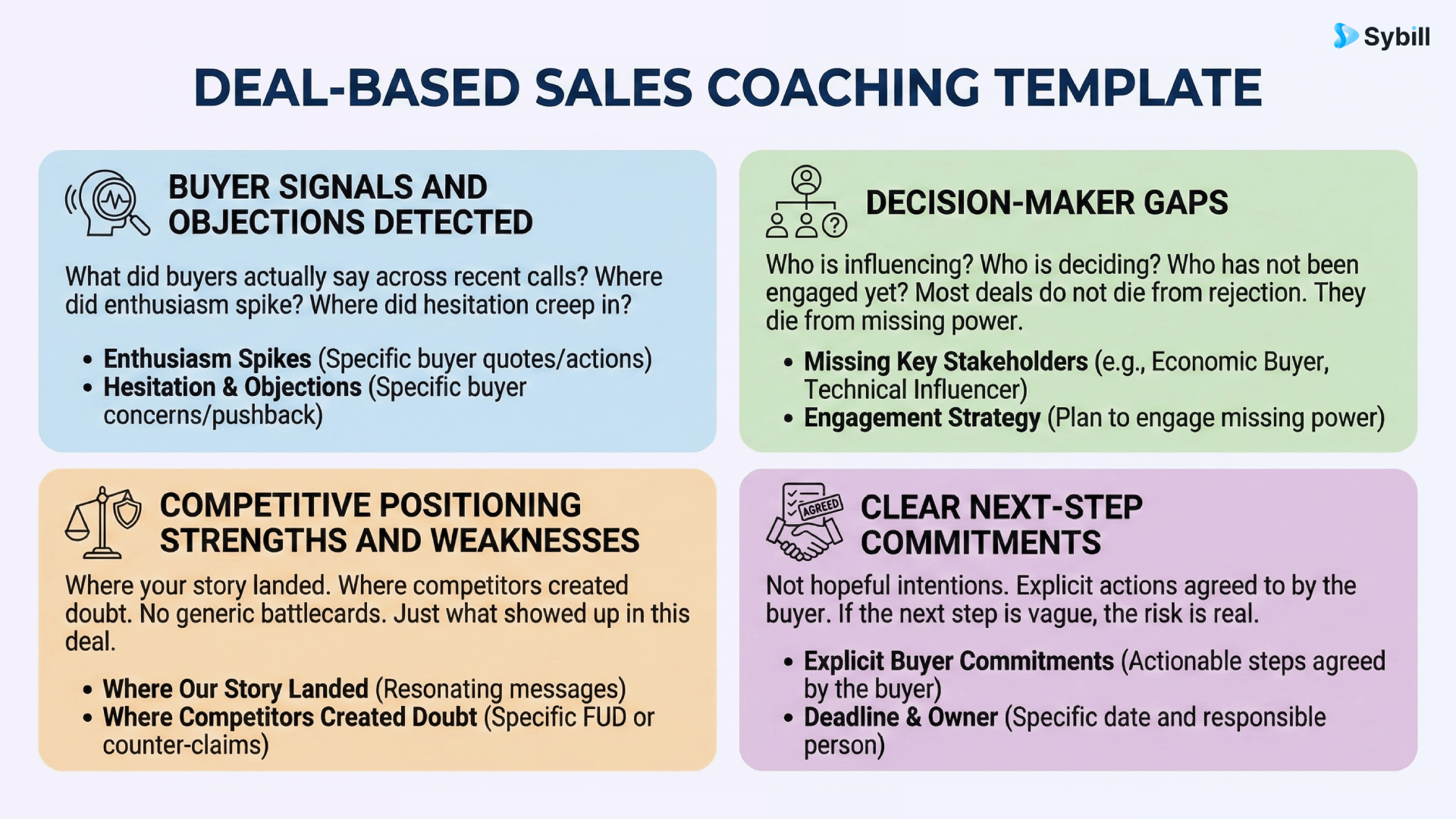
Buyer signals and objections detected
What did buyers actually say across recent calls? Where did enthusiasm spike? Where did hesitation creep in?
Decision-maker gaps
Who is influencing? Who is deciding? Who has not been engaged yet? Most deals do not die from rejection. They die from missing power.
Competitive positioning strengths and weaknesses
Where your story landed. Where competitors created doubt. No generic battlecards. Just what showed up in this deal.
Clear next-step commitments
Not hopeful intentions. Explicit actions agreed to by the buyer. If the next step is vague, the risk is real.
Most managers jump into deal coaching with advice. This template forces strategy instead.
It works because it:
Instead of rescuing deals at the eleventh hour, teams learn to course-correct while there is still time.
AI changes deal-based coaching from reactive to anticipatory.
With AI in play:
Managers stop asking “What happened?”
They start asking “What changed and what do we do next?”
Most sales coaching tools tell you what happened. Sybill helps you understand what to coach and how to coach it. That distinction matters.
Traditional coaching relies on managers spotting issues manually. Listening to calls. Reading notes. Remembering patterns. It does not scale and it burns people out. Sybill flips that model by grounding coaching in real sales conversations, automatically.
Instead of guessing where to coach, teams ask better questions and get clear answers.
With Sybill, coaching is no longer dependent on who has time or the best memory.
Sybill:
This creates a coaching environment where feedback is continuous, not episodic.
Ask Sybill is where templates come to life.
Instead of starting with static documents, teams start with questions. The same questions they ask in coaching sessions today.
For account executives, Ask Sybill can power self-coaching templates like:
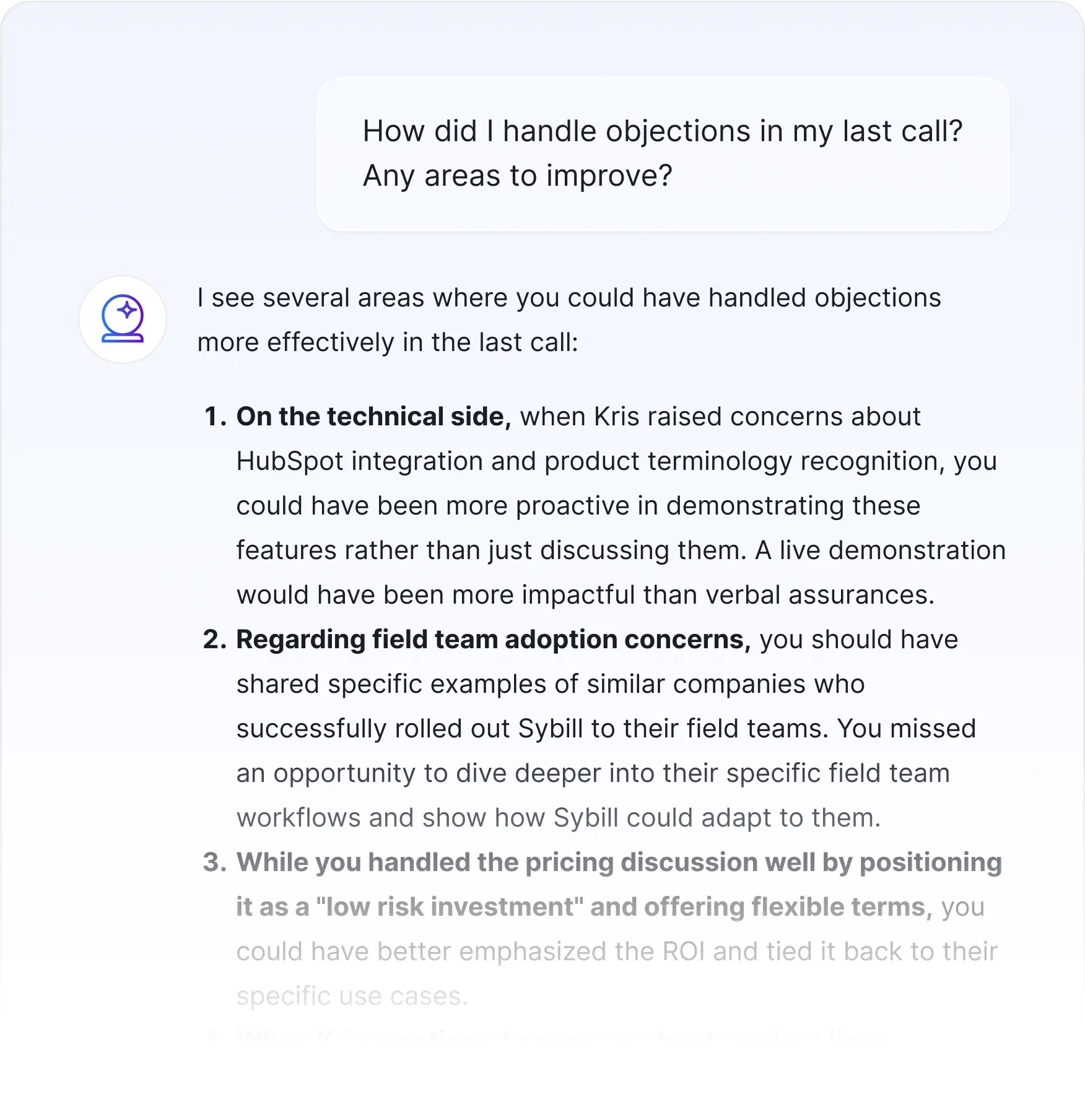
Each question becomes a repeatable coaching lens. Over time, these questions form personalized coaching templates that reps can run on demand.
For managers, Ask Sybill turns team-wide coaching into a system.
Common coaching prompts include:
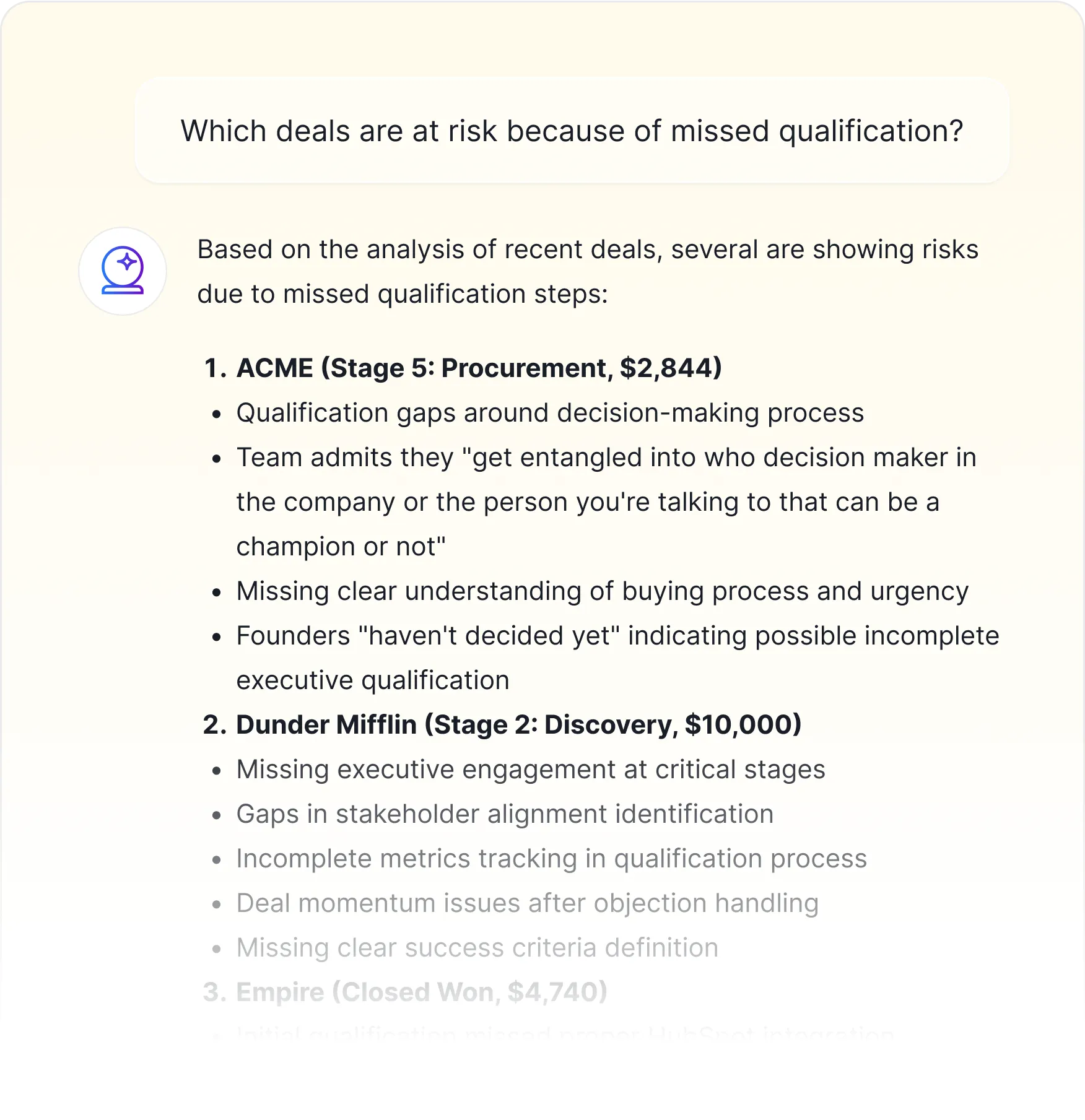
Instead of spreading attention evenly, leaders focus coaching where it actually moves outcomes.
Sybill does not stop at answers. Teams can:
This is how sales coaching templates evolve from static checklists into living systems.
Sybill helps teams:
Because in the AI universe, the best sales coaching templates are constantly tested, refined, and reused.
Most sales coaching fails for one simple reason - it tries to fix everything at once.
Reps hear feedback like “be more consultative” or “close stronger” and walk away unsure what to actually change. Skill-specific coaching fixes that by slowing things down and getting precise.
This sales coaching template is most effective for skills that show up clearly in conversations:
These are not theoretical skills. They are audible, observable, and coachable.
A skill-specific sales coaching template should feel almost clinical. Clear inputs. Clear outputs. No ambiguity.
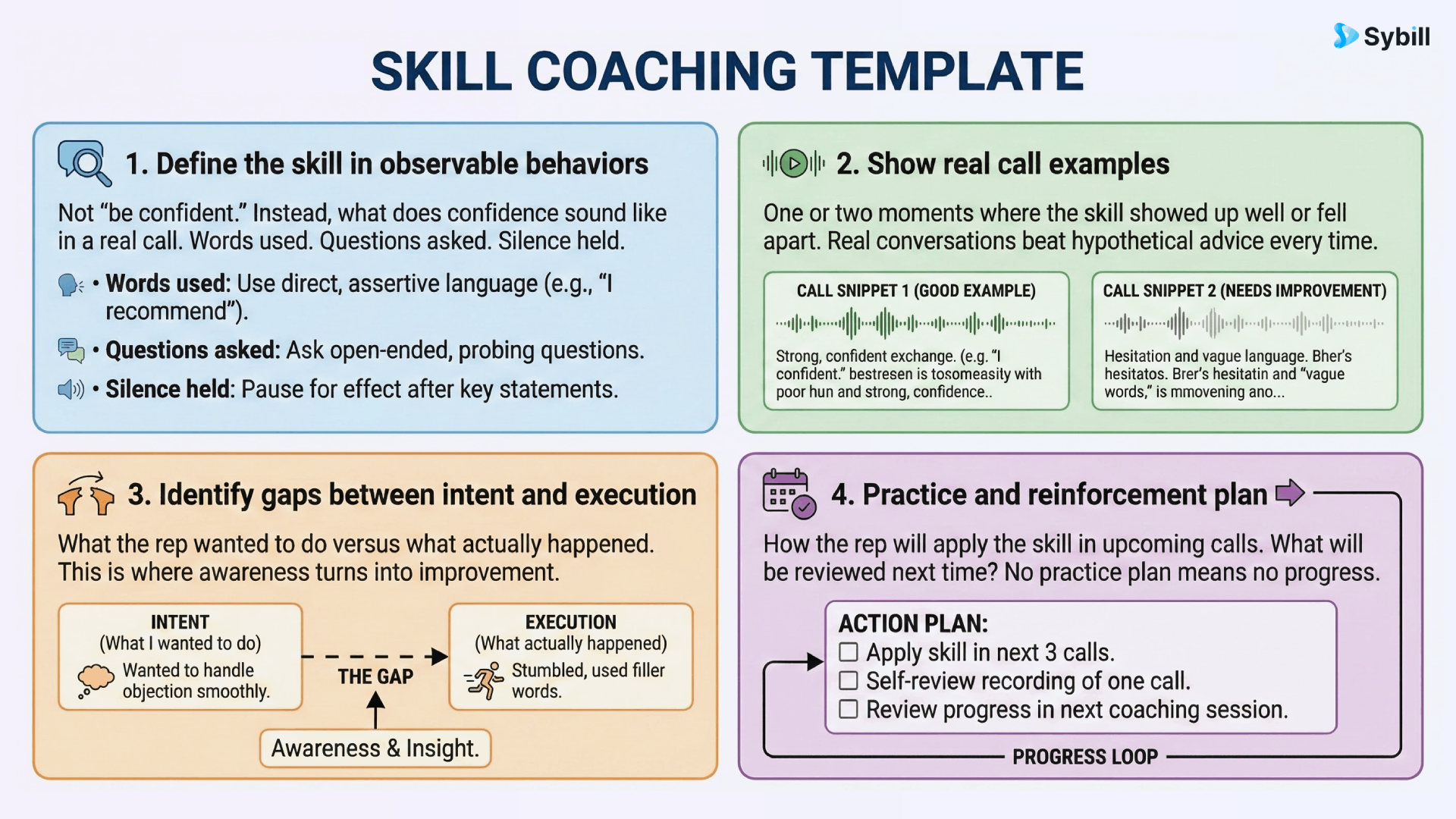
Define the skill in observable behaviors
Not “be confident.” Instead, what does confidence sound like in a real call. Words used. Questions asked. Silence held.
Show real call examples
One or two moments where the skill showed up well or fell apart. Real conversations beat hypothetical advice every time.
Identify gaps between intent and execution
What the rep wanted to do versus what actually happened. This is where awareness turns into improvement.
Practice and reinforcement plan
How the rep will apply the skill in upcoming calls. What will be reviewed next time? No practice plan means no progress.
This template works because it respects how people actually learn.
It:
Reps improve faster because they are not guessing. Managers coach better because the conversation stays grounded.
AI turns skill coaching from anecdotal to systematic.
With AI in place:
Over time, teams stop debating what “good” looks like. They can see it.
Remote sales teams exposed how fragile sales coaching already was.
When teams stopped sharing offices, they also lost hallway clarifications, informal context, and quick course corrections. What remained were meetings. And meetings alone are not enough.
Remote coaching fails when it relies on proximity that no longer exists.
Distributed teams face:
Without structure, remote, async coaching becomes inconsistent, reactive, and easy to deprioritize.
A remote sales coaching template must work before, during, and after the session.

Async call review before live coaching
Reps and managers review key moments ahead of time. The live conversation starts with shared context, not recaps.
Written feedback alongside discussion
Coaching does not disappear once the meeting ends. Written notes reinforce what matters and remove ambiguity.
Clear documentation of takeaways
What was learned? What will change? What will be reviewed next? If it is not documented, it will not stick.
Follow-up checkpoints
Coaching without follow-up is just conversation. This template builds accountability without micromanagement.
This structure solves the most common remote coaching failures.
It:
Managers spend less time repeating themselves. Reps gain clarity and confidence.
AI is what makes remote coaching sustainable at scale.
With AI in place:
Remote coaching stops feeling like a compromise. It becomes an advantage.
Ramp is where most sales teams quietly lose money. Because expectations are fuzzy, feedback is delayed, and underperformance is spotted too late.
This template is built to remove guesswork from growth.
This sales coaching template is designed for moments of transition:
It works equally well for first-time sellers and experienced reps stepping into unfamiliar territory.
This template brings structure to what is usually handled through hope and patience.

Skill expectations by stage
What good looks like at 30, 60, and 90 days. Not quotas. Behaviors. What a rep should consistently demonstrate at each stage.
Real call examples to emulate
Concrete examples of strong discovery, clean positioning, or effective objection handling. Learning accelerates when reps can hear success, not just read about it.
Early warning signs to watch
Signals that indicate a rep is drifting off track before numbers make it obvious. Missed questions. Weak next steps. Buyer disengagement.
Weekly coaching focus areas
One improvement area per week. Clear. Measurable. Reviewable. Ramp improves when focus stays narrow.
Fast growth magnifies small coaching gaps.
This template matters because it:
Teams stop waiting for quarterly reviews to address issues. Progress becomes visible week by week.
AI turns ramp from a waiting game into a guided process.
With AI supporting this template:
Instead of asking “Is this rep ramping well,” managers can answer it. Early. Confidently. And with data.
Sales coaching templates only fail when teams treat them like documents instead of systems. Implementation is where most SaaS companies slip. Not because the templates are wrong, but because the rollout is sloppy.
Here is how to do it properly.
The biggest mistake teams make is over-customizing too early.
Start by:
Standardization creates a shared coaching language. Optimization can come later. Without this step, every manager coaches differently and improvement stays uneven.
Coaching without evidence is just opinion.
Every session should be grounded in:
This step removes memory-based feedback and replaces it with reality. Reps trust coaching more when it reflects what actually happened, not what someone remembers.
Templates do not make someone a good coach.
Managers need to understand:
Investing in manager capability is what turns templates into leverage instead of compliance.
Random coaching produces random results.
Effective teams establish:
Cadence turns coaching from a reaction into a rhythm.
If coaching is working, something should move.
Look for:
If none of these change, the issue is not effort. It is the system.
Sales coaching templates work because they remove guesswork. Not just for reps, but for managers too. When expectations are clear and feedback is grounded, performance improves naturally.
Here is what actually changes.
Most reps do not underperform because they lack effort. They underperform because they are unsure what “good” looks like.
Sales coaching templates make success visible:
Clarity compounds faster than motivation.
Without templates, coaching quality depends heavily on the manager.
With templates:
Reps stop comparing managers. They start focusing on improvement.
Timely feedback beats perfect feedback.
Sales coaching templates:
Learning accelerates when feedback arrives while it still matters.
Great coaching should not require heroic effort.
Templates reduce:
Managers spend less time organizing thoughts and more time actually coaching.
The biggest impact is cultural.
When coaching is structured:
That is how high-performing sales cultures sustain themselves.
There is no universal sales coaching template that works for every startup. What works brilliantly at ten reps will collapse at fifty. What works in SMB will fall apart in enterprise.
That’s precisely why customization is not optional. Here’s how to go about it.
At this stage, speed and learning matter more than polish. Sales coaching templates should:
The goal is pattern discovery, not enforcement. Templates should help teams learn faster, not slow them down.
This is where coaching either scales or breaks. Templates need to:
Growth exposes inconsistency. Templates provide the structure that keeps performance from drifting.
Complex deals demand disciplined coaching.
Here, templates should:
Enterprise coaching fails when every manager invents their own system. Consistency becomes a competitive advantage.
Sales coaching templates should evolve as fast as your sales motion.
If your product, buyer, or deal complexity changes, your coaching system must change with it. Static templates in a dynamic sales environment are just another form of technical debt.
Most sales coaching tools tell you what happened. Sybill helps you understand what to coach and how to coach it. That distinction matters.
Traditional coaching relies on managers spotting issues manually. Listening to calls. Reading notes. Remembering patterns. It does not scale and it burns people out. Sybill flips that model by grounding coaching in real sales conversations, automatically.
Instead of guessing where to coach, teams ask better questions and get clear answers.
With Sybill, coaching is no longer dependent on who has time or the best memory.
Sybill:
This creates a coaching environment where feedback is continuous, not episodic.
Ask Sybill is where templates come to life.
Instead of starting with static documents, teams start with questions. The same questions they ask in coaching sessions today.
For account executives, Ask Sybill can power self-coaching templates like:
Each question becomes a repeatable coaching lens. Over time, these questions form personalized coaching templates that reps can run on demand.
For managers, Ask Sybill turns team-wide coaching into a system.
Common coaching prompts include:
Instead of spreading attention evenly, leaders focus coaching where it actually moves outcomes.
Sybill does not stop at answers. Teams can:
This is how sales coaching templates evolve from static checklists into living systems.
Sybill helps teams:
Because in the AI universe, the best sales coaching templates are constantly tested, refined, and reused.
Sales coaching in the AI world is no longer about charisma, instinct, or who happens to be the loudest voice in the room. It is about building systems that surface reality, focus attention, and drive consistent improvement.
Sales coaching templates do exactly that. They turn vague feedback into observable behaviors. They replace memory with evidence. They help reps improve while deals are still alive, not after they are lost. Most importantly, they scale coaching quality as teams grow, roles evolve, and sales motions become more complex.
AI sharpens sales coaching. It removes guesswork and gives managers and reps a shared source of truth to work from.
If your coaching still relies on vibes, anecdotes, or post-mortems, it is time to upgrade the system behind it.
Coach smarter. Ramp faster. Sell better.
Yes. Sales coaching templates are especially valuable for small teams because they replace ad-hoc feedback with structure. Founders and first-time managers can use a consistent sales coaching template to coach effectively without relying on instinct. This ensures every rep receives clear, repeatable guidance from day one.
Free sales coaching templates are useful for basic structure and early-stage teams. Paid solutions are worth it when sales coaching templates integrate with call recordings, CRM data, and AI insights. That integration turns templates into living coaching systems rather than static documents.
The best 1 on 1 sales coaching template focuses on observable behaviors, real deal evidence, and one improvement goal per session. Strong sales coaching templates keep 1 on 1s centered on skill development, not pipeline updates, making coaching more actionable and consistent.








