Find us at booth #83, join us for a harbor side happy hour, or catch Gorish’s talk.

Sept, 16-18 > Learn more


Tamanna Mishra

February 5, 2026
TL;DR
Your dashboard looks great. Green arrows everywhere. Activity up and to the right. And yet, revenue slips past targets like it never got the memo. Forecast calls feel awkward. Deals you were sure about suddenly stall. Nobody can explain why.
This is what sales KPIs in the age of AI look like for a lot of teams. You are tracking motion, not momentum. It is like driving a 90s car with a speedometer that works perfectly while the engine is overheating. You know how fast you are going. You have no idea whether you are about to break down.
Most sales teams are still measuring effort, not progress.
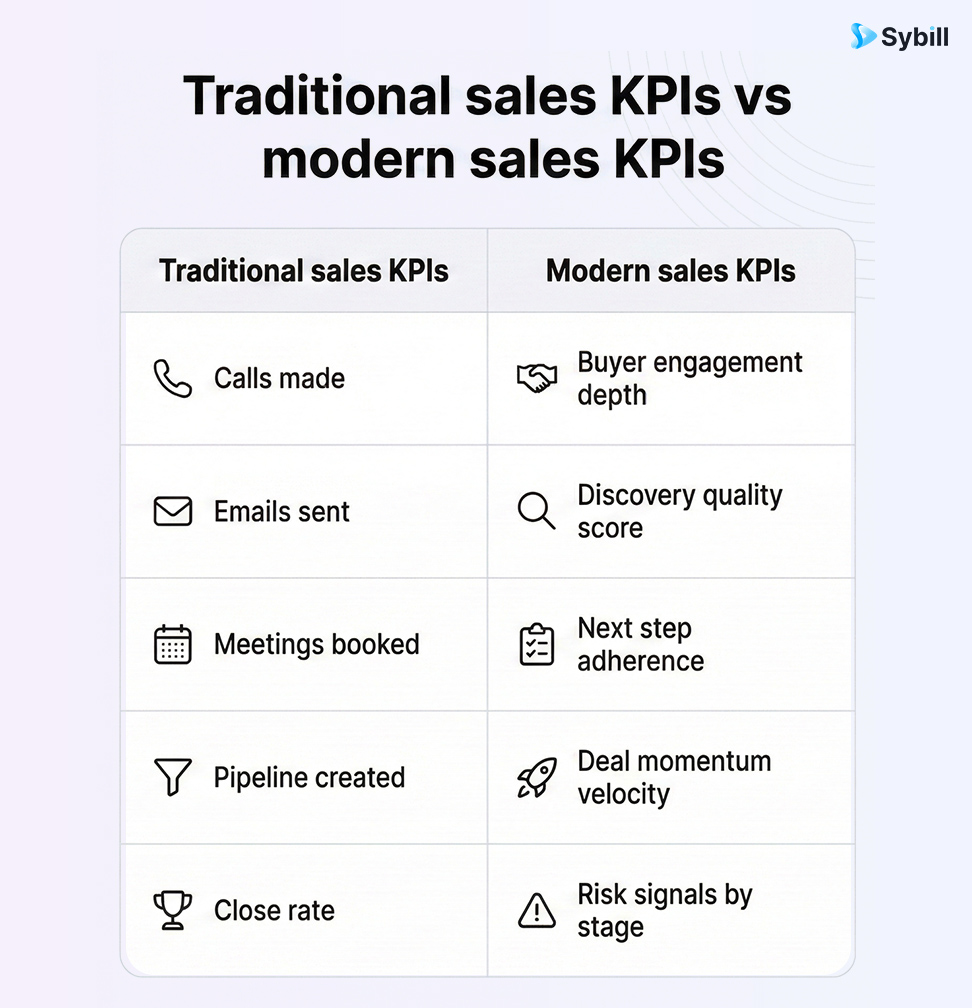
Calls made.
Emails sent.
Meetings booked.
Those numbers feel productive, but they do not explain buyer intent, deal risk, or decision readiness. Meanwhile, AI has completely reshaped how buyers research, evaluate, and decide. Sales KPIs, on the other hand, are stuck in the spreadsheet era.
The gap is not theoretical. Multiple RevOps studies show that 60 to 70 percent of CRM data is outdated or inaccurate, and fewer than 30 percent of sales leaders trust their pipeline forecasts. When your inputs are unreliable, your KPIs become comforting fiction.
This blog will call that out. We break down why traditional sales KPIs are actively misleading, what modern sales KPIs look like in an AI-driven world, and what high-performing B2B teams track instead to actually understand deal health, not just activity.
That is the textbook definition. And it is not wrong. It is just incomplete.
In practice, most sales teams treat sales KPIs as end-of-quarter scorecards. Numbers to report. Numbers to defend. Numbers to explain after deals are already won or lost.
In the AI age, sales key performance indicators need to do more.
A modern sales KPI is a signal, not a target.
It explains why deals move forward, stall, or die long before revenue is booked.
Here is how the definition has evolved.
Traditional view of sales key performance indicators
AI-informed view of sales KPIs
This shift matters because revenue does not fail suddenly. It degrades gradually through weak discovery, unclear next steps, and disengaged buyers. KPIs that only measure the final result miss every warning sign along the way.
Good sales KPIs improve execution by removing ambiguity at every stage of the funnel.
Prospecting
Discovery
Pipeline management
Closing
The biggest impact shows up in forecasting.
Teams that track discovery quality and buyer engagement signals consistently forecast more accurately than teams tracking call volume and meeting counts.
That is the difference between sales KPIs that document effort and sales KPIs that guide action.
This difference exists because AI changed what is observable.
Manual KPIs were limited to what reps logged.
AI-driven KPIs capture what buyers actually say, ask, hesitate on, and avoid across thousands of conversations.
That scale unlocks pattern recognition humans cannot replicate. It also exposes a hard truth.
None of that improves deal health. It just improves optics.
AI tools like Sybill sit underneath this shift as insight infrastructure. Sybill captures real buyer behavior from calls and emails, identifies engagement patterns, surfaces deal risk, and highlights intent automatically. Not to track more KPIs, but to make the right ones visible without relying on manual reporting.
Not all KPIs deserve a seat on your dashboard. These are the B2B sales KPIs that consistently predict deal outcomes and can actually be acted on.
This KPI answers a simple question.
Is the buyer leaning in or checking out?
What it measures
Why it matters
How Sybill helps
Discovery is not about time spent. It is about clarity achieved.
What it measures
Why it matters
How Sybill helps
This KPI measures commitment, not politeness.
What it measures
Why it matters
How Sybill helps
A healthy pipeline is about early warning systems.
What it measures
Why it matters
How Sybill helps
Great sales outcomes are patterned, not accidental.
What it measures
Why it matters
How Sybill helps
Sales measurement used to be a reporting exercise. Pull numbers. Build dashboards. Explain variance.
In the AI era, it has become a decision system.
What changes with AI-driven sales KPIs
This is a structural advantage, not just another tooling upgrade.
Why this matters for sales leadership
Managers can use Ask Sybill to query deal health, uncover risk patterns, and spot coaching gaps instantly across real conversations. Not to add more metrics, but to make modern sales KPIs actionable at the moment decisions are made.
.png)
.png)
This is not a rip-and-replace exercise. It is a sequencing problem.
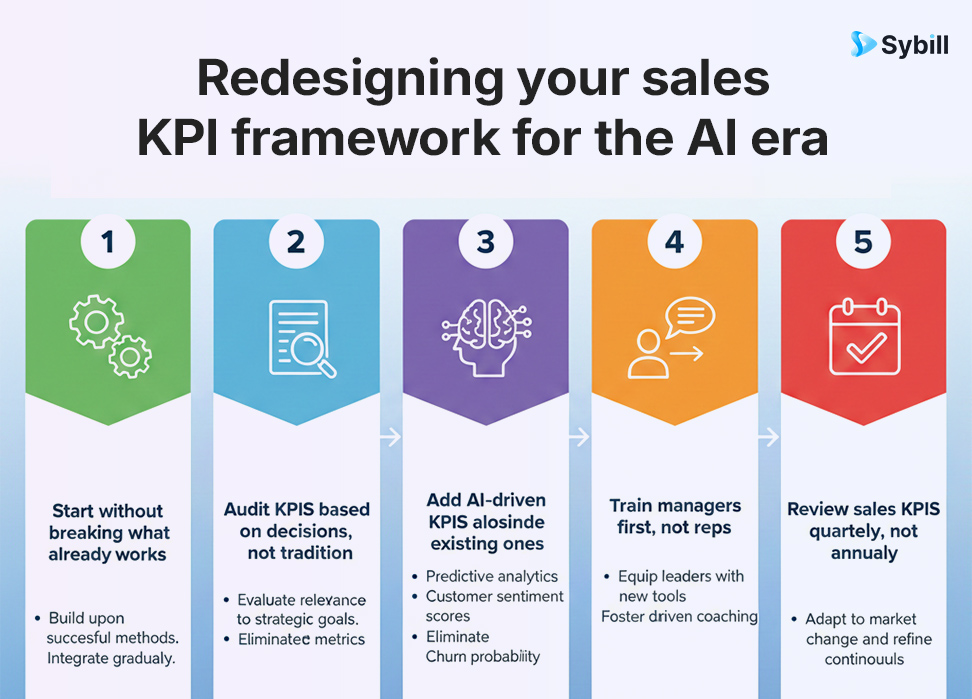
Don’t plan a full overhaul without a plan.
The goal is confidence, not chaos.
Ask one question of every metric.
What decision does this KPI enable?
This step alone usually eliminates half the dashboard.
Modern sales KPIs should complement, not compete.
Compare outcomes. Let evidence do the convincing.
Managers translate KPIs into behavior.
Reps follow what managers reinforce.
The sales environment changes faster than your planning cycle.
Quarterly KPI reviews keep measurement aligned with reality, not last year’s assumptions.
Done right, this framework replaces noise with signal and turns sales KPIs into a system that helps teams win, not just report.
The future of sales measurement is not another dashboard.
It is not more reports.
It is not more metrics to explain on a Monday forecast call.
It is fewer KPIs, better signals, and smarter execution.
Sales KPIs in the age of AI are not designed to police reps or micromanage activity. They exist to help teams understand buyers. What they care about. Where they hesitate. Why deals stall. And when momentum is real versus assumed.
When KPIs are built on real buyer behavior, teams stop guessing.
Managers coach earlier. Forecasts stabilize. Deals move with intent instead of hope.
That is the shift modern sales teams are making. Away from measuring effort. Toward measuring progress.
Measuring AI success in sales is less about model accuracy and more about business impact. The strongest KPI examples focus on outcomes. Reduction in manual CRM updates and admin work Improvement in forecast accuracy over multiple quarters Increase in win rates without a corresponding increase in activity Faster ramp time for new reps reaching productivity Measurable coaching impact on deal outcomes and consistency If AI is working, it should remove friction, surface insight earlier, and improve decision quality without adding effort.
The 30 percent rule reflects a hard reality. Only about 30 percent of AI initiatives deliver measurable business value. The reason is rarely the model. The real failure points are poor data foundations and unclear success metrics. When teams deploy AI without defining what success looks like, adoption becomes superficial and ROI remains unproven. Sales teams that establish clear sales KPIs before rolling out AI consistently see higher returns because measurement is aligned to execution from day one.
The five sales key performance indicators that matter most in modern B2B sales are: Buyer engagement quality Discovery effectiveness Deal momentum velocity Next step adherence Win rate by deal complexity Together, these KPIs explain not just how many deals close, but why they close and which behaviors make the difference.