Find us at booth #83, join us for a harbor side happy hour, or catch Gorish’s talk.

Sept, 16-18 > Learn more

%20(1).avif)
Mamta Tainwala

August 2, 2026
%20(61).png)
The sales manager role is really three jobs, and the multiple skills that matter map onto them: developing people (evidence-based coaching, honest feedback, motivation that fits each rep), managing the pipeline (deal inspection, forecast discipline, prioritization), and running the system (hiring and onboarding, communication up and down, delegation). The classic trap is that none of these is the skill that got you promoted, which was selling.
That last sentence is the honest starting point for everything below, so let us start there.
Because sales management is a different profession wearing the same badge. Companies overwhelmingly promote their best sellers into management, but the job stops rewarding personal deal heroics and starts rewarding multiplication: your number is now the sum of eight other people's numbers, and the instincts that made you a great closer (take over the deal, trust your gut, control the conversation) actively sabotage the new job.
Every experienced sales leader has watched the movie: the team's top rep gets the manager title, keeps selling through their reps' deals, coaches by grabbing the wheel ("just let me talk to them"), and burns out somewhere in quarter three, confused about why the team is not simply doing what worked for them. The rep was promoted for a skill set the new job barely uses.
The nine skills below are the actual job description. They divide into three areas because the job genuinely is three jobs, and the managers who struggle are usually excellent at one area while unaware the other two exist. For the broader role playbook (rhythms, rituals, first 90 days), our guide to being the best sales manager is the companion piece; this post stays on the skills themselves.
Coaching is the highest-leverage activity in the role, and most of what passes for it is not coaching: it is deal takeover or pep talk. Real coaching is specific, behavioral, and grounded in what actually happened: this call, this moment, this pattern across your last ten discovery conversations. That standard used to be impossible at scale, because a manager could shadow maybe three calls a week; with every call recorded and analyzed, coaching from recordings makes the evidence the starting point instead of the manager's memory. The craft is the same as ever (diagnose the one behavior, practice it, inspect for the change), but the diagnosis now runs on tape, not vibes, and coaching and performance analytics show you which rep needs which conversation this week. The full system is in our AI coaching playbook.
Adjacent to coaching but its own skill: the ability to say the true thing kindly and specifically, on time. Feedback fails in two directions: the manager who avoids hard conversations until the PIP, and the one who delivers drive-by criticism with no path forward. The working format is boringly reliable: the specific observed behavior, its concrete impact, the requested change, and a follow-up date. What managers underestimate is timing: feedback within 48 hours of the behavior changes behavior; feedback at the QBR changes nothing except trust.
Team-wide pep talks are theater; motivation is retail, not wholesale. One rep runs on public recognition, another on autonomy, a third on a path to their next role, a fourth on money and nothing but. The skill is knowing which is which (asking works remarkably well) and shaping assignments, recognition, and incentives accordingly. This is also where empathy earns its place on the list as a working tool rather than a poster: the manager who knows a rep is grinding through a rough personal quarter manages that rep differently, and keeps them.
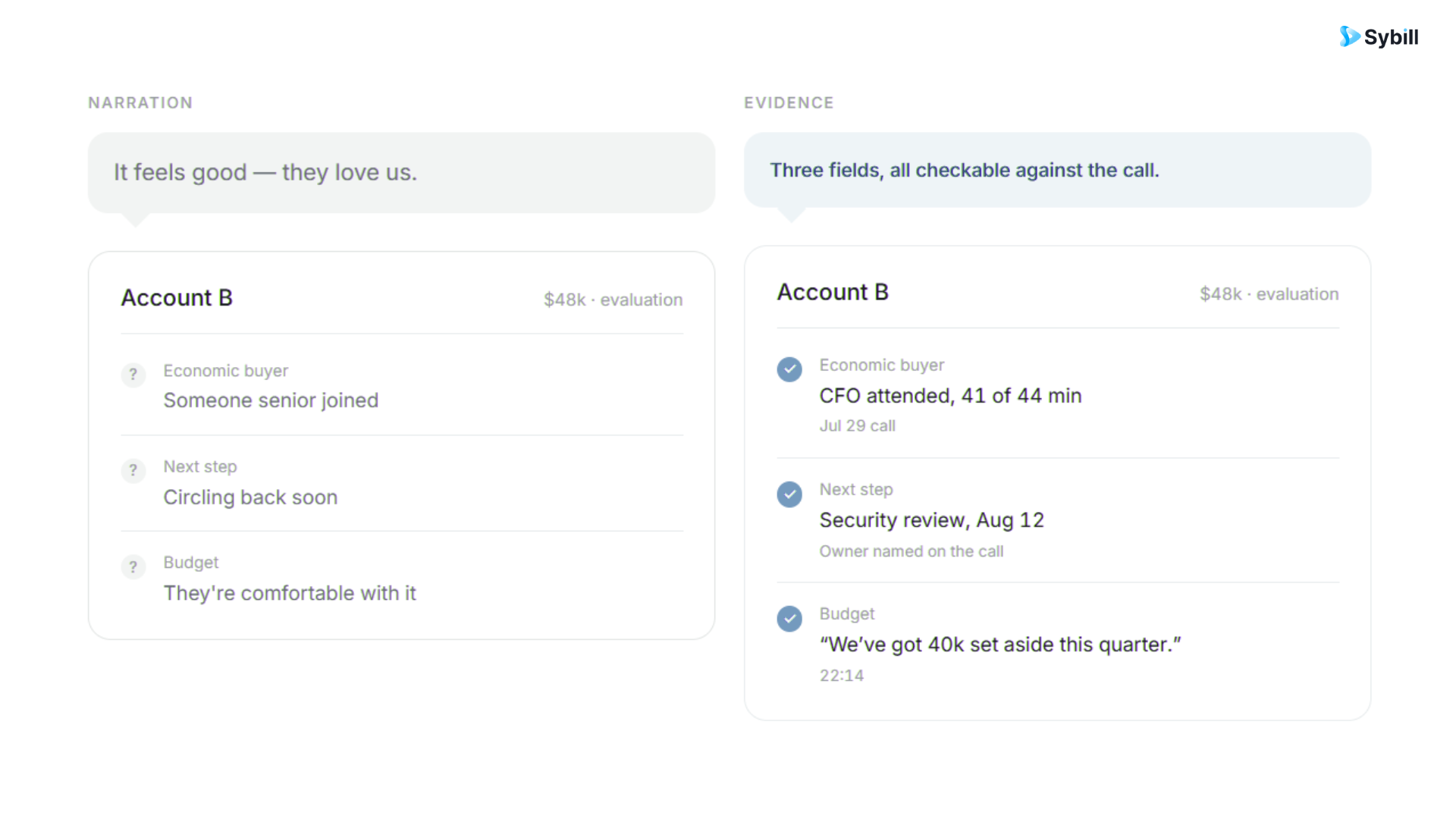
The Monday pipeline meeting is where manager skill is most visible. Weak inspection accepts narration ("it feels good, they love us"); strong inspection asks evidence questions: has the economic buyer attended anything, is there a confirmed next step with a date, what did the buyer actually say about budget. The skill is knowing which questions expose which risks, and modern deal inspection puts the conversation record on screen so the questions get answered by facts instead of optimism. We wrote the manager-specific playbook in deal inspection for sales managers, and the deal-level coaching version in deal coaching for closers. Sybill has analyzed around 33 million sales conversations, and the consistent finding is that the deals that close leave evidence trails early: engaged buyers, confirmed steps, named events. Managers who inspect for those trails forecast reality; managers who inspect narration forecast hope.
The forecast is the manager's signature on a check leadership will cash. The skill has two halves: building the number honestly (deal-by-deal, evidence-weighted, sandbagging and heroics both stripped out) and communicating it with its assumptions attached, so a miss is a learning event instead of a credibility event. The mechanics of a good forecast call are learnable, and the weekly hygiene that feeds it lives in pipeline management. What separates the pros: they treat forecast accuracy as a skill they are personally developing, tracked quarter over quarter, not a weather condition that happens to them.
A manager's scarcest resource is attention, and the pipeline always demands more than exists. The skill is triage: which three deals need executive air cover, which rep needs the coaching hour, which fire is actually a fire. Weak managers spread evenly and help nothing decisively; strong ones concentrate force where it changes outcomes and consciously let the rest run. The tell of good prioritization is what the manager ignores on purpose.
Managers multiply when they see everything and type nothing. Sybill gives you every call, every deal's evidence, and every coaching moment, without a single rep-nagging Slack message. Get started for free with Sybill.
Nothing a manager does compounds like who they hire and how fast those hires ramp. The hiring half is a skill of structured evaluation: scorecards over gut feel, work samples over charm, references actually called. The onboarding half is a design problem: a call library of your best conversations, staged certifications, and a ramp plan measured in weeks-to-first-deal, which is exactly the system in our sales training guide, automated where possible per the onboarding automation playbook. The managers who treat every departure and every ramp as a process to improve, rather than an event to survive, build teams that outlast them.
The manager sits at the choke point of three information flows: leadership's expectations flowing down, the team's reality flowing up, and cross-functional needs flowing sideways. The skill is translation without distortion: turning "the board wants 30% growth" into achievable team commitments, and turning "the team says the leads are junk" into data leadership will act on. Managing expectations upward is its own discipline, and the managers who master it protect their teams from whiplash while keeping leadership's trust. The failure mode in both directions is the same: passing messages through unprocessed, which makes the manager a router instead of a leader.
The instinct that closed deals ("I will just do it myself, faster") is the instinct that caps teams. Delegation is a trainable skill with known mechanics: match the task to the person's development edge, define the outcome not the method, agree on check-in points, and then actually let go. Our delegation strategy guide covers the full method. The deeper reframe: every task a manager hoards is a development opportunity confiscated from a rep, so chronic non-delegation is not diligence, it is a team-growth ceiling with good intentions.
The skill list did not change; the leverage did. AI removed the drudgery that used to consume the role (chasing CRM updates, reconstructing what happened on calls, assembling pipeline reports), which means the differentiating skills shifted decisively toward judgment: what to coach, which deals to press, whom to hire, what to ignore. The managers pulling ahead treat AI as their inspection and memory layer, and spend the recovered hours on the human work.
Concretely, the trade looks like this. The hours that went to "did you update the CRM?" now go to coaching, because the CRM updates itself and every deal's story is queryable through Ask Sybill instead of buried in a rep's memory. The pipeline meeting starts from a live board instead of a Sunday-night spreadsheet. The great call from Tuesday becomes a shared clip the whole team learns from by Thursday. And the win-loss patterns that used to take a quarterly project surface continuously.
What AI does not do is any of the nine skills. It will not deliver the hard feedback, make the triage call, or know that your best rep needs a different kind of quarter. It hands the manager complete visibility and returned hours, and then the skills decide what those are worth. A mediocre manager with perfect visibility is a mediocre manager with better dashboards.
Strip the listicle away and the whole job reduces to one question: is the team measurably better because you manage it? Not "did the number land" (a good market can carry a bad manager for years) but the harder evidence: are reps improving on tape quarter over quarter, does the forecast hold, do people you hired become people others want to hire away, does the team run when you take a vacation.
The nine skills are how you pass that test. Three of them develop the people, three of them manage the revenue, three of them run the machine, and none of them is selling, which is exactly why the promotion is a career change and deserves to be treated like one.
The visibility layer, the memory, the returned hours: that part is Sybill's job. The multiplication is yours.
Get started for free with Sybill or book a demo and manage from evidence, not archaeology.
Nine skills across three areas: coaching, feedback, and individualized motivation (developing people); deal inspection, forecast discipline, and prioritization (managing the pipeline); hiring and onboarding, multi-directional communication, and delegation (running the system). Coaching is widely considered the highest-leverage of these, because it compounds across every rep.
Sales managers run teams directly: coaching reps, inspecting deals, owning a team forecast. Sales leaders (directors, VPs, CROs) run the system of teams: strategy, territory design, hiring managers, and the company number. The skill sets overlap, but leadership adds organizational design and subtracts most deal-level involvement.
Treat it as a profession change, not a promotion. The selling instincts that earned the role (taking over deals, trusting gut feel) actively harm management, so the transition is deliberately building the multiplication skills: coaching instead of closing, delegating instead of doing, and measuring yourself on team improvement rather than personal heroics.
They need credibility and pattern recognition from having sold, but continued personal selling excellence matters far less than multiplication skills. The best-rep-equals-best-manager assumption fails constantly, because the manager's output is the team's performance, and coaching, inspection, and hiring drive that more than the manager's own closing ability.
AI absorbed the role's drudgery: CRM chasing, call reconstruction, report assembly, and continuous deal monitoring. That shifts the differentiating skills toward judgment: what to coach, which deals to press, whom to hire. Managers now operate with complete conversation visibility, and the value of that visibility depends entirely on their coaching and inspection skills.
Nine skills across three areas: coaching, feedback, and individualized motivation (developing people); deal inspection, forecast discipline, and prioritization (managing the pipeline); hiring and onboarding, multi-directional communication, and delegation (running the system). Coaching is widely considered the highest-leverage of these, because it compounds across every rep.
Sales managers run teams directly: coaching reps, inspecting deals, owning a team forecast. Sales leaders (directors, VPs, CROs) run the system of teams: strategy, territory design, hiring managers, and the company number. The skill sets overlap, but leadership adds organizational design and subtracts most deal-level involvement.
Treat it as a profession change, not a promotion. The selling instincts that earned the role (taking over deals, trusting gut feel) actively harm management, so the transition is deliberately building the multiplication skills: coaching instead of closing, delegating instead of doing, and measuring yourself on team improvement rather than personal heroics.