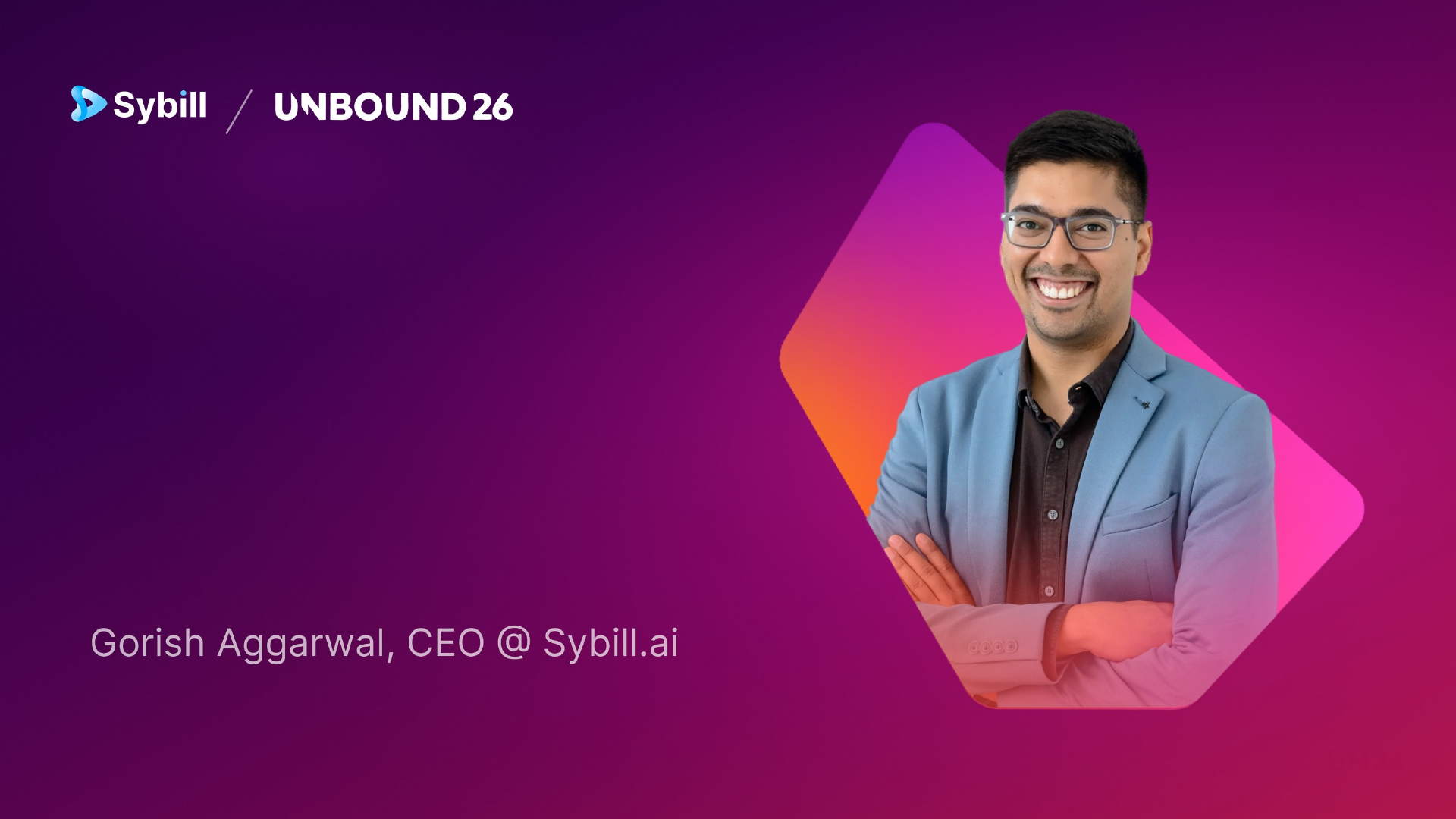
Find us at booth #83, join us for a harbor side happy hour, or catch Gorish’s talk.

Sept, 16-18 > Learn more


Mamta Tainwala

March 14, 2026
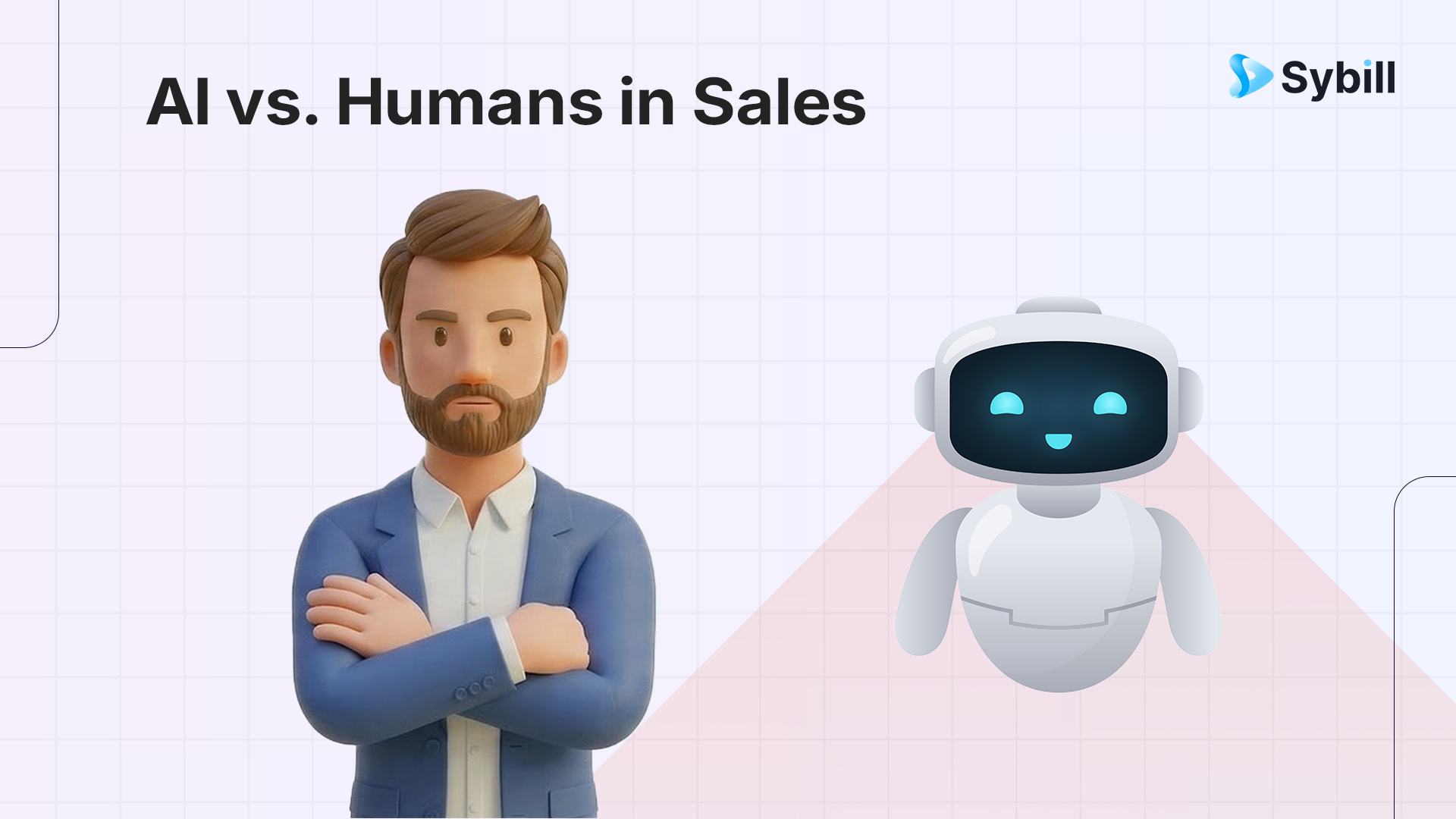
Let's get the obvious out of the way: AI is not coming for your sales job. But also: your team probably shouldn't be working the way it did in 2019.
The conversation around AI vs. humans in sales doesn't need to be a grudge match. It's a talent evaluation. Where does AI outperform people? Where do people outperform AI? And what does a revenue team actually look like when both are firing on all cylinders?
If you're a sales leader, an AE, or someone who just wants to close more deals without losing their mind, you're in the right place.
Before comparing the two, it's worth getting clear on what "AI in sales" actually covers. It's not one thing. It's a collection of capabilities that have gotten remarkably good, remarkably fast.
AI in sales includes:
These are not hypothetical features. They're what tools like Sybill deliver for revenue teams today. The question isn't whether AI can do these things. It absolutely can. The real question is: where does it do them better than a human, and where does a human still win?
There's a pattern in every honest conversation about AI in sales. The things AI does best are the things human reps like least. That's not a coincidence.
Ask any rep what the most soul-crushing part of their job is, and most will point straight at the CRM. Logging every call, updating every field, keeping MEDDPICC scores current, it's the administrative tax on every deal.
AI does this without complaining, and without errors. CRM automation tools powered by AI pull data directly from call transcripts and fill fields with precision. No rounding up win probabilities. No copy-pasting notes into the wrong opportunity. Just clean, accurate data, every time.
The window between ending a call and sending a follow-up matters more than most reps realize. Most also jump straight into the next meeting and write the follow-up three hours later when context has gone fuzzy.
AI doesn't have that problem. AI-generated follow-up emails drafted from actual call data reference the specific pain points raised, the objections discussed, and the exact next steps agreed upon. Sybill users send follow-ups 80% faster post-call, and the quality is consistently better than what a fatigued rep produces in a hurry. That's not a shot at reps. It's just what happens when you're four calls deep by Thursday afternoon.
This is where AI genuinely does something humans cannot: it processes thousands of calls, identifies what separates closed-won from closed-lost, and surfaces those patterns in real time. Machine learning for sales can tell you that your top performers talk 35% of the time while average reps talk 65%. It can surface that deals where ROI is discussed on the first call close 40% faster.
A sales manager reviewing ten calls a week cannot compete with that depth of analysis. AI running over thousands of conversations can.
When you're looking at 50 open opportunities, gut feel is not a strategy. AI sales intelligence tools use engagement signals, call sentiment, email behavior, and CRM activity to rank deals by health, flag which ones are quietly dying, and predict slippage before it shows up in your numbers.
Writing tailored outreach for 20 prospects is manageable. At 200, it's not. Generative AI for personalization in sales pulls in context from call data, CRM notes, and email history to generate messages that feel custom rather than templated. Every prospect gets a version that reflects their actual situation.
For everything AI accelerates, there are parts of the sales process where a human being is simply irreplaceable.
A deal doesn't close because your follow-up email had the perfect subject line. It closes because a prospect decided they trusted you enough to bet part of their budget on your solution. The champion who went to bat for you internally, the call you took at 8 PM when a deal was unraveling, the moment you remembered a detail the buyer mentioned offhandedly three weeks ago. These are the things that turn a prospect into a long-term customer.
AI can support a relationship. It cannot replace one.
Objection handling in enterprise sales is part logic, part intuition, and part reading the room. When a CFO says "this is too expensive," they might mean any of five different things. A skilled rep listens to the tone, picks up on what's unsaid, and responds with the right angle.
AI can flag that a pricing objection came up. AI can pull up how your best reps handled similar objections in past deals. But in the moment, in a live negotiation, the human on the call is the one making the judgment call. That skill is built through experience, and the best sales techniques are still fundamentally human ones.
Most B2B deals don't fail because of product fit. They stall because of invisible stakeholders, competing internal priorities, or a champion who lost their budget mid-cycle. Navigating these situations takes creativity, adaptability, and emotional intelligence. No algorithm can read a room the way a rep who's been through twenty deals like this one can.
Data closes deals in spreadsheets. Stories close deals in the room. The rep who can tie a product's capabilities directly to a prospect's specific situation, told as a narrative with a real before-and-after, holds attention in a way that no AI-generated script fully captures.
Emotional resonance is a human specialty. Full stop.
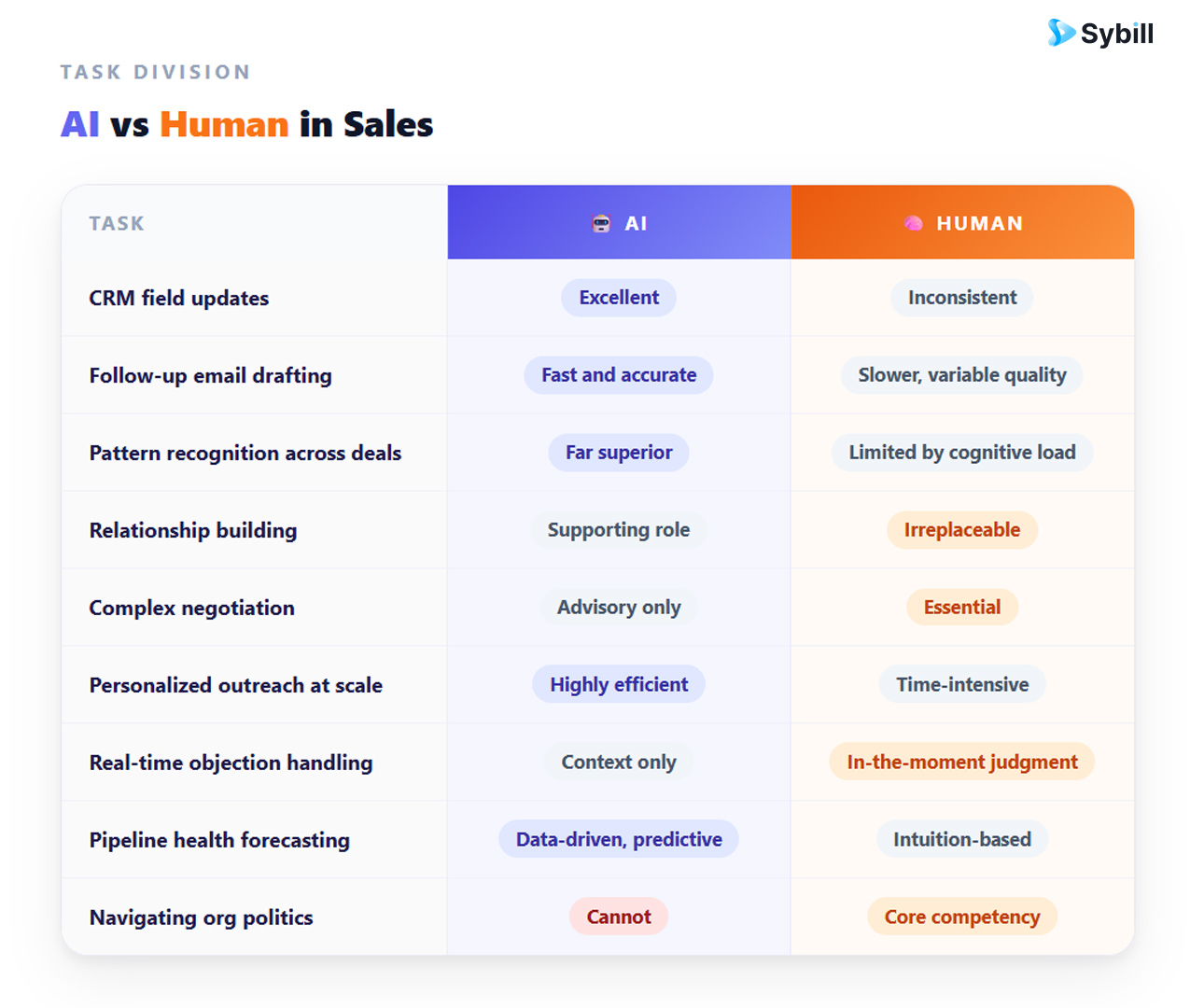
The pattern is clear. AI wins on consistency, scale, and data. Humans win on judgment, creativity, and connection.
Here's the framing that actually helps sales teams win: AI handles the 70% of the job that doesn't require human judgment, so humans can focus on the 30% that does.
That's not a compromise. That's a structural upgrade. Reps stop drowning in admin and start showing up to every conversation prepared, with context they couldn't have gathered manually, and enough mental bandwidth to actually sell.
This is what's often described as the shift from AI to Intelligence Amplification. The idea isn't that AI replaces human capability. It's that AI multiplies it. A rep with the right AI tools doesn't just close the same deals faster. They close more deals because they're running a better process at every stage.
Get started for free with Sybill and see what your team looks like when AI handles the admin and your reps focus on closing.
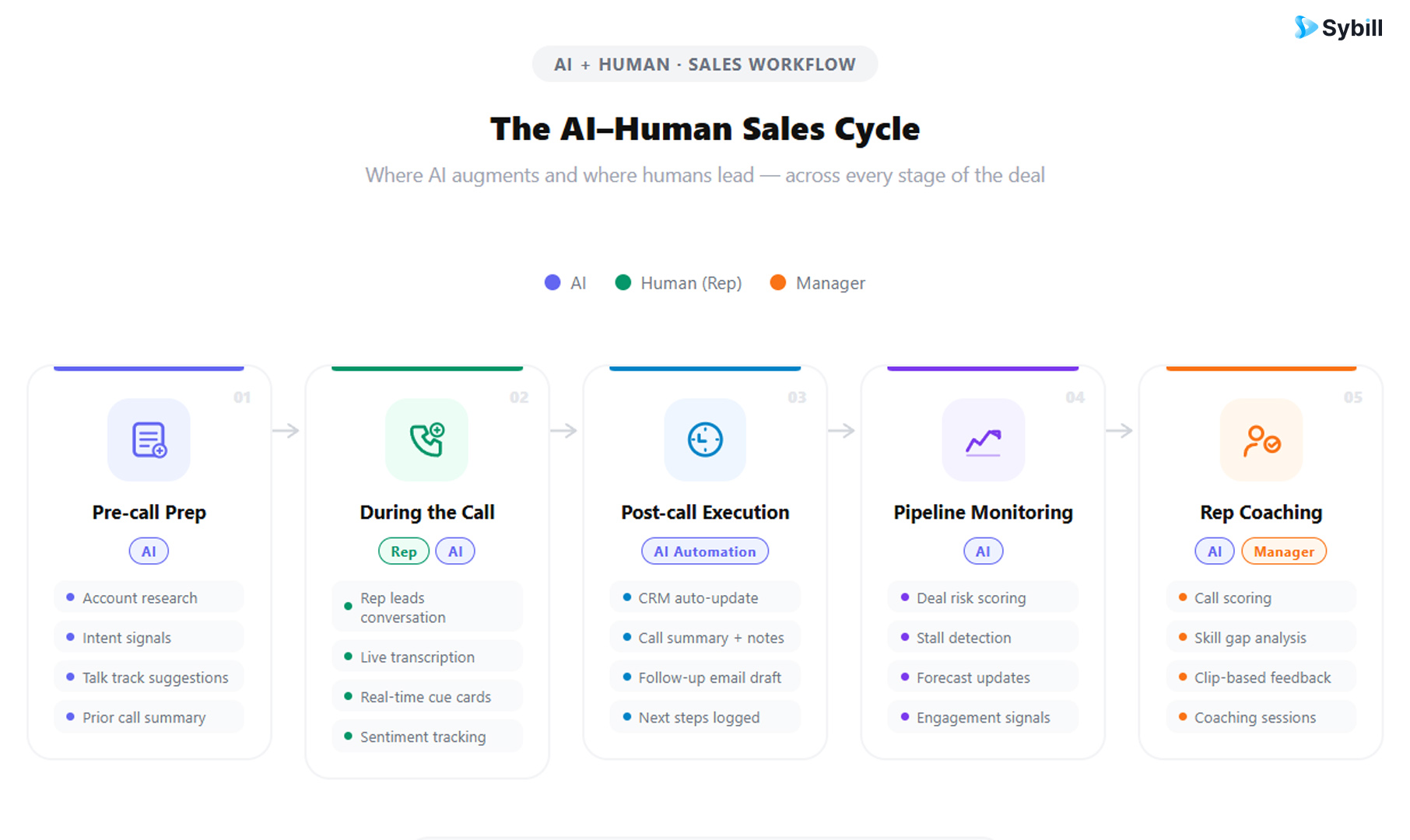
Knowing the theory is one thing. Building the workflow is another. Here's where revenue teams consistently see the biggest returns.
Before the call: AI preps the rep. It pulls deal history, recent emails, CRM activity, and relevant context into a pre-call brief. The rep walks in knowing exactly what's been discussed, what's unresolved, and what the buyer cares about most. No last-minute scrambling through notes.
During the call: The rep is fully present. AI records and analyzes in the background, tracking topics, flagging sentiment shifts, and capturing action items. No divided attention between listening and note-taking. Just selling.
After the call: This is where sales email automation earns its keep. The follow-up email is drafted automatically, CRM fields are filled, next steps are logged, and a summary lands in the rep's inbox before they've closed their laptop. Five to ten minutes of admin, automated, per call.
Across the pipeline: AI agents for sales managers monitor deal health at scale. Instead of a manager manually reviewing every opportunity, AI surfaces what needs attention: the stalling deal, the rep struggling with a recurring objection, the champion who's gone quiet.
For coaching: AI in sales coaching speeds up the feedback loop dramatically. Reps don't wait for a monthly one-on-one to learn what they're doing wrong. Pattern-based insights surface after every call, automatically.
One thing worth noting: AI doesn't operate in isolation. The teams getting the most out of this model have invested in the right infrastructure. That means a CRM that stays current, an AI-automated sales funnel that doesn't leak revenue at every stage, and conversation intelligence software that surfaces insights at the right moment rather than burying them in recordings nobody revisits.
Tools that record calls and stop there are table stakes at this point. The actual value is in what happens after: the summary that writes itself, the CRM that updates on its own, the AI-enhanced cold and follow-up emails that reflect the actual conversation rather than a generic template. Sales enablement software built around this principle doesn't just save time. It fundamentally changes what a rep is capable of in a given week.
That's where the AI vs. humans debate becomes irrelevant. Because the best teams stopped choosing and started combining.
Not anytime soon. AI is extraordinary at tasks that are repetitive, data-heavy, or pattern-based. Sales, at its core, is about human judgment, relationship-building, and trust. AI can make reps faster and better informed. It cannot build a relationship on a human's behalf. The better question is whether your reps have the AI tools they need to compete with teams that already do.
AI performs best in tasks that require scale, consistency, and data processing: CRM updates, follow-up email drafts, pipeline forecasting, lead scoring, and conversation analysis. Anything that requires a human to do the same thing many times, AI handles it faster, more accurately, and without fatigue.
AI improves sales performance by eliminating the admin burden that slows reps down, surfacing insights about what winning deals look like, automating personalized outreach, and keeping the CRM clean without manual effort. Sales teams using AI consistently report more time actually selling, better follow-up rates, and improved win rates.
AI can support negotiations by providing context, surfacing past objections, and suggesting relevant proof points. But the negotiation itself, particularly in complex B2B deals, requires human judgment, real-time improvisation, and emotional intelligence. AI advises. The rep decides.
The best AI tools for sales integrate deeply into a rep's existing workflow without adding overhead. Sybill is built specifically for revenue teams: it records and analyzes calls, auto-drafts follow-up emails, fills CRM fields, surfaces deal risks, and lets reps ask ChatGPT-style questions about their entire pipeline. It's designed to handle the work between calls so reps can focus on what they were hired to do.
AI isn't the competitor your reps need to worry about. It's the co-pilot they've been waiting for. Get started for free with Sybill and let AI handle the admin while your team handles the deals.
Not anytime soon. AI is extraordinary at tasks that are repetitive, data-heavy, or pattern-based. Sales, at its core, is about human judgment, relationship-building, and trust. AI can make reps faster and better informed. It cannot build a relationship on a human's behalf. The better question is whether your reps have the AI tools they need to compete with teams that already do.
AI performs best in tasks that require scale, consistency, and data processing: CRM updates, follow-up email drafts, pipeline forecasting, lead scoring, and conversation analysis. Anything that requires a human to do the same thing many times, AI handles it faster, more accurately, and without fatigue.
AI improves sales performance by eliminating the admin burden that slows reps down, surfacing insights about what winning deals look like, automating personalized outreach, and keeping the CRM clean without manual effort. Sales teams using AI consistently report more time actually selling, better follow-up rates, and improved win rates.