Find us at booth #83, join us for a harbor side happy hour, or catch Gorish’s talk.

Sept, 16-18 > Learn more

%20(1).avif)
Mamta Tainwala

August 31, 2026
%20(82).png)
TL;DR: "Balance acquisition and retention" is the business advice equivalent of "eat well and exercise." True, and useless. Your allocation between the two should be decided by three numbers: CAC payback period, net revenue retention, and where in the customer lifecycle your churn actually happens. And here is the part most retention playbooks miss: a large share of churn is baked in before the customer ever onboards, through wrong-fit deals, overpromises, and handoffs that lose everything the buyer said during the sale. Fix the sale and you fix half of retention for free.
Neither is universally more important. The right split depends on your stage and your unit economics.
Early-stage companies searching for product-market fit need acquisition volume, because without customers there is nothing to retain and no signal to learn from. Growth and scale-stage companies with a real customer base usually get more profit per dollar from retention and expansion, because keeping and growing existing revenue is structurally cheaper than winning new logos.
The direction of the math is not controversial. Research by Frederick Reichheld of Bain & Company, cited by Harvard Business Review, found that increasing customer retention rates by 5% increases profits by 25% to 95%. The same HBR analysis puts the cost of acquiring a new customer at 5 to 25 times the cost of retaining an existing one, depending on industry.
But guess what? Knowing retention is cheaper does not tell you what to do with your next dollar. For that, you need your own numbers, not Bain's.
Stop debating philosophy in your planning meetings and pull up three metrics instead.
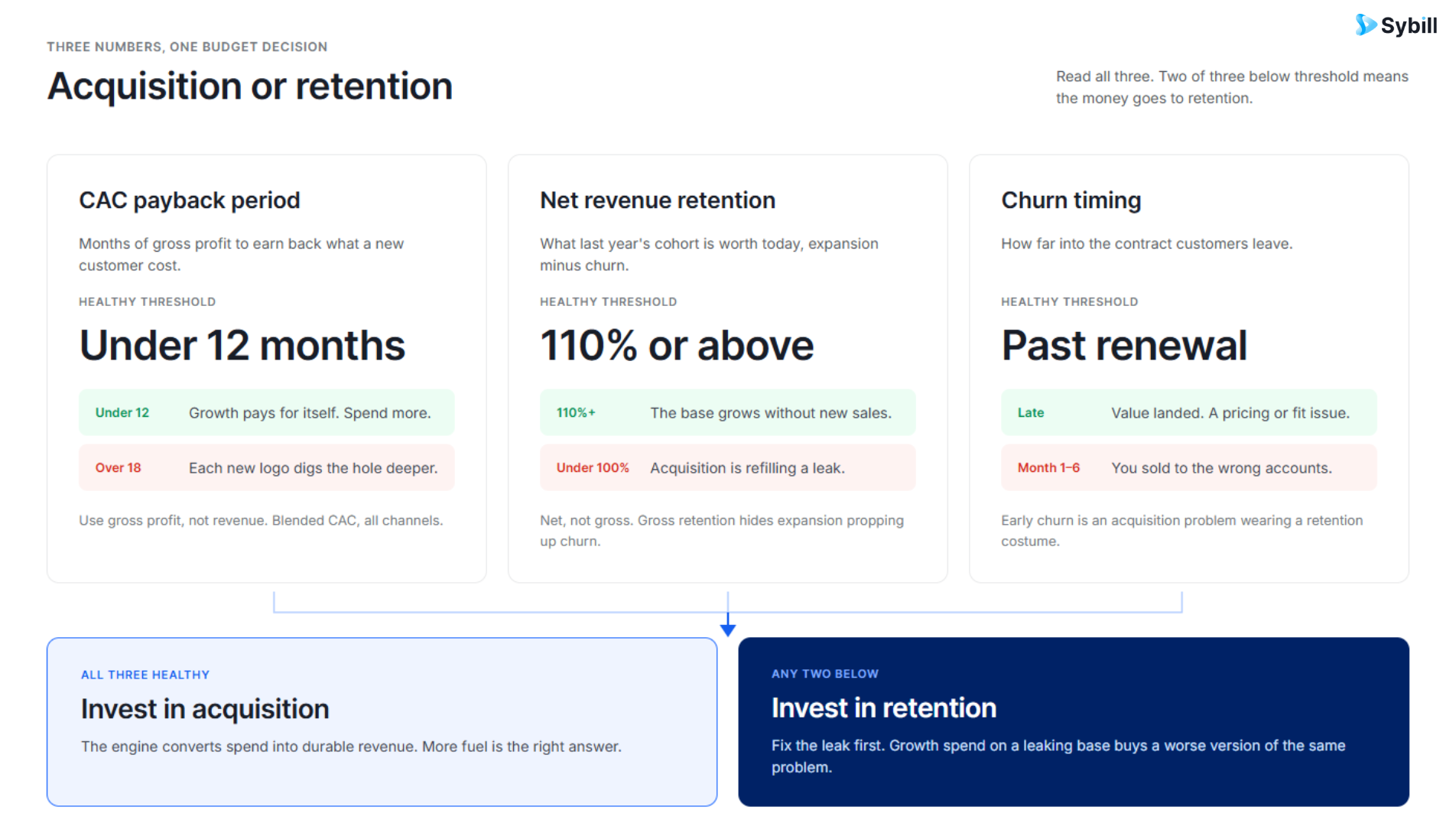
If your customer acquisition cost pays back in under 12 months, your acquisition engine is efficient and probably deserves more fuel. If payback stretches past 18 to 24 months, every new customer is a loan you are hoping they stay long enough to repay. Pouring more budget into acquisition at that point is scaling a leak.
NRR above roughly 110% means your existing customers are expanding faster than they churn. Your base compounds on its own, and acquisition dollars land on top of a rising floor. NRR below 100% means you are refilling a draining bathtub, and acquisition spend is partially going toward standing still.
The blunt rule: earn the right to spend on acquisition by getting NRR over 100% first.
This is the number almost nobody segments, and it changes everything about where "retention budget" should go:
If most of your churn happens early, hiring more CSMs to run better QBRs is treating a symptom two quarters after the disease.
Here is the argument this article exists to make: retention is not a post-sale department. A meaningful share of it is decided before the contract is signed.
Think about what actually causes early churn. The customer bought for an outcome the product does not deliver. The rep promised a capability that was "on the roadmap." The buyer told the AE their success criteria in the second discovery call, and by the time CS ran the kickoff, that context was gone, so onboarding optimized for the wrong thing.
None of those are CS failures. They are conversation failures. The buyer said what they needed. The information existed. It just lived in a call recording nobody transferred, and the CRM captured "Discovery complete" instead.
That gap has a name at Sybill: CRM records seller activity, but conversations reveal buyer reality. Your CRM says the deal closed at $60K with a March start date. The conversations say the buyer's CFO is skeptical, success means cutting reporting time in half by Q3, and the champion is worried about adoption on the support team. Guess which version determines whether they renew.
So before you approve another retention line item, audit three things in your sales motion:
None of this means acquisition is the enemy. It means acquisition spend should be efficient and fit-focused. The channels that keep earning their keep in SaaS:
Product-led trials and freemium, where the product can demonstrate value fast without a human walkthrough. The trial is also your cheapest fit filter: prospects who never activate were probably churn risks wearing a prospect costume.
Content that answers real buyer questions, which now matters double because buyers ask AI assistants, not just Google. Generic thought leadership is dead weight; specific answers to specific questions get found and cited.
Referrals from existing customers, the channel where acquisition and retention stop being rivals. Referred customers arrive pre-trusted, close faster, and churn less, and they only exist because you retained someone well. We have covered how to build that motion properly in our guide to referral selling.
Partnerships and integrations that put you inside the workflow your buyers already live in.
Whatever the channel, hold it to the same bar: does it bring customers who fit, at a CAC that pays back inside your target window? A channel that delivers cheap logos who churn in six months is not an acquisition channel. It is a churn subscription.
Once the sale is clean, the post-sale playbook is refreshingly short:
Onboard to the buyer's stated outcome, not your feature list. The customer defined success during the sales process. Onboarding should be a straight line to that definition, with time-to-first-value measured in days.
Prove value before the renewal conversation, not during it. If the first time a customer sees their ROI is in a renewal deck, you are negotiating, not renewing.
Watch conversations for churn signals, not just usage dashboards. Login data tells you something is wrong after engagement drops. Conversations tell you before: a champion mentioning reorgs, budget language getting cautious, a new stakeholder asking pointed questions about alternatives. Sybill flags these signals across customer calls because it is listening to every conversation, not sampling the ones a manager had time to review.
Expand from evidence. The best expansion pitch quotes the customer's own words back to them: the pain they mentioned in month four, the team they said was struggling. Deal history is an expansion weapon if anyone can actually retrieve it.
Sybill is not an acquisition platform and it will not run your ad campaigns. It is the post-conversation intelligence and execution layer, and this specific problem, the leak between what buyers say and what your systems remember, is the problem it exists to close.
Across the funnel, that looks like:
The acquisition-versus-retention debate assumes the two are separate budgets fighting over the same dollar. They stop fighting when the intelligence from your sales conversations flows into your retention motion, because at that point every well-run deal is also a retention investment.
What is a good ratio of acquisition to retention spend in SaaS?
There is no universal ratio, and anyone selling you one is skipping the diagnosis. Derive yours from the three metrics above: CAC payback, NRR, and churn timing. As a rough directional pattern, early-stage companies skew heavily toward acquisition, while scale-stage companies with NRR problems should shift spend toward retention until NRR clears 100%.
Is customer retention really cheaper than acquisition?
Across published research, yes. Harvard Business Review puts new-customer acquisition at 5 to 25 times the cost of retention, and Bain & Company's work ties a 5% retention improvement to 25% to 95% profit gains. The caveat: "cheaper" does not mean every retention dollar is well spent. Retention spend aimed at the wrong lifecycle stage, like QBR programs for customers who churn in onboarding, wastes money just as efficiently as bad ads.
How do I know if churn is a sales problem or a customer success problem?
Segment churn by lifecycle stage and by deal characteristics. If churned accounts cluster in the first 90 days, in specific segments, or around unmet expectations set during the sale, the root cause sits in qualification and promise-setting, not post-sale execution. Reviewing what was actually said in the sales conversations of churned accounts settles the question with evidence instead of interdepartmental finger-pointing.
What is a good CAC payback period for SaaS?
Under 12 months is strong and signals an acquisition engine worth scaling. Twelve to 18 months is workable for companies with high net revenue retention, since expansion revenue shortens the effective payback. Past 18 to 24 months, every new customer is a bet on longevity, and acquisition spend deserves scrutiny before it deserves more budget.
What is a good net revenue retention rate for SaaS?
NRR above 100% means your existing base grows even with zero new logos; above roughly 110% is the benchmark for strong SaaS companies, and top performers run higher. Below 100%, churn and contraction are outpacing expansion, and acquisition dollars are partially spent standing still.
Should early-stage SaaS startups focus on acquisition or retention?
Acquisition first, but with fit discipline. Pre-product-market fit, you need enough customers to generate learning and revenue, so acquisition dominates. The retention work at that stage is not a CS team; it is refusing to close wrong-fit deals whose churn will later masquerade as a product problem.
There is no universal ratio, and anyone selling you one is skipping the diagnosis. Derive yours from the three metrics above: CAC payback, NRR, and churn timing. As a rough directional pattern, early-stage companies skew heavily toward acquisition, while scale-stage companies with NRR problems should shift spend toward retention until NRR clears 100%.
Across published research, yes. Harvard Business Review puts new-customer acquisition at 5 to 25 times the cost of retention, and Bain & Company's work ties a 5% retention improvement to 25% to 95% profit gains. The caveat: "cheaper" does not mean every retention dollar is well spent. Retention spend aimed at the wrong lifecycle stage, like QBR programs for customers who churn in onboarding, wastes money just as efficiently as bad ads.
Segment churn by lifecycle stage and by deal characteristics. If churned accounts cluster in the first 90 days, in specific segments, or around unmet expectations set during the sale, the root cause sits in qualification and promise-setting, not post-sale execution. Reviewing what was actually said in the sales conversations of churned accounts settles the question with evidence instead of interdepartmental finger-pointing.