Find us at booth #83, join us for a harbor side happy hour, or catch Gorish’s talk.

Sept, 16-18 > Learn more


Tamanna Mishra

August 28, 2026
%20(75).png)
NEAT selling is a non-linear sales qualification and discovery methodology built around four areas: Need, Economic Impact, Access to Authority and Timeline. It helps sellers determine whether a buyer has a consequential problem, whether solving it creates enough value, whether the right stakeholders can be reached, and whether a buyer-owned event makes action necessary. NEAT works best in consultative B2B sales where the business case must be developed, not merely matched to an existing budget. Its value comes from verified buyer evidence, not completed CRM fields.
A CRM record says the buyer’s need is “better efficiency.” Economic impact is marked “high.” The decision-maker is apparently “the VP.” The timeline says “Q4.”
Everything is filled in. Almost nothing is qualified.
Better efficiency could mean anything. “High” is an adjective, not an economic impact. A job title does not prove that someone owns the decision. And Q4 is a quarter, not a reason to act.
This is where sales qualification frameworks go wrong. Reps learn the acronym, add four fields to the CRM, ask one question per field, and call the deal qualified. The framework becomes administrative theatre.
NEAT selling is more useful when it is treated as a way to test four propositions:
Until there is evidence for those propositions, the deal contains hypotheses, not facts.
N.E.A.T. Selling™ is a sales qualification and discovery methodology created by Richard Harris, founder of The Harris Consulting Group. NEAT stands for Need, Economic Impact, Access to Authority and Timeline.
According to the official N.E.A.T. Selling methodology, the framework is designed to follow the natural movement of a sales conversation. Sellers do not have to ask every Need question before moving to Economic Impact, then Authority and finally Timeline.
That flexibility matters. Real buyers do not explain their organizations in framework order.
A buyer may mention an implementation deadline before describing the underlying problem. A conversation about cost may reveal a stakeholder the seller has not met. An executive may challenge the economic case and force the team to revisit the Need.
NEAT gives the seller direction without turning the conversation into a script.
It also shifts qualification away from an early fixation on budget. In many B2B purchases, particularly when the solution is new or replaces an informal process, there may be no neat budget line waiting to be discovered. The business must first understand the problem and construct a credible case for change.
NEAT asks what the problem is worth solving before asking how much the buyer can spend.
Each NEAT element tests a different source of deal strength.
A buyer’s first request is rarely the complete Need.
“We need better call notes” is a request. The underlying need could be more reliable CRM data, faster follow-ups, stronger coaching or better visibility into deals. Those problems have different users, consequences and solutions.
NEAT asks sellers to move beyond the stated requirement and understand what is happening underneath it.
A credible Need normally includes:
The aim is not to make the problem sound larger than it is. Sometimes deeper discovery reveals that the problem is small, isolated or already being addressed. That is useful qualification too.
Economic Impact translates the Need into a consequence the business can evaluate.
That impact may involve:
Not every impact must be expressed as revenue. A company may prioritize reduced risk, faster execution or stronger customer retention. But “this is frustrating” is not yet a business case.
The seller should help the buyer examine the impact without supplying convenient numbers that the buyer has never validated.
Access to Authority does not mean asking, “Are you the decision-maker?”
Modern B2B purchases are rarely controlled by one person. One stakeholder may own the business outcome, another the budget, another technical approval, and another the procurement process.
A champion who likes the product but cannot involve those people provides enthusiasm, not access.
Access can be direct or facilitated. What matters is whether the seller has a credible way to validate the problem, value and solution with the people whose agreement the purchase requires.
A timeline is credible when it belongs to the buyer.
The seller’s quarter-end target does not create urgency. Neither does repeatedly asking whether the buyer can sign by Friday.
A meaningful timeline usually contains:
A product launch, contract renewal, regulatory deadline, annual planning cycle or executive commitment may create a genuine timeline. “We would like to do this sometime in Q4” usually does not.
The best NEAT selling questions do not sound like questions copied from a qualification worksheet. They follow what the buyer has already said and help both sides understand the situation more clearly.
Richard Harris also connects NEAT with the idea of earning the right to ask questions. His book, The Seller’s Journey, describes a Respect Contract that establishes the purpose of the conversation and gives both sides permission to decide that there is no fit.
That matters because even a thoughtful question feels intrusive when it arrives without context.
Start with the buyer’s current reality:
Listen for the difference between a request, a symptom and a root need.
If an answer remains vague, ask for a recent example:
Specific events usually produce better evidence than general opinions.
Once the Need is clear enough, explore what it costs or prevents.
Ask:
A simple current-state calculation can help:
Annual current-state impact = frequency × affected volume × cost per occurrence
For a time-based problem, that might become:
People affected × hours lost per week × working weeks × hourly cost
Suppose 25 sales reps each spend three hours a week reconstructing notes, updating the CRM and preparing follow-ups. Using 48 working weeks and a buyer-provided loaded hourly cost of $60:
25 × 3 × 48 × $60 = $216,000 per year
That does not automatically mean a solution will save $216,000. Some administrative work will remain, adoption may vary, and recovered time does not instantly become revenue.
The calculation gives the buyer a starting point. The inputs and assumptions must be validated before the number becomes part of the business case.
Economic Impact should help a buyer make a decision, not frighten them with creative arithmetic.
Once the impact is clearer, ask who owns it.
Avoid belittling the person already speaking with you. “I need to talk to the real decision-maker” is an excellent way to lose a potential champion.
Instead, connect broader access to the buyer’s own objective:
“You mentioned that RevOps owns CRM governance and finance will validate the business case. Would it be useful to bring them into the next conversation so we can test the workflow and assumptions together?”
Access is not a title stored in a contact field. It is the ability to navigate how the organization will actually decide.
Start with the event, not the desired close date.
A useful timeline can be expressed as:
Credible timeline = event + date + consequence + required milestones
For example:
That is a timeline. “Close by September 30” is merely the seller’s preferred outcome.
Consider a sales leader evaluating AI meeting assistants.
The initial request sounds simple: the team needs better call notes. A weak qualification process would confirm budget, identify the sales leader as the decision-maker, record a target date and schedule a generic demonstration.
NEAT pushes the seller to test what is actually happening.
Some teams give every NEAT element a numerical score and total the result. Scoring can standardize deal reviews, but it also creates false confidence.
A deal with excellent Need and Economic Impact but no path to authority is not “75% qualified.” It has a specific weakness that may prevent any purchase.
A more useful approach is to label the evidence behind each element.
This creates better deal-review questions:
Qualification is not a permanent stamp. Evidence can decay as priorities, people and plans change.
Sales teams often compare these frameworks as if they are interchangeable. They operate at different levels and can sometimes be combined.
The BANT qualification framework works well when a team needs a quick initial screen and buyers commonly arrive with defined budgets.
SPIN Selling can strengthen the Need and Economic Impact portions of NEAT. Its Problem and Implication questions help sellers move from a surface issue to its consequences.
The SPICED sales methodology is useful when teams want to capture more explicit information about the buyer’s situation, pain, critical event and decision.
MEDDIC goes deeper into the architecture of complex enterprise deals, including decision criteria, decision process and champions.
NEAT can also sit inside a broader consultative selling or solution selling approach. The broader approach guides how the seller behaves. NEAT helps determine whether the opportunity deserves continued investment.
NEAT is especially useful when:
NEAT may be excessive when:
No framework is automatically better because it has more letters. The best qualification framework is the lightest one that still exposes the risks that matter in your sales motion.
Understanding NEAT is easy. Using it naturally across a sales team is harder.
Research the account, attendees, previous interactions and known initiatives. Form hypotheses about the likely Need, impact, stakeholders and timeline, but label those hypotheses as unverified.
Sybill’s Pre-Meeting Briefs can bring previous calls, emails, CRM context, attendee research and outstanding tasks into one customizable brief. That helps reps avoid asking buyers to repeat information the team already has.
Follow the buyer’s sequence rather than the acronym.
A strong seller may move from Need to Timeline, back to Economic Impact, then discover a new authority figure. The conversation should feel coherent to the buyer, even if the CRM fields are being completed out of order.
Ask fewer questions with better follow-ups. Reflect what you heard before moving on:
“It sounds like the immediate frustration is manual note-taking, but the larger issue is that managers cannot trust the deal record. Have I understood that correctly?”
That gives the buyer a chance to confirm, correct or sharpen the interpretation.
Separate:
Sybill’s Magic Summaries can capture customizable meeting outcomes, buyer needs, objections and next steps. CRM Autofill can move the relevant context into qualification fields without asking reps to reconstruct the conversation hours later.
Managers should ask for evidence. Instead of “How is the deal looking?” ask:
This turns the framework into a coaching and deal-inspection system rather than a documentation exercise.
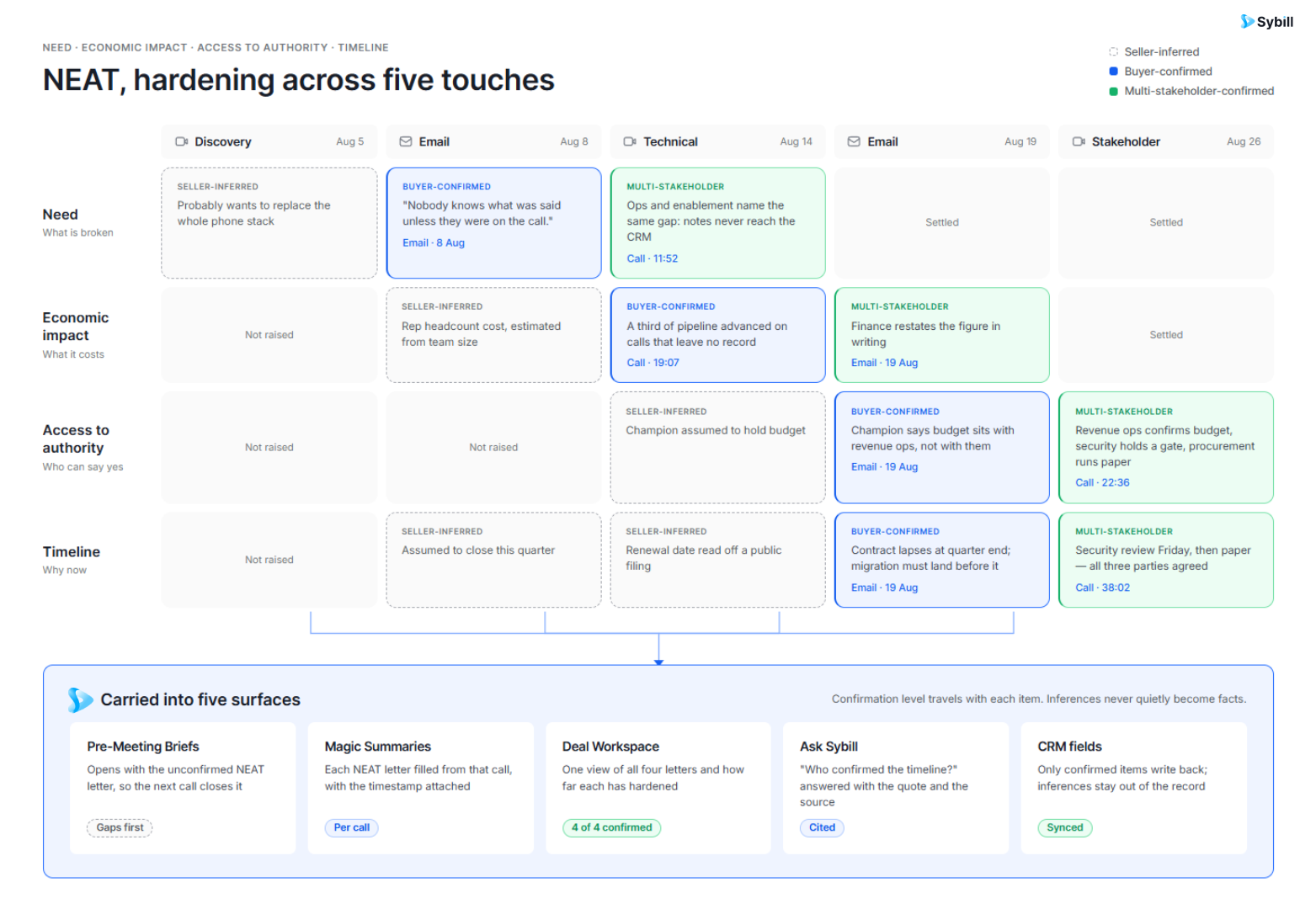
NEAT evidence rarely arrives in one perfect discovery call.
A user may explain the Need in one meeting. A finance leader may challenge the Economic Impact two weeks later. An email may reveal a new stakeholder. A procurement conversation may change the Timeline.
The difficulty is not merely hearing the information. It is preserving and connecting it across the deal.
Sybill’s Deal Workspace maintains deal context, stakeholders, risks, buyer signals and next actions in a dedicated workspace. Reps can use Ask Sybill to ask questions such as:
AI can also help managers inspect qualification patterns across the pipeline and identify where reps commonly stop too early.
But AI needs the same evidence standard as the seller.
It should not:
AI can capture, organize and retrieve NEAT evidence. People still need to judge what the evidence means.
NEAT selling does not make a weak deal stronger simply because every field is complete.
Its real value is that it makes uncertainty visible.
A deal may have an urgent Need but no meaningful Economic Impact. It may have a compelling business case but no Access to Authority. It may have an engaged buying group but no event that makes the Timeline credible.
Those are not administrative gaps. They are reasons the deal may not happen.
The strongest sellers do not use NEAT to prove that an opportunity belongs in the pipeline. They use it to understand what is true, what is assumed and what must be tested next.
Sybill helps preserve that evidence across every call, email and CRM update, so qualification reflects the deal the buyer is actually running, not the deal the seller hopes to close.
Explore Sybill to see how buyer needs, impact, stakeholders and timelines can stay connected across the full sales cycle.
NEAT stands for Need, Economic Impact, Access to Authority and Timeline. It is a sales qualification and discovery framework that helps sellers understand the buyer’s underlying problem, the value of solving it, the stakeholders involved and the event creating urgency.
N.E.A.T. Selling™ was created by Richard Harris, founder of The Harris Consulting Group. The methodology is designed as a flexible conversational compass rather than a rigid sequence of qualification questions.
BANT qualifies buyers using Budget, Authority, Need and Timeline. NEAT replaces an early focus on budget with Economic Impact and reframes Authority as Access to Authority. This makes NEAT better suited to consultative sales where the business case and buying group must be developed during the sales process.
No. Need, Economic Impact, Access to Authority and Timeline can emerge in any order during a sales conversation. Sellers should follow the buyer’s natural sequence while ensuring that credible evidence is eventually gathered for all four areas.
The best NEAT selling questions uncover the root problem, quantify its consequences, identify who owns and influences the decision, and connect urgency to a buyer-owned event. Strong questions include “What happens if nothing changes?”, “Which metric does this affect?”, “Who else must validate this?” and “What event makes this date important?”
Yes. NEAT can be combined with other frameworks because they serve different purposes. SPIN can improve discovery questions, SPICED can capture wider buyer and decision context, and MEDDIC can add deeper enterprise deal inspection after an opportunity has been qualified.
NEAT stands for Need, Economic Impact, Access to Authority and Timeline. It is a sales qualification and discovery framework that helps sellers understand the buyer’s underlying problem, the value of solving it, the stakeholders involved and the event creating urgency.
N.E.A.T. Selling™ was created by Richard Harris, founder of The Harris Consulting Group. The methodology is designed as a flexible conversational compass rather than a rigid sequence of qualification questions.
BANT qualifies buyers using Budget, Authority, Need and Timeline. NEAT replaces an early focus on budget with Economic Impact and reframes Authority as Access to Authority. This makes NEAT better suited to consultative sales where the business case and buying group must be developed during the sales process.