Find us at booth #83, join us for a harbor side happy hour, or catch Gorish’s talk.

Sept, 16-18 > Learn more

%20(1).avif)
Mamta Tainwala

August 31, 2026
%20(81).png)
TL;DR: Most referral programs fail for one reason: teams ask the wrong customers at the wrong time. They pick "advocates" based on NPS surveys and gut feel, then blast a generic ask with a gift card attached. Real advocacy shows up earlier and more reliably in your actual customer conversations: unprompted praise, internal championing, expansion signals. This guide covers how to identify genuine advocates from conversation data, when the ask actually lands, and how to run referrals as a sales motion instead of a marketing afterthought.
Referral selling is a sales motion where your existing customers actively introduce you to new prospects, and your team treats those introductions as a managed pipeline source, not a lucky accident.
That last part is the whole game. Every company gets occasional referrals. Very few run referral selling: a deliberate process for identifying advocates, timing the ask, making introductions easy, and tracking referred deals separately in the pipeline.
The payoff is well documented. Nielsen's Global Trust in Advertising survey found that 92% of consumers trust recommendations from people they know above every other form of advertising. Referred prospects arrive with borrowed trust you did not have to build on a cold call.
Let us be adults for a second. You have probably watched this movie before.
Someone in marketing launches a referral program. There is a landing page, a $200 gift card, and a launch email. Three referrals trickle in the first month. Two are unqualified. By quarter two, nobody mentions the program again.
Here is why that keeps happening:
The ask goes to everyone, so it lands with no one. Blasting your entire customer list treats a delighted power user and a customer who has opened three support tickets this month exactly the same. One of those people should never receive a referral ask.
"Advocate" gets defined by a survey score. NPS tells you someone clicked a 9 six months ago. It does not tell you whether they would put their professional reputation on the line for you today. Those are very different commitments.
The timing is tied to your calendar, not the customer's experience. Quarterly referral campaigns ask for favors on your schedule. Advocacy peaks at value moments on theirs, and value moments do not check your campaign calendar first.
Nobody owns it. Marketing built it, sales ignores it, CS forgot about it. A referral program without a clear owner is a landing page with a gift card budget.
This is where most guides tell you to "leverage your data" and move on. Credit where it is due, that advice is not wrong. It is just uselessly vague. Here is a sharper filter.
A real advocate clears three bars:
Look for customers hitting the outcomes they bought for: adoption depth, usage frequency, results they can point to in their own metrics. A customer who cannot articulate their ROI cannot articulate it to a peer either.
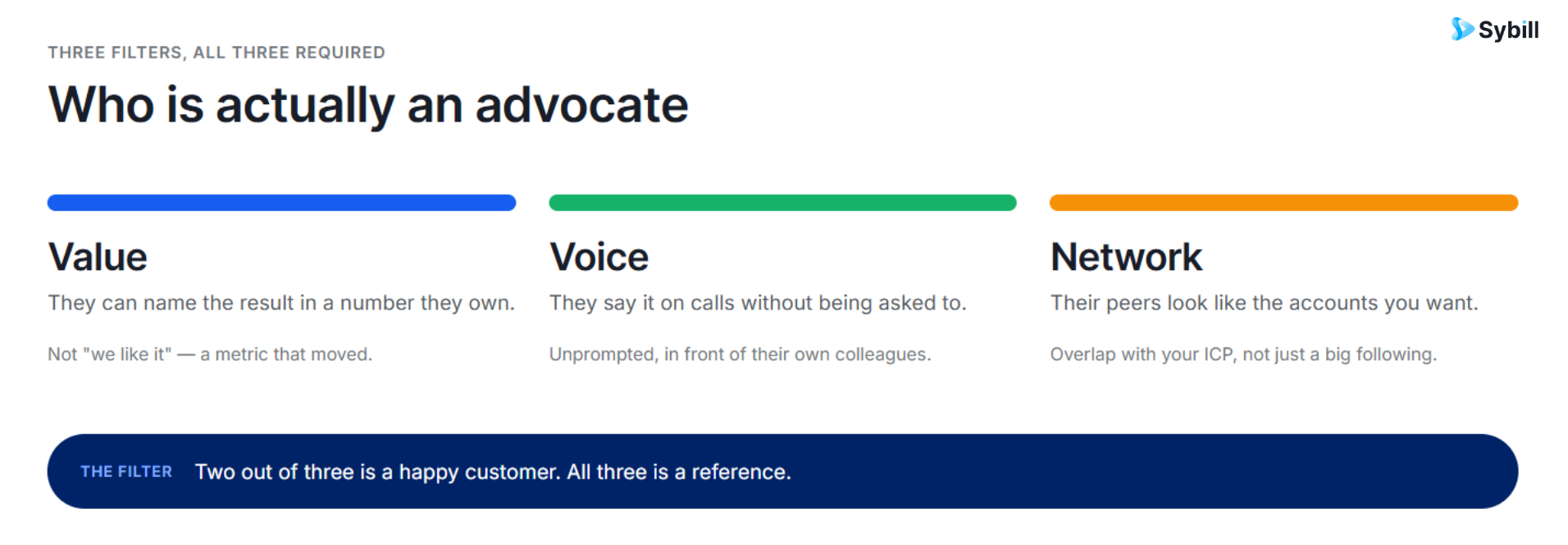
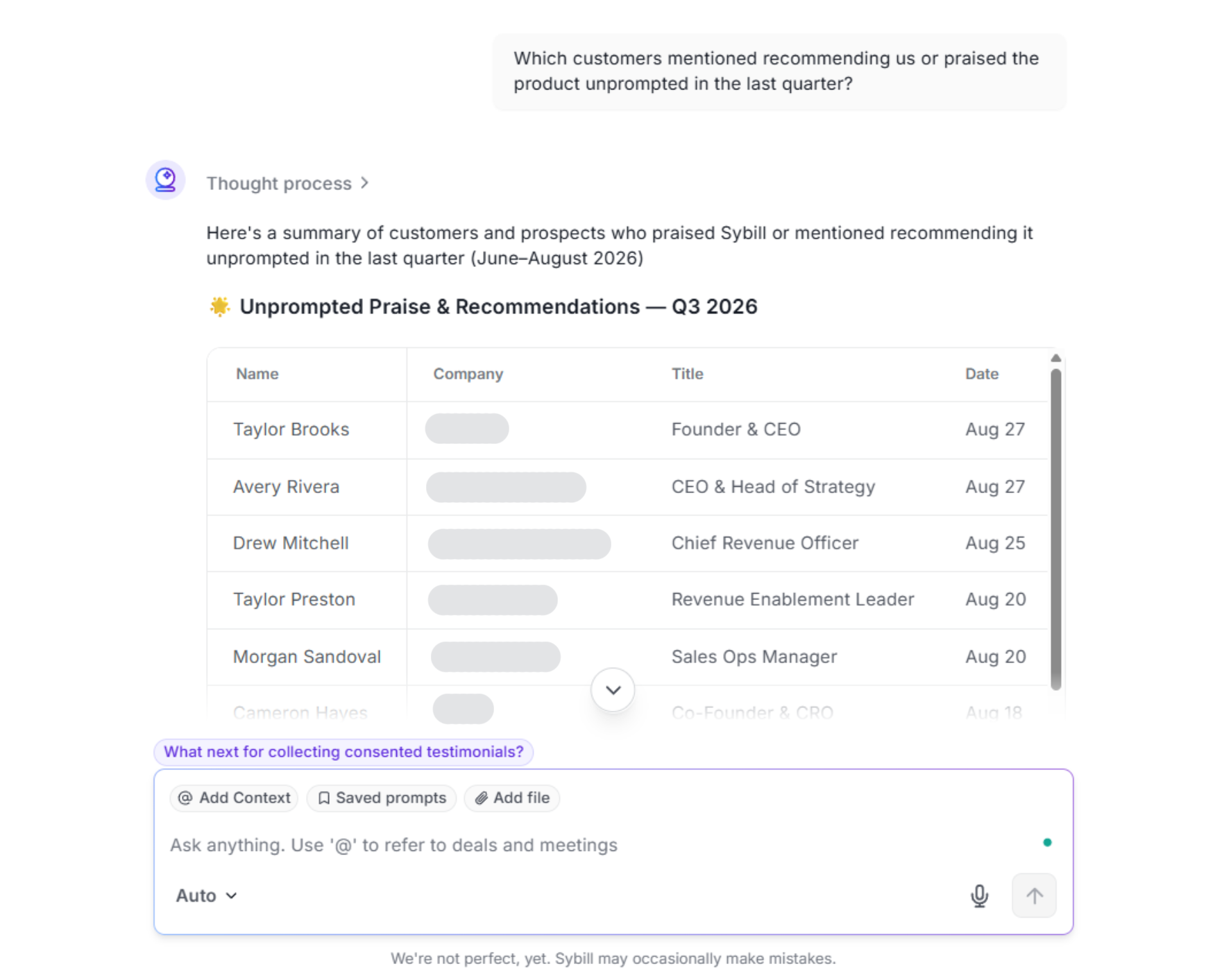
This is the signal almost every referral guide skips, and it is the strongest one you have. Advocacy leaks into conversations long before anyone fills out a survey:
These moments happen on sales calls, QBRs, and support conversations every week. The problem is they live in call recordings nobody rewatches. If your team is on Sybill, this is a question, not a research project: ask across your customer conversations who has mentioned recommending you, praising the product unprompted, or introducing new stakeholders. Your advocate shortlist is sitting in your calls. More than 33 million analyzed sales calls back this up: buyers reveal far more in conversations than they ever type into a survey field.
A thrilled customer whose peers all work in industries you do not serve is a testimonial, not a referral source. Both are valuable. Only one belongs in this program. Prioritize advocates in communities, industries, and roles where your next customers already hang out.
Run your customer list through all three filters and you will end up with a short list. Good. A referral program built on 15 genuine advocates will outperform one sprayed across 1,500 accounts, and your team will actually run it.
The best time to ask for a referral is within days of a moment where the customer just experienced or acknowledged value. Not at renewal. Not on your quarterly campaign date. At their moment, on their high.
Value moments worth acting on:
Now picture this: a CS manager sees that a customer called the product "the best decision we made this year" on Tuesday's QBR. On Thursday, the AE sends a short, personal note referencing that exact comment and asking for one introduction. That ask converts. The generic gift card email does not.
One rule inside the rule: one value moment, one ask. Do not turn every QBR into a shakedown.
Keep the ask specific, small, and easy to fulfill.
Be specific about who. "Do you know anyone who might benefit" invites a polite nothing. "You mentioned your former colleague now runs sales at a company about your size. Would you be open to introducing us?" invites a yes or a no, and either is progress.
Make it one introduction, not a quota. You are asking a favor, not recruiting a channel partner.
Write the forwardable email for them. Three sentences they can send as-is. Every step of effort you remove doubles your odds.
Report back. Whether the referral closes or not, tell your advocate what happened. People who feel like insiders refer again. People who feel like lead sources do not.
Incentives are seasoning, not the meal. The evidence for them working is real: Dropbox's famous two-sided referral program, which rewarded both parties with storage, permanently increased signups by 60% according to Drew Houston's own 2010 Startup Lessons Learned presentation. But note what made it work. The reward was in-product value, it benefited both sides, and the product was genuinely worth sharing.
What tends to work in B2B:
What backfires:
The uncomfortable truth: if nobody refers you without an incentive, an incentive will not fix that. It will just pay for worse referrals.
Your team has targets, not vibes. So treat referred pipeline the way you treat outbound and inbound:
This is not guesswork. It is a channel, and channels get measured.
The hardest parts of referral selling are identification and timing, and both are conversation problems. Advocacy signals surface in calls and emails, then evaporate because no human is going to rewatch a quarter of QBR recordings hunting for compliments.
This is exactly the layer where Sybill earns its seat. Because Sybill captures and remembers every customer conversation across the deal and the relationship, the advocacy signals stop evaporating:
To be clear about the division of labor: your referral platform or CRM runs the program mechanics. Sybill tells you who to ask, when to ask, and what to say, because it is the layer that actually heard your customers talk.
Surveys tell you who scored you a 9. Conversations tell you who is already selling for you.
What is the difference between customer advocacy and referral selling?
Customer advocacy is the broader state of customers actively supporting your brand through reviews, references, case studies, and word of mouth. Referral selling is the specific sales motion that converts that advocacy into introductions and tracked pipeline. Advocacy is the fuel; referral selling is the engine.
How many customers should be in a referral program?
Fewer than you think. A focused program built on 10 to 20 verified advocates, each asked at the right moment with a specific request, will typically outproduce a mass program covering your whole customer base. Expand only when your qualification and win rates on referred deals hold up.
Should sales, marketing, or customer success own referrals?
One team must own the number, and for B2B referral selling it usually works best with sales owning referred pipeline while CS owns advocate identification and relationship health. Marketing supports with assets and program infrastructure. Shared ownership without a single accountable owner is how referral programs die the first time.
When is the best time to ask a customer for a referral?
Within days of a value moment: a milestone the customer credits to your product, unprompted praise on a call, an expansion or upgrade, or an agreement to be a reference. Asking at renewal or on a fixed campaign calendar ties the request to your schedule instead of their enthusiasm, and it converts worse.
How do you ask for a referral without being pushy?
Make the ask specific, small, and effortless. Name the person or type of person you want to meet, request one introduction rather than an open-ended favor, and include a short forwardable email your advocate can send as-is. Then report back on what happened, whether the referral closed or not.
Do referral incentives work in B2B sales?
Yes, when the reward is modest, benefits both sides, and does not resemble a commission. In-product value, recognition, early access, and charitable donations work well. Cash-heavy rewards backfire in B2B because they undermine the advocate's credibility and can trip the prospect's procurement or compliance policies.
How do you measure a referral program?
Track asks made, introductions received, qualification rate, win rate, and sales cycle length for referred deals versus other pipeline sources, with referral-sourced deals tagged in the CRM. Referred deals should close faster and at higher rates than cold pipeline; if they do not, the problem is advocate selection, not the incentive.
Customer advocacy is the broader state of customers actively supporting your brand through reviews, references, case studies, and word of mouth. Referral selling is the specific sales motion that converts that advocacy into introductions and tracked pipeline. Advocacy is the fuel; referral selling is the engine.
Fewer than you think. A focused program built on 10 to 20 verified advocates, each asked at the right moment with a specific request, will typically outproduce a mass program covering your whole customer base. Expand only when your qualification and win rates on referred deals hold up.
One team must own the number, and for B2B referral selling it usually works best with sales owning referred pipeline while CS owns advocate identification and relationship health. Marketing supports with assets and program infrastructure. Shared ownership without a single accountable owner is how referral programs die the first time.