Find us at booth #83, join us for a harbor side happy hour, or catch Gorish’s talk.

Sept, 16-18 > Learn more


Tamanna Mishra

September 8, 2026
A user activates a new feature. Your product analytics platform celebrates. A notification fires in Slack. Sales receives a “hot PQL” alert and sends an email before the user has finished exploring the dashboard.
There is only one problem: the user is not evaluating an enterprise contract. They are trying to complete one task on the free plan and would rather be left alone.
That is not product-led sales. It is product-led interruption.
Product-led sales sounds deceptively simple. Let people experience the product, use their behavior to identify promising accounts and bring in sales when human assistance can increase conversion or expansion.
The complexity hides inside that final clause: when human assistance can help.
Get that decision right and product usage gives sales a more informed, efficient route into valuable accounts. Get it wrong and product-led sales becomes another collection of noisy alerts, overeager emails and dashboards nobody trusts.
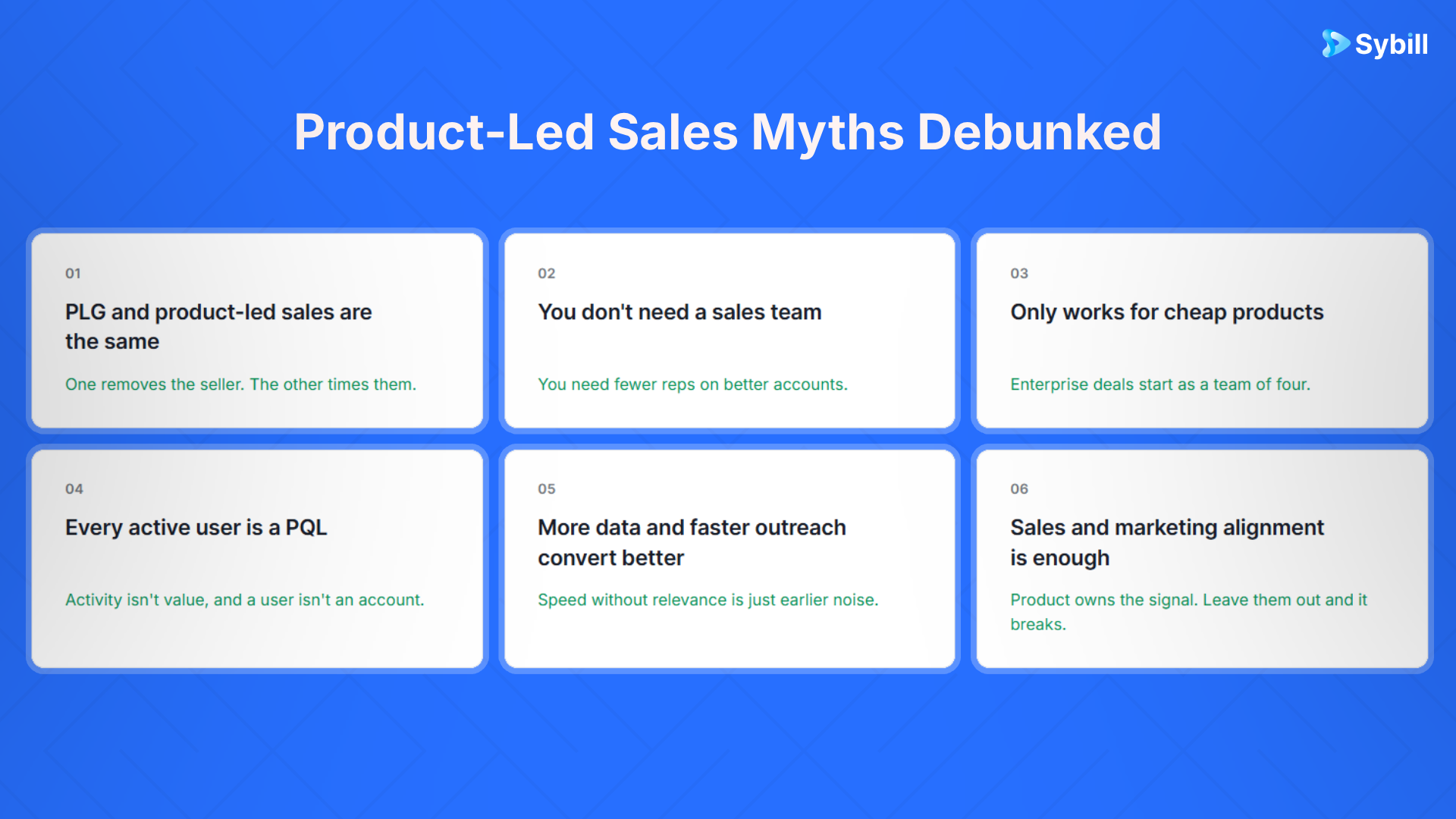
These six product-led sales myths explain where the motion most often goes wrong.
Product-led sales is a go-to-market motion in which people experience value through the product before or alongside human sales assistance. Product usage helps the company identify where a salesperson may improve conversion, support a complex purchase or expand adoption across an account.
The product does not close a complex deal by magic. It changes what the seller knows before entering the conversation.
Instead of beginning with a cold account and a generic pitch, a product-led seller may already know:
That creates a more informed starting point. It does not answer every commercial question.
Product telemetry cannot always tell the seller why a user adopted the product, whether the company has budget, who controls the decision, which alternatives are being considered or whether the account wants human assistance.
That gap between product evidence and buying evidence is where most product-led sales misconceptions begin.
If you need the complete definition, readiness criteria and implementation process, start with Sybill’s guide to what product-led sales is and when to adopt it.
Product-led growth and product-led sales are closely related, but they do different jobs.
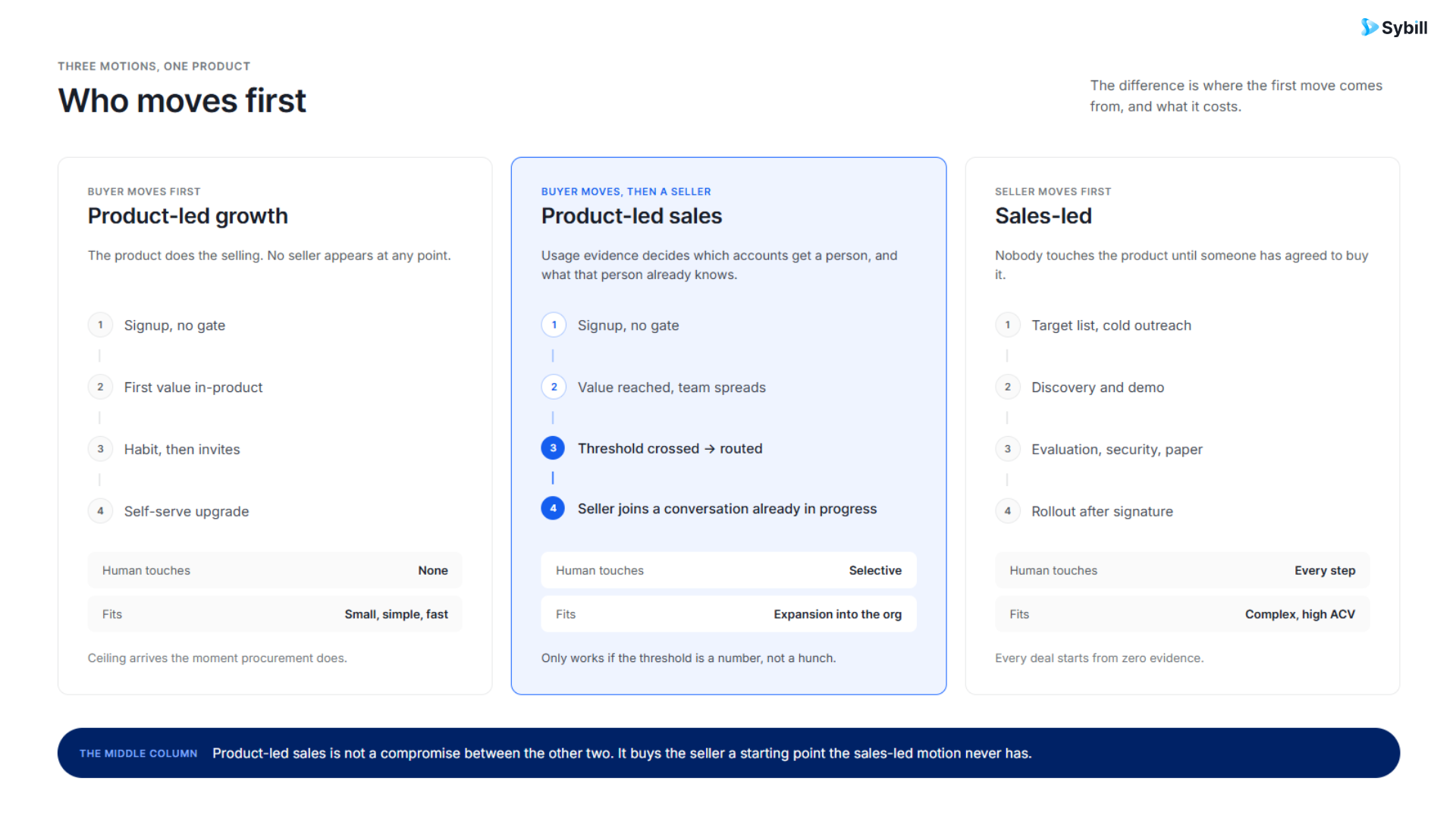
Product-led growth, or PLG, uses the product as a primary driver of acquisition, activation, retention and expansion. People can discover value with limited human involvement through free trials, freemium tiers, self-service onboarding, interactive demos or other product experiences.
Product-led sales, or PLS, adds a selective sales-assisted motion. Sellers engage when product adoption creates an opportunity that is easier, larger or more likely to convert with human involvement.
McKinsey describes PLS as a hybrid of product-led growth and the traditional enterprise sales model. The product generates demand and evidence of value, while sales helps convert appropriate users or accounts into larger commercial opportunities. McKinsey’s product-led sales research also emphasizes that the two motions exist on a spectrum rather than as a simple either-or choice.
That is why a business can be:
The right balance depends on the product, buyer, use case and economics.
For a deeper decision framework, see Product-Led Growth vs. Sales-Led Growth.
If the product demonstrates value before a sales conversation, what is left for a seller to do?
Plenty, particularly when the account is large, the problem is complex or the purchase affects more than one person.
A free user may be able to activate a feature without help. They may not be able to:
These are not product-tour problems. They are organizational buying problems.
McKinsey surveyed SaaS buyers across five software categories and found that 65% strongly preferred a combination of product-led and sales-led experiences. Buyers valued both opportunities to experience the product and access to human expertise. Read the McKinsey findings.
The role of sales shifts from creating interest out of nothing to recognizing and developing commercial opportunities emerging from product use.
A product-led seller may:
The product can prove that people use a capability. The seller helps the organization decide whether that capability deserves wider investment.
This does not mean every product-led company needs a large sales organization. A low-cost product with simple onboarding and individual purchasing authority may remain almost entirely self-service. Human involvement should be justified by the value it adds and the revenue available.
When Sybill moved from individual self-service users toward larger accounts, the company also had to introduce an enterprise sales layer. The first-hand account in How to Build a PLG Sales Team From the Ground Up explains why moving upmarket changed the team and operating requirements.
For the broader role and process design, see How to Build a Product-Led Sales Team.
Product-led adoption often begins with individuals or small teams because they can try the product without waiting for a company-wide purchase.
That does not mean the commercial opportunity must remain small.
A team may begin with five active users and later discover that the product could support several departments. A developer tool may enter through an individual contributor before attracting security, IT and executive attention. A productivity platform may spread organically until fragmented subscriptions create a reason to consolidate.
The product creates proof. Sales helps translate that proof into an enterprise decision.
Bottom-up adoption does not remove the realities of enterprise buying. It gives the seller better evidence with which to navigate them.
An enterprise opportunity may still require:
Bain found that primarily product-led software businesses grew revenue about twice as fast as businesses with little or no product-led focus. However, Bain’s more useful conclusion is not that PLG guarantees faster growth. It is that companies frequently struggle to integrate enterprise sales into product-led motions. More successful companies define data-based engagement triggers, clarify cross-functional ownership and allocate resources across self-service and sales-assisted activity. Read Bain’s enterprise PLS analysis.
Bessemer Venture Partners’ analysis of enterprise sales in PLG companies reaches a similar conclusion. Bottom-up adoption can provide initial traction, but many companies need a coordinated top-down sales motion to reach enterprise scale.
The myth is not corrected by saying, “PLS closes six-figure deals too.” A trial user does not automatically become a six-figure opportunity. The potential appears when product adoption intersects with account-level value, a wider use case and an enterprise buying process the company is equipped to support.
A person logging in repeatedly may be engaged. That does not automatically make them a lead.
They might be:
This is why product-led teams must distinguish activity from activation, and activation from commercial readiness.
A product-qualified lead, or PQL, is generally an individual whose product behavior meets criteria associated with meaningful activation or conversion potential.
A product-qualified account, or PQA, aggregates relevant signals at the company level. It may consider several activated users, team growth, shared activity, feature adoption, account fit and enterprise requirements.
McKinsey describes PQLs as activated individuals and PQAs as accounts containing multiple activated users. Its recommended scoring model combines product analytics with account intelligence and marketing behavior rather than relying on one isolated action. See McKinsey’s PQL and PQA explanation.
Neither label should be assigned using a borrowed universal rule.
“Logged in three times” could be meaningful for one product and meaningless for another. A useful activation event must correlate with customers experiencing the product’s core value and, if it is used for sales qualification, with a higher probability of commercial progression.
Sybill’s guide to product-led sales metrics explains why teams should work backwards from the behavior of converted customers rather than defining activation around whichever event produces the most impressive dashboard.
A stronger qualification model looks beyond activity and evaluates four evidence layers. This is a Sybill editorial framework for evaluating PLS signals.
A signal becomes more useful as these layers reinforce one another.
One activated user at a poor-fit account may deserve no sales attention. Several activated users at a strong-fit enterprise account who begin investigating security and administration features may justify a conversation.
The objective is not to create the largest possible PQL queue. It is to identify situations where human involvement can make the customer experience or commercial outcome better.
Product data is essential to product-led sales. More product data is not automatically more useful.
A seller does not need a dashboard containing every click, hover, login, page view and session. They need signals connected to an appropriate decision.
Product telemetry can answer questions such as:
It usually cannot answer, on its own:
That is why the product-led sales data stack needs more than product analytics.
Speed matters only after the team has decided that contact is appropriate.
An immediate sales email may be useful when an enterprise account requests security information or reaches a collaboration limit. It may be intrusive when a new user is still trying to complete onboarding.
The best response is not always an email from an account executive. It could be:
Fast, irrelevant outreach tells users that your automation noticed them. Contextual assistance shows that your company understood what they might need.
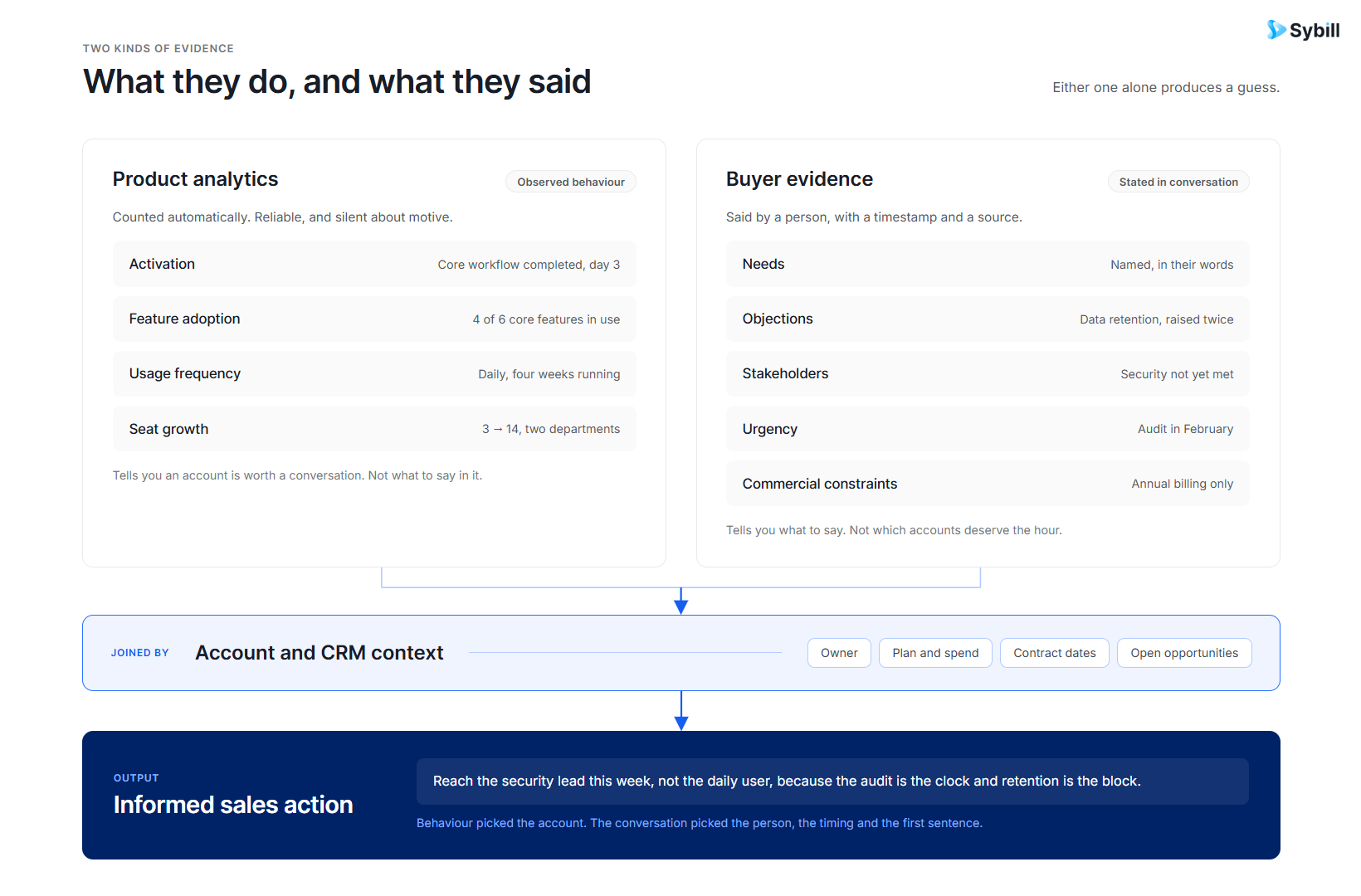
Sybill becomes relevant once human buyer interactions begin.
Ask Sybill can help sales teams retrieve stated needs, objections, stakeholder information, decision criteria and next steps from their sales interactions and connected deal context. CRM Autofill can keep standard and custom CRM fields updated using evidence from those interactions.
That creates a useful division of labor:
Sybill supplements product signals with buyer and deal evidence.
Sales and marketing alignment is helpful. It is not a complete product-led operating model.
In a traditional sales motion, marketing may generate demand and pass leads to sales. In product-led sales, the customer journey crosses several teams before and after that handoff.
If these teams use different definitions, even a sophisticated PLS stack will fail.
Product may define activation as completing a workflow. Marketing may treat every free-trial registration as a lead. Sales may consider only demo requests. Customer success may not know which promise was made before purchase. RevOps is then asked to automate a journey nobody has agreed upon.
A functioning product-led sales motion needs shared answers to questions such as:
Bain identifies carefully designed engagement triggers, cross-functional collaboration and dynamic allocation across product-led and sales-led activity as characteristics of stronger hybrid motions. Read Bain’s analysis.
McKinsey similarly argues that PLS requires product, marketing, sales and customer success teams to share ownership across an integrated customer journey, with explicit routing, handoffs and feedback loops. Read McKinsey’s operating-model recommendations.
Alignment is not a recurring meeting or a shared Slack channel. It is an operating agreement about evidence, ownership and action.
Product-led sales rarely fails because a company did not collect enough clicks.
It fails when the product, data, commercial model and customer journey do not support one another.
This is why PLS should not be treated as an automation project.
Buying another product analytics platform will not fix a weak activation experience. Hiring enterprise sellers will not fix poor account identification. Sending faster emails will not fix an irrelevant trigger. Adding more CRM fields will not fix disagreement about what qualifies an account.
Companies also do not need to split investment equally between product-led and sales-led activity. General Catalyst’s analysis of hybrid go-to-market motions argues that the balance should follow the target buyer and the return produced by each motion.
A useful product-led sales strategy therefore asks three questions:
Everything else is implementation.
Product-led sales does not mean eliminating sellers, treating every active user as a lead or sending an automated email the moment somebody clicks the right button.
It means using the product to create evidence before asking sales to act.
That evidence must be interpreted carefully. Product activity shows what happened inside the product. Account data shows whether the company fits. Expansion signals indicate whether value may be spreading. Buyer conversations reveal the needs, stakeholders and constraints that telemetry cannot.
The product leads by proving value.
The operating model converts that value into revenue by deciding when human assistance is useful, what kind of assistance the customer needs and which team should provide it.
That is the distinction between product-led sales and product-led interruption.
When product evidence and buyer evidence need to meet inside the same deal workflow, explore Sybill.
No. A product-led experience can include a free trial, freemium tier, sandbox, interactive demo, proof of value or another way for potential customers to experience meaningful product value before completing the purchase. The appropriate model depends on product complexity, implementation requirements, buyer preferences and commercial economics.
A product-qualified lead is generally an individual user whose product behavior meets defined activation or engagement criteria. A product-qualified account combines relevant activity from users associated with the same company. PQAs are often more useful for identifying team adoption, consolidation opportunities and potential enterprise expansion.
No. Sales may help convert or expand qualified accounts, while customer success supports adoption, outcomes, retention and continued expansion. The exact handoff varies by company, but PLS works best when sales and customer success share context instead of approaching the customer as separate journeys.
Yes. A sales-led company can introduce interactive demos, trials, sandboxes, self-service purchasing or product-informed qualification without abandoning enterprise sales. The right balance depends on how easily users can experience value, who controls the purchase, the contract value and how much human support the buying process requires.
No. A product-led experience can include a free trial, freemium tier, sandbox, interactive demo, proof of value or another way for potential customers to experience meaningful product value before completing the purchase. The appropriate model depends on product complexity, implementation requirements, buyer preferences and commercial economics.
A product-qualified lead is generally an individual user whose product behavior meets defined activation or engagement criteria. A product-qualified account combines relevant activity from users associated with the same company. PQAs are often more useful for identifying team adoption, consolidation opportunities and potential enterprise expansion.
No. Sales may help convert or expand qualified accounts, while customer success supports adoption, outcomes, retention and continued expansion. The exact handoff varies by company, but PLS works best when sales and customer success share context instead of approaching the customer as separate journeys.