Find us at booth #83, join us for a harbor side happy hour, or catch Gorish’s talk.

Sept, 16-18 > Learn more

%20(1).avif)
Mamta Tainwala

July 29, 2026
Remember when Netflix was still mailing DVDs and decided their ideal customer was "anyone with a mailbox and electricity"? Yeah, that's basically every household in America.
The brutal truth that most B2B companies learn the hard way: trying to sell to everyone means you end up selling to no one.
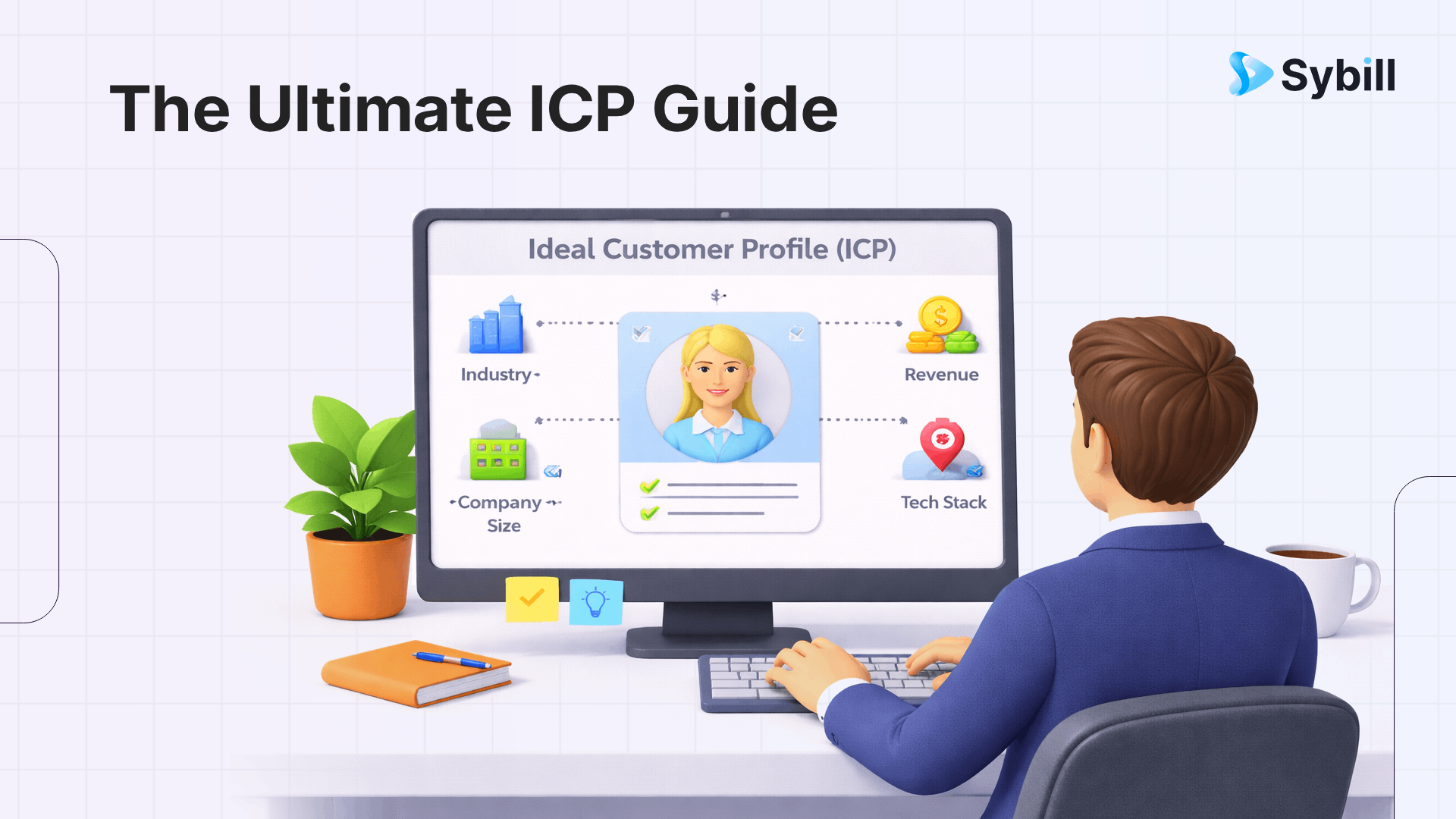
Enter the Ideal Customer Profile. An ICP is basically your business's north star, the detailed blueprint of companies that are most likely to buy from you, love your product, stick around for years, and tell all their friends about you.
An Ideal Customer Profile (ICP) is a detailed description of the type of company most likely to buy your product, achieve full value from it, retain long-term, and generate referrals — defined by firmographic attributes (industry, company size, revenue, geography), technographic signals (current tech stack, tools used), behavioral indicators (growth stage, hiring patterns, funding), and pain-based criteria (specific problems your product solves). Companies with clearly defined ICPs see up to 68% higher account win rates and 36% higher retention, and the most effective ICPs in 2026 are built by combining CRM closed-won analysis, conversation intelligence from tools like Sybill that surface what winning customers actually said during sales calls, and intent data that reveals which accounts are actively researching your solution category.
But here's where it gets interesting. According to research from leading sales organizations, companies with clearly defined ICPs experience up to 68% higher account win rates and 36% higher customer retention rates compared to those without. Sales teams that align on ICP see 38% higher sales win rates. That's not just incremental improvement, that's the difference between hitting quota and crushing it.
This guide is your roadmap to building an ICP that actually works. We'll cover everything from the foundational concepts to advanced AI-powered tactics, with practical templates you can steal and real examples from companies that got it right.
Let's turn your spray-and-pray strategy into a sniper's precision.
An Ideal Customer Profile is a detailed description of a fictitious company that represents your perfect customer. Not just any company that might buy from you, but the specific type of organization that gets maximum value from your solution and provides maximum value back to your business.
Think of your ICP as the company equivalent of your dream client. They have the right budget, the right pain points, the right tech stack, the right organizational structure, and the right timing. They're not just willing to buy, they're eager to buy. They implement quickly, adopt thoroughly, renew reliably, and become vocal advocates.
The Ideal Customer Profile focuses on firmographic, technographic, environmental, and behavioral attributes of companies that are expected to become your most valuable customers. These are organizations that align perfectly with what you're selling and how you sell it.
Here's what makes an ICP different from just "target market" or "customer segment":
Specificity: Your ICP isn't "mid-market SaaS companies." It's "Series B SaaS companies with 150 to 400 employees, $15M to $50M ARR, selling to enterprise customers, using Salesforce and HubSpot, headquartered in North America, and actively hiring for revenue operations roles."
Value focus: Your ICP prioritizes companies based on their lifetime value potential, not just their likelihood to buy. A company that buys a small package and churns in six months isn't ideal, even if they're easy to close.
Actionability: A good ICP translates directly into prospecting criteria, messaging frameworks, and qualification standards. Your sales and marketing teams should be able to look at an ICP and immediately know who to target and why.
The biggest mistake companies make is treating their ICP like a wishlist rather than a data-driven profile. They create ICPs based on who they want to sell to instead of who actually buys, succeeds, and stays. That's like a dating app profile that says "must be a billionaire supermodel astronaut." Cool fantasy, zero useful matches.
This is where things get confusing for most people. ICP and buyer persona sound similar, they're often used interchangeably, and plenty of marketing blogs don't help by treating them as synonyms.
They're not the same thing. Understanding the difference is critical because using the wrong tool for the wrong job tanks your results.
Ideal Customer Profile (ICP): Describes the company. It's organization-centric, focusing on firmographic and behavioral attributes of businesses that are your best fit.
Buyer Persona: Describes the person. It's individual-centric, focusing on the specific decision-makers, influencers, and users within those ideal companies.
Think of it this way: your ICP tells you which building to walk into. Your buyer personas tell you which offices to visit and what to say to each person when you get there.
You need your ICP first. Always. It's your foundational targeting layer. Without a clear ICP, your buyer personas are just floating in space with no organizational context.
Once your ICP is defined, you build multiple buyer personas representing the different roles within your ideal customer companies. For a typical B2B sale, you might have personas for:
The ICP and buyer personas work together to form your complete targeting strategy. The ICP gets you to the right companies while buyer personas help you engage the right people within those companies with the right messaging.
Let's say you sell sales enablement software.
Your ICP might be: "B2B SaaS companies with $10M to $100M ARR, 50 to 500 employees, selling products with ACV over $25K, using Salesforce, headquartered in North America or Western Europe, and experiencing rapid growth (30%+ YoY)."
Within that ICP, you might have buyer personas like:
Economic Buyer (VP of Sales): Mid-40s, been in sales leadership for 10+ years, measured on team quota attainment and pipeline velocity, skeptical of new tools that disrupt workflows, cares about ROI and adoption rates.
User Buyer (Account Executive): Late 20s to mid-30s, quota-carrying rep, drowning in admin work, wants tools that make them more productive without adding complexity, influenced by peer reviews.
Champion (Sales Enablement Manager): Early 30s, owns onboarding and ongoing training, frustrated with inconsistent rep performance, looking for ways to scale coaching, willing to advocate internally if they see value.
Same ICP, three very different people with different priorities, objections, and motivations. Your ICP gets you targeting the right companies. Your personas help you have the right conversations with each stakeholder.
Building an effective ICP isn't about throwing random attributes into a document and calling it done. It's about systematically identifying the characteristics that correlate with high-value, successful customers.
Here are the five essential components every ICP needs:
Firmographics are the B2B equivalent of demographics. They're the basic company attributes that define your target market.
Essential firmographic criteria include:
Company size: How many employees? Revenue range? This impacts budget, decision-making complexity, and implementation needs. A 50-person startup operates completely differently from a 5,000-person enterprise.
Industry and vertical: Which sectors do you serve best? SaaS, healthcare, financial services, manufacturing? Industry determines pain points, regulations, buying cycles, and competitive dynamics.
Geographic location: Where are they headquartered? Do they have distributed teams? Location affects time zones, legal requirements, payment processing, and sales coverage models.
Company maturity: Are they seed stage, Series B, publicly traded? Maturity level correlates with sophistication, budget availability, and organizational complexity.
Business model: B2B, B2C, marketplace, transactional, subscription? Their business model shapes how they think about value and ROI.
The key is specificity. Don't say "tech companies with 100 to 1,000 employees." A 101-employee startup and a 999-employee scale-up are in completely different universes. Narrow it down. Get uncomfortable with how specific you're being. That discomfort usually means you're on the right track.

Technographics refer to the technology your ideal customers already use. This is goldmine information that most companies completely ignore.
Why technographics matter:
Integration compatibility: If your product integrates with Salesforce and HubSpot, targeting companies using those platforms makes your sales process smoother and your value prop stronger.
Tech sophistication signals: Companies using modern martech stacks signal that they value technology and are willing to invest in tools. Companies still on spreadsheets might not be ready for your solution.
Competitive intel: If they're using a competitor's tool, you know they have the pain point and budget. The question becomes displacement strategy, not education.
Buying signals: Companies actively implementing new tools or expanding their tech stack signal readiness to buy. They're in change mode, not status quo mode.
Common technographic data points:
You can gather technographic data through tools like BuiltWith, Datanyze, or enrichment platforms like Clearbit and ZoomInfo. Or just look at your best existing customers and identify patterns in their tech stacks.
Understanding the specific problems your ideal customers face is what separates generic targeting from precision marketing.
Your ICP should document:
Primary pain points: What's broken in their current state? What's costing them money, time, or competitive advantage? For a sales enablement platform, it might be: "Reps take 6+ months to ramp, quota attainment is under 60%, and there's no systematic way to replicate top performer behaviors."
Impact and urgency: How bad is the pain? Is it a "nice to fix eventually" or a "burning platform that demands immediate attention"? Pain level determines buying urgency and budget prioritization.
Buying triggers: What events cause companies to start actively looking for solutions? Common triggers include:
Current workarounds: How are they attempting to solve the problem today? Understanding their workarounds helps you position against them and demonstrate why your solution is better.
The more specific you can be about pain points and triggers, the better your messaging will resonate. Don't say "companies struggling with sales productivity." Say "companies where reps spend less than 30% of their time actually selling, buried in admin work and CRM updates, causing them to miss quota by an average of 23%."
That's the difference between generic and visceral.
Your ICP needs to reflect not just who buys, but how they buy. The buying process dramatically affects your sales strategy.
Key elements to document:
Decision-making structure: Is there a single decision-maker or a buying committee? How many stakeholders typically get involved? Research shows that over 60% of B2B purchases involve four or more decision-makers, often from different departments.
Budget and procurement process: Do they have allocated budget or need to build a business case? Do they go through procurement? What's their typical approval process? Understanding this prevents deals from stalling in "budget approval purgatory."
Sales cycle length: How long does it typically take from first conversation to closed deal? Is it 30 days or 9 months? This affects your pipeline forecasting and cash flow planning.
Evaluation criteria: What do they care about most? Price, features, security, support, references? Knowing their evaluation priorities helps you lead with your strongest points.
Common objections: What concerns or pushback do they typically raise? Price objections, change management fears, integration concerns? Documenting common objections lets you proactively address them.
For example, your ICP might note: "Typical buying committee includes VP of Sales (economic buyer), Revenue Operations Manager (technical buyer), 2-3 Account Executives (user buyers). Average sales cycle is 45-60 days. Primary evaluation criteria are ease of use (weighted 40%), ROI (30%), and integration with Salesforce (30%). Most common objection is concern about rep adoption."
This level of detail transforms your ICP from a static profile into an actionable playbook.
The final component is understanding what makes a customer truly valuable to your business. Not all customers are created equal, and your ICP should reflect that.
Success indicators to include:
Annual Contract Value (ACV): What's their typical deal size? Higher ACV customers might require more hand-holding but generate more revenue per deal.
Lifetime Value (LTV): How long do they typically stay? What's their expansion potential? A customer who starts small but grows 3x in year two might be more valuable than one who starts large but never expands.
Customer Acquisition Cost (CAC) ratio: How much does it typically cost to acquire this type of customer relative to their value? The LTV:CAC ratio should be at least 3:1 for healthy unit economics.
Time to value: How quickly do they see results? Customers who see value in 30 days are more likely to renew than those who take 6 months to implement.
Referral and advocacy potential: Do they become vocal advocates? Refer other customers? Participate in case studies? These multiplier effects increase their total value beyond direct revenue.
Churn risk factors: What predicts churn in this segment? If customers in a certain industry or size category churn at 40% while others churn at 10%, that's a signal to refine your ICP.
Your most valuable customers aren't necessarily your largest deals. They're the ones with the best combination of high revenue, low acquisition cost, fast time-to-value, long retention, and strong advocacy potential.
Document what success looks like so you can intentionally pursue more of it.
Now that you understand what goes into an ICP, let's talk about how to actually build one. This isn't a "brainstorm in a conference room for an hour" exercise. It's a data-driven process that requires research, analysis, and cross-functional input.
Start with the customers you already have. Your best customers are the blueprint for finding more like them.
Pull data on your top 10 to 20 customers based on:
Don't just look at revenue. A customer paying $100K/year but requiring constant hand-holding and threatening to churn every quarter isn't ideal. You want the customers who are profitable, happy, and low-maintenance.
Once you have your list, dig into their characteristics:
Look for patterns. If 70% of your best customers are Series B SaaS companies with 100 to 300 employees using Salesforce, that's a strong signal. If they're scattered across 12 different industries with wildly different sizes and tech stacks, you might not have found product-market fit yet.
Data tells you what happened. Interviews tell you why it happened.
Customer interviews: Talk to 5 to 10 of your best customers. Ask them:
Sales team interviews: Your reps are on the front lines. They know which deals close easily and which ones are painful slogs. Ask them:
Customer success team interviews: CS knows which customers succeed and which ones struggle. Ask them:
Leadership input: Get perspective from founders, executives, and product leaders on:
Synthesize all this qualitative feedback. You'll start seeing themes emerge that help you understand not just who your ideal customers are, but why they're ideal.
Just as important as knowing who you want is knowing who you don't want. Anti-ICPs are the companies that look like they might be a fit but consistently turn into bad customers.
Common anti-ICP red flags:
Chronic churners: Companies in certain industries or size ranges that churn at 2x to 3x your average rate. If hospitality companies churn at 50% while SaaS companies churn at 10%, hospitality might be an anti-ICP.
Resource drains: Customers who require disproportionate support relative to their revenue. Small deals that demand enterprise-level hand-holding destroy your unit economics.
Misaligned expectations: Companies looking for features you don't have and won't build. Trying to force-fit your product to their needs leads to disappointment on both sides.
Budget constraints: Companies that can't actually afford your solution at the price point that makes sense for you. Discount-hunting customers who need 50% off to close are a bad sign.
Wrong buying process: Organizations with procurement processes so complex that closing deals takes 12+ months. Sometimes the juice isn't worth the squeeze.
Document your anti-ICPs as clearly as your ideal ICPs. Make it easy for sales and marketing to disqualify bad-fit leads early rather than waste time chasing deals that will never close or succeed.
One of the hardest but most valuable exercises is saying "We're not a good fit for X type of company." It feels like you're turning away revenue, but you're actually protecting your team's time and your company's reputation.
Now it's time to synthesize everything into a clear, actionable ICP document. This isn't a 20-page manifesto. It's a concise reference guide that sales and marketing can actually use.
Your ICP document should include:
Executive Summary (2 to 3 sentences) "Our ideal customer is a Series B B2B SaaS company with 150 to 400 employees, $15M to $50M ARR, selling to mid-market and enterprise customers, based in North America, using Salesforce and modern sales engagement tools, and actively scaling their sales team."
Firmographic Criteria
Technographic Indicators
Pain Points and Triggers
Buying Process
Success Indicators
Anti-ICP Criteria (Disqualifying Factors)
This is your targeting bible. Share it widely. Reference it constantly. Use it to evaluate every lead, campaign, and partnership opportunity.
Don't treat your ICP as a set-it-and-forget-it document. It's a hypothesis that needs constant validation and refinement.
Test it in the market:
Set review cadence:
Create feedback loops:
Track key metrics:
If your ICP-fit accounts are converting at 35% while non-ICP accounts convert at 12%, you're onto something. If there's no meaningful difference, your ICP might be too broad or based on wrong assumptions.
Markets evolve. Products evolve. Your ICP should evolve with them. The goal isn't perfection from day one. It's continuous refinement toward increasingly accurate targeting.
Building an ICP is the easy part. Using it consistently across your entire go-to-market motion is where most companies fall apart.
Here's how to operationalize your ICP so it's not just another document gathering dust:
Your ICP should be the foundation of sales and marketing alignment. When both teams agree on who you're targeting and why, magic happens. Sales and marketing alignment leads to 36% higher customer retention rates and 38% higher sales win rates.
For marketing:
For sales:
Shared tools:
When marketing generates leads that match the ICP and sales prioritizes those leads, conversion rates skyrocket and everyone's happier.
Your ICP should directly inform your lead scoring model. Not all leads are created equal, and your scoring should reflect that.
Build an ICP-based scoring model:
Firmographic match (40 points possible):
Technographic match (30 points possible):
Behavioral signals (30 points possible):
Leads scoring 70+ are hot ICP-fit prospects. Leads scoring 40 to 69 are warm but imperfect fits. Leads scoring under 40 should be nurtured or disqualified.
Qualification frameworks:
Incorporate ICP criteria into your qualification methodology (BANT, MEDDIC, MEDDPICC, SPICED, etc.). For example, in MEDDIC:
Lead scoring based on ICP criteria helps your team focus energy on the leads most likely to close and succeed.
If you're doing ABM, your ICP is literally the foundation of your entire strategy. ABM is about targeting specific high-value accounts that match your ideal profile, then creating personalized campaigns for them.
Using ICP for ABM:
Tier your target accounts based on ICP fit:
Create account-specific campaigns:
Engage multiple stakeholders:
Measure ABM performance:
A well-defined ICP is an ABM campaign that actually works versus one that feels like you're throwing darts blindfolded.
Your ICP shouldn't just influence sales and marketing. It should inform product decisions too.
How product teams use ICP:
Feature prioritization: When deciding what to build next, ask "Does this solve a pain point for our ICP?" Features that matter to your ideal customers get prioritized. Features that only matter to edge cases get deprioritized.
User research: Focus user interviews and beta testing on ICP-fit companies. Their feedback is more relevant than input from companies that don't match your ideal profile.
Positioning and messaging: Product marketing should emphasize the benefits that matter most to your ICP, not just generic feature lists.
Pricing strategy: Your pricing should be structured for the deal sizes and buying processes common in your ICP, not optimized for outlier cases.
Integration roadmap: Build integrations with tools your ICP commonly uses. If 90% of your ICP uses Salesforce, that integration should be rock-solid. If only 2% use some niche tool, it's probably not worth the engineering investment.
Product teams that understand and build for a specific ICP create products that feel tailor-made for those customers. Products that try to be everything to everyone end up mediocre for everyone.
"But we're a startup! We don't have enough customers to analyze!"
Fair point. Here's what to do:
Start by identifying who you built the product for in the first place. Who was the original persona or problem that inspired your solution?
Research your competitors' customers. Who are they serving? What do those companies look like? LinkedIn, Crunchbase, and company websites reveal a ton of information.
Create a hypothesis ICP based on who you think should get the most value from your product. Be specific about industry, size, tech stack, and problems.
Before you have customers, talk to prospects. Reach out to 100 companies that match your hypothesis ICP. Ask them:
These conversations serve double duty: they validate your ICP hypothesis and generate leads.
Your hypothesis ICP will be wrong. That's expected. The key is to iterate fast.
After your first 5 to 10 customers, revisit your ICP. What's working? What's not? Which industries are responding? What company sizes close fastest?
Successful startups often pivot their ICP multiple times in the first year. Gusto started incredibly narrow, with six specific ICP attributes. Sprig found that their ICP was companies with millions of users, which was challenging for an early-stage startup but became their winning formula.
Don't be afraid to get really, really narrow initially. It's easier to expand a narrow ICP than to focus a broad one.
Even smart companies screw this up. Here are the landmines to avoid:
"Our ICP is B2B SaaS companies" tells you nothing useful. That's a market segment, not an ICP.
The broader your ICP, the less useful it becomes. Your messaging becomes generic. Your targeting becomes wasteful. Your sales reps don't know who to prioritize.
A company with 100 employees and one with 700 employees has massive differences in their stages of maturity and levels of organization. You can't target both with the same message.
Fix: Get specific. Layer multiple criteria. "B2B SaaS companies with 100 to 300 employees, $10M to $30M ARR, selling to enterprise, using Salesforce, experiencing 30%+ YoY growth, and struggling with forecasting accuracy." Now you have something actionable.
Your target market is everyone who could buy. Your ICP is everyone who should buy because you're uniquely positioned to help them.
Most companies waste resources chasing their entire addressable market instead of focusing on their ICP. This dilutes everything: your messaging, your product roadmap, your sales focus.
Fix: Use your ICP for proactive targeting and outbound. Let your target market come to you through inbound and content, but don't actively chase them.
"I think CTOs at mid-market companies would love us" isn't an ICP. It's a hypothesis at best, wishful thinking at worst.
ICPs should be data-driven. Based on real customer behavior, real revenue data, real churn patterns.
Fix: Start with analysis of your actual customers. Use hard data, not hunches. Validate your assumptions with metrics.
Markets evolve. Products change. Competitors shift. Customer needs transform. Your ICP should evolve with them.
An ICP from 2023 is probably outdated in 2026. If you haven't revisited your ICP in the last 6 months, it's stale.
Fix: Review your ICP quarterly. Update it based on new data. Make it a living document that reflects current reality, not past assumptions.
If sales doesn't know the ICP, marketing is building campaigns for the wrong audience, and product is building features nobody wants, your ICP is useless.
Fix: Make ICP education part of onboarding for every revenue-facing role. Include ICP criteria in your CRM. Reference it in weekly meetings. Make it part of your culture.
.png)
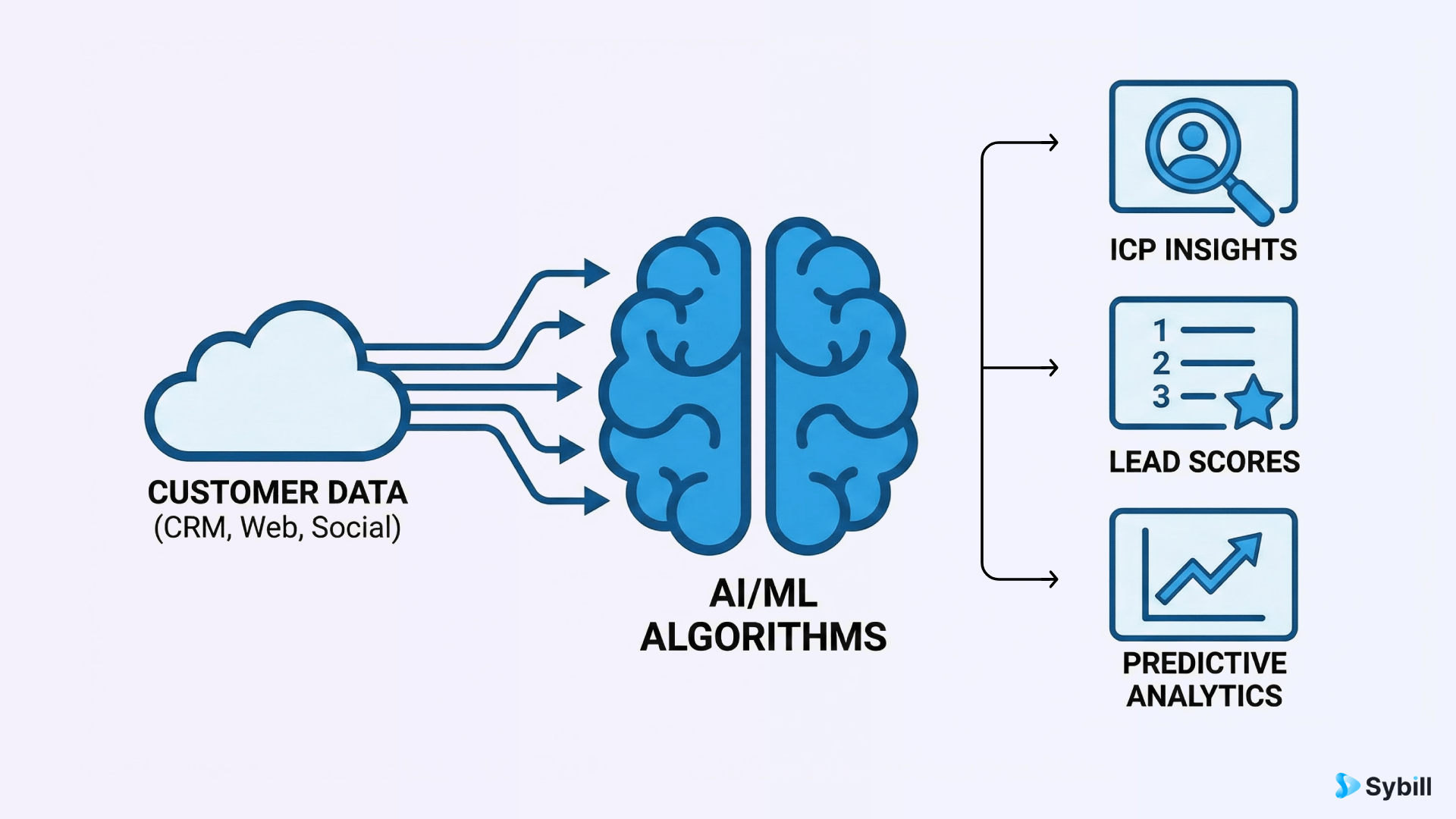
Here's where things get really interesting. AI isn't just hype; it's fundamentally changing how companies build and use ICPs.
Instead of manually reviewing customer data for patterns, AI can analyze thousands of data points across your entire customer base in seconds.
Platforms like Sybill use Behavior AI to capture real-time buyer intent and engagement cues during sales calls. This helps define and continuously refine your ICP based on what's actually working in the field, not what you hoped would work.
AI can identify patterns you'd never spot manually:
AI-powered tools can score incoming leads against your ICP automatically and instantly. No more manual qualification. No more gut-feel decisions.
When a new lead comes in, AI checks them against your ICP criteria, enriches their data from public sources, and provides a fit score. Your reps know immediately whether to pursue aggressively or pass.
AI can analyze your historical data to predict which prospects are most likely to convert, what their expected LTV will be, and how long the sales cycle should take.
This lets you allocate resources smartly. High-fit, high-value prospects get more attention. Low-fit prospects get self-serve options or are gently disqualified.
Instead of quarterly ICP reviews, AI can monitor performance continuously and flag when your ICP needs updating.
If conversion rates for a certain segment drop, AI surfaces it. If a new industry segment starts outperforming, AI catches it. Your ICP stays current without manual analysis.
Once you have AI-powered ICP insights, you can personalize outreach at scale. AI can draft customized emails, create tailored pitch decks, and suggest relevant case studies based on each prospect's specific ICP attributes.
Sybill's Magic Summary and Deal Summaries features gather and organize crucial insights from all touchpoints, enabling you to tailor your pitch with laser focus for each ICP segment.
An ICP shouldn't live in a sales deck. It should permeate your entire organization.
Your ICP should drive every marketing decision:
Content Strategy: Create content that addresses ICP pain points. Stop creating generic blog posts. Write specifically for your ICP's challenges.
Account-Based Marketing: Use your ICP to build target account lists. Focus ABM campaigns on Tier 1 ICP companies.
Paid Advertising: Use firmographic and technographic filters to target ICP companies on LinkedIn, Google, and other platforms. Stop wasting ad spend on non-ICP audiences.
Website Optimization: Use dynamic content to show ICP-specific messaging to visitors who match your profile.
Lead Magnets: Create resources (templates, guides, calculators) specifically designed for your ICP's needs.
Sales should live and breathe the ICP:
Prospecting: Focus outbound efforts exclusively on ICP companies. Use your ICP criteria to filter LinkedIn Sales Navigator, ZoomInfo, and other prospecting tools.
Discovery: Use ICP insights to ask better questions and identify fit early. Disqualify non-ICP leads quickly instead of wasting time.
Pitching: Customize your pitch based on ICP attributes. A Series B SaaS company needs different messaging than a Series D company.
Forecasting: Weight pipeline opportunities based on ICP fit. Tier 1 ICP deals should have higher probability than Tier 3.
CS teams need ICP context:
Onboarding: Tailor onboarding based on ICP characteristics. Different company sizes need different implementation approaches.
Adoption: Focus proactive outreach on ICP customers. They're more likely to expand and refer.
Renewal: Understand that non-ICP customers may churn more. Don't be surprised when they do.
Expansion: Prioritize upsell and cross-sell efforts on ICP customers with growth potential.
Product teams should use ICP to guide development:
Feature Prioritization: Build features that solve ICP problems. Stop building edge-case features for non-ICP customers.
Product Roadmap: Align your roadmap with ICP needs and strategic priorities.
User Research: Conduct research with ICP customers, not just any customer who'll talk to you.
Beta Testing: Recruit ICP customers for beta programs. Their feedback is more valuable.
Let's look at how actual companies use ICPs effectively:
ICP: B2B SaaS companies with 50 to 500 employees, $5M to $50M ARR, selling complex solutions with multi-stakeholder sales cycles, currently using Salesforce or HubSpot, experiencing challenges with CRM data quality and lack of visibility into sales conversations, growing 25%+ annually, and operating in North America.
Why It Works: This ICP is specific enough to guide targeting but broad enough to have substantial market opportunity. It identifies companies experiencing the exact pain Sybill solves (conversation intelligence and CRM automation).
How They Use It: Sybill uses their ICP to focus marketing content on challenges specific to these companies. Their sales team prioritizes outbound to companies matching this profile. Their product roadmap emphasizes integrations and features this ICP needs most.
ICP: E-commerce companies with $10M to $100M annual revenue, 50 to 200 employees, selling direct-to-consumer, using Shopify Plus, sending at least 1M emails monthly, struggling with personalization at scale, and focused on improving customer lifetime value.
Why It Works: It layers multiple specific criteria (revenue, platform, email volume) that indicate strong fit and buying power. These companies have the scale where automation matters and the sophistication to use it effectively.
ICP: Financial services companies with 500 to 5,000 employees, operating in heavily regulated industries, managing sensitive customer data, recently experienced a security incident or failed audit, using cloud infrastructure (AWS or Azure), and undergoing digital transformation initiatives.
Why It Works: It identifies companies with urgent pain (security incidents), regulatory pressure (compliance requirements), budget (financial services), and strategic priority (digital transformation). These factors create strong buying triggers.

How do you know if your ICP is working? Track these metrics:
ICP Fit Rate: What percentage of your pipeline matches your ICP? If it's below 60%, your targeting needs work.
Conversion Rate by ICP Tier: How do Tier 1 ICP leads convert vs. Tier 2 vs. non-ICP? Tier 1 should convert at 2 to 3x the rate of non-ICP.
Lead Source Effectiveness: Which channels bring you the highest percentage of ICP leads? Double down on those.
Sales Cycle Length: ICP leads should close faster than non-ICP. If they don't, your ICP might be wrong.
Average Contract Value: ICP customers should have higher ACV. They see more value, so they're willing to pay more.
Win Rate: Your close rate on ICP opportunities should be significantly higher than non-ICP.
Time to Value: How quickly do ICP customers get results? Faster time to value indicates good fit.
Product Adoption: ICP customers should use your product more extensively. Higher usage indicates fit.
Net Revenue Retention (NRR): ICP customers should expand over time. NRR above 100% indicates strong fit and value delivery.
Churn Rate: ICP customers should churn at significantly lower rates. If they're churning like everyone else, revisit your ICP.
Customer Satisfaction (CSAT/NPS): ICP customers should be happier. They're getting value because you built for their needs.
Customer Lifetime Value (LTV): ICP customers should have higher LTV. They stay longer, expand more, and cost less to serve.
Customer Acquisition Cost (CAC): ICP leads should cost less to acquire because your targeting is more efficient.
LTV:CAC Ratio: For ICP customers, this ratio should be 3:1 or higher. For non-ICP, it might be break-even or negative.
Revenue Concentration: What percentage of revenue comes from ICP customers? Healthy companies see 70% to 80%+ from ICP accounts.
Set up a dashboard that tracks these metrics by ICP tier. Review it monthly. If the data tells you your ICP isn't working, listen to it.

Your ICP isn't done when you document it. It requires ongoing maintenance.
Schedule recurring ICP reviews every 90 days. Bring together sales, marketing, CS, and product leadership.
Review the data:
Make updates based on evidence, not anecdotes. One customer churning doesn't mean you need to change your ICP. Ten customers with similar profiles churning does.
Sometimes you need to review your ICP outside the regular schedule:
After Major Product Changes: If you launch a new product line or significantly expand capabilities, your ICP might shift.
After Market Shifts: Regulatory changes, economic downturns, or technological disruptions can change who's a good fit.
After Go-to-Market Changes: If you shift from self-serve to enterprise sales or vice versa, your ICP needs updating.
After Competitive Changes: New competitors or changing competitive positioning might affect who you can win.
Treat your ICP like product code. Use version control. Document what changed and why.
Keep a change log:
This historical record helps you understand how your ICP evolved and prevents you from repeating past mistakes.
We've touched on this throughout the guide, but let's zoom in on what AI means for ICPs going forward.
Traditional ICPs rely on static firmographic and technographic data. AI enables behavioral ICP criteria.
Sybill's Behavior AI analyzes buyer engagement during calls to detect genuine interest, concerns, and buying intent. This behavioral data helps refine your ICP beyond demographics.
Imagine scoring leads not just on company size but on engagement patterns: "Companies where decision-makers ask detailed technical questions in the first call convert at 3x the rate of passive listeners."
AI can analyze thousands of sales conversations to identify which prospect characteristics correlate with wins.
Maybe you discover that prospects who mention "forecast accuracy" in discovery calls close 40% faster. That becomes part of your ICP: companies struggling with forecasting.
Or AI notices that deals with CFO involvement from the start have 2x higher ACV. That informs your ICP targeting strategy.
Tools like Sybill capture these insights automatically from every call, continuously refining your understanding of what makes a good fit.
AI can automatically enrich prospect data in real-time, checking every incoming lead against your ICP criteria without manual work.
When a lead fills out a form, AI:
This happens in seconds, ensuring no good-fit lead sits unattended.
AI can identify which existing customers match expansion ICP characteristics even if they don't match your initial ICP.
Maybe smaller customers who grow quickly become great expansion opportunities. AI spots these patterns and alerts your CS team to focus expansion efforts there.
Let's tackle some questions that come up frequently:
Specific enough to guide action but broad enough to have sufficient market opportunity. If your ICP describes exactly three companies, it's too narrow. If it describes 50,000 companies, it's too broad.
Start narrow. Most companies have 3 to 6 core attributes that define their ICP initially. You can always expand later, but contracting a too-broad ICP is painful.
Most companies should start with one primary ICP. As you scale and diversify your product offerings, you might develop 2 to 3 ICP variants.
For example, you might have a mid-market ICP and an enterprise ICP with different characteristics. Or you might have ICPs for different verticals if your solution works very differently across industries.
But don't start with five ICPs. Master one first.
Then you need more data or you're looking at the wrong characteristics. Every customer set has patterns if you look deep enough.
Sometimes the pattern isn't obvious demographics. It might be behavioral (they all asked similar questions in discovery) or situational (they all just raised funding).
Use AI and conversation intelligence tools to surface non-obvious patterns you might miss.
Show data. When you propose ICP changes, back them up with evidence: conversion rates, LTV, churn data, sales cycle metrics.
Share customer stories that illustrate why the change matters. Numbers convince executives, but stories convince teams.
Start small. Test ICP changes with a subset of your team before rolling them out broadly.
This usually happens when the ICP feels like an administrative burden rather than a helpful tool.
Make the ICP easy to use. Build it into systems they already use. Show them how ICP-fit leads close faster and easier.
Tie compensation to ICP metrics. If reps get rewarded for closing any deal regardless of fit, they'll chase non-ICP leads. If they get bonuses for ICP deals, behavior changes.
Most importantly, demonstrate results. When reps see their ICP-focused peers crushing quota, they'll come around.
Here's the reality: most of your competitors don't have a real ICP. They think they do, but they're operating on gut feel and outdated assumptions.
The companies that dominate markets have laser-focused ICPs. They know exactly who they serve. They say no to bad-fit opportunities. They invest heavily in customers who match their profile. They build products these customers love. They create content these customers consume. They generate referrals because they're solving real problems for the right people.
Your ICP isn't a document. It's a decision-making framework. Every strategy question, every resource allocation debate, every "should we build this feature?" discussion should reference your ICP.
When someone proposes a new market expansion, ask: "Does this align with our ICP?"
When product wants to add a feature, ask: "Does our ICP need this?"
When marketing wants to sponsor an event, ask: "Will our ICP be there?"
Your ICP forces clarity. Clarity drives focus. Focus creates results.
The companies winning in 2026 aren't the ones with the biggest budgets or the flashiest products. They're the ones who know exactly who they're building for and relentlessly execute against that vision.
So build your ICP. Test it. Refine it. Operationalize it. Make it part of your DNA.
And if you want to see how AI can supercharge your ICP development and execution, try Sybill for free. Our Behavior AI and conversation intelligence capabilities help you identify, target, and convert your ideal customers with unprecedented precision.
Because in a world where everyone is competing for attention, the companies that win are the ones that know exactly whose attention to compete for.
An ideal customer profile is a detailed description of the type of company that gets the most value from your product and brings the most value to your business. It includes firmographic data (company size, revenue, industry, location), technographic data (tech stack, tools, IT maturity), behavioral characteristics (pain points, buying triggers, decision-making process), and strategic fit criteria. Most B2B companies have one primary ICP with 3 to 6 core defining attributes, though larger organizations might have 2 to 3 ICP variants.
Start by analyzing your top 10-20 best customers who have high lifetime value, quick implementation, low churn, and strong expansion potential. Identify common patterns in their firmographics, technographics, pain points, and buying behavior. Interview them to understand why they chose you and what value they're getting. Analyze your worst customers to identify anti-patterns and disqualifiers. Document your findings in a structured ICP framework that includes company characteristics, technology profile, pain points, buying triggers, and strategic fit criteria. Validate your ICP by testing it against your current pipeline to see if high-scoring leads convert better.
An ICP describes the company while a buyer persona describes the individual people within that company. The ICP focuses on firmographic data like company size, industry, revenue, and tech stack to identify which businesses are the best fit for your solution. Buyer personas focus on demographics, psychographics, goals, pain points, and buying behavior of individual decision-makers. For example, your ICP might be mid-market SaaS companies with 100 to 500 employees, while your buyer personas within that ICP would be specific individuals like the VP of Sales, RevOps Manager, or CEO.