Find us at booth #83, join us for a harbor side happy hour, or catch Gorish’s talk.

Sept, 16-18 > Learn more

%20(1).avif)
Mamta Tainwala

July 31, 2026
%20(58).png)
Nurturing high-value accounts means running a deliberate system on the small set of customers that drives most of your revenue: tier them by value and risk, hold a fixed rhythm of reviews and value-adds, watch conversation-level signals for expansion openings and early churn risk, and multithread relationships so no account depends on one champion. The teams that do this well grow existing revenue on schedule; everyone else discovers account health at renewal time.
That is the whole playbook in one paragraph. The rest of this guide is the operating detail: who qualifies as high-value, what the rhythm actually contains, which signals matter, and how to run it at scale without hiring an army.
A high-value account scores on five dimensions: current revenue contribution (typically the top slice of accounts producing the bulk of revenue), growth potential (upsell, cross-sell, and expansion headroom), strategic alignment (their roadmap needs more of what you build), engagement level (active participants, not passive renewers), and retention risk (value at stake if they leave). Tier accounts on these, then match investment to tier.
The classic 80/20 pattern holds in almost every enterprise book: a minority of accounts carries the majority of revenue, which makes identification the highest-leverage step in the whole discipline. Get the tiering wrong and you will lavish white-glove attention on accounts that were never going to grow while a genuinely expandable one quietly takes a competitor's call.
Score honestly on each dimension:
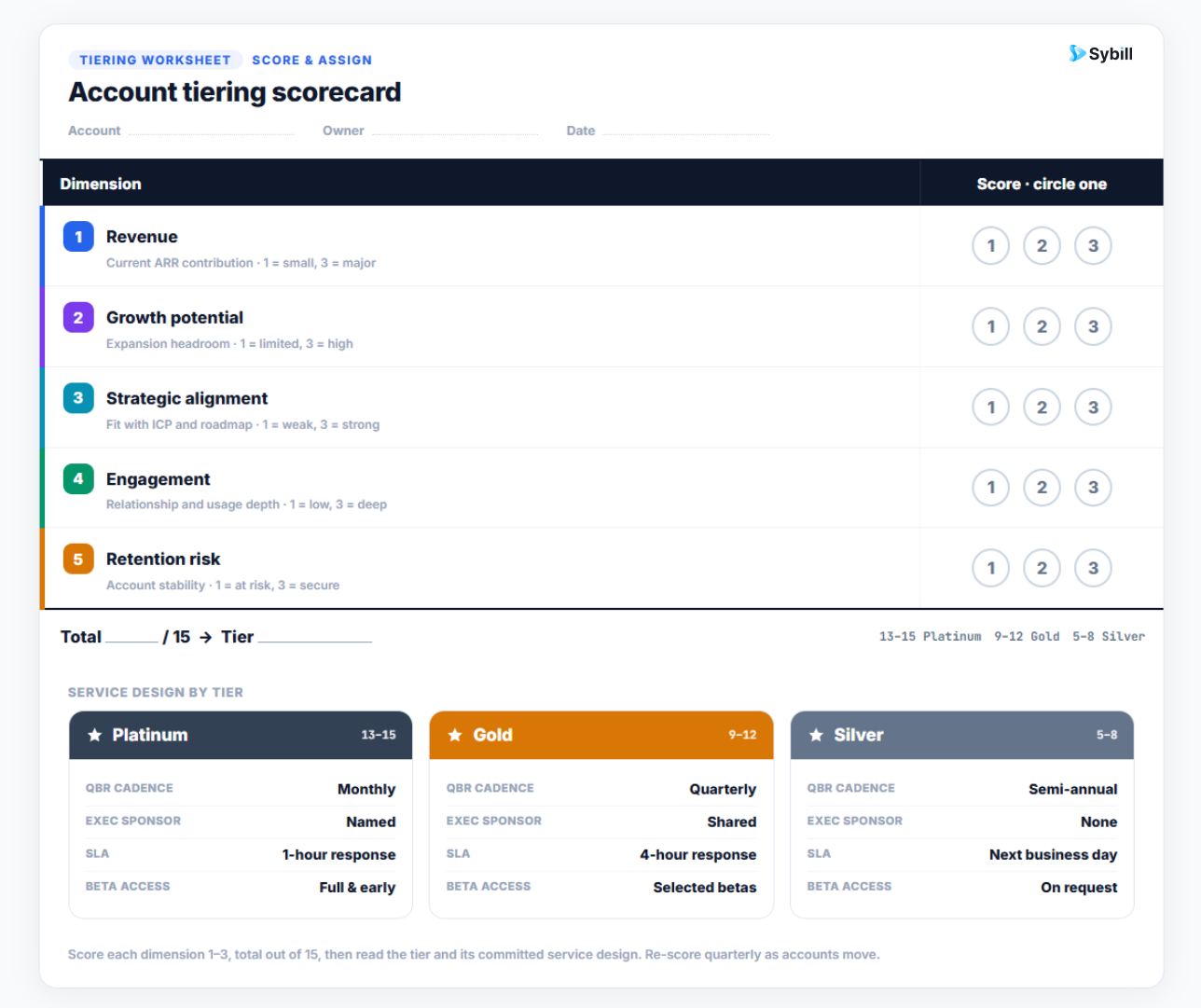
Then tier (Platinum, Gold, Silver works fine) and, critically, write down what each tier gets: executive sponsorship, QBR frequency, support SLA, beta access. Tiering without a service design attached is just labeling. For the fuller strategic frame, our strategic account management guide and the classic Miller Heiman LAMP methodology go deeper on the planning layer; this post stays on the nurturing motion itself.
Because expansion revenue is structurally cheaper and more predictable: existing high-value accounts already trust the product, already cleared procurement, and already know your team, so growing them skips the most expensive stages of a new-logo cycle. The strategic case is just as strong: unattended key accounts are precisely where competitors hunt, and a lost anchor account destabilizes forecasts for quarters.
Let us be adults for a second about the famous acquisition-cost multiples ("5x more!", "6x more!") that usually anchor this argument: those figures trace to decades-old studies laundered through infinite listicles, and you do not need them. Your own numbers make the case better. Compare your CAC and cycle length on a new enterprise logo against the cost of an expansion motion inside an existing account, and check what share of your new revenue already comes from expansion; for most mature B2B books it is a large and growing slice. The math is local, checkable, and more persuasive to your CFO than any borrowed multiple.
The compounding effects stack on top:
Revenue stability. Anchor accounts are the ballast in every forecast; losing one blows a hole that new-logo volume cannot patch mid-year. This is also why net dollar retention is the number investors read first: it measures exactly how well this motion works.
Referral gravity. Well-nurtured enterprise accounts produce champions who change jobs, sit on peer councils, and take reference calls. That pipeline never shows up in the nurture line item, and it is often the best pipeline you have.
Competitive insulation. Every quarter of delivered value, every integration adopted, every co-built roadmap raises the switching cost. Nurture is a moat you dig one QBR at a time.
A working rhythm has four layers: scheduled strategic reviews (QBRs plus an annual roadmap session), a value-beyond-product stream (insights, benchmarks, beta access, peer introductions), continuous account mapping that tracks the real decision graph as people move, and a co-built growth plan with shared milestones. The discipline is that all four run on the calendar, not on inspiration.
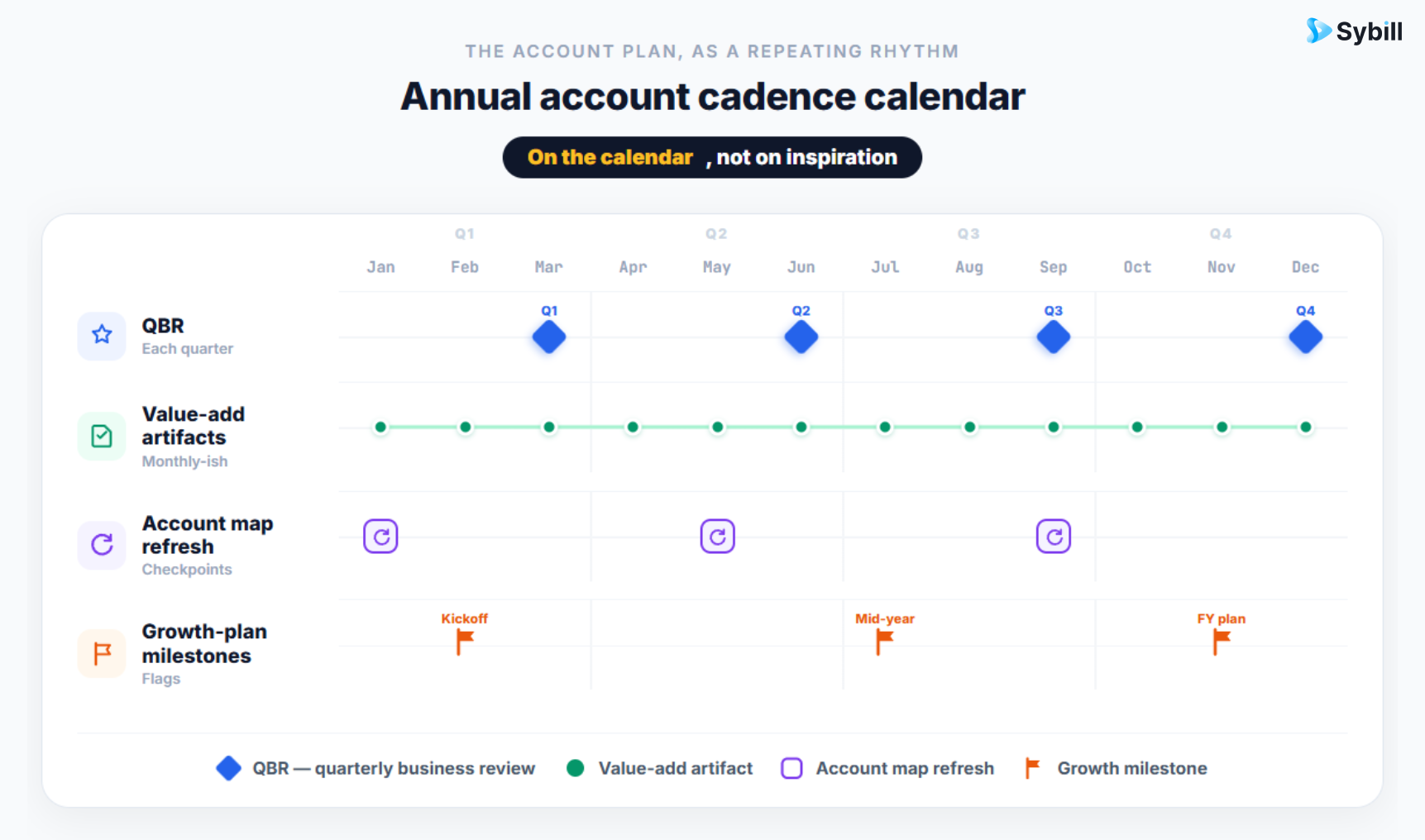
Layer 1: The review cadence. Quarterly business reviews for top-tier accounts, with an honest agenda: value delivered against last quarter's commitments, what changed in their business, what is next. The tell of a mature program is that the QBR contains no surprises for either side, because the ongoing touchpoints already surfaced everything. QBRs where the vendor learns about a reorg they should have caught two months ago are audit failures dressed as meetings.
Layer 2: Value beyond the product. High-value accounts expect a partner, not a vendor with a renewal date. The stream that earns partner status: industry benchmarks relevant to their metrics, early access to betas (which doubles as roadmap co-creation), introductions to peers solving adjacent problems, and the occasional insight memo that has nothing to sell. One genuinely useful artifact per quarter beats a monthly newsletter nobody opens.
Layer 3: Living account maps. Enterprise accounts are organizations, not contacts, and organizations churn people constantly. The decision graph you mapped at close is stale within two quarters: your champion moved, a new VP arrived with her own preferred vendors, procurement changed hands. Keeping the map current used to be manual archaeology; now the raw material accumulates automatically, because every call, attendee list, and mention is in the conversation record, and researching the full stakeholder picture is a query rather than a project.
Layer 4: The co-built growth plan. For the very top tier: a written one-to-three-year plan with the customer, naming shared goals, expansion milestones, and success metrics. This is the single strongest retention artifact that exists, because it converts the relationship from "contract we renew" to "plan we are executing together." Track it in the same place the account's whole history lives, one single source of truth instead of a deck in someone's drive.
And underneath all four layers, the unglamorous foundation: the sales-to-CS handoff that determines whether the nurturing team starts with the account's full story or a two-line note. Nurture programs inherit their ceiling from that handoff.
Your key accounts are telling you how to keep them. On every call. Sybill captures the whole conversation record, so expansion openings and quiet risks surface while there is still time to act. Get started for free with Sybill.
Both signal types live in the conversation record long before they reach a dashboard. Expansion signals: questions about unowned capabilities, new departments joining calls, usage-limit discussions, "can it also do X" moments. Risk signals: shrinking meeting attendance, lengthening response times, a champion gone quiet, competitor names entering the vocabulary. Reading these systematically is the difference between proactive account management and renewal-season surprises.
The honest version of how this works matters, so here it is without the AI mysticism: nobody is reading minds or measuring emotions. What conversation intelligence actually does is make the observable record legible at scale. Concretely:
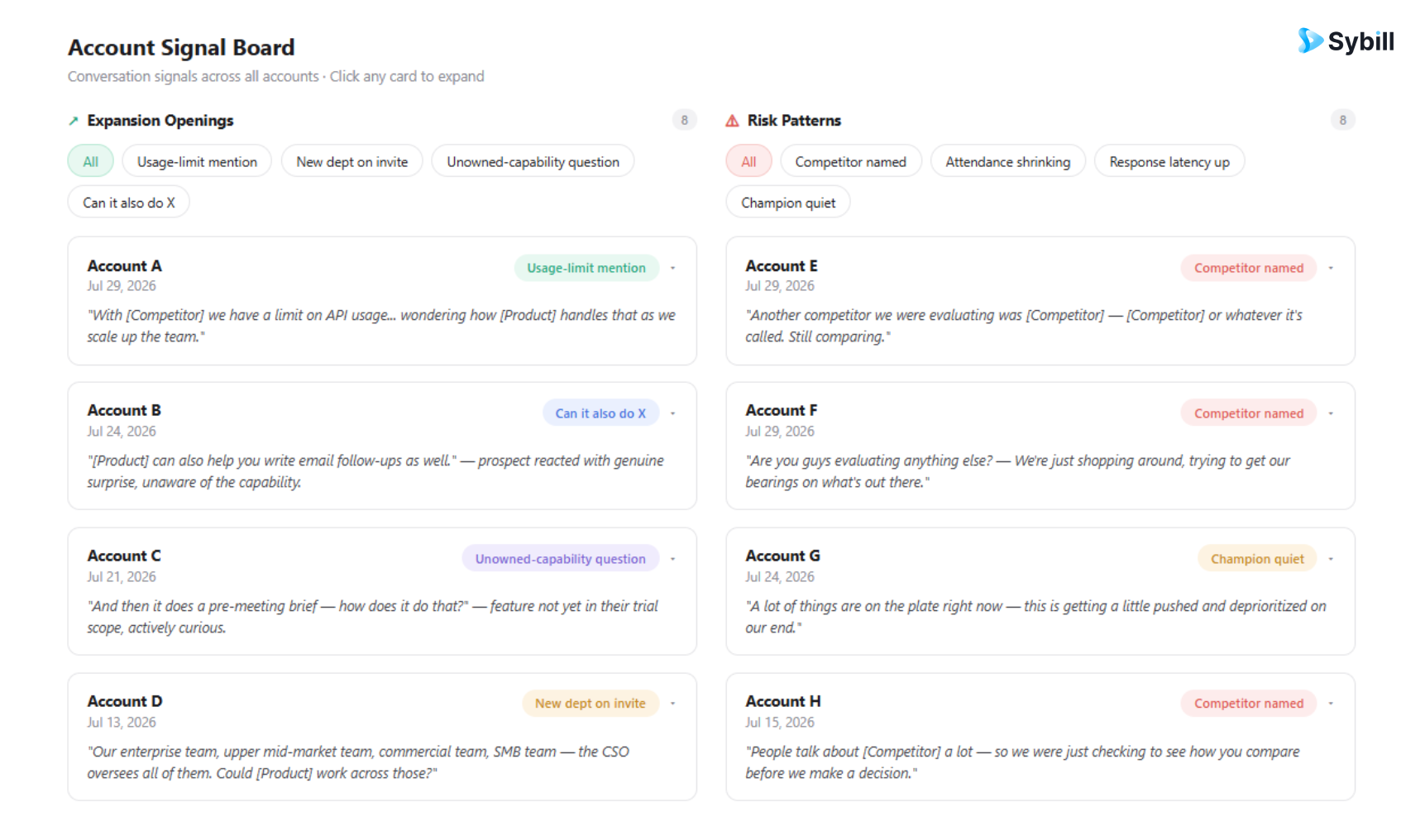
Expansion openings show up as language: a stakeholder from a team you do not serve appearing on an invite, a "we have been thinking about rolling this out to EMEA" aside, a feature question that maps to a higher tier. Individually, easy for a busy AM to lose; across the record, they are queryable. Ask Sybill turns "which of my accounts mentioned needs we have not proposed against?" into an answer instead of a quarterly archaeology dig, and the openings feed straight into upsell and expansion plays.
Risk patterns show up as behavior visible in the record: the VP who attended every QBR sending a delegate twice running, next steps going unconfirmed, response latency stretching, a competitor mentioned by name for the first time (competitor intelligence catches that one the week it happens). Deal inspection rolls these into account-level flags, so intervention starts months before the renewal call instead of during it. The deeper playbook for acting on risk lives in our churn prevention guide and the renewal playbook.
The champion-dependency check deserves its own line, because it is the most common single point of failure in enterprise books: if one person's departure would orphan the account, the account is at risk no matter how healthy every metric looks. The conversation record answers the audit question directly: how many stakeholders have we actually engaged this quarter? Fewer than three is a multithreading task, not a stable account.
Sybill has analyzed over 33 Million sales conversations, and the consistent pattern across them is that both expansion and churn announce themselves in conversation one to two quarters before they show up in revenue. The signal was always there. What changed is that reading it no longer requires a human to re-listen to everything.
Three failure modes account for most broken programs: engagement drift that nobody notices until it is entrenched, competitor courtship of your best accounts while your attention is on new logos, and AM capacity spread so thin that nurturing collapses into renewal administration. The first two are detection problems; the third is an automation problem.
Engagement drift. Accounts rarely announce disengagement; they just attend less, respond slower, and stop asking questions. The fix is making drift measurable (the signals above) and pre-committing the response: when an account's engagement drops below its tier's baseline, a re-engagement play triggers: an executive touchpoint, a value-add artifact, an honest "what has changed on your side?" conversation. The worst response to drift is the "just checking in" email, which signals you noticed nothing and have nothing.
Competitor courtship. Your Platinum accounts are on every rival's target list, permanently. Insulation is the compounding work of the rhythm layers, but detection matters too: competitor mentions in the record are your early warning, and the response is a value-driven counter, not a panic discount. Knowing precisely which claims the competitor is landing (because your calls contain them) turns the counter from generic reassurance into a targeted rebuttal.
Capacity collapse. The quiet killer. An AM covering twenty enterprise accounts cannot run four rhythm layers manually; something gives, and it is always the proactive work, because the reactive work has deadlines. This is where the economics of automation stop being a productivity story and become a coverage story: when summaries, CRM updates, follow-ups, and task tracking run themselves, and pre-meeting briefs compress QBR prep from an afternoon to ten minutes, the same AM covers the same book with the proactive layers intact. The customer success enablement stack exists precisely to make coverage scale without headcount scaling with it.
Here is the reframe worth keeping: a high-value account list is a spreadsheet, but a high-value account strategy is a set of standing commitments: this tier gets this rhythm, these signals trigger these plays, no account rides on one relationship, and the whole history lives where the next person can use it. Teams with the list do heroic saves at renewal time. Teams with the strategy rarely need them.
And the strategy runs on one raw material above all others: memory. Every promise made, every priority the customer voiced, every warning sign and every raised hand for more, spoken out loud across dozens of calls that no human can hold in their head. That memory layer is Sybill's job: captured, structured, queryable, and feeding the plays while the relationship is still warm enough to act on.
The accounts that pay for everything else deserve a system that never forgets them.
Get started for free with Sybill or book a demo and give your key accounts a perfect memory.
An account scoring high on some combination of current revenue contribution, expansion headroom, strategic alignment with your roadmap, engagement level, and value-at-risk. Most enterprise books follow the 80/20 pattern, where a minority of accounts drives the majority of revenue, which makes deliberate tiering the first step of any nurturing program.
Quarterly for top-tier accounts, with an annual strategic roadmap session on top; lower tiers can run semi-annual reviews. Frequency matters less than content: a QBR should review value delivered against commitments and contain no surprises, because ongoing touchpoints already surfaced changes in the account.
Behavioral drift visible in the interaction record: shrinking meeting attendance, senior stakeholders delegating downward, lengthening response times, unconfirmed next steps, a previously engaged champion going quiet, and competitor names entering conversations. These signals typically precede revenue impact by one to two quarters.
Listen for raised hands in the conversation record: questions about capabilities the account does not own, new departments appearing on calls, usage approaching plan limits, and stated initiatives that map to your roadmap. Systematic review of call history surfaces these openings far more reliably than waiting for the customer to ask for a proposal.
Enough that no single departure orphans the account; three actively engaged stakeholders is a practical floor, with top-tier accounts warranting relationships across the champion, economic buyer, and daily-user layers. Audit quarterly: if the interaction record shows fewer than three engaged contacts, multithreading is the next play.
An account scoring high on some combination of current revenue contribution, expansion headroom, strategic alignment with your roadmap, engagement level, and value-at-risk. Most enterprise books follow the 80/20 pattern, where a minority of accounts drives the majority of revenue, which makes deliberate tiering the first step of any nurturing program.
Quarterly for top-tier accounts, with an annual strategic roadmap session on top; lower tiers can run semi-annual reviews. Frequency matters less than content: a QBR should review value delivered against commitments and contain no surprises, because ongoing touchpoints already surfaced changes in the account.
Behavioral drift visible in the interaction record: shrinking meeting attendance, senior stakeholders delegating downward, lengthening response times, unconfirmed next steps, a previously engaged champion going quiet, and competitor names entering conversations. These signals typically precede revenue impact by one to two quarters.