Strategic accounts rarely stall because the team has no plan.
They stall because the plan was built with incomplete information, discussed once and allowed to age while the customer kept changing.
Miller Heiman LAMP gives account teams a structured way to understand important customers, choose where to invest and coordinate long-term action. But the framework only works when the account plan remains connected to what buyers are actually saying, doing and prioritizing.
This guide explains how to build a Miller Heiman LAMP account plan, run strategy sessions, translate the Gold Sheet into action and use AI to keep the underlying customer evidence current.
TL;DR: Miller Heiman LAMP, short for Large Account Management Process, helps sales teams protect and grow strategic accounts. Its three stages are data gathering, strategy sessions and execution. Teams use the Gold Sheet to organize account intelligence, identify strategic opportunities, set relationship and revenue goals and coordinate investments. LAMP works best as a living operating process, not an annual planning document. AI can help capture customer priorities, stakeholder concerns, risks and next steps, but account strategy and customer validation still require human judgment.
The Real Work Begins After Your LAMP Gold Sheet Is Completed
The customer did not freeze when your planning workshop ended.
A new executive may have arrived. A regional team may have changed its priorities. An implementation problem may have weakened confidence. A competitor may have built a relationship your team did not know existed.
If the account plan does not reflect those changes, the team is making strategic decisions with old evidence.
That is the operational challenge behind Miller Heiman LAMP. The framework is structured, but the information feeding it is fluid.
Static account plan
Living LAMP process
Updated before an annual planning session
Updated when material account evidence changes
Built mainly from CRM fields and rep memory
Informed by calls, emails, CRM activity and customer validation
Lists stakeholders by title
Tracks influence, relationships, concerns and changes
Records broad growth ambitions
Connects growth hypotheses to customer outcomes and evidence
Produces actions such as "build executive alignment"
Assigns a specific action, owner, deadline and expected customer outcome
Reviewed because the calendar says so
Reviewed when a risk, opportunity or relationship changes
The goal is not constant administrative updating. It is to make sure the team sees important changes early enough to respond.
What Is Miller Heiman LAMP?
Miller Heiman LAMP stands for Large Account Management Process. It is a strategic account planning methodology designed to help teams manage, protect and grow important customer relationships over time.
Today, LAMP is part of Korn Ferry’s sales methodology portfolio. According to Korn Ferry’s official LAMP overview, the process has three stages:
Static account plan
Living LAMP process
Updated before an annual planning session
Updated when material account evidence changes
Built mainly from CRM fields and rep memory
Informed by calls, emails, CRM activity and customer validation
Lists stakeholders by title
Tracks influence, relationships, concerns and changes
Records broad growth ambitions
Connects growth hypotheses to customer outcomes and evidence
Produces actions such as "build executive alignment"
Assigns a specific action, owner, deadline and expected customer outcome
Reviewed because the calendar says so
Reviewed when a risk, opportunity or relationship changes
LAMP operates at the account level. It is not simply a method for winning one opportunity.
An account may contain several business units, geographic regions, stakeholders, active opportunities and future growth hypotheses. LAMP helps the team understand how those pieces fit together.
If you are building a broader program around account tiers, coverage models and customer segmentation, see Sybill’s guide to strategic account management.
What is the Miller Heiman Gold Sheet?
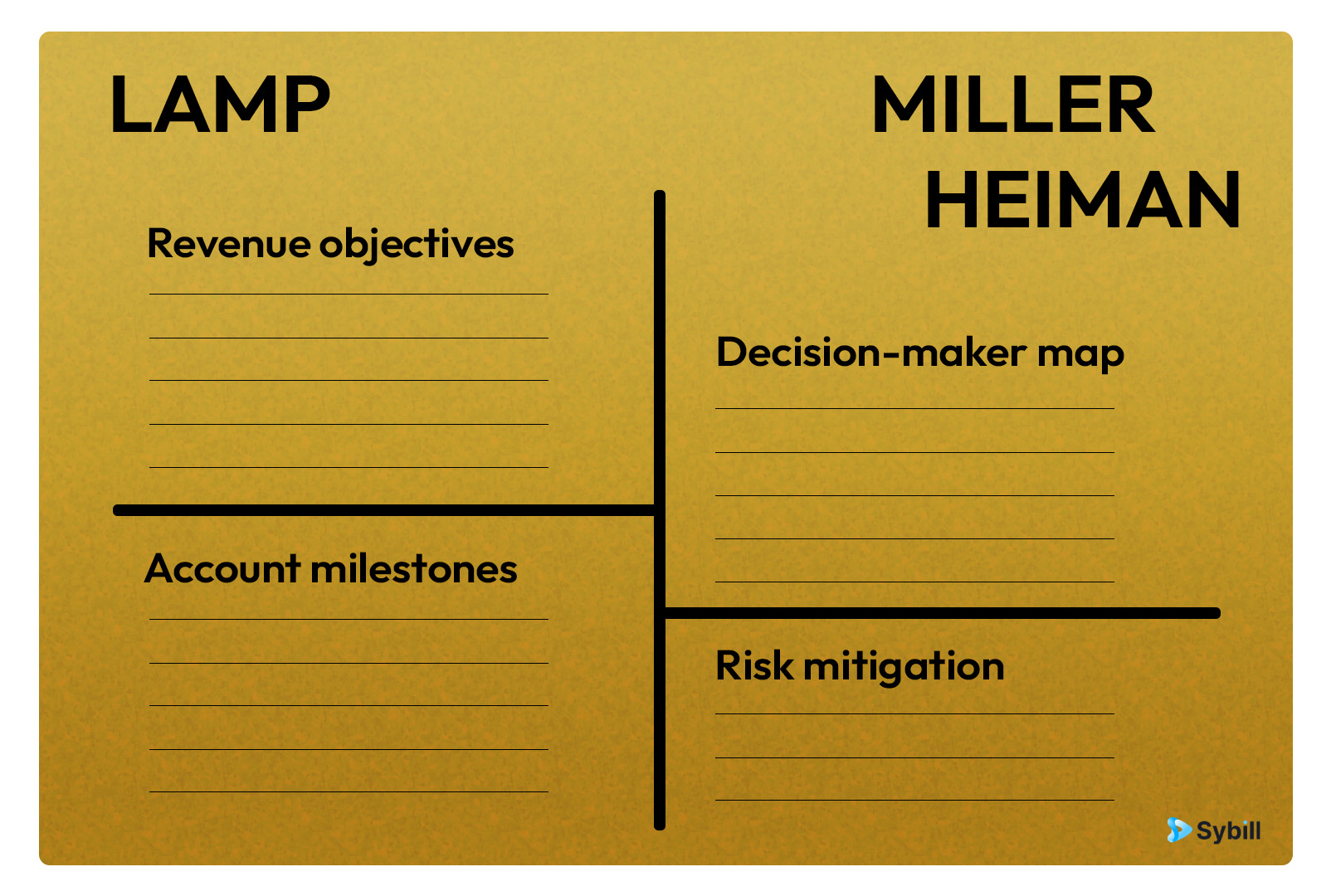
The Gold Sheet is the central planning tool associated with Miller Heiman LAMP. Account teams use it to consolidate their account analysis, strategic direction, relationship goals, revenue objectives and planned investments.
A completed Gold Sheet should help the team answer questions such as:
How does the customer see its relationship with us?
Which business and organizational issues are shaping the account?
Which stakeholders influence our position?
Where are our strongest relationships?
Where are we vulnerable?
Which opportunities deserve investment?
What should we stop doing?
What customer value are we trying to create?
What actions must happen next?
Before You Build a LAMP Plan, Decide Which Accounts Deserve One
LAMP requires real effort. If every customer becomes a “strategic account,” the label stops meaning anything and account managers spend more time maintaining plans than improving customer outcomes.
Start by defining a transparent selection rubric.
Selection factor
Question to ask
Evidence to review
Current value
Is the account already commercially significant?
Revenue, margin, product adoption and renewal exposure
Future potential
Is there a credible path to additional customer value and revenue?
Customer initiatives, unmet needs, addressable teams and regions
Strategic fit
Does the account align with your product, market and long-term direction?
Use cases, industry fit and roadmap alignment
Mutual value
Can both companies benefit from a deeper relationship?
Customer outcomes, joint initiatives and executive interest
Relationship potential
Can you build access beyond one contact or department?
Stakeholder coverage, sponsorship and cross-functional engagement
Delivery fit
Can your organization deliver what the account will require?
Product capability, services, security and implementation capacity
Resource return
Does the likely value justify additional attention and investment?
Expected upside, risk, cost to serve and strategic learning
Do not use account size alone. A large customer with weak product fit, limited access and low mutual value may consume strategic resources without becoming a strategic partnership.
Likewise, a smaller account entering a major transformation may warrant focused planning if your company can create meaningful, measurable value.
How to Build a Miller Heiman LAMP Account Plan
The official LAMP stages provide the structure. The steps below turn that structure into an operating workflow.
Stage 1: Gather Account Intelligence
The purpose of data gathering is not to fill every available box. It is to create a shared, defensible view of the account.
That means separating facts from assumptions.
Step 1: Define the field of play
Before discussing growth, agree on the boundaries of the account.
Clarify:
Which legal entities, subsidiaries and business units are included?
Which regions and departments currently use your product?
Which teams are outside the current relationship?
Which active opportunities sit within the account?
Which partners or competitors influence the customer?
Which internal teams own the customer relationship?
What planning period will the account strategy cover?
Without a clear field of play, one team may be discussing a regional renewal while another assumes the plan covers a global expansion.
Step 2: Build the current account picture
Create a concise account narrative that explains what is happening now.
Useful questions include:
What outcomes did the customer originally expect?
Which outcomes have been achieved?
Where is value still unproven?
What has changed in the customer’s business?
Which initiatives are receiving executive attention?
What problems are creating cost, risk or delay?
How does the customer describe your company?
What concerns or objections appear repeatedly?
Which competitors or internal alternatives are being considered?
What commitments have been made by each side?
Which decisions are approaching?
Answers should be traceable to evidence wherever possible. “The customer wants to expand” is a weak observation. “The VP of Revenue Operations asked for a regional workflow assessment before the September planning cycle” is usable account intelligence.
Step 3: Map stakeholder relationships
An org chart is not a relationship map.
A stakeholder can hold a senior title and have little influence over your initiative. Another person may have no budget authority but can make implementation impossible.
For each important stakeholder, document:
Stakeholder dimension
What to capture
Role
Their formal responsibility in the customer organization
Influence
How strongly they affect account or initiative decisions
Current position
Supportive, neutral, resistant or unknown
Priorities
Outcomes, pressures or risks that matter to them
Relationship strength
Strength of your team's access and trust
Internal owner
The person on your team responsible for the relationship
Evidence gap
What the team still needs to learn or validate
Next action
The specific interaction required
Do not assign support levels from intuition alone. Validate them through direct interactions, observed behavior and multiple sources inside the account.
Step 4: Assess your position and critical vulnerability
Your current revenue does not automatically equal a strong strategic position.
Ask:
Where does the customer depend on us today?
Where could the customer replace or reduce us?
Which stakeholder relationships are concentrated around one person?
Where has a competitor built stronger executive access?
Which customer outcomes remain undocumented?
What delivery problems could weaken trust?
What happens if our internal champion leaves?
Which initiatives depend on capabilities we cannot provide?
What information would materially change our strategy?
A critical vulnerability is not every possible risk. It is a weakness that could substantially damage the account if it remains unresolved.
Examples include:
No relationship with the executive who owns the transformation
Heavy dependence on one champion
Poor adoption in the customer’s largest region
No verified proof of business value
A competitor embedded in the customer’s preferred workflow
Expansion assumptions that have not been validated with buyers
Separate account signals from real opportunities
A product mention is not an expansion opportunity.
A credible opportunity normally needs:
A confirmed customer need
A meaningful business outcome
A stakeholder who owns or cares about that outcome
A solution that can realistically help
A decision route
A reason to act within a defined period
This distinction prevents account teams from filling strategic plans with speculative pipeline.
For additional guidance on turning customer signals into responsible growth plays, see Sybill’s guide to upsell and expansion plays.
Stage 2: Run the LAMP Strategy Session
A good strategy session is not a presentation by the account owner. It is a working session in which the team challenges assumptions and makes choices.
Participants may include the account executive, account manager, customer success manager, solutions consultant, executive sponsor, services lead and relevant regional owners.
Step 5: Write an account charter
The charter explains why the account matters and what the team intends to accomplish together with the customer.
A useful account charter should include:
The customer outcomes the team wants to support
The scope of the relationship
The desired future position
The planning period
The mutual value expected
The boundaries of the strategy
A weak charter says:
Become the customer’s trusted strategic partner.
A stronger charter says:
Over the next 18 months, help the customer standardize its revenue workflow across three regions while improving CRM data quality and reducing manual sales administration.
The second version creates a basis for customer validation and measurable action.
Step 6: Make Focus and Stop decisions
Strategy requires saying no.
During the session, identify investments that deserve additional time, resources or executive support. Then identify activities that should stop because they do not advance customer outcomes or improve your account position.
Focus investments
Stop investments
Build access to global IT and finance leaders
Run generic product demonstrations without a validated use case
Quantify the business impact of current adoption
Pursue speculative expansion based on weak signals
Design a regional pilot around a confirmed priority
Send broad executive outreach without a clear customer purpose
Resolve a recurring implementation risk
Maintain duplicate account plans across disconnected systems
Strengthen relationships beyond one champion
Treat every positive comment as buying intent
If the account plan contains only things the team will do, it is a task list. The Stop decisions reveal whether the team has made a genuine strategic choice.
Step 7: Set relationship goals, revenue targets and strategic initiatives
These three elements should support one another, but they are not interchangeable.
Planning element
Example
Validation required
Relationship goal
Establish a working relationship with the global IT sponsor
The sponsor accepts engagement around a relevant initiative
Customer outcome
Improve CRM data consistency across three regions
Customer confirms the baseline and desired improvement
Strategic initiative
Run a regional workflow and governance pilot
Scope, owners and success measures are agreed
Revenue target
Grow the account from $480,000 to $900,000 in 18 months
Upside is tied to validated value milestones and buying processes
Risk-reduction goal
Reduce dependence on a single operational champion
Multiple relevant relationships become active
Revenue targets matter, but they should follow the customer-value logic. A target without a credible path is an internal aspiration, not an account strategy.
Stage 3: Turn the Strategy Into Execution
Account plans fail when thoughtful analysis produces vague follow-up.
“Meet more senior stakeholders” is not an action.
“Jordan will ask the VP of Revenue Operations to introduce Priya to the global IT lead before the September governance workshop” is an action.
Step 8: Build the account action plan
Each action should specify:
What will happen
Why it matters
Who owns it
Who else must participate
The expected customer outcome
The due date
The evidence that will confirm completion
The next decision triggered by the result
A practical action register might look like this:
Action
Owner
Due date
Customer purpose
Completion evidence
Validate the global workflow problem with regional sales leaders
Account executive
September 12
Confirm whether regional inconsistency is material
Notes from three customer interviews
Document current CRM data-quality baseline
Solutions consultant
September 20
Establish measurable starting point
Customer-approved baseline
Resolve security requirements for a regional pilot
Security lead
October 3
Reduce implementation risk
Agreed security checklist
Build an executive outcome review
Executive sponsor
October 15
Connect the initiative to strategic priorities
Meeting held and next decision documented
Step 9: Establish a review cadence
The plan should change when the account changes, not when the calendar tells you to open the deck.
Use several review layers:
Weekly: Open actions, customer commitments, immediate risks and upcoming meetings
Monthly: Stakeholder changes, opportunity evidence, relationship coverage and initiative progress
Quarterly: Account charter, strategic position, Focus and Stop investments, customer outcomes and revenue targets
Trigger-based: Executive change, acquisition, restructuring, major implementation issue, competitive entry, new initiative or champion departure
The full account team does not need to attend every update. Match the meeting to the decision being made.
Miller Heiman LAMP Example: Acme Group
The following account is fictional, and all values are illustrative.
Apex Revenue Systems currently supports Acme Group’s North American sales organization. The account is worth $480,000 in annual recurring revenue.
Adoption is healthy, but the relationship is concentrated within one regional Revenue Operations team. Acme is now considering a broader CRM standardization program across Europe and Asia-Pacific.
The account team identifies three customer priorities:
Standardize revenue workflows across regions
Improve CRM data quality
Reduce manual administration for sales teams
The team also identifies a major vulnerability: Apex has no active relationships with Acme’s global IT, finance or regional sales leaders.
The account charter
Over the next 18 months, help Acme standardize revenue workflows across North America, Europe and Asia-Pacific while improving CRM data quality and reducing manual sales administration.
Focus investments
Secure executive alignment around the global program
Run a cross-regional workflow diagnostic
Design a limited regional pilot
Address security and data-governance requirements early
Quantify the operational impact of the existing deployment
Stop investments
Generic demonstrations without confirmed regional requirements
Expansion proposals based only on North American adoption
Executive outreach that lacks a relevant customer purpose
Revenue forecasting before the buying process is understood
The first 90 days
Current evidence
Strategy choice
Action
Owner
Expected customer evidence or outcome
North American adoption is strong, but business impact is not quantified
Build a defensible value baseline
Conduct an outcome review with Revenue Operations
Customer success manager
Customer confirms value achieved and gaps remaining
Regional leaders use different processes
Validate whether standardization is a priority
Interview three regional sales leaders
Account executive
Shared problems and regional differences are documented
Global IT owns governance but has no relationship with Apex
Build technical sponsorship early
Request an introduction through the VP of Revenue Operations
Executive sponsor
Discovery meeting with global IT is scheduled
Security requirements are unknown
Reduce implementation uncertainty
Run an early security and architecture review
Solutions consultant
Requirements and blockers are documented
Expansion potential is estimated at $900,000
Tie revenue upside to customer milestones
Build a milestone-based commercial path
Account manager
Customer agrees on pilot scope and success criteria
The $900,000 target is not treated as committed pipeline. It remains a planning hypothesis until the customer confirms the need, stakeholders, process and value milestones.
That distinction protects forecast quality and customer trust.
Gold Sheet vs. Blue Sheet vs. Green Sheet
Miller Heiman tools operate at different levels of the sales process. Confusing them can lead to an account strategy that is too opportunity-focused or an opportunity plan that is too broad.
Tool
Methodology context
Planning level
Central question
Gold Sheet
LAMP
Strategic account
How do we protect, develop and grow this account over time?
Blue Sheet
Strategic Selling
Individual sales opportunity
How do we improve our position and win this opportunity?
Green Sheet
Conceptual Selling
Individual customer meeting
How do we understand the customer's concept and create a productive meeting?
The Gold Sheet may contain several opportunities. A Blue Sheet focuses on one complex opportunity within that account. A Green Sheet helps prepare for a particular customer interaction.
SPIN Selling can also support discovery conversations, but it remains a distinct methodology. See the SPIN Selling guide for its Situation, Problem, Implication and Need-payoff questioning structure.
How AI Keeps a LAMP Account Plan Current
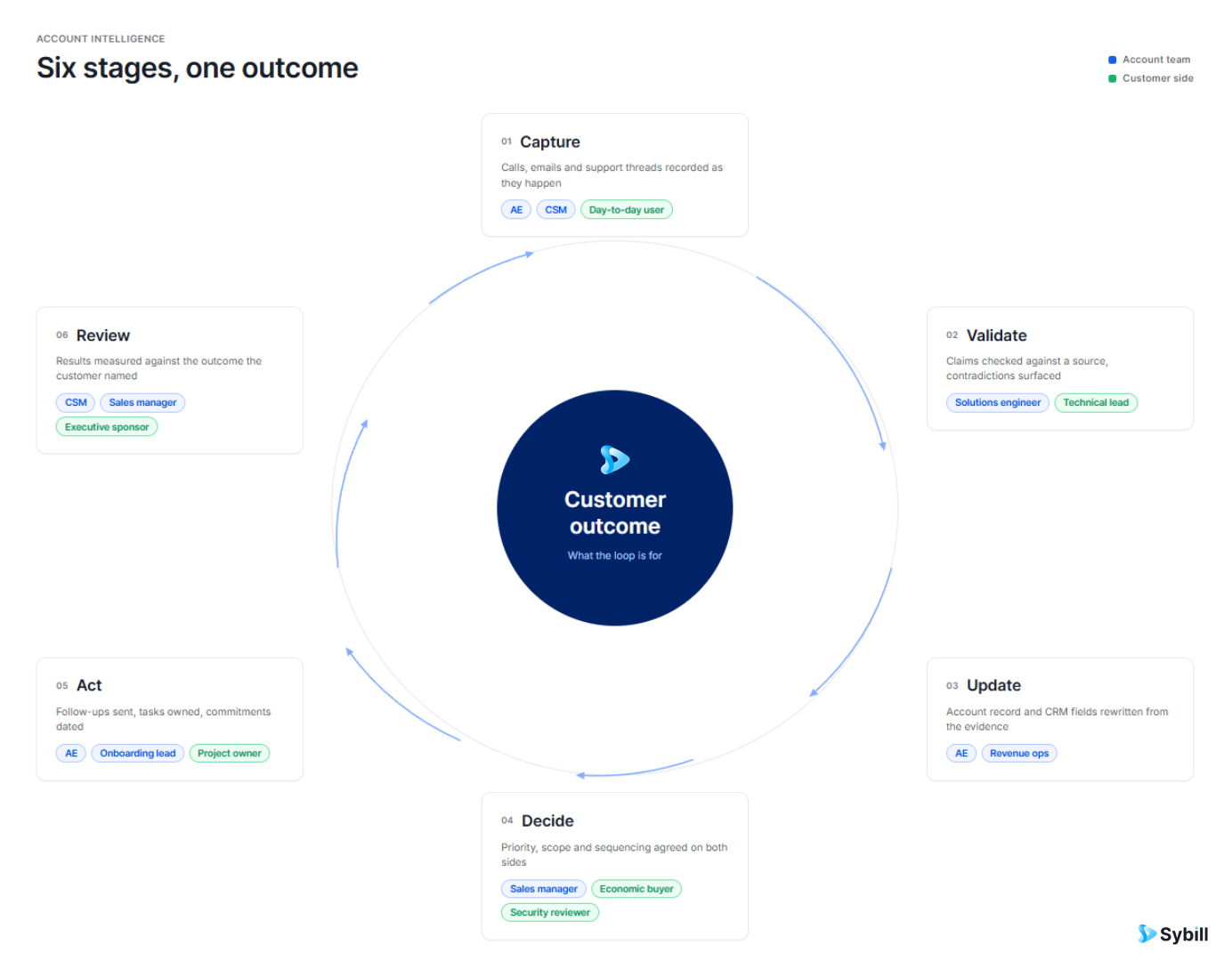
AI is useful when it reduces the distance between customer conversations and account decisions.
It should not independently decide which accounts matter, label people as supporters or commit the customer to an initiative. Those decisions require context, judgment and customer validation.
It can help account teams retrieve and organize evidence more consistently.
LAMP activity
How Sybill can help
Human or system responsibility
Prepare for customer meetings
Pre-Meeting Briefs bring together previous interactions, CRM context, attendee information and open tasks
Account owner chooses the meeting objective and validates context
Capture priorities and risks
Magic Summaries can summarize outcomes, buyer needs, objections and next steps
Seller reviews the summary and confirms important interpretations
Retrieve account history
Ask Sybill lets teams query calls, emails and connected account context
Team decides how the evidence affects account strategy
Maintain execution context
CRM Autofill and AI Tasks can update fields and capture agreed actions
CRM remains the system of record, and action owners remain accountable
Coordinate opportunity work
Deal Workspace keeps deal-specific context, risks and actions accessible
The account team connects opportunity work to the larger LAMP plan
Review progress
Deal Inspection can surface recurring risks or gaps
Sales leaders coach the team and approve strategic changes
Sybill helps account teams keep the customer evidence and execution surrounding an account plan from becoming stale.
For strategic accounts, that evidence may include:
Repeated customer priorities across multiple meetings
Concerns raised by different stakeholders
Unresolved implementation risks
Commitments made by the customer and seller
Changes in stakeholder participation
Questions that remain unanswered
Next actions without owners
New initiatives mentioned across calls and emails
Before an account review, the team should not have to spend two hours reconstructing what happened since the last meeting.
Your LAMP strategy session should begin with decisions, not detective work. See how Sybill brings customer conversations, CRM context, stakeholder information and open actions into searchable deal memory.
How to Evaluate Technology for LAMP Account Planning
A tool should make account planning easier to maintain and more useful to the team. It should not create another disconnected document.
When evaluating technology, ask whether it can:
Connect to the CRM your team already uses
Retrieve account context from customer conversations
Separate account-level and opportunity-level work
Preserve the source behind important claims
Support shared action ownership
Surface stakeholder and relationship gaps
Let teams customize summaries for different meeting types
Control access to sensitive customer information
Support the languages and regions your strategic accounts require
Fit existing security and governance requirements
Make account information accessible before customer meetings
Reduce duplicate manual entry
Watch for warning signs:
Account recommendations do not show supporting evidence
The tool requires teams to maintain a second CRM
Summaries cannot be reviewed or corrected
The product treats every keyword mention as buying intent
The workflow cannot distinguish an account plan from an opportunity plan
It encourages automation without clear human ownership
A practical evaluation should use a real but anonymized account workflow. Ask the vendor to retrieve customer priorities, identify unresolved risks, show open actions and prepare an account manager for the next meeting.
Bring an anonymized strategic-account workflow to a Sybill demo. Test how quickly your team can retrieve customer priorities, stakeholder concerns, unresolved risks and agreed next actions from calls, emails and CRM context.
A 30-60-90-Day LAMP Implementation Plan
Do not launch LAMP across every account at once. Start with a controlled group and learn where the process breaks.
Period
Primary objective
Recommended actions
Evidence of progress
Days 1-30
Establish the operating model
Define strategic-account criteria, select pilot accounts, assign account teams, obtain authorized LAMP training and templates, and agree on data sources
Pilot list, ownership model and baseline account plans
Days 31-60
Run strategy sessions
Gather customer evidence, map relationships, identify vulnerabilities, write charters and make Focus and Stop decisions
Completed strategy sessions with documented choices
Days 61-90
Execute and inspect
Launch account actions, review customer responses, update plans when evidence changes and inspect adoption with sales managers
Owned actions, customer validation and revised account strategies
During the pilot, review the process itself:
Which account fields were useful?
Which sections became administrative?
Where did teams rely on assumptions?
Which evidence was difficult to retrieve?
Did strategy sessions produce clear Stop decisions?
Were actions linked to customer outcomes?
Did managers use the plan in coaching?
Did teams update the plan after meaningful account changes?
The goal is better account judgment and coordinated execution.
How to Measure Whether LAMP Is Working
Revenue growth matters, but it is a lagging result. Teams also need leading indicators that show whether their account position is improving.
Leading indicators
Percentage of strategic accounts with a customer-value charter
Percentage of account claims supported by customer evidence
Stakeholder coverage across business, technical and executive roles
Number of relationships dependent on a single champion
Percentage of actions with owners and due dates
Completion rate for customer-facing account actions
Time between an important account change and plan update
Number of customer-validated initiatives
Reduction in unverified expansion assumptions
Frequency of manager-led account strategy reviews
Lagging indicators
Retention and renewal rate
Net revenue retention
Expansion revenue
Product adoption
Customer outcome achievement
Strategic-account margin
Forecast accuracy for account opportunities
Sales cycle length for expansion initiatives
Do not reward teams for adding stakeholders or actions without considering their quality. A meeting with an executive is useful only when it advances a relevant customer objective.
Common Miller Heiman LAMP Mistakes
Mistake
Why it causes problems
Better practice
Selecting too many strategic accounts
Resources become diluted
Use a documented selection rubric
Treating the Gold Sheet as a yearly form
Information becomes stale
Update the plan when material evidence changes
Mapping titles instead of influence
The team misreads the buying and relationship landscape
Validate influence, concerns and relationships
Confusing interest with opportunity
Pipeline becomes speculative
Require confirmed need, value, ownership and decision route
Setting revenue targets before customer outcomes
The plan becomes seller-centric
Build targets from a credible mutual-value path
Avoiding Stop decisions
Resources remain spread across low-value activity
Explicitly remove investments
Assigning vague actions
No one is accountable
Name the action, owner, due date and expected outcome
Allowing AI to make strategic judgments
Unverified interpretations enter the plan
Use AI to organize evidence and humans to decide
Mixing account and opportunity planning
Long-term strategy becomes dominated by one deal
Use the right planning level and tool
Ignoring delivery and customer success
Expansion outpaces the ability to create value
Include implementation, adoption and success evidence
Make LAMP a Process, Not a Planning Event
Miller Heiman LAMP gives enterprise account teams a disciplined way to gather intelligence, make strategic choices and execute across complex relationships.
The Gold Sheet is valuable because it makes the team’s account thinking visible. But visibility is not enough. The underlying evidence must stay current, strategic choices must be explicit and actions must remain connected to customer outcomes.
That requires three habits:
Capture what customers actually say and do
Validate assumptions before treating them as strategy
Update the plan when the account changes
LAMP provides the account strategy. Sybill helps keep the customer evidence and execution behind that strategy current.
Book a Sybill demo to see how your account teams can prepare for meetings, retrieve customer context and keep agreed actions from disappearing between account reviews.
Frequently Asked Questions About Miller Heiman LAMP
What does LAMP stand for in Miller Heiman?
LAMP stands for Large Account Management Process. It is a Miller Heiman methodology for planning, managing, protecting and growing strategically important customer accounts.
What are the three stages of Miller Heiman LAMP?
The three stages are data gathering, strategy sessions and execution. Teams first build a shared account picture, then make strategic choices and finally translate those choices into owned actions.
What is the Miller Heiman Gold Sheet?
The Gold Sheet is the proprietary account-planning tool used with Miller Heiman LAMP. It helps teams organize account intelligence, analyze their position, establish goals and coordinate strategic investments and actions.
What is the difference between the Gold Sheet, Blue Sheet and Green Sheet?
The Gold Sheet supports long-term account planning through LAMP. The Blue Sheet supports strategy for an individual complex opportunity. The Green Sheet helps sellers plan an individual customer meeting within Conceptual Selling.
How often should a LAMP account plan be updated?
Teams should review open actions weekly, inspect account intelligence monthly and revisit the full strategy quarterly. They should also update the plan when material events occur, such as an executive change, competitive entry, restructuring or major delivery problem.
Can AI automate Miller Heiman LAMP?
AI can help capture conversations, retrieve account history, summarize buyer priorities and maintain actions. It should not independently choose strategic accounts, assign stakeholder influence or make final account strategy decisions.
Does Sybill replace the Miller Heiman Gold Sheet?
No. Sybill does not provide the official Gold Sheet or replace authorized LAMP training. It can help account teams retrieve and organize the customer evidence, meeting context and follow-up actions that support their account-planning process.
Get started with Sybill
Accelerate your sales with your personal assistant
Oops! Something went wrong while submitting the form.
Frequently Asked Questions
What does LAMP stand for in Miller Heiman?
LAMP stands for Large Account Management Process. It is a Miller Heiman methodology for planning, managing, protecting and growing strategically important customer accounts.
What are the three stages of Miller Heiman LAMP?
The three stages are data gathering, strategy sessions and execution. Teams first build a shared account picture, then make strategic choices and finally translate those choices into owned actions.
What is the Miller Heiman Gold Sheet?
The Gold Sheet is the proprietary account-planning tool used with Miller Heiman LAMP. It helps teams organize account intelligence, analyze their position, establish goals and coordinate strategic investments and actions.




%20(76).png)