Find us at booth #83, join us for a harbor side happy hour, or catch Gorish’s talk.

Sept, 16-18 > Learn more

%20(1).avif)
Mamta Tainwala

June 22, 2026
%20(9).png)
You retain your best sales reps by improving employee satisfaction and engagement, not just pay: prioritize well-being, build trust through real communication, lead authentically, recognize good work, offer flexibility, create clear growth paths, and remove busywork so reps spend time selling. The teams that keep their top performers treat retention as a daily management practice, not an annual scramble after someone resigns.
This matters because sales turnover is brutally expensive. Voluntary turnover in sales runs far higher than the cross-industry average, and replacing a single rep can cost between half and twice their annual salary once you factor in recruiting, onboarding, lost productivity, and the client relationships that walk out the door with them. The good news: most voluntary departures are preventable with the strategies below.
You retain your best sales reps by addressing the two things underneath every resignation: satisfaction and engagement. Satisfaction is the baseline (do reps feel secure, fairly paid, and supported), and engagement is the upside (do they feel motivated, recognized, and connected to the work). Pay matters, but it is rarely the deciding factor on its own.
Retention is not a single program you launch; it is the cumulative result of how reps are managed every week. A rep who feels heard in their 1:1s, sees a path to grow, gets recognized for good work, and is not drowning in administrative busywork has far fewer reasons to take a recruiter's call. The sections below break down the why, then give you seven concrete strategies.
Sales reps quit primarily because of poor management, lack of recognition, no clear path to advancement, burnout from unrealistic workloads, and a culture they no longer believe in. Compensation is a factor, but it is usually the reason reps cite last, not first.
The pattern is consistent across research: people leave managers, not companies. A rep who feels micromanaged, ignored, or stuck will start looking even if the pay is competitive. Burnout is the other major driver, and in sales it is often self-inflicted by the role's structure, with reps spending hours on manual note-taking, CRM updates, and follow-up emails instead of the selling they were hired to do. Understanding which of these is driving departures at your company is the first step to fixing it.
Employee satisfaction drives retention by giving reps reasons to stay that money alone cannot buy. When people feel genuinely cared for beyond their working hours, they form a stronger attachment to the workplace and are far less likely to leave.
Reps stick around for more than a salary. Job security, solid health benefits, humane working conditions, and supportive managers combine into the loyalty that no counteroffer easily breaks. Treating well-being as a real priority, rather than a perk page, signals that the company values the person, not just the quota.
Trust is built through communication, and most of it comes down to actually listening. When a rep raises a concern or shares an idea, genuinely hearing them, showing you understand, and then advocating for them internally is what turns a transactional relationship into a loyal one. Reps who trust their manager give the benefit of the doubt during hard quarters instead of heading for the door.
Engagement keeps reps loyal by making the work itself rewarding. An engaged rep contributes enthusiastically, takes ownership, and feels part of something, which is far stickier than satisfaction alone. Engagement is built on three things: authentic leadership, a positive environment, and consistent recognition.
Authentic leadership means leaders being honest, reliable, and human, owning their actions and admitting what they do not know. When leaders show up as real people rather than performance machines, reps feel safe to do the same, and that psychological safety is one of the strongest predictors of whether someone stays.
A positive environment makes collaboration feel energizing rather than draining. It eases the Monday slump, makes meetings productive, and turns the team into a place people want to be. Culture is not built by ping-pong tables; it is built by how people treat each other under pressure.
The seven best sales team retention strategies are: prioritize well-being, build trust through communication, lead authentically, create a culture of recognition, promote work flexibility, craft growth opportunities, and strengthen connection in remote teams. Used together, they address both satisfaction and engagement.
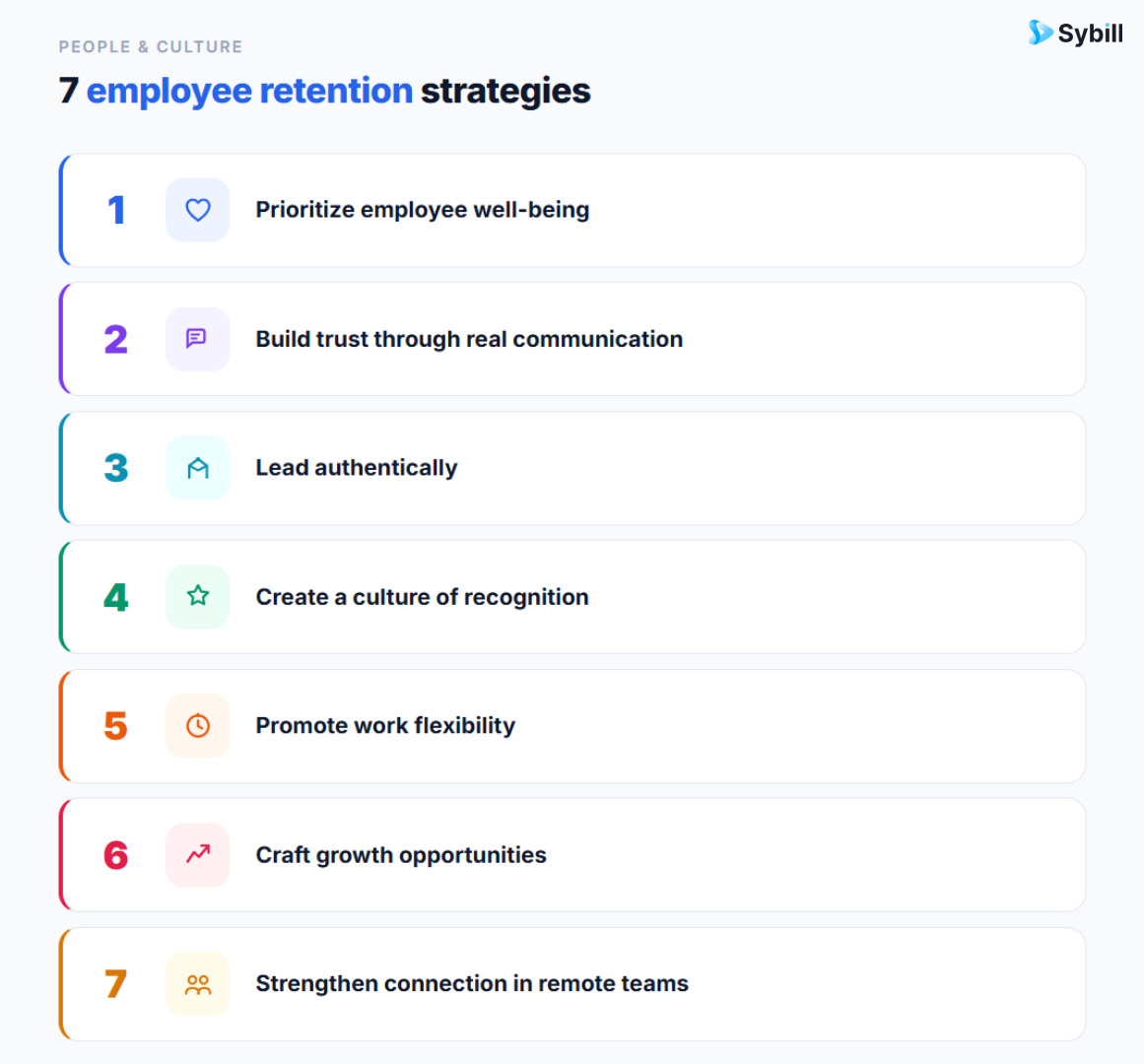
1. Prioritize employee well-being. Treat security, benefits, and humane workloads as non-negotiable foundations, not perks.
2. Build trust through real communication. Listen to concerns, empathize, and advocate for your reps internally so they know you have their back.
3. Lead authentically. Be honest and human; model the openness you want from the team.
4. Create a culture of recognition. Acknowledge good work specifically and often. A genuine "great job on that demo, the discovery questions were sharp" costs nothing and lands hard. Recognition is one of the strongest, cheapest retention levers available.
5. Promote work flexibility. Whether it is a compressed week, remote options, or control over hours, flexibility signals trust and respects that reps have lives beyond the pipeline.
6. Craft growth opportunities. Give reps a visible path forward through stretch projects, leadership tracks, and upskilling. People stay when they can see who they are becoming, not just what they are billing.
7. Strengthen connection in remote teams. Use regular 1:1s, virtual team building, and collaborative spaces to keep distributed reps bonded to the team and the mission.
Get started for free with Sybill
Burnout from admin is a retention problem hiding in plain sight. Sybill takes note-taking, follow-ups, and CRM updates off your reps' plates with Magic Summary and CRM Autofill, so they spend their time selling, not typing. Get started for free with Sybill →
Sales turnover costs far more than most leaders budget for: replacing a single rep can run between 50 and 200 percent of their annual salary once recruiting, onboarding, ramp time, lost productivity, and damaged client relationships are included. Voluntary turnover in sales also runs well above the cross-industry average.
The hidden costs are the expensive ones. An open territory erodes revenue every day it sits empty. A departing rep takes institutional knowledge and warm client relationships with them, and the replacement needs months to ramp before producing at full capacity. This is why prevention is so much cheaper than replacement, and why the strategies above pay for themselves quickly when they keep even one top performer from leaving.
AI helps with sales retention by removing the administrative busywork that drives burnout, freeing reps to spend their time on the selling they actually find rewarding. The role's manual overhead, including note-taking, CRM updates, and follow-up emails, is one of the biggest and most fixable sources of rep frustration.
This is where Sybill acts as the post-conversation execution layer. After every call, Magic Summary captures the conversation and key takeaways, personalized email follow-ups are drafted in the rep's own voice, and CRM Autofill updates fields automatically. For managers, coaching and performance insights make 1:1s more substantive and recognition more specific, both of which directly support retention. As Sybill CEO Gorish Aggarwal puts it, the goal is to give reps their time back so they can focus on customers instead of admin.
Sales reps most often leave because of poor management, lack of recognition, no clear growth path, burnout from heavy workloads, and weak culture. Compensation plays a role but is rarely the primary driver, which is why pay raises alone often fail to stop attrition.
There is no single silver bullet, but recognition consistently delivers the highest return for the lowest cost. Reps who feel their work is genuinely seen and appreciated are significantly less likely to leave, and meaningful recognition requires only consistent attention from managers.
Replacing a sales rep can cost between 50 and 200 percent of their annual salary once recruiting, onboarding, ramp time, lost productivity, and disrupted client relationships are included. The cost rises with the seniority and tenure of the departing rep.
No. Competitive pay is necessary but not sufficient. Reps regularly leave well-paying roles over poor management, burnout, or a lack of growth, which is why satisfaction and engagement strategies matter as much as compensation.
Manual note-taking, CRM updates, and follow-ups are a major source of burnout in sales. Automating that busywork lets reps spend more time on the selling they find rewarding, which improves both job satisfaction and the morale that keeps people around.
Managers are the single biggest factor. People tend to leave managers rather than companies, so a manager who listens, recognizes good work, removes obstacles, and supports growth is the most powerful retention asset a sales organization has.
Sales reps most often leave because of poor management, lack of recognition, no clear growth path, burnout from heavy workloads, and weak culture. Compensation plays a role but is rarely the primary driver, which is why pay raises alone often fail to stop attrition.
There is no single silver bullet, but recognition consistently delivers the highest return for the lowest cost. Reps who feel their work is genuinely seen and appreciated are significantly less likely to leave, and meaningful recognition requires only consistent attention from managers.
Replacing a sales rep can cost between 50 and 200 percent of their annual salary once recruiting, onboarding, ramp time, lost productivity, and disrupted client relationships are included. The cost rises with the seniority and tenure of the departing rep.