Find us at booth #83, join us for a harbor side happy hour, or catch Gorish’s talk.

Sept, 16-18 > Learn more


Tamanna Mishra

April 17, 2026
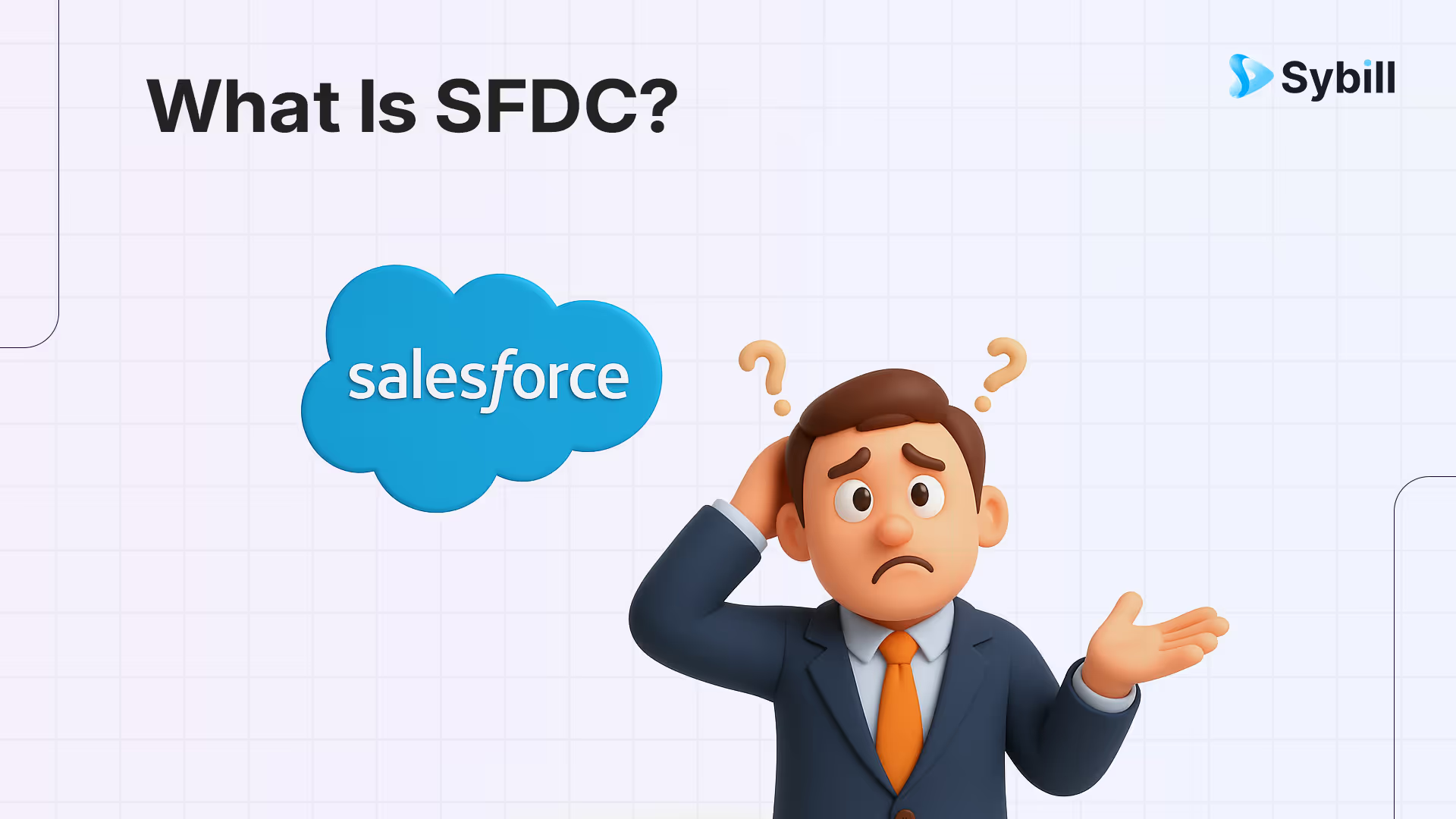
If you are Googling “SFDC meaning,” you are not alone. Every revenue team eventually hits the same wall. Salesforce has become such a default part of the enterprise stack that nobody questions whether it is needed. The real question is why a tool this powerful still inspires entire Slack channels dedicated to complaining about updating it. Every rep hates logging into it. Every manager swears by it. And every RevOps leader is stuck somewhere in between.
SFDC stands for Salesforce Dot Com, the original company name and stock ticker for Salesforce, the world's largest CRM platform used by over 150,000 companies to manage sales pipelines, customer relationships, forecasting, and revenue operations. In modern sales stacks, SFDC remains the dominant enterprise CRM but its value depends entirely on data quality — which is why teams pair Salesforce with AI tools like Sybill that automatically fill CRM fields from sales calls and emails, eliminating the manual data entry that causes reps to avoid updating Salesforce and managers to distrust the pipeline data inside it.
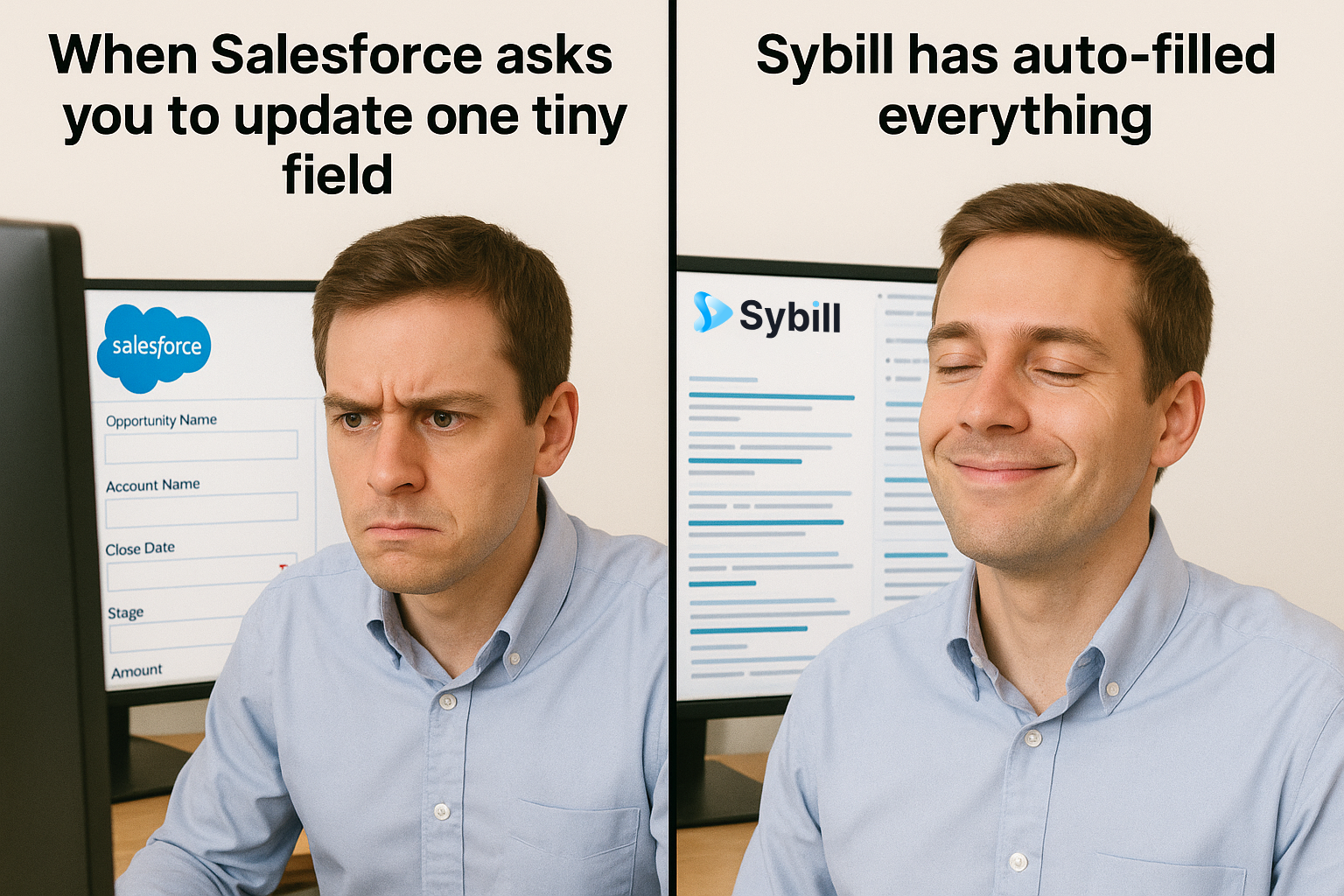
Salesforce sits at the center of how modern companies sell, forecast, support customers, and measure performance. That part is not up for debate. What is up for debate is whether teams are actually using SFDC in a way that makes their work easier rather than heavier. And that is why people search for “What is SFDC?” long after they have already used it for years. They are really looking for a better way to make Salesforce work instead of working for Salesforce.
This blog does exactly that.
You will get a clear definition of SFDC, a crisp breakdown of the platform, the difference between SFDC and SFDX, real use cases that go beyond brochure-speak, and the modern challenges sales and RevOps leaders face inside Salesforce. More importantly, you will learn the 3 integrations that instantly make SFDC more valuable and less painful, including the one upgrade that solves the biggest problem of all: reps refusing to update it.
By the end, you will not just know what SFDC means. You will know how to make it pay for itself.
If you want the simplest, most search-friendly definition of SFDC meaning, here it is.
SFDC stands for SalesForceDotCom, the original name and stock ticker symbol used by Salesforce in its early years. Today, people use “SFDC” and “Salesforce” interchangeably, but the acronym has stuck because entire sales and RevOps ecosystems were built around it long before the brand became the global CRM giant it is now.
Salesforce chose the ticker symbol SFDC to differentiate itself in the early SaaS era and to signal one clear message to the market: this was software delivered through the internet, not installed on a server. In 1999, that was radical. Most companies still ran sales on spreadsheets, on-prem CRMs, and homegrown tools that required maintenance and patience in equal measure. Salesforce flipped the script by introducing one of the first cloud-hosted CRMs accessible through a simple browser login.
That early bet on SaaS turned Salesforce from a scrappy experiment into the backbone of modern go-to-market operations. Today, Salesforce is the default CRM for enterprise sales teams, customer success departments, RevOps leaders, service teams, and IT groups because it scales, integrates, and centralizes customer data better than almost anything else on the market. Its combination of customization, automation, security, and ecosystem depth makes it the CRM large organizations pick when they want one long-term system of record instead of ten disconnected tools.
To keep clarity high:
Salesforce refers to the company and the broader platform.
SFDC refers specifically to the CRM infrastructure and its operational ecosystem.
Different words. Same world. And the world runs on it.
If SFDC is the CRM everyone knows, SFDX is the behind-the-scenes engine most business users never see.
SFDX stands for Salesforce Developer Experience, a modern toolkit designed to help development teams build, test, package, and deploy Salesforce applications more efficiently. It comes with a command line interface, version control friendly workflows, modular development structures, and full CI/CD support. In simple terms, SFDX turns Salesforce into a serious software engineering environment instead of a point-and-click admin tool.
The easiest way to understand the difference is to think about who touches which part of the ecosystem.
SFDC is the everyday world of sales teams, SDRs, AEs, RevOps, CSMs, and managers. It is where pipeline gets updated, opportunities move, customer data lives, notes get stored, and dashboards help leaders forecast. When people search for SFDC meaning, they are almost always referring to this operational layer.
SFDX is where technical teams work when they build new features, customize objects, automate workflows, or deploy a new package to multiple sandboxes and production. It is the framework that ensures changes are stable, trackable, and repeatable.
Understanding the difference matters more than most teams realize.
When RevOps knows what is possible with SFDX, and engineering understands what sales teams need inside SFDC, collaboration becomes faster and cleaner. Feature requests move faster. Custom automation becomes more reliable. And the CRM evolves without breaking the workflows that revenue teams depend on every day.
If you want to define SFDC, think business operations.
If you want to understand SFDX, think Salesforce engineering.
Click here to learn more about SFDC vs Zoho.
Salesforce isn’t just a CRM anymore. In most companies, it’s the operational core that holds sales, marketing, service, and revenue data together. Here’s what the major clouds actually do in real sales environments today.
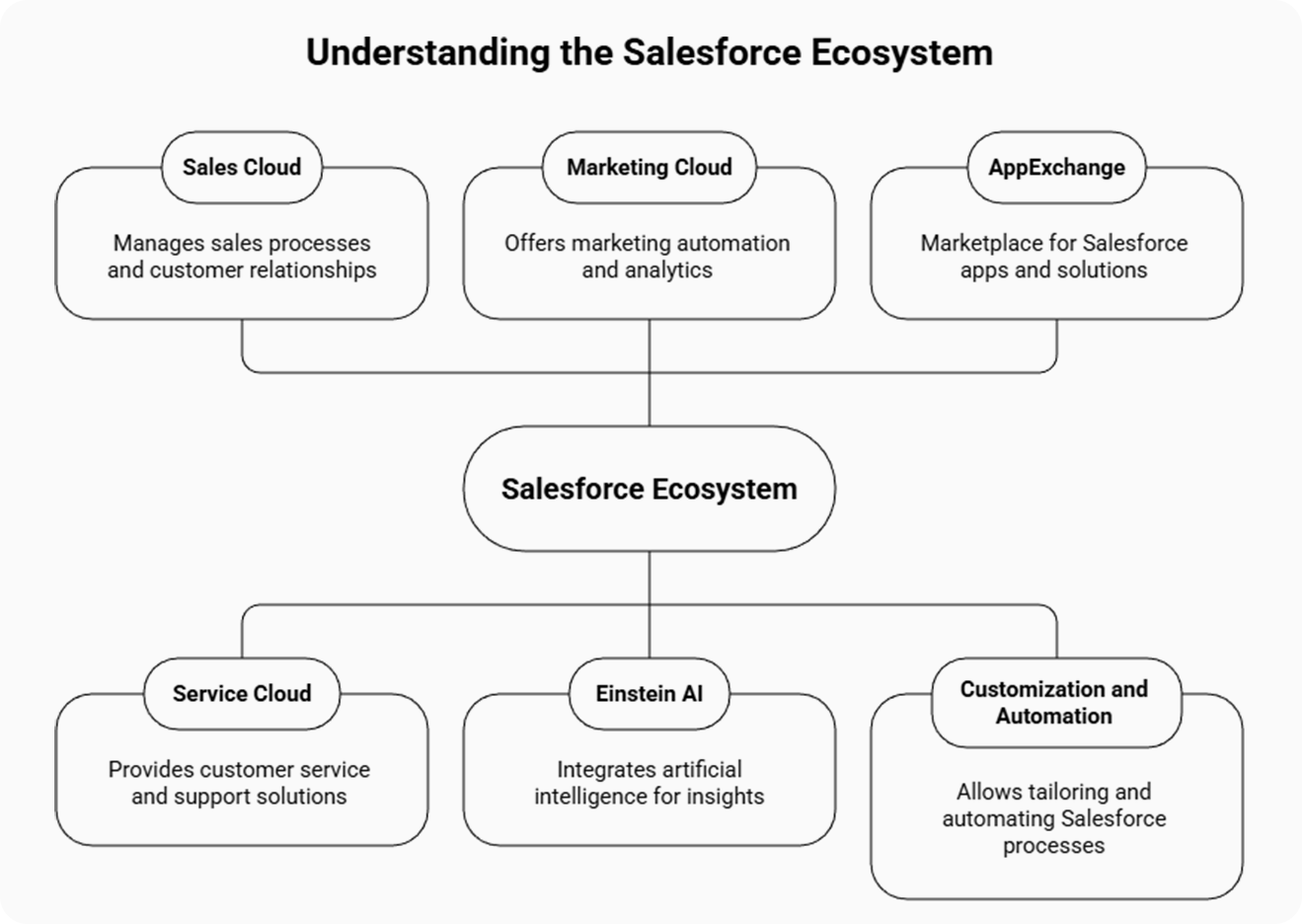
This is the heartbeat of the revenue engine. Sales Cloud tracks leads and opportunities, but its real value is pipeline truth, forecasting discipline, and the data leaders use to coach and course-correct. If something is “real” in sales, it exists inside the Sales Cloud.
Support teams use it to manage cases and SLAs, but its bigger impact is on renewals. Service Cloud gives sales and CS visibility into customer issues before they become churn risks. It keeps the customer experience consistent across every touchpoint.
Marketing Cloud connects channels, journeys, and personalization into one orchestrated system. Email, ads, landing pages, segments, attribution. Everything loops back into a single customer profile so sales gets cleaner intent signals and warmer conversations.
Einstein adds intelligence to the stack. Predictive lead scoring, forecast signals, next-action suggestions. It’s helpful, but not omniscient. Einstein sees patterns. It doesn’t capture nuance, intent, or the emotional subtext buyers share on calls.
This is Salesforce’s real superpower. Thousands of apps expand SFDC into whatever a company needs: integrations, analytics, revenue intelligence, workflow tools, AI assistants like Sybill. Most of the ROI companies cite from SFDC comes from the ecosystem, not the native features.
Flows, custom fields, validation rules, approval chains. These quietly turn Salesforce into a company’s operating system. Done well, they remove repetitive work and create process consistency. Done poorly, they break everything.
Salesforce becomes indispensable not because of its features, but because of how revenue teams use it to run the business. Here are the real-world use cases that matter in high-performing sales orgs.
Every team touches the customer, but only Salesforce captures the entire journey end to end. A rep can see marketing touchpoints, support tickets, product usage, contract history, and renewal risks from one place. No chasing spreadsheets or pinging three teams for context. One source of truth means tighter conversations and fewer surprises.
In a mature org, Salesforce isn’t just a “pipeline tracker.” It is the forecasting engine. Leaders use it to see deal stages, inspection notes, next steps, and risk signals in real time. A VP can look across regions and instantly know which numbers are solid, which are sandcastles, and which deals need executive muscle. Without SFDC, forecasting becomes guesswork.
Salesforce keeps handoffs clean. SDR qualification notes flow directly into AE workflows. Closed-won records move to CSMs with onboarding requirements, implementation details, and contract scope already in place. No missed steps. No mystery ownership. The customer feels continuity instead of chaos.
Lead routing, lead scoring, meeting SLAs, escalation rules, approval flows. RevOps turns Salesforce into a rules engine that enforces the process automatically. For example, when an enterprise lead comes in from APAC, it routes to the right AE within seconds. When a deal hits a discount threshold, an approval chain triggers instantly. SFDC becomes the referee of the entire GTM motion.
Account-based teams rely on Salesforce to align messaging, outreach, buying committees, and activity across multiple stakeholders. Reps see who’s engaging, which channels work, who’s blocking, and who’s championing. Marketing can run targeted ads to open opportunities without guesswork. Salesforce keeps the entire ABM motion synchronized.
Salesforce powers the slides that decide budgets, hiring, and GTM strategy. Leaders pull pipeline coverage ratios, deal velocity, quota attainment, churn patterns, and forecast confidence from SFDC dashboards. Board meetings run on Salesforce data. When the CRM is wrong, the business makes the wrong calls. That is why data hygiene matters so much.
As companies expand, Salesforce enforces consistency. A rep in Singapore and a rep in Chicago follow the same qualification steps, log the same fields, and move deals through the same stages. New hires onboard faster because the process exists inside the system, not inside someone’s head. This is how companies scale without losing methodology discipline.
Salesforce becomes far more powerful when teams stop treating it as a database and start using it as an intelligence layer. Here are the modern, high-impact applications top revenue teams rely on.
Einstein gives predictive scores, forecast insights, and basic pattern detection. It is useful for spotting historical trends but still misses the most important part of selling: intent, emotion, hesitation, confidence, and buyer readiness.
That is where AI-powered integrations complete the picture. Tools like Sybill analyze conversations, surface objections and risks, and push those insights straight into SFDC. With Ask Sybill and the Deal Workspace, reps get context-rich deal views that combine Salesforce fields with real buyer signals. Salesforce does the structure. Sybill adds the human layer.
SFDC automation handles reminders, routing, status updates, and workflow triggers that remove a lot of manual admin work. But all of it depends on accurate data going in. That is the bottleneck. Most reps update Salesforce late or inconsistently. This is why teams add tools like Sybill’s CRM Autofill. It captures call details, fills fields automatically, and creates AI Tasks based on what buyers actually said. The result is automation that finally works because the underlying data is clean.
Salesforce knows the deal stage. It does not know the real story behind the deal. Conversational intelligence bridges that gap. When tools like Sybill sit on top of SFDC, teams get a single pane of glass that combines CRM data with objections, interests, tone shifts, champions, blockers, and exact moments that moved the deal forward or backward. Managers coach better. Reps prepare smarter. Deals stop slipping quietly.
If you want Salesforce to finally reflect reality instead of rep guesswork, Sybill is the fastest upgrade.
Try Sybill to finally get the SFDC accuracy, speed, and data quality your team has never had.
Mature sales orgs hit a point where Salesforce stops being “just the CRM” and becomes the operational center of the business. But getting there requires the right layers on top. These are the tools teams add when they want SFDC to drive revenue instead of simply storing it.
Sybill isn’t a replacement for SFDC. It is the missing layer that unlocks its real value. Salesforce becomes exponentially more powerful when every field, insight, and buyer signal inside it is accurate, complete, and current. That is exactly what Sybill delivers.
Here is how Sybill upgrades SFDC in the real world:
The reality behind all of this is simple:
Reps hate updating Salesforce.
Sybill fixes that.
RevOps finally gets the data quality they’ve dreamed of.
Leaders forecast with confidence instead of crossed fingers.
This solves Salesforce’s biggest problem: accurate, timely, contextual data that reflects what’s actually happening in the deal.
When companies grow past a certain size, they need stronger forecasting infrastructure. These tools sit on top of SFDC and analyze activity patterns, historical performance, deal engagement, and pipeline movements. They highlight risk, identify sandbagging, and help leaders model revenue scenarios with far more accuracy than spreadsheets ever could.
Think of them as the analytics layer that transforms raw Salesforce data into predictive signals that steer the business.
When to use them:
This category is less glamorous but absolutely essential. Salesforce becomes sticky only when it integrates with the tools reps use every hour of the day.
These plugins and integrations do the heavy lifting:
When these layers are in place, Salesforce stops feeling like “another system” and becomes the natural hub of the GTM workflow.
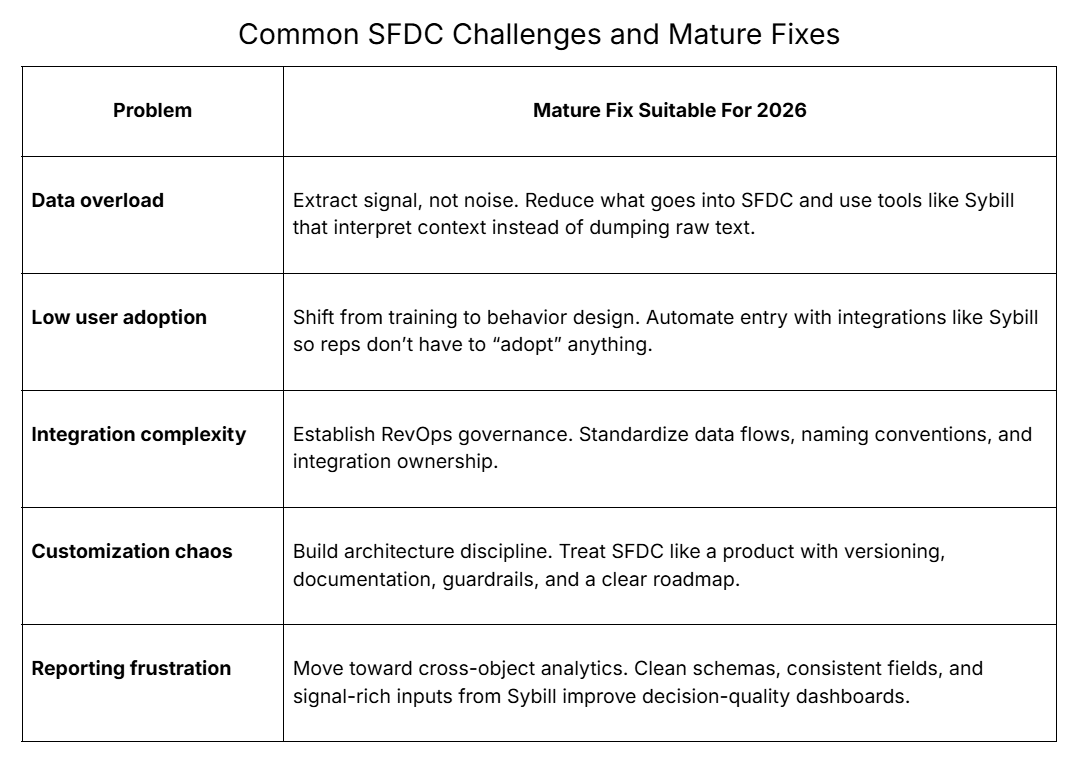
Salesforce is evolving faster than most teams realize, and 2026 will separate the orgs that treat SFDC as a strategic engine from those that still use it as storage. The next phase of CRM is defined by four shifts.
CRMs will no longer wait for humans to enter data before acting on it. Workflow triggers, next-step generation, deal risk identification, and buyer insights will originate from AI interpreting conversations, emails, tone, and intent. Salesforce will remain the hub, but its intelligence will increasingly depend on the AI layers built around it.
Reps will spend less time updating systems and more time steering deals. Their job becomes orchestration: managing conversations, navigating stakeholders, and executing strategies that AI surfaces. Anything repeatable or administrative will be done by the system. Human judgment becomes the differentiator.
By 2026, the best CRMs will not just store information. They will drive action. An opportunity update will trigger predictive next steps, follow-up prompts, content recommendations, and risk alerts. Instead of being a passive database, SFDC becomes an active participant in the sales process.
Salesforce is too deeply embedded in enterprise operations to be replaced. But its value will increasingly depend on AI layers like Sybill that sit on top of SFDC and provide the context, behavioral signals, and automation Salesforce cannot generate on its own. Salesforce remains the system of record. AI becomes the system of intelligence.
The biggest shift is also the simplest. Manual updates are disappearing.
2026 is the year when CRMs stop relying on reps to type notes, update fields, fill next steps, or log calls. Tools like Sybill will extract intent, objections, interests, commitments, and actions directly from conversations and sync them to SFDC without human intervention. Clean data. Zero effort. Better forecasting. Stronger execution.
This is where high-performing teams are already moving.
SFDC is still the backbone of modern revenue operations because it centralizes customer data, standardizes process, and anchors forecasting.
But most teams never realize its full value because data is incomplete, updates are late, and Salesforce becomes a place to store information rather than act on it. The shift happens when SFDC is paired with the right AI layer. Tools like Sybill capture context, automate updates, and feed Salesforce the buyer signals it cannot gather on its own. The result is a CRM that reflects reality, not rep memory.
Try Sybill to finally get the SFDC accuracy, speed, and data quality your team has never had.
SFDC meaning refers to SalesForceDotCom, the original acronym used for Salesforce when it launched as one of the first cloud-based CRMs. Today, SFDC is commonly used to describe the Salesforce CRM platform and its ecosystem of sales, service, and marketing tools. When someone searches “SFDC meaning,” they are usually trying to understand how Salesforce functions as the central system of record for customer data, pipeline, forecasting, and revenue operations.
SFDC is used to run the entire customer lifecycle across sales, marketing, service, and RevOps. It manages leads, opportunities, forecasting, account history, customer support, campaign activity, and reporting. Mature sales teams rely on SFDC to ensure pipeline accuracy, streamline handoffs, automate workflows, and centralize all customer interactions. In most organizations, Salesforce is the operational backbone that powers revenue strategy, execution, and data-driven decision making.
There is no functional difference between SFDC and Salesforce. SFDC simply stands for SalesForceDotCom, the company’s early ticker symbol and acronym. Salesforce is the brand name of the full platform. In practice, “Salesforce” refers to the company and its product suite, while “SFDC” is often used in technical, operational, or RevOps contexts to describe the CRM environment where teams manage sales processes, customer data, and business workflows.