Find us at booth #83, join us for a harbor side happy hour, or catch Gorish’s talk.

Sept, 16-18 > Learn more


Tamanna Mishra

March 26, 2026
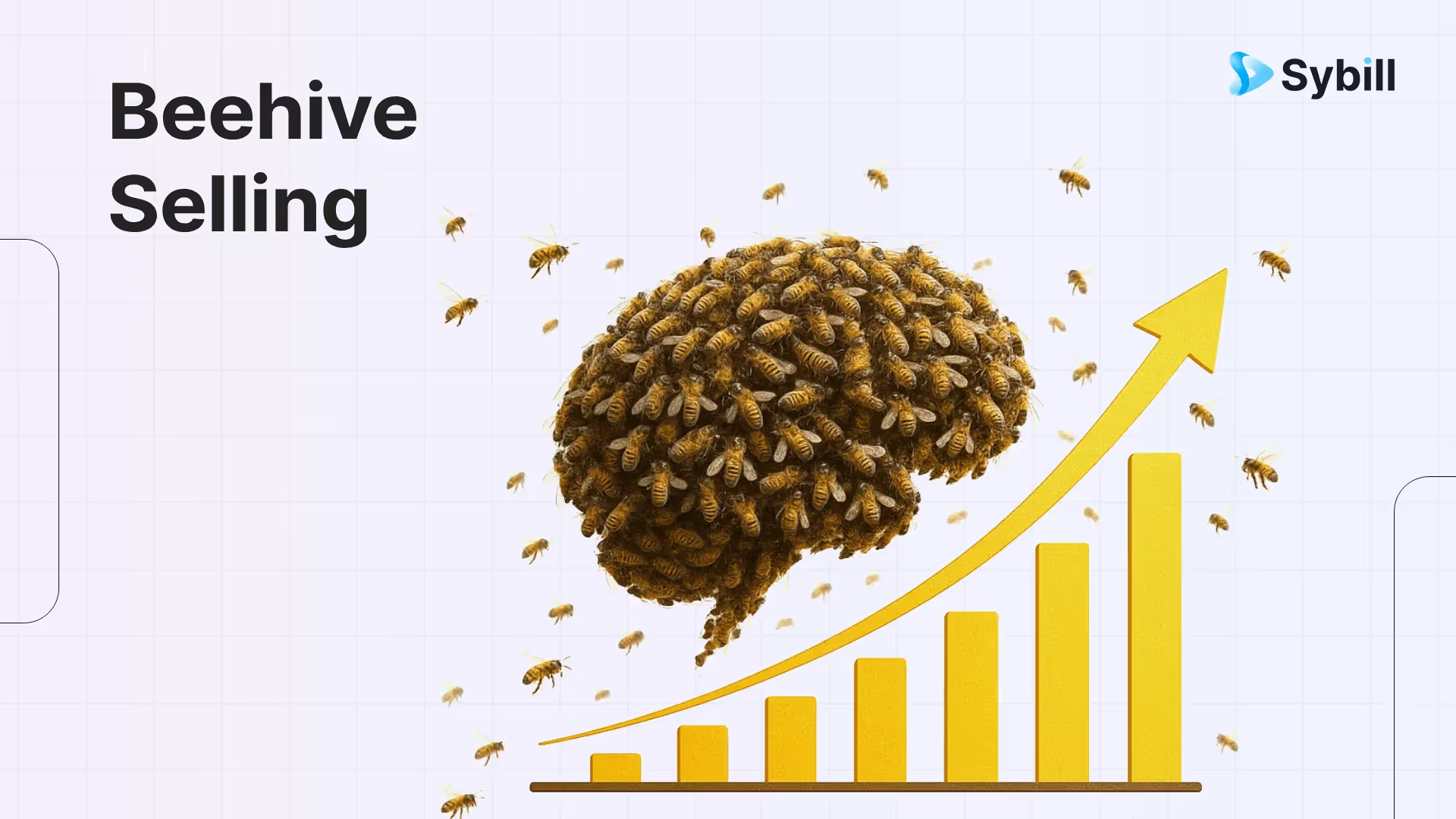
Still playing sales like it’s a solo sport? That’s so 2007.
The days of the lone wolf rep swaggering through deals armed with charm and guesswork are done. Today’s top-performing teams aren’t driven by individual genius. They’re powered by group intelligence.
Beehive selling is a team-based sales approach where the entire revenue organization shares real-time deal intelligence, call insights, and competitive learnings — treating every rep’s experience as data that improves the whole team. Unlike traditional sales models where reps operate as individual contributors with siloed deal knowledge, beehive selling uses conversation intelligence, shared call libraries, and collaborative deal reviews to distribute winning patterns across the team. The result is that new reps ramp faster, mid-performers close the gap with top performers, and the organization’s collective win rate improves because no insight stays trapped in a single rep’s head.
Precisely what beehive selling does. It’s where sales is a full-on team swarm, buzzing with collective intelligence, real-time deal data, and strategic collaboration that scales.
I know it all sounds a bit like kumbaya but what it really is is performance engineering. Every call, every objection, every win or miss is a data point - not just for one rep, but for the entire team to learn from, prep with, and act on.
PS - That’s precisely what Sybill is built to enable. With smart features like Pre-Call Briefs, Deal Pipeline views, and the always-on hive mind of Ask Sybill, your team no longer stops at guessing the best way forward. They sync, swarm, and sell smarter. Together.
Ready to ditch silos and embrace collaborative selling? Let’s get buzzing!
Beehive selling is the opposite of the “every rep for themselves” mindset.
It’s a sales approach that thrives on group intelligence, where sales, marketing, and customer success operate as one adaptive, insight-sharing unit. Think of it as the high-performance sales equivalent of a beehive.
In nature, bees don’t fly solo to figure things out. They communicate in real-time, share signals, adapt roles, and constantly respond to changing conditions. That’s exactly how beehive selling works. One team member picks up a new buyer objection? It gets logged, learned, and leveraged by others. One deal’s loss becomes another deal’s win.
Compare that to traditional selling. Pipeline data lives in silos, reps hoard hard-won learnings, and marketing and CS often find out about deal blockers after the fact. It’s tribal knowledge in spreadsheets - and it doesn’t scale.
Beehive selling flips the model by going beyond meeting- and email-led collaboration where insights go to die. Instead, it sets collaborative selling in motion, powered by shared knowledge, synced tools, and swarm-level strategy. Every insight becomes a team advantage. Every rep becomes smarter, faster, and more aligned with the hive.
In a beehive model, your team doesn’t just close more deals. They evolve together. (And yes, AI tools like Sybill are built to make this swarm sing. We’ll get to the how of it in just a bit. Or you can try it for yourself - click here to try Sybill for free.)
Sales used to be about gut instinct. A good chat, a good rapport, wide eyed wonder at the product or service. And sometimes, some happy ears.
Modern sales though is about informed instinct - and the smartest teams know the difference.
This is where collective intelligence makes a difference. It emerges as a superpower when teams collaborate, share information, and act on unified data. And it’s scientifically backed. Science.org published a study that says “In two studies with 699 people, working in groups of two to five, we find converging evidence of a general collective intelligence factor that explains a group’s performance on a wide variety of tasks.”
What makes a difference? Not brainpower alone, but diversity, how well people communicate, read social cues, and collaborate. In other words, success came from swarm thinking, not solo brilliance.
So what does this mean for sales?
Let’s go back to our hive analogy. Picture this:
Beehive selling works the same way. It turns the entire sales team, along with marketing and CS into a coordinated swarm. They share deal signals, buyer behaviors, and competitive intel. And typically, in real time.
In traditional sales orgs, insights live and die inside individual reps’ heads. That’s tribal knowledge - unscalable and risky.
But in a beehive selling model, every insight is recorded, surfaced, and shared, creating a system that gets smarter with every interaction.
The rise of AI-powered collaboration tools has made collective intelligence actionable. You don’t need a manual debrief to learn from a teammate’s call anymore.
Tools like Sybill capture the essence of conversations - objections, pain points, buying signals - and make them available to the whole team, on auto pilot.
This ensures that AI doesn't replace human sellers. It amplifies them - turning the best of your hive into insights the whole colony can act on.
Great sellers close deals. Smart teams scale revenue.
And in a noisy sales world, the smartest teams aren’t guessing alone. They’re buzzing together, with collective intelligence as their edge. That’s the science - and the strategy - behind beehive selling.
So how does beehive selling play out in real life?
Picture this: a sales team that acts like a well-synced hive - buzzing with collaborative selling tactics, surfacing shared insights in real time, and learning faster than the competition can blink.
We’re not talking about endless Slack channel sharing and calling it collaboration. What beehive selling really does is turn every conversation, every signal, every “hmm, that’s interesting” moment into group intelligence the whole team can use to win more.
Let’s break it down.
In traditional sales, when a rep loses a deal because of a surprise objection or silent decision-maker, that insight often dies in the rep’s head (or gets buried in a dusty CRM note).
But in a beehive-selling team:
Done right, collective intelligence looks like sales foresight.
One-off call moments are just noise unless they’re captured and connected. With beehive selling, reps and managers get:
Instead of reacting after deals die, teams act while the signals are still warm.
In most teams, coaching looks like this: one rep, one deal, one manager.
But in a beehive model:
Swarm coaching means you’re not just creating good reps. You’re building a great system.
Sybill isn’t just listening. It’s thinking. And more importantly, it’s sharing.
Here’s how it enables beehive selling:
When sales becomes a shared system and not a set of siloed instincts, you don’t just hit quota. You swarm it.
That’s the power of collaborative selling with Sybill. Welcome to the hive.
You’ve got the tools. You’ve got the talent. And still… something feels off.
Deals stall mysteriously.
Coaching feels repetitive.
Your top rep’s results look like magic - and no one knows how to replicate them.
That’s not a “people problem.” It’s a process problem. Specifically, a lack of beehive selling - the collaborative, real-time, insight-sharing approach that helps sales teams sell smarter.
Here are five flashing red signals your team needs to ditch silos and start selling like a hive.
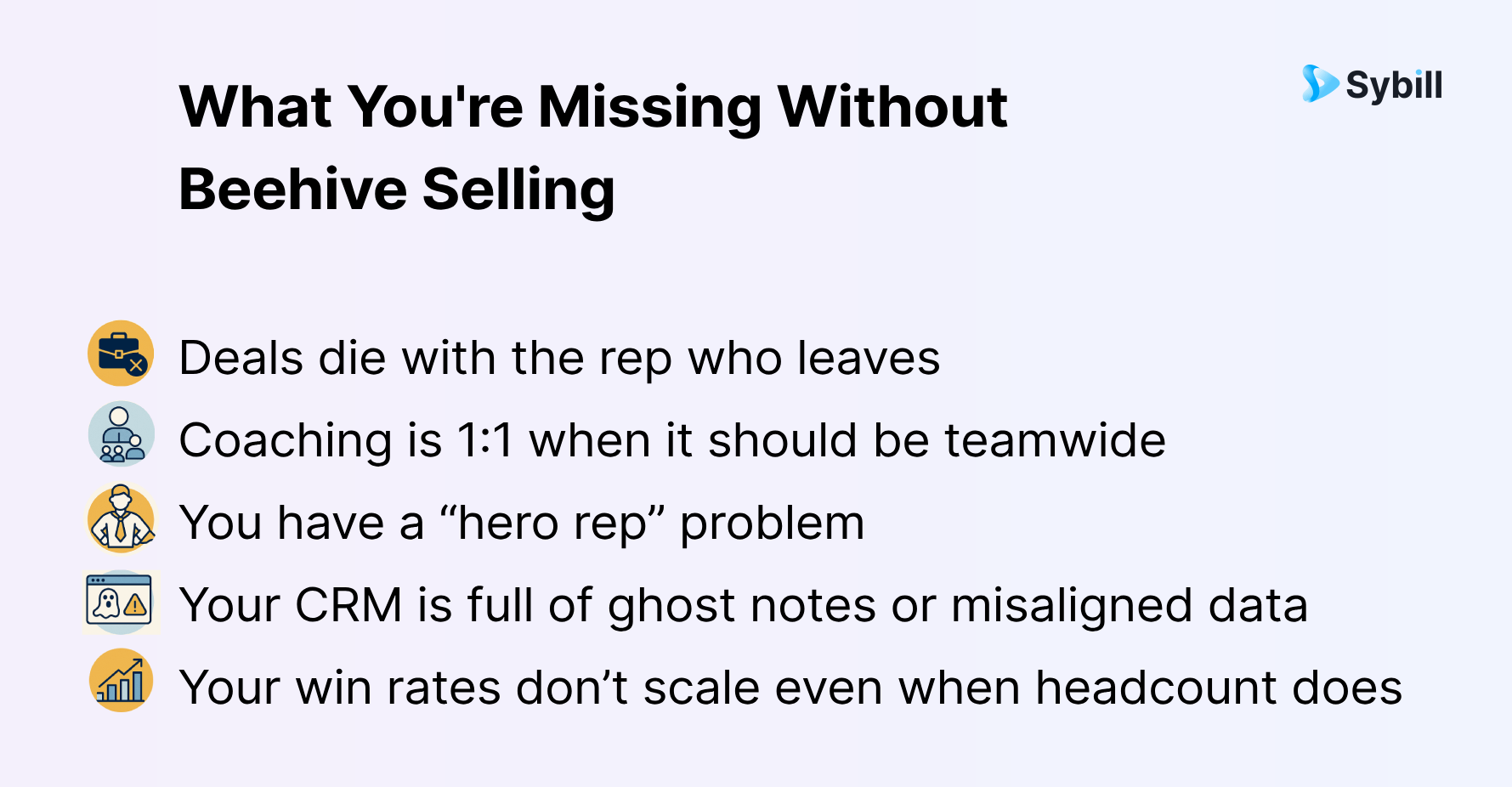
Your best AE resigns, and suddenly the pipeline looks like a crime scene - cold leads, vanishing opps, and zero context. Why? Because all the buyer intelligence was locked in one person’s head (or their personal call notes).
With beehive selling, the data lives in the system, not with the individual. For example, with tools like Sybill’s CRM Autofill, every objection, every stakeholder insight, every timeline update is captured and shared - even after the rep is long gone.
When the hive holds the knowledge, the deals survive the attrition.
You spend hours each week coaching reps one by one, rehashing the same themes: poor discovery, missed objections, weak follow-ups. It's exhausting - and it doesn’t scale.
With swarm coaching, managers use tools like Ask Sybill to identify systemic issues and coach the team as a whole. If five reps are struggling with pricing pushback, that’s not five coaching sessions - it’s one shared insight and one smarter team.
Stop coaching symptoms. Start coaching systems.
Every team has a top performer. But if your entire quota depends on one person’s performance, that’s not a win. It’s a risk.
Hero reps are often hoarders of knowledge, even unintentionally. They’ve figured out the right talk track, the right tone, the right timing. But the team doesn’t benefit unless you build a system to capture and share it.
That’s where AI powered systems like Sybill come in. They let every rep search through past call moments, effective rebuttals, and buyer questions - turning one rep’s brilliance into team-level success.
So you make sure you constantly create more heroes.
If your CRM is a mess of vague updates, missing stakeholders, and post-demo gaps, your forecast is fiction. Sales isn’t just about relationships. It’s about reliable intelligence.
Beehive selling fixes this by:
When data is alive and shared, your CRM stops being a graveyard and becomes your single source of truth.
You’re hiring, onboarding, training... and still stuck at the same win rate. That’s a sign you’re scaling people, not process.
Beehive selling gives every new rep access to the best talk tracks, proven responses, and real-time deal intelligence from day one. Instead of shadowing one person for a week, they can tap into the collective intelligence of your entire org.
Because adding bodies doesn’t grow revenue. Sharing brains does.
If even one of these signs feels familiar, your team is flying solo when it should be swarming.
Time to switch from hustle mode to hive mode. Try Sybill for free to see how that works.
You can’t fake collective intelligence. It’s not about installing a Slack plugin or adding another AI tool to your tech stack. It’s about rewiring your sales culture - from reactive chaos to collaborative selling with intention, clarity, and rhythm.
If your team is overwhelmed by scattered notes, uncoordinated follow-ups, or “Did anyone talk to this lead before?” energy, here’s how to build your beehive.
These aren’t meetings for the sake of meetings. They’re rituals that bake in sales teamwork and continuous improvement. And with tools like Sybill, much of these doesn’t even have to be in meetings.
Let’s be honest: no one has time to listen to every call, transcribe objections, or document buyer behaviors manually. And yet, those are the moments that define whether you close or lose.
Use AI to:
When this call intelligence is automated, your team can focus on acting on insights, not hunting for them.
A “Closed Won” post on the sales channel is nice. But what did we learn from the deal?
Rather than forcing reps to build slide decks or write postmortems, leverage AI to auto-summarize the full story. Call moments, buying signals, pain points - so that the entire team learns from the real context, not just the outcome.
Collaborative selling means every win is a team asset. Every loss is a learning opportunity.
If your reps start sentences with “my pipeline,” “my deal,” “my account,” you might have a culture problem. Yes, ownership matters. But if collaboration ends at the AE’s inbox, you’re leaving revenue on the table.
Beehive selling thrives on shared accountability. Marketing contributes messaging that works. CS shares retention triggers. Sales engineers loop in key product value proof points.
It’s not “I won.” It’s “We closed.”
The result is a smarter, tighter, more resilient revenue machine that doesn't fall apart when one rep leaves or one deal goes sideways.
In a world where buyers are more complex, competition is fierce, and cycles are longer, selling alone just doesn’t cut it anymore.
Sales teamwork is no longer optional. It’s your differentiator.
TL;DR: You don’t need more meetings! You need smarter collaboration, faster learning, and collective rep intelligence that scales with every deal.
That’s what beehive selling is all about - and that’s exactly what Sybill enables.
With Sybill, your team becomes more than the sum of its parts.
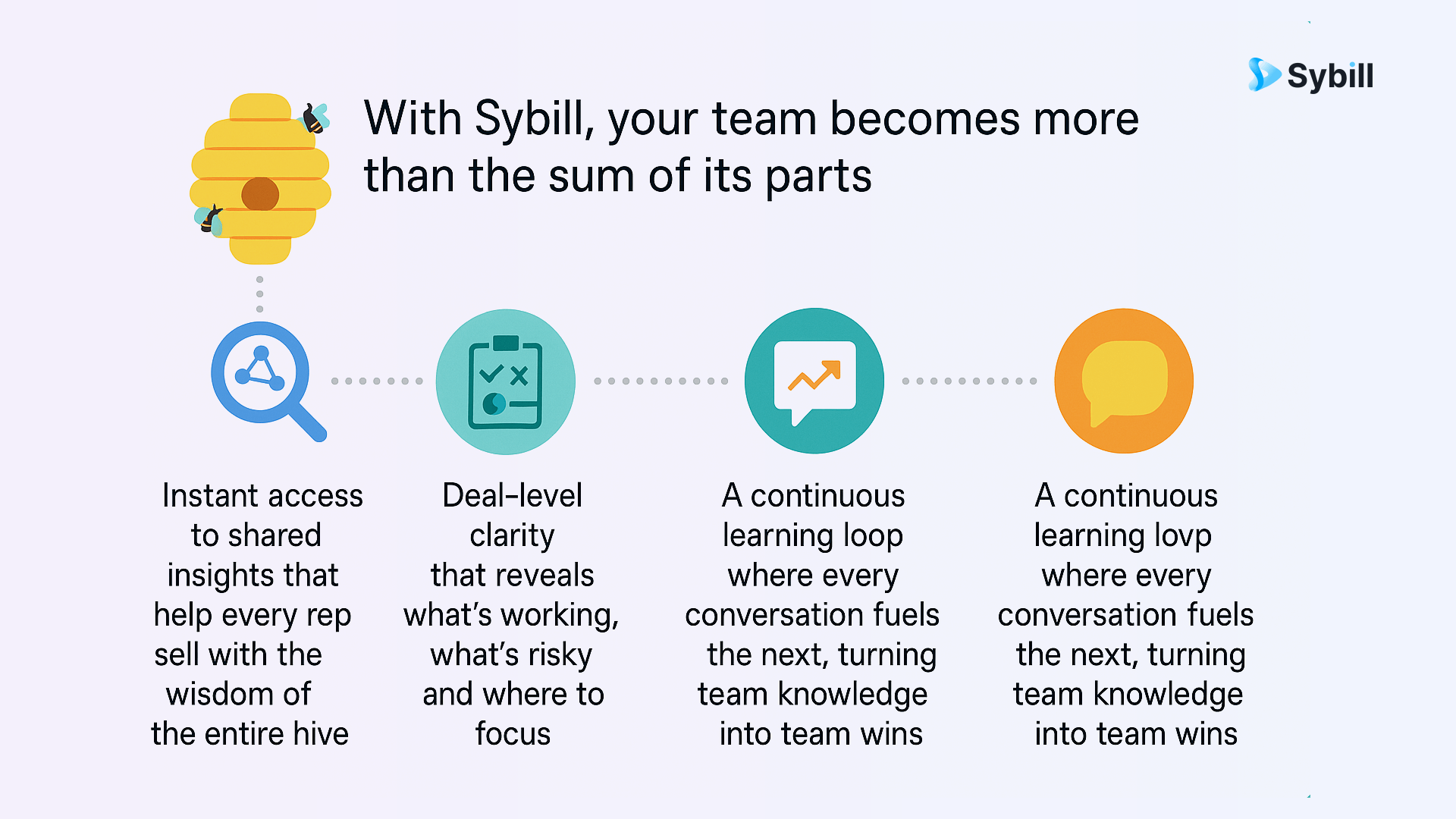
No silos. No solo guesses. Just one intelligent, connected, high-performing sales swarm.
Try Sybill free and empower your hive.