Find us at booth #83, join us for a harbor side happy hour, or catch Gorish’s talk.

Sept, 16-18 > Learn more


Tamanna Mishra

July 3, 2026
%20(1).jpg)
Most AI generated case studies sound the same, because the input is thin.
No real customer quote. No sharp before-and-after. No measurable outcome. No tension. No reason to care. Just the usual corporate pudding: “Company X streamlined workflows and improved productivity with Product Y.”
Sound familiar?
Of course ChatGPT can help you create case studies faster, but it cannot magically invent customer proof. The strongest case studies still come from real conversations, real pain, real buyer language, and real outcomes. ChatGPT can structure the story, analyze transcripts, draft sections, rewrite for different personas, and create sales assets from the final piece.
But the story has to exist first.
That is why the best workflow is not “open ChatGPT and ask it to write a case study.” It is: collect customer evidence, extract the strongest narrative, validate the claims, then use ChatGPT to shape the raw material into a credible customer story.
This guide breaks down how to create case studies with ChatGPT using copy-ready prompts, practical best practices, and a workflow that keeps the output specific, useful, and trustworthy.
Yes, ChatGPT can help create case studies. No, it should not be left alone with a vague prompt and a dream.
ChatGPT is useful across the case study process. It can help you analyze customer interview transcripts, identify themes, create a structure, draft sections, sharpen headlines, write executive summaries, turn a long story into a sales one-pager, and repurpose the final case study into emails, LinkedIn posts, ads, and sales enablement content.
That makes it a powerful assistant for marketing, sales, and customer success teams. It does not make it the source of truth.
A good case study is not just a content asset. It is proof. It tells a skeptical buyer, “Someone like you had this problem, made this decision, and got this result.” That means your claims need to be accurate, your quotes need approval, and your metrics need context.
OpenAI’s own prompt engineering best practices for ChatGPT recommend being clear, specific, and iterative. That matters here because “write me a case study” is not a prompt. It is a cry for help.
A better prompt gives ChatGPT the customer profile, problem, stakes, solution, product features used, results, audience, tone, constraints, and approval boundaries.
The better the evidence, the better the story.
Most AI-written case studies sound like they were assembled in a beige conference room by five people who all said “circle back” unironically.
The problem is rarely grammar. The problem is weak substance.
Generic AI case studies usually have five issues.
First, they start with the product instead of the customer. Nobody wants to read a 1,200-word love letter to your feature set. The customer should be the hero. Your product is the guide, the engine, the assist, the Gandalf, not the whole Fellowship.
Second, they skip the tension. A case study needs a real business problem. Missed revenue. Slow handoffs. Manual CRM updates. Low forecast confidence. Poor buyer follow-up. A team drowning in admin. Without tension, there is no transformation.
Third, they use vague results. “Improved efficiency” is not a result. “Saved each rep five hours a week on meeting notes, follow-ups, and CRM updates” is a result. Specificity wins because specificity sounds true.
Fourth, they flatten the customer voice. Real people do not talk in product brochure language. They say things like, “We kept losing track of what buyers actually cared about after calls.” That line is worth more than ten polished adjectives.
Fifth, they publish without verification. Google’s guidance on helpful, reliable, people-first content emphasizes experience, expertise, authoritativeness, and trust. In case studies, trust is not decorative. It is the whole point.
That is why your workflow matters more than the AI tool.
Before you ask ChatGPT to write, gather the proof.
This is where a tool like Sybill becomes very useful for revenue teams. Case studies often live inside scattered customer conversations: discovery calls, demos, renewal meetings, customer success check-ins, Slack notes, CRM fields, and follow-up emails. The story is there, but nobody wants to dig through call transcripts like they are decoding the Dead Sea Scrolls.
Sybill’s Magic Summaries capture customer conversations and turn them into structured summaries, follow-ups, CRM updates, and next steps. That helps sales, marketing, and customer success teams spot the real story: the original pain, the buyer’s words, the objections, the turning point, the feature that mattered, and the outcome worth publishing.
ChatGPT can help shape the case study. Sybill helps you find the customer evidence that makes the case study worth reading.
Also read: Generative AI For Sales: 2026 Guide For Sales Teams
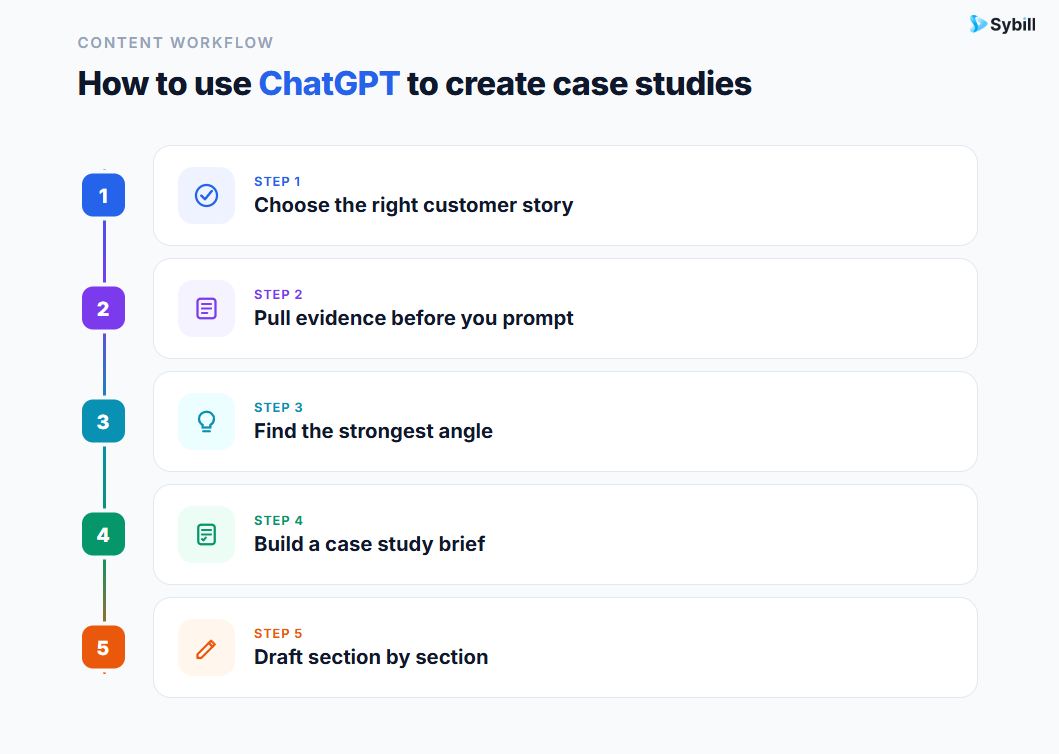
Not every happy customer makes a good case study.
A strong case study needs a clear before-and-after. Look for customers who had a painful problem, made a meaningful change, and can describe the impact in a way your target buyers will recognize.
Use this selection checklist:
The last point matters. A case study should not exist just because marketing needs one more PDF for the resource center. It should help sales answer a real buyer question.
For example, if buyers often ask, “Will this actually save reps time?” then a customer story about reduced admin work and faster follow-ups is gold. If buyers ask, “Can this help managers coach better?” then a story about call insights, rep performance, and deal visibility will work harder.
ChatGPT needs raw material.
Before writing, gather:
This is where conversation intelligence changes the game. If your team uses Sybill’s AI call summaries, you can find pain points, objections, action items, buyer priorities, and follow-up context without hunting through full transcripts. That gives ChatGPT better inputs and gives your case study more teeth.
Prompt to organize evidence:
“Act as a B2B case study strategist. I will give you raw customer notes, call summaries, CRM context, quotes, and results. Organize the information into a case study brief with these sections: customer profile, original problem, stakes, buying trigger, solution used, implementation details, measurable outcomes, qualitative outcomes, strongest customer quotes, possible story angles, missing proof, and claims that need verification. Do not invent information. Flag anything that is unclear.”
One customer story can become several different case studies.
A sales leader may care about faster deal execution. A RevOps leader may care about CRM hygiene. A frontline AE may care about follow-up emails. A founder may care about scaling revenue without adding more admin.
ChatGPT can help you choose the angle, but only after you give it evidence.
Prompt to identify the angle:
“Analyze the customer evidence below and suggest the three strongest case study angles for a B2B SaaS audience. For each angle, explain the target reader, the core pain point, the before-and-after narrative, the proof points available, the likely headline, and what additional evidence would make the story stronger. Do not exaggerate the results.”
A strong angle sounds like this:
“ServiceBell used Sybill to reduce manual call admin, improve follow-up quality, and create a shared conversation repository across sales, admin, and customer support.”
A weak angle sounds like this:
“ServiceBell used Sybill to improve sales productivity.”
One has a story. The other has a nap schedule.
Body image idea: Workflow diagram showing customer call, Sybill summary, proof extraction, ChatGPT prompt, draft, approval, and sales asset.
Alt text: How to create case studies with ChatGPT from Sybill customer call summaries and verified proof points
Do not draft until the brief is clean.
Use this template:
Case study title:
Target audience:
Customer name:
Industry:
Company size:
Primary buyer persona:
Customer challenge:
Why the challenge mattered:
Previous process or tools:
Trigger for change:
Solution chosen:
Features or workflows used:
Implementation details:
Quantitative results:
Qualitative results:
Customer quote 1:
Customer quote 2:
Objections overcome:
Approved claims:
Claims needing verification:
Primary CTA:
Prompt to create the brief:
“Using the information below, create a complete B2B SaaS case study brief. Keep the customer as the hero. Separate verified facts from assumptions. Put any missing information in a section called ‘Questions to ask before drafting.’ Do not create metrics or quotes that are not present in the source material.”
This one prompt can save hours. More importantly, it prevents the classic AI mistake: filling gaps with confident nonsense.
Do not ask ChatGPT for the whole case study in one go.
That is how you get the content equivalent of hotel buffet scrambled eggs. Technically food. Emotionally suspicious.
Break the draft into sections:
Prompt for the executive summary:
“Write a 120-word executive summary for this case study. Include the customer, the business challenge, why they chose the solution, and the most important outcome. Use clear B2B SaaS language. Avoid hype, jargon, and unsupported claims.”
Prompt for the challenge section:
“Write the challenge section of this case study for a VP Sales audience. Show the operational pain clearly: what was slow, manual, risky, or hard to scale. Use the customer’s language where possible. Do not mention the product until the final paragraph.”
Prompt for the solution section:
“Write the solution section. Explain how the customer used the product to solve the challenge. Connect each product capability to a specific workflow or pain point. Avoid feature dumping. Make the product useful, not magical.”
Prompt for the results section:
“Write the results section using only the verified outcomes below. Separate quantitative results from qualitative impact. If a result is directional rather than measured, phrase it carefully. Do not overclaim.”
Here is the prompt library worth stealing. Legally.
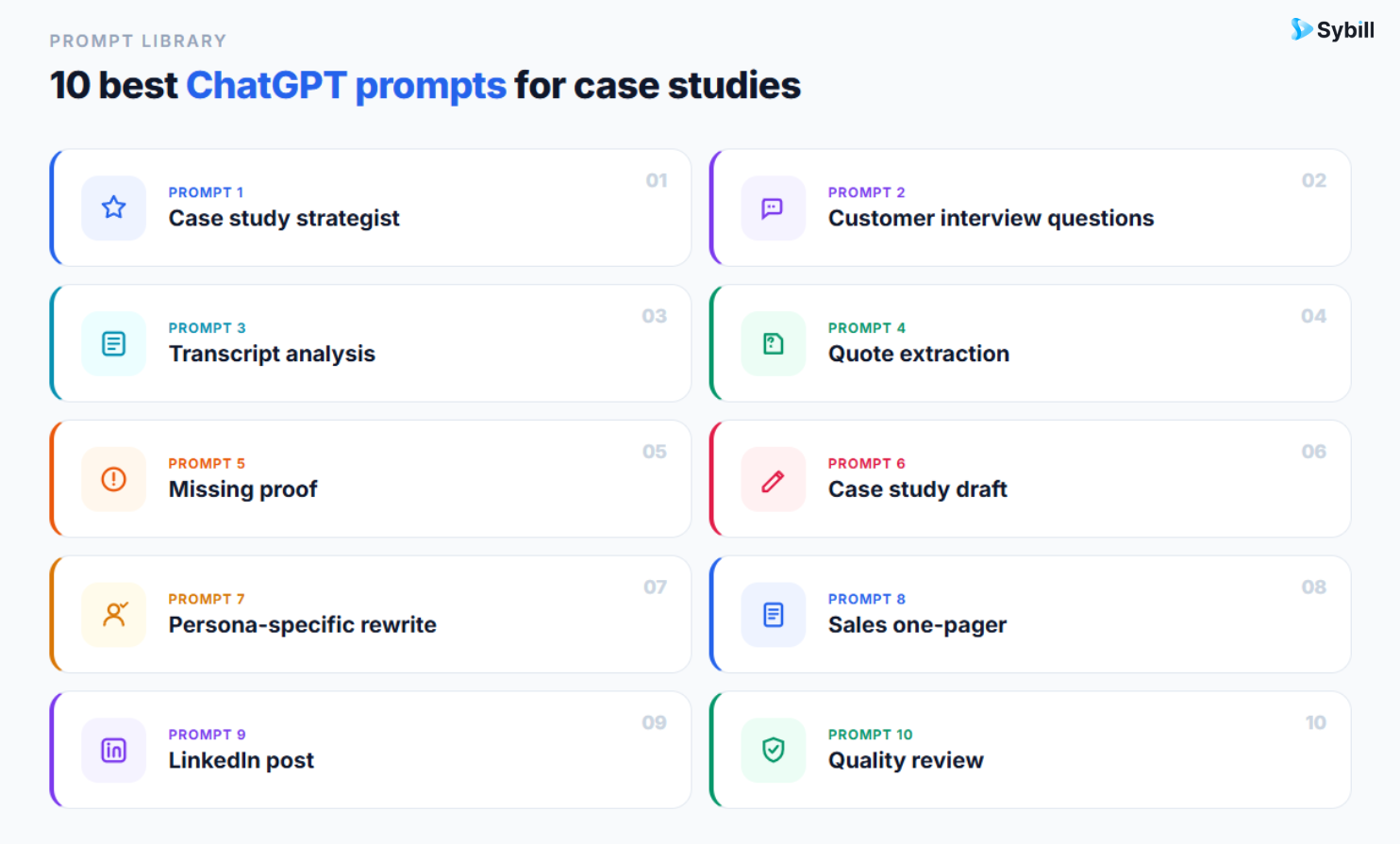
“Act as a senior B2B SaaS case study strategist. I will give you raw customer evidence. Your job is to find the strongest story angle, identify the target reader, organize the evidence, flag missing proof, and recommend a case study structure. Do not draft the case study yet. Do not invent facts.”
“Create a customer interview guide for a B2B SaaS case study. The customer uses [product] to solve [problem]. The target reader is [persona]. Include questions about the old process, pain points, trigger for change, buying criteria, implementation, measurable outcomes, qualitative impact, objections, and advice for peers.”
“Analyze this customer interview transcript. Extract the customer’s main pain points, business stakes, emotional language, objections, decision criteria, product capabilities mentioned, measurable outcomes, qualitative outcomes, and quote-worthy lines. Group the findings by theme. Do not rewrite quotes.”
“Find the strongest customer quotes from this transcript for a public case study. Prioritize quotes that sound natural, specific, and tied to business impact. Avoid generic praise. For each quote, explain where it would fit in the case study.”
“Review this case study brief and identify what proof is missing. List questions we should ask the customer, sales rep, or customer success manager before drafting. Focus on metrics, timeline, implementation details, buyer motivation, and approval risks.”
“Write a B2B SaaS case study using the approved brief below. Structure it with: executive summary, customer background, challenge, solution, results, and conclusion. Keep the customer as the hero. Use a confident, clear tone. Do not add unsupported claims. Use only the provided quotes and metrics.”
“Rewrite this case study for a [persona] audience. Emphasize the problems, outcomes, and product details this persona would care about most. Keep the claims accurate. Do not change the customer story.”
“Turn this case study into a one-page sales enablement asset for account executives. Include the customer profile, pain points, solution, results, buyer objections answered, discovery questions to ask similar prospects, and a short talk track.”
“Turn this case study into three LinkedIn post options for a B2B SaaS audience. Make each post useful even for people who do not click. Avoid hype. Include a clear takeaway.”
“Act as a strict editor and fact-checker. Review this case study draft for unsupported claims, vague language, weak structure, customer approval risks, invented details, unclear metrics, and sections that sound too generic. Recommend specific edits.”
Also read: 10 ChatGPT Roleplay Prompts for Sales Reps
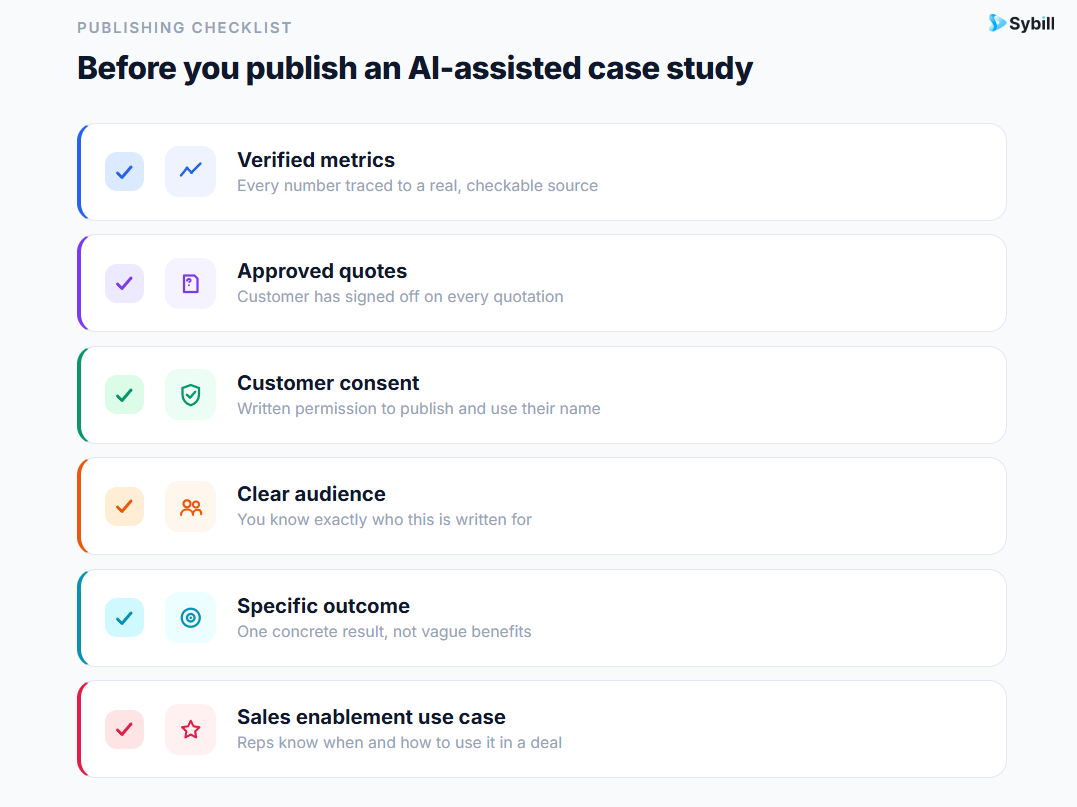
ChatGPT performs better when you give it clear context. That includes call notes, interview transcripts, CRM details, product usage, business outcomes, and approved customer quotes.
The more specific the input, the less generic the output.
Your product is important, obviously. But the customer is the one who had the problem, made the decision, drove change, and got the result.
A good case study should make the reader think, “That sounds like us.”
Not, “Cool, this vendor owns a thesaurus.”
Do not rush to the solution. Show the cost of the old way.
For Sybill customers, that might mean reps spending too much time on CRM updates, managers lacking visibility into calls, follow-ups getting delayed, or teams losing buyer context between meetings. Those details make the transformation believable.
Metrics are powerful. Fake precision is not.
If the customer says Sybill saves “a few hours a week,” do not turn that into “10 hours per week” because it sounds stronger. It does not sound stronger. It sounds like legal will be sending a calendar invite.
Use exact numbers when verified. Use directional language when the customer has not measured the result formally.
Before uploading customer transcripts or sensitive notes into any AI tool, follow your company’s data privacy, customer consent, and legal approval policies. OpenAI’s business data privacy guidance says business products do not train on an organization’s data by default, but your internal policy still matters.
Remove confidential details, personal information, pricing, legal terms, and anything the customer has not approved for external use.
ChatGPT can draft. It cannot always tell when a sentence sounds like it escaped from a procurement portal.
Edit for rhythm, clarity, and credibility. Cut filler. Replace generic claims with specific proof. Make the customer sound human.
A finished case study should not sit quietly on the website like a museum artifact.
Turn it into:
If your sales team is already using AI for follow-ups, tools like Sybill can help carry customer context into revenue workflows. For more on that, read AI Tools That Write Personalized Follow-Up Emails After Sales Calls.
A prompt without evidence produces filler. A case study without evidence produces distrust.
Do not ask:
“Write a case study about our customer.”
Ask:
“Using this approved customer evidence, write a case study for a VP Sales audience. Do not invent metrics, quotes, or implementation details.”
Never let AI create results because they sound plausible. “Reduced admin time by 40%” is not a vibe. It is a claim.
Verify it or remove it.
Customer quotes should sound like real people. Not like a testimonial generator wearing a blazer.
Bad quote:
“This solution transformed our operations and empowered our team to achieve unprecedented productivity.”
Better quote:
“We finally stopped losing important customer details between calls.”
Do not open with features. Open with pain.
The reader needs to see the problem before they care about the solution.
A case study should help close deals. Ask sales how they will use it before you write it.
For example, a story about better stakeholder visibility can support reps working complex deals. Pair it with resources like Multi-Threading Best Practices for Sales Reps to help teams turn the case study into practical deal motion.
The hardest part of creating a case study is not writing. It is finding the truth fast.
Marketing asks sales for customer stories. Sales says, “Sure, we have a great one.” Then everyone disappears into transcripts, CRM notes, Slack threads, and half-remembered call moments. Three weeks later, the case study still has no quote, no metric, and no angle.
Sybill helps because it captures the customer context as work happens.
With Magic Summaries, teams can see what happened in customer calls without reading every transcript. With CRM Autofill and personalized follow-up workflows, important details do not stay trapped in someone’s memory. With Ask Sybill, teams can ask plain-English questions across calls, emails, CRM notes, and deal history to find the exact customer proof they need. And with Buyer Intelligence and Deal Workspace, they can identify customer pain points, objections, needs, outcomes, buying signals, and deal context that can later become strong customer stories.

That makes ChatGPT more useful too. Instead of feeding it vague notes, you can feed it structured customer evidence.
The workflow becomes:
Customer conversation happens.
Sybill captures the important context.
Marketing extracts the strongest story.
ChatGPT helps structure, draft, edit, and repurpose it.
The team verifies claims and gets customer approval.
Sales gets a case study that actually helps move deals.
That is the difference between an AI-generated case study and an AI-assisted customer proof asset.
One is content. The other is evidence.
ChatGPT can absolutely help you create case studies. But it is not the hero of the workflow. Your customer is.
The best case studies come from real conversations, specific proof, honest outcomes, and sharp editing. ChatGPT can help you move faster, organize messy inputs, draft cleaner sections, and repurpose the final story across sales and marketing channels.
Sybill helps make that process stronger by capturing the customer context that usually gets lost after calls: pain points, objections, next steps, buyer language, outcomes, and deal signals.
Use Sybill to find the proof. Use ChatGPT to shape the story. Use human judgment to make it trustworthy.
That is how you create case studies that help buyers believe.
Yes. ChatGPT can draft a case study when you provide the right customer details, including the challenge, solution, results, quotes, and target audience. It works best as an assistant for structuring, drafting, editing, and repurposing the story. It should not invent customer proof or publish unverified claims.
The best prompt gives ChatGPT a complete brief. Include the customer profile, problem, stakes, solution, features used, results, approved quotes, audience, tone, structure, and restrictions. Also tell it not to invent facts, metrics, or quotes.
Give ChatGPT customer interview notes, call summaries, CRM context, buyer pain points, decision criteria, implementation details, product usage, measurable outcomes, qualitative impact, and approved quotes. The stronger the evidence, the stronger the case study.
Start with the customer’s business problem, explain why it mattered, show why they chose the solution, describe how they used it, and prove the impact with specific results. Keep the customer as the hero and connect every product mention to a real business outcome.
Yes. ChatGPT can summarize customer interviews and extract themes, quotes, objections, pain points, outcomes, and possible story angles. For better accuracy, give it clear instructions to preserve exact quotes and separate verified facts from assumptions.
It depends on your company’s AI, privacy, legal, and customer consent policies. Use business-grade AI settings where appropriate, remove confidential information, and avoid uploading sensitive customer data unless you are authorized to do so.
A case study should include the customer background, business challenge, stakes, solution, implementation details, results, customer quotes, and a clear takeaway. For B2B SaaS, it should also connect the story to a specific buyer pain or sales objection.
Use real customer language. Add tension. Cut generic claims. Replace vague benefits with specific outcomes. Edit the rhythm. Remove anything that sounds like a brochure. Most importantly, make the customer sound like a person, not a press release.
Yes. ChatGPT can draft a case study when you provide the right customer details, including the challenge, solution, results, quotes, and target audience. It works best as an assistant for structuring, drafting, editing, and repurposing the story. It should not invent customer proof or publish unverified claims.
The best prompt gives ChatGPT a complete brief. Include the customer profile, problem, stakes, solution, features used, results, approved quotes, audience, tone, structure, and restrictions. Also tell it not to invent facts, metrics, or quotes.
Give ChatGPT customer interview notes, call summaries, CRM context, buyer pain points, decision criteria, implementation details, product usage, measurable outcomes, qualitative impact, and approved quotes. The stronger the evidence, the stronger the case study.