Find us at booth #83, join us for a harbor side happy hour, or catch Gorish’s talk.

Sept, 16-18 > Learn more

%20(1).avif)
Mamta Tainwala

June 9, 2026
.png)
Dark social on LinkedIn refers to private, untracked engagement: content shared in DMs, closed groups, Slack channels, and internal team chats. Because it leaves no analytics fingerprint, most sales teams ignore it entirely.
That is a mistake. Here is what the data tells you in 2026:
If your LinkedIn strategy only accounts for likes, comments, and shares, you are measuring the surface while the real decisions happen underneath.
What to do about it:
You post a sharp take on LinkedIn. A few likes. Moderate reach. The algorithm moves on.
Three weeks later, a prospect books a demo and says: "We've been discussing your content internally. Your post on [X] kept coming up in our team chat."
No click. No tracked referral. No attribution in your CRM.
Welcome to dark social.
In 2026, understanding dark social is not a marketing curiosity. It is a competitive requirement. With social sellers 51% more likely to hit quota than their peers, and 89% of top performers citing LinkedIn as crucial to closing deals, the stakes of invisible influence are too high to ignore.
This guide breaks down exactly what dark social is on LinkedIn, why it works psychologically, and the practical strategies your team can use to leverage it right now.
Dark social is any content engagement that happens in private, untracked channels. On LinkedIn, that means:
The term was coined by Alexis Madrigal in The Atlantic back in 2012. Its relevance has only compounded since, as end-to-end encrypted messaging and privacy-first communication became the norm in professional settings.
None of these interactions show up in your LinkedIn analytics. All of them shape buying decisions.
"The most influential B2B conversations in 2026 will continue to happen out of sight. Your role is not to track every interaction, but to support the people having those conversations with content worth sharing." (B2B Academy, 2026)
Dark social does not happen randomly. There are consistent psychological drivers behind why professionals choose to share content privately on LinkedIn rather than publicly.
Trust and intimacy. A recommendation delivered privately feels more personal and more credible than a public post. When a colleague forwards something in a DM, it carries implicit vetting. The message is: "I read this and thought it was worth your time." That signal carries far more weight than a public like.
Avoiding social noise. Sharing content publicly can invite unwanted scrutiny, especially on polarizing topics like sales methodology, pricing strategy, or competitive comparisons. Private channels let people share, discuss, and agree without the friction of public debate.
Value-driven filtering. In private spaces, people only share what they genuinely believe is useful. Low-quality content does not survive this filter. This is actually good news for sales teams: if your content is being shared privately, it means it passed a high bar.
Collective decision-making. B2B buying groups now typically involve 6 to 10 decision-makers (Gartner). Alignment between those stakeholders happens before the first sales call, often in private channels. Content that earns a share inside a buying committee is content that shapes the shortlist.
A practical example: A VP of Sales comes across your LinkedIn post on AI-assisted pipeline forecasting. She does not comment publicly, but she shares it with her RevOps lead and two AEs in a private Slack channel. That conversation informs the criteria they use to evaluate vendors. Your name is on the list before you ever send a cold email.
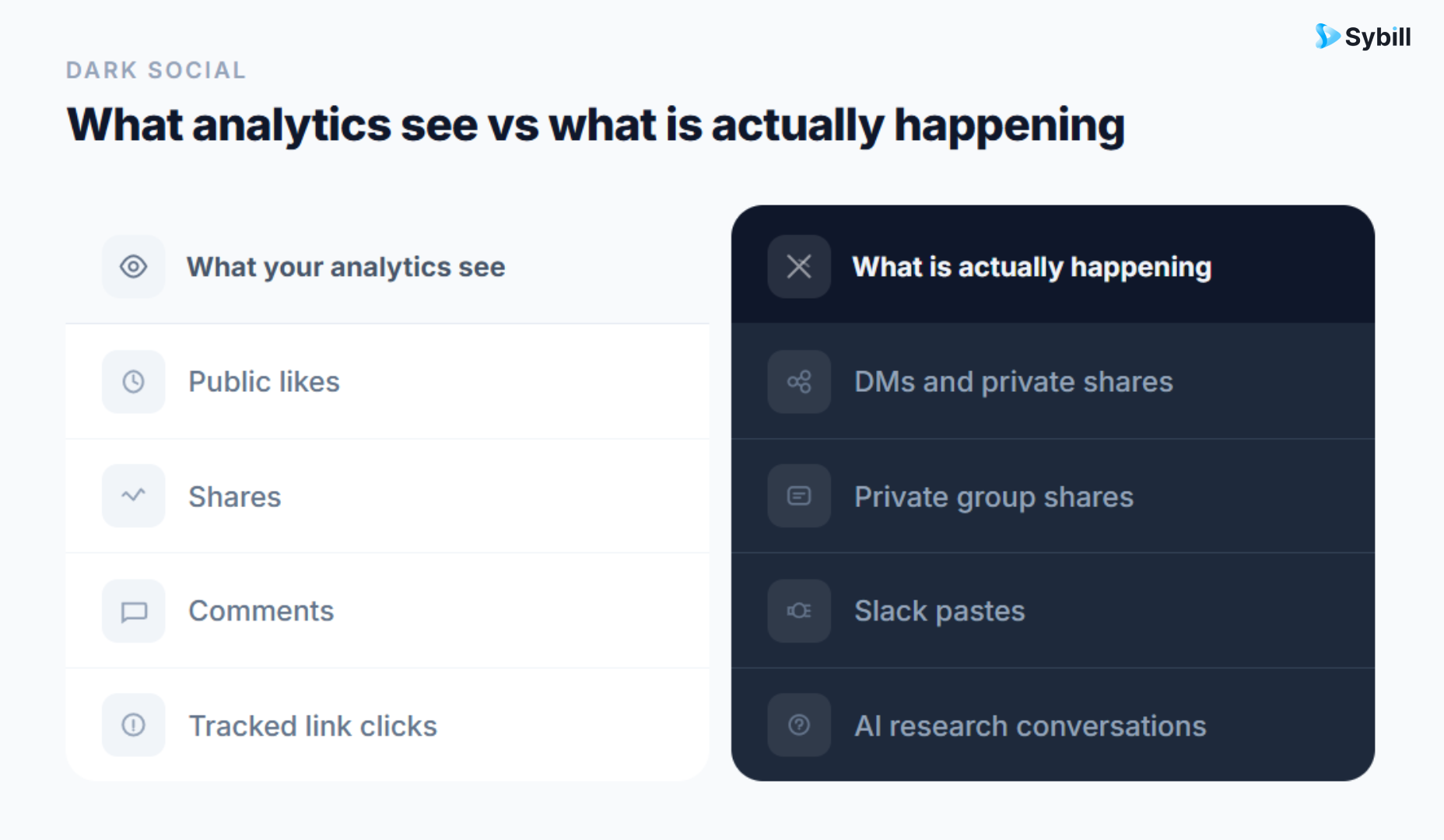
Dark social is not a niche phenomenon. It is the majority of how content actually travels in B2B.
The attribution gap is getting bigger. LLMs such as ChatGPT, Claude, Gemini, and Copilot are increasingly acting as private advisors for buyers. Instead of Googling your brand, a prospect asks an AI to compare your product against three competitors. That conversation leaves no footprint. This behavior is expanding the dark funnel because it moves critical thinking and decision-shaping even further below the surface.
Trust is the new KPI. The 2025 Edelman x LinkedIn Thought Leadership Impact Report found that 55% of decision-makers use thought leadership as part of their vetting process. The content they trust most is content their peers have validated. Dark social is the mechanism through which that peer validation travels.
The pre-contact favorite wins. 6sense's 2025 Buyer Experience Report found that 95% of the time, the winning vendor is already on the buyer's shortlist before any outreach lands. The trust and credibility built through content shared in private channels is a primary driver of who makes that list.
Your direct traffic is lying to you. When a CFO shares your whitepaper in a private executive Slack channel and three colleagues visit your website, every one of those sessions is recorded as direct traffic. That means your analytics are attributing real pipeline influence to nothing in particular. Dark social is hiding inside your "direct" numbers right now.
The content that earns dark social traction is not the content designed to go viral. It is content that solves a specific problem, challenges a common assumption, or delivers data that a professional would want to bring to their team.
Formats that travel well in private channels: case studies, counter-intuitive data points, side-by-side comparisons, practical frameworks, and short "what we got wrong" posts. Content that says something specific is far more shareable in a DM than content that says something safe.
Use Sybill's buyer intelligence to identify which themes, objections, and pain points come up repeatedly in your sales calls. Those patterns are your content brief. If your buyers are consistently raising the same question in discovery calls, write the LinkedIn post that answers it and watch what happens in your direct traffic.
Dark social is private, but it is not completely unmeasurable. UTM parameters let you trace the origin of clicks even when the referral source is blank.
Add UTM codes to every link you share in a LinkedIn DM, post, or group comment. A structure like ?utm_source=linkedin_dm&utm_medium=dark_social&utm_campaign=outreach creates a paper trail you can actually analyze. When you see a spike in direct traffic, check whether your UTM-tagged links spiked at the same time. The correlation is often the signal you are looking for.
Pair this with shortlinks for cleaner sharing and easier click tracking.
A well-crafted DM is one of the most powerful dark social moves available to a sales rep. The mistake most reps make is treating DMs as cold email with a LinkedIn wrapper. That is not what dark social is.
The dark social DM shares something useful first. A relevant case study. A specific insight from a recent sales call with a similar ICP. A short data point that speaks directly to a challenge you know they are facing.
This creates a private, high-value exchange that the prospect is likely to forward internally, which in turn surfaces your name inside the buying committee before you ever ask for a meeting.
Use Sybill's pre-meeting briefs to research exactly what a prospect's role involves and what they care about before you write that first DM. Generic messages do not travel. Specific ones do.
LinkedIn groups get dismissed because public-facing engagement there is modest. That misses the point. Closed groups are a prime dark social environment: the conversations that happen there travel to team chats, email threads, and internal Slack channels where you have no visibility.
Show up consistently in 3 to 5 niche groups where your ICP actually hangs out. Answer questions with genuine expertise rather than product pitches. Share perspectives that demonstrate you understand their world. Over time, your name becomes the one people forward when a relevant topic comes up.
The LinkedIn post that gets shared in a DM is almost always the one that made someone say "you have to see this." That reaction comes from specificity, contrast, or surprise.
A few formats that consistently generate private shares: "We analyzed 500 sales calls and found X. Not what we expected." Or: "The metric everyone tracks on LinkedIn tells you almost nothing about whether a deal will close. Here is what does." Or: "Three things I got completely wrong about [common practice]."
These formats work because they give someone a reason to forward the post with a personal note, which is exactly how dark social compounds.
Dark social does not leave a tidy footprint, but it leaves consistent signals. Watch for:
These signals are imperfect individually. As a pattern, they give you a real picture of your dark social reach.
The most underused dark social measurement tool is the simplest one: ask.
Add a standard question to every discovery call and demo form: "How did you first hear about us?" and "Was there a specific piece of content that made you want to reach out?"
The answers will consistently point to sources your analytics cannot track. "Someone shared your post in our leadership Slack." "My VP forwarded me something you wrote." "I saw your name come up a few times in [private community]." This qualitative data reshapes your content strategy more reliably than any UTM report.
Sybill captures these moments automatically in its Magic Summaries, so you can look back across dozens of discovery calls and spot the patterns in how prospects first encountered your brand.
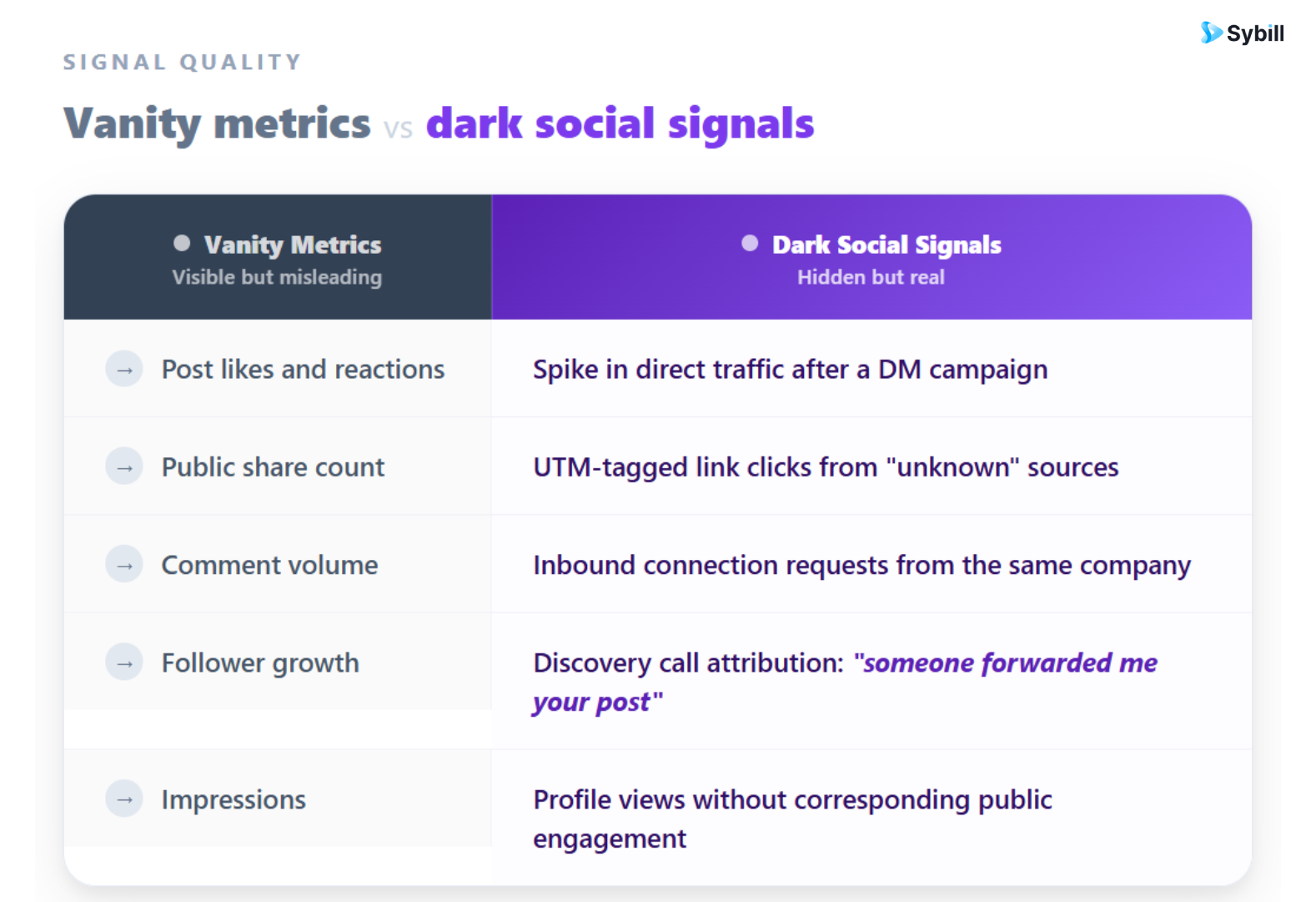
The vanity metrics tell you how your content performed on LinkedIn's surface. The dark social signals tell you whether your content is actually influencing pipeline.
A B2B team tracking UTM links across their LinkedIn outreach can often discover that the first touch on a deal was a DM containing a case study, three weeks before the rep ever sent a formal intro email. Without that tracking, the deal looks like it came from nowhere.
You cannot achieve perfect dark social measurement. That is the nature of private sharing. But you can close a significant portion of the gap.
Step 1: Tag everything. Every link you share publicly or privately on LinkedIn should carry UTM parameters. Standardize your taxonomy across the team so you can aggregate data across reps.
Step 2: Build a direct traffic baseline. Establish what your normal direct traffic volume looks like. Any meaningful deviation after a LinkedIn activity (post, DM campaign, group discussion) is a candidate for dark social attribution.
Step 3: Track conversation-based metrics. Count the number of discovery calls where prospects reference content. Track what percentage of those reference LinkedIn specifically. This is your qualitative dark social pulse.
Step 4: Combine quantitative and qualitative. UTM data tells you where clicks came from. Discovery call attribution data tells you what content influenced the decision. Together, they paint a picture that neither alone can produce.
Step 5: Ask your existing customers. Post-close surveys and customer success conversations often surface dark social patterns. "How did you evaluate us before your first call?" reveals the full influence chain.
Sybill is an AI sales intelligence platform built for the moments that happen after the hidden influence does its work, when a prospect finally shows up on a call.
Surface what resonates with your ICP. Sybill's buyer intelligence analyzes patterns across your sales calls to show which talk tracks, features, and pain points land most strongly with each ICP segment. Use those insights to build LinkedIn content and DMs that mirror the language your best prospects use when they are actually engaged. This is how you create content that earns private shares.
Know exactly what to say before you send a DM. Sybill's pre-meeting briefs pull together prospect context, company intelligence, and your own deal history so every outreach message is specific and relevant, not generic. Specific content travels through dark social. Generic content does not.
Capture discovery call attribution automatically. Every time a prospect tells you how they found you during a discovery call, Sybill's Magic Summary captures it. Over time, you can query Sybill across dozens of calls to see how dark social is actually driving pipeline. Ask Sybill "which deals mentioned LinkedIn in discovery?" and get a clear picture in seconds.
Follow up in a way that earns the next private share. Automated follow-up emails in your own voice, built from what was actually discussed on the call, keep the conversation moving. A good follow-up is itself a piece of content that the prospect might forward internally.
Dark social builds the reputation that earns the meeting. Sybill helps you convert that reputation into closed revenue.
What is dark social on LinkedIn?
Dark social on LinkedIn is any engagement with your content that happens in private, untracked channels: direct messages, closed groups, email forwards, Slack and Teams shares, and AI research conversations. It does not appear in your LinkedIn analytics but it significantly influences buying decisions.
Why is dark social important for B2B sales?
Research shows that 95% of the time, the winning vendor is already on a buyer's shortlist before any tracked interaction occurs. Dark social is the primary mechanism by which vendors earn a place on that shortlist. Ignoring it means your attribution model misrepresents how your pipeline actually develops.
How do you measure dark social on LinkedIn?
You cannot measure it perfectly, but you can get close by using UTM-tagged links in every post and DM, monitoring direct traffic for spikes that correlate with LinkedIn activity, and asking attribution questions on every discovery call. Combining quantitative UTM data with qualitative call attribution gives you the most accurate picture.
What content works best for dark social sharing?
Content that earns private shares tends to be specific, surprising, or immediately useful: contrarian takes with supporting data, practical frameworks, case studies with real numbers, and side-by-side comparisons. Content that is safe or generic does not travel well in private channels.
What is the difference between dark social and the dark funnel?
Dark social specifically refers to content sharing through private, untracked channels. The dark funnel is a broader concept that includes all the research, evaluation, and peer conversations that happen before a buyer ever engages with a vendor directly, including AI-assisted research, community discussions, and analyst conversations. Dark social is one significant component of the dark funnel.
How does LLM usage affect dark social in 2026?
AI tools like ChatGPT, Claude, and Gemini are increasingly acting as private research advisors for B2B buyers. When a prospect asks an AI to compare vendors, that conversation leaves no analytics footprint. This expands the dark funnel further and increases the importance of having high-quality, widely-shared content that AI tools can surface when asked about your category.
Can Sybill help with dark social strategy?
Yes. Sybill surfaces buyer intelligence from your sales calls to help you create LinkedIn content that mirrors the language and concerns of your best prospects. It also captures discovery call attribution in Magic Summaries, so you can track which pieces of content are driving dark social pipeline over time.
Dark social is not a gap in your analytics. It is a window into how B2B buying decisions actually get made.
The deals that feel like they appeared from nowhere were shaped weeks or months earlier, in a DM, a private group, an internal Slack thread, or an AI conversation your analytics never touched. The sales teams that understand this create content that deserves to be forwarded, track the signals that dark social leaves behind, and build the invisible reputation that puts them on the shortlist before the first cold email ever lands.
Your social selling strategy is incomplete without it. Your LinkedIn analytics are incomplete without it. And your pipeline attribution is almost certainly undercounting it.
Start with one change: tag every link you share on LinkedIn with UTM parameters. Then ask every new prospect how they first heard about you. The answers will tell you more about where your pipeline actually comes from than any dashboard you are currently running.
Ready to turn hidden influence into closed revenue? Try Sybill free and see what your deals look like when your discovery calls become an intelligence feed.
Dark social on LinkedIn is any engagement with your content that happens in private, untracked channels: direct messages, closed groups, email forwards, Slack and Teams shares, and AI research conversations. It does not appear in your LinkedIn analytics but it significantly influences buying decisions.
Research shows that 95% of the time, the winning vendor is already on a buyer's shortlist before any tracked interaction occurs. Dark social is the primary mechanism by which vendors earn a place on that shortlist. Ignoring it means your attribution model misrepresents how your pipeline actually develops.
You cannot measure it perfectly, but you can get close by using UTM-tagged links in every post and DM, monitoring direct traffic for spikes that correlate with LinkedIn activity, and asking attribution questions on every discovery call. Combining quantitative UTM data with qualitative call attribution gives you the most accurate picture.