Find us at booth #83, join us for a harbor side happy hour, or catch Gorish’s talk.

Sept, 16-18 > Learn more


Tamanna Mishra

September 4, 2026
%20(90).png)
Social selling does not fail because reps post too little. It fails when they treat a relationship network like an email list with headshots.
The connection request becomes a disguised pitch. Comments become visibility hacks. AI manufactures “personal” messages at industrial scale. A prospect likes one post and suddenly appears in a six-touch sequence they never asked to join.
None of this is particularly social.
Social selling uses professional networks to understand buyers, contribute useful ideas, build credible familiarity and create relevant sales conversations. For most B2B sellers, LinkedIn is the primary environment. But access to millions of professionals does not mean every profile is a prospect or every interaction is buying intent.
The following LinkedIn social selling mistakes damage more than reply rates. They make sellers less credible before a sales conversation even begins.
The biggest mistake in social selling is using a relationship and research environment as a distribution channel.
An email list is built for sending. A professional network is built around people observing, learning from and evaluating one another. Buyers can see how a seller thinks long before they agree to a call.
LinkedIn and Ipsos surveyed more than 900 B2B buyers across seven markets for the Trust Advantage report. The research identifies credibility, attentiveness, respect and validation as behaviours that build seller trust.
Notice what is missing: posting seven days a week, collecting thousands of connections or deploying the cleverest DM sequence.
The objective is to become recognisably useful to the right people.
A large network can create reach. It cannot rescue bad targeting.
If your connections span every industry, company size and buying role imaginable, your posts become generic because they must speak to everyone. Your outreach also becomes harder to personalise without resorting to superficial details.
Start with your ideal customer profile, target accounts and relevant stakeholder roles. Then ask why this particular person might benefit from connecting.
“Works in sales” is not an ICP. Neither is “has a LinkedIn account.”
Awards, quota attainment and “top 1% closer” claims may impress a hiring manager. A buyer visiting your profile wants different evidence:
Write the headline and About section around the market you understand and the outcomes you help create. Your profile should establish buyer relevance without turning into a product brochure.
The connection acceptance arrives. Seventeen seconds later:
Thanks for connecting! We help innovative companies transform revenue with our cutting-edge platform. Do you have 15 minutes Tuesday?
This is pitch-slapping. The prospect accepted a connection, not a meeting invitation disguised as punctuation.
There is no universal rule requiring five likes, two comments or fourteen days of waiting. Contact the person when you have a credible reason, such as a relevant business trigger, an explicit question or a conversation already underway.
For structured outreach across LinkedIn, email and phone, use the principles in Sales Cadence Best Practices.
Research should create relevance. It should not create surveillance theatre.
Dishonest social selling tactics include:
Referencing a prospect’s recent product launch may be relevant. Opening with details about their child’s school probably is not.
AI can help organise research and improve wording. It cannot create a relationship that never happened.
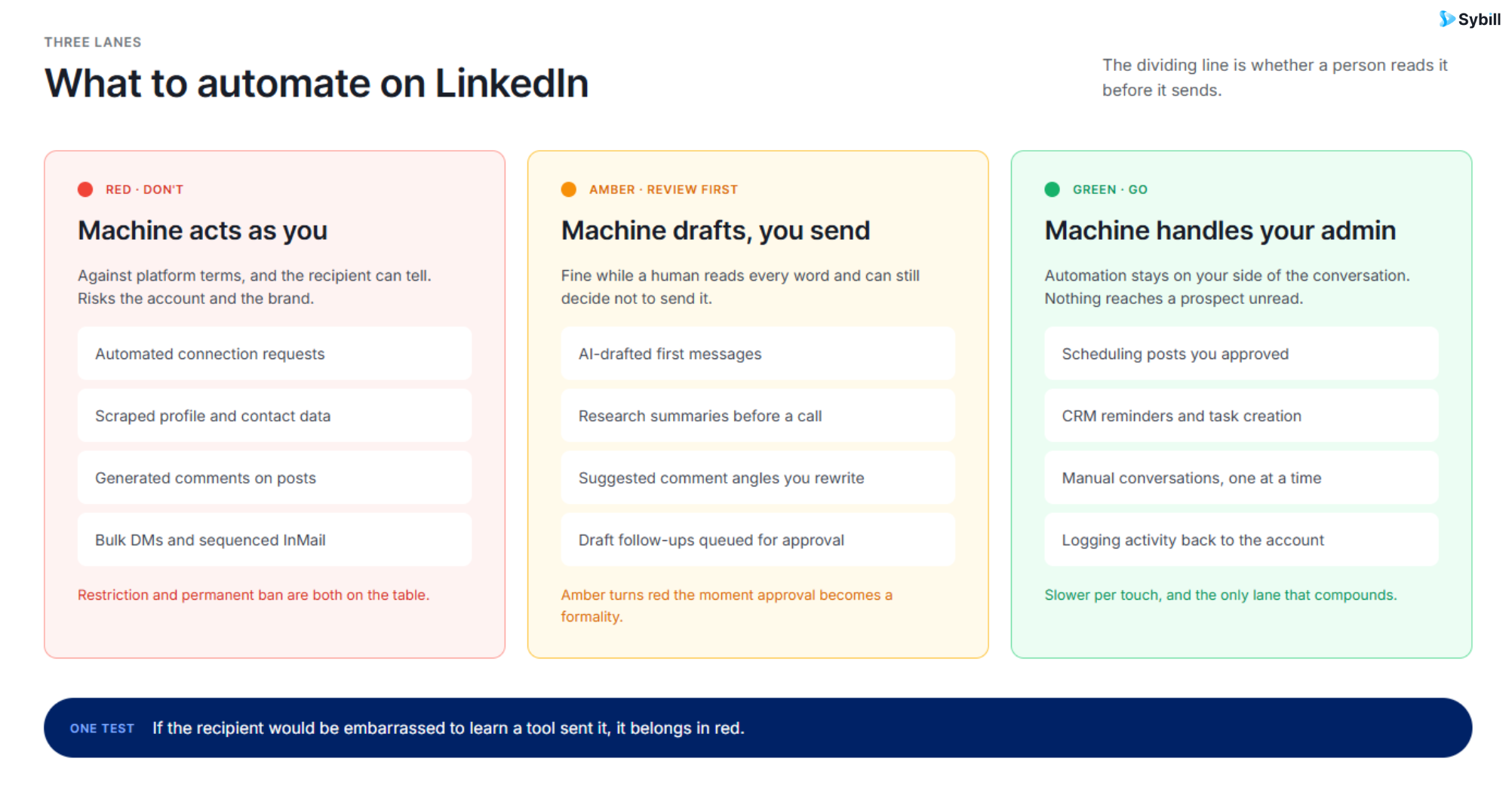
Automation promises a seductive equation: more connections, more comments, more messages, more meetings.
It frequently produces more evidence that nobody involved was paying attention.
LinkedIn prohibits unauthorised bots, scraping, automated messages and services that create fake engagement. Its User Agreement also prohibits using bots to add contacts, send messages, comment, like or otherwise drive inauthentic activity. Automated violations can lead to temporary or permanent account restrictions. LinkedIn Help
Use AI and automation for legitimate research, reminders, approved scheduling, data organisation and drafting assistance. Keep identity, judgment and direct participation human.
For the broader role of AI in responsible prospecting, read AI for Sales Prospecting.
LinkedIn already has enough posts about resilience, coffee and “five lessons leadership taught me at the airport.”
Posting consistently does not help if every post could have been written by anyone, for everyone, about nothing in particular.
Useful seller content can come from:
Instead of asking AI to invent another generic post, sales teams can use Ask Sybill to identify recurring questions, buyer language, objections and priorities across real sales calls and emails.
Sybill supplies first-party conversation context. The seller still needs an opinion worth reading.
“Great insights!”
“Couldn’t agree more.”
“This.”
These are not conversations. They are digital furniture.
A valuable comment may:
Do not manufacture contrarian opinions merely to attract attention. The point is to contribute something the reader did not already receive from the post.
A profile view is not a request for a demo. A like is not budget approval. Sometimes a thumb is just a thumb.
Use social signals as context, not verdicts. Combine them with ICP fit, account activity, business triggers and direct evidence from the buyer.
If you need to reach additional stakeholders after a relevant conversation begins, use a deliberate decision-maker outreach strategy.
A prospect comments on a post about forecast accuracy. The rep starts a relevant DM conversation and books a call.
Then the calendar invitation says “Sybill demo,” the discovery call begins with “So, tell me about your role,” and every piece of context that earned the meeting vanishes.
Carry the original signal into:
Once social engagement becomes a sales conversation, Sybill can help preserve that continuity. Pre-meeting briefs prepare the rep using existing account and attendee context. CRM Autofill captures what the buyer says, while email follow-ups and the Deal Workspace help turn new evidence into action. Click here to try free.
Sybill helps sellers carry relevant context forward once social interest enters a human sales process.
See Multi-Channel Prospecting for the complete channel strategy.
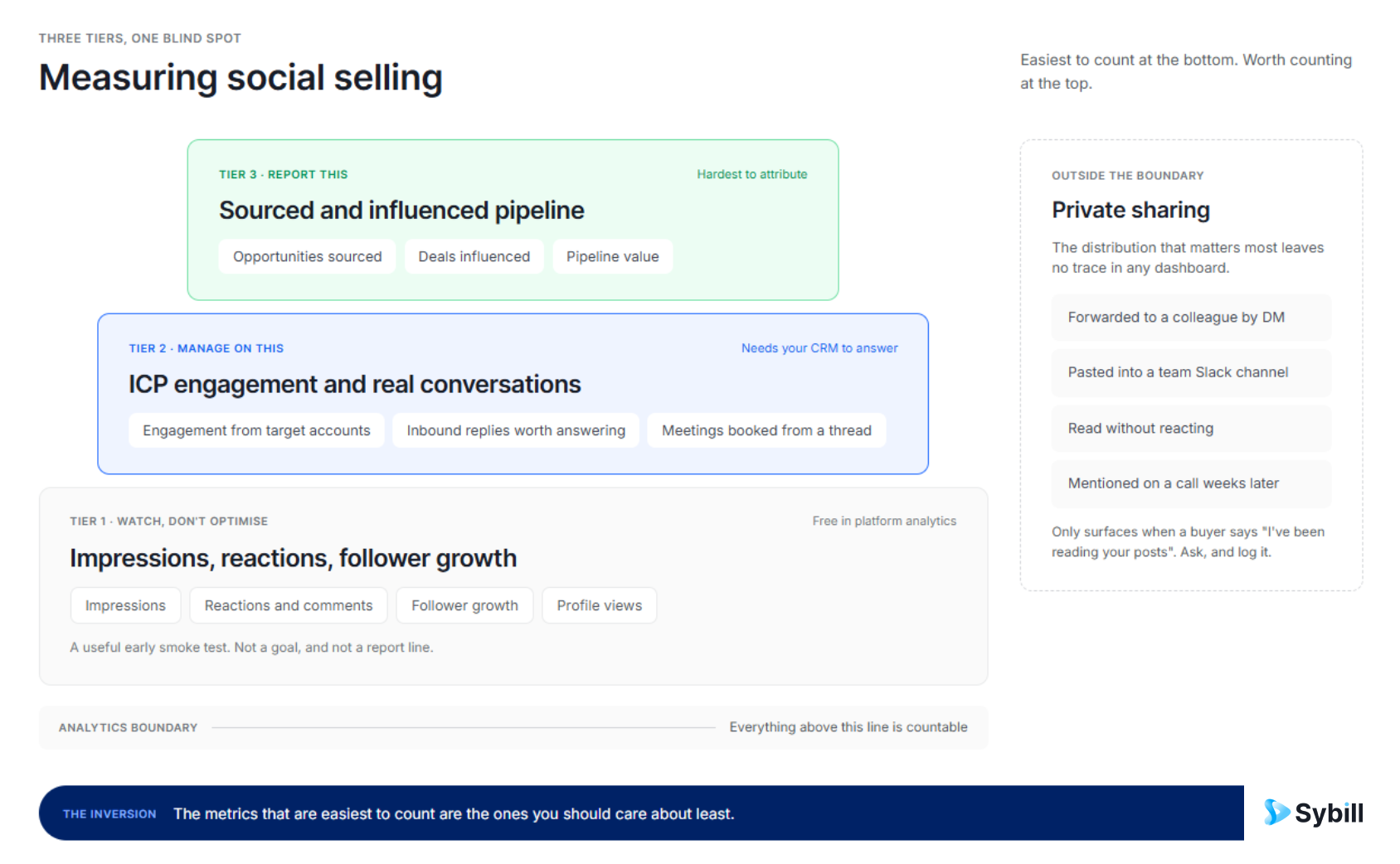
Likes, impressions and follower growth help diagnose content distribution. They do not prove commercial impact.
Measure social selling at several levels:
Do not assume low visible engagement means the content failed. A buyer may send your post to a colleague through a private message, Slack channel or email without leaving a public reaction.
That hidden influence is why dark social on LinkedIn matters. Public engagement shows what happened on the surface. Buyer conversations can reveal what travelled underneath it.
Social selling is not a softer name for automated prospecting.
It is the practice of becoming visible, credible and useful to the people you may eventually help. Sometimes that creates a direct conversation. Sometimes it earns a private share. Sometimes it simply means a buyer recognises your name six months later when the problem becomes urgent.
Avoiding common social selling mistakes requires more than posting regularly. It requires disciplined targeting, honest research, useful participation, contextual outreach and a clean handoff into the sales process.
LinkedIn can help you earn the conversation. Sybill helps you carry the context into the deal.
Common social selling mistakes include prioritising connection volume over relevance, writing seller-centred profiles, pitching immediately, using fake personalisation, automating LinkedIn activity, posting generic content, leaving empty comments, treating engagement as buying intent, losing context across channels and measuring vanity metrics instead of pipeline influence.
Dishonest social selling tactics include pretending a mutual contact made a referral, fabricating familiarity, using personal details manipulatively, inventing scarcity, exaggerating customer results, citing unverified statistics and presenting an automated message as individually researched. Relevant personalisation should be accurate, proportionate and connected to a legitimate business reason.
LinkedIn permits native and approved functionality, but prohibits unauthorised bots, scraping, automated connection activity, automated messaging and fake engagement. Third-party tools that automate activity on LinkedIn can lead to account restrictions. Review LinkedIn’s current User Agreement and prohibited-software guidance before adopting any automation product.
There is no universal waiting period. Pitching immediately is usually inappropriate unless the person explicitly requested information. Start a sales conversation when you have a relevant reason, such as an expressed need, business trigger, direct question or established discussion. Waiting several days does not make an irrelevant pitch relevant.
Track ICP-account engagement, meaningful comments and direct messages, social-sourced conversations, stakeholder coverage, sales calls influenced by content, opportunities created and influenced pipeline. Likes, impressions and follower growth can measure distribution, but they should not be treated as evidence of buying intent or revenue impact.
Common social selling mistakes include prioritising connection volume over relevance, writing seller-centred profiles, pitching immediately, using fake personalisation, automating LinkedIn activity, posting generic content, leaving empty comments, treating engagement as buying intent, losing context across channels and measuring vanity metrics instead of pipeline influence.
Dishonest social selling tactics include pretending a mutual contact made a referral, fabricating familiarity, using personal details manipulatively, inventing scarcity, exaggerating customer results, citing unverified statistics and presenting an automated message as individually researched. Relevant personalisation should be accurate, proportionate and connected to a legitimate business reason.
LinkedIn permits native and approved functionality, but prohibits unauthorised bots, scraping, automated connection activity, automated messaging and fake engagement. Third-party tools that automate activity on LinkedIn can lead to account restrictions. Review LinkedIn’s current User Agreement and prohibited-software guidance before adopting any automation product.