Find us at booth #83, join us for a harbor side happy hour, or catch Gorish’s talk.

Sept, 16-18 > Learn more


Tamanna Mishra

July 28, 2026
%20(55).png)
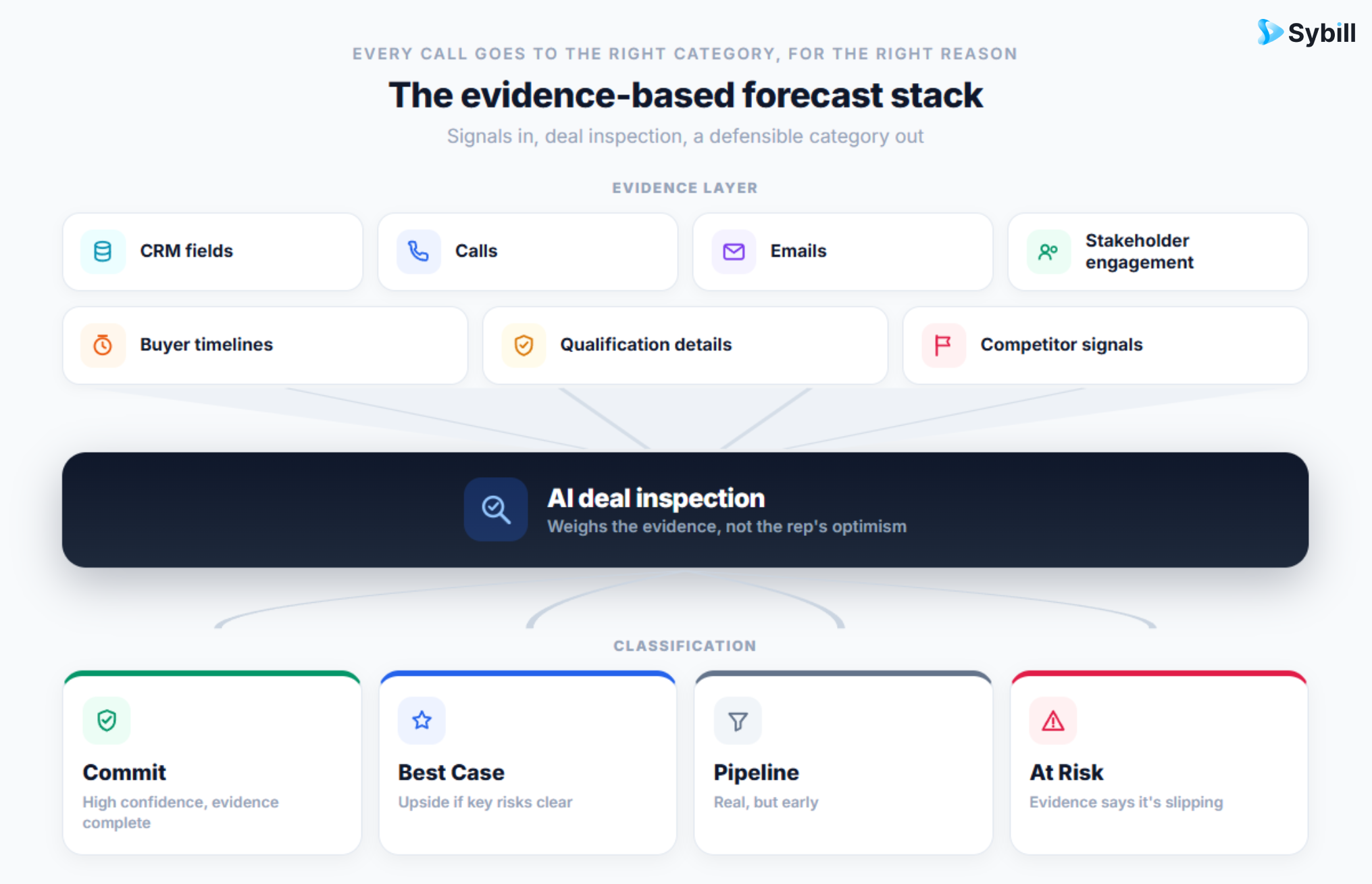
Sales forecasting case studies show that accurate forecasts depend on more than CRM stages, close dates, and rep confidence. Teams need current deal data, verified buyer intent, stakeholder coverage, clear next steps, and evidence supporting the expected value and timing of each opportunity. AI can inspect conversations, emails, CRM records, and deal activity to challenge assumptions before they become missed forecasts.
A deal enters the forecast as “looking good.” The close date is this month. The champion loves the product. The rep is confident. Then procurement appears, the economic buyer goes quiet, the product scope changes, or the customer reveals that the project was never approved.
Poof. The commit disappears.
That is because sales forecasts rarely fail inside the forecasting spreadsheet. They fail upstream, where incomplete deal information gets dressed up as certainty.
A forecast built on vibes is less Moneyball and more astrology with ARR attached.
The sales forecasting case studies covered in this article show a better approach. But first…
Salesforce defines a sales forecast as a data-driven estimate of how much revenue a company expects to generate during a specific period. Pipeline management, by contrast, focuses on tracking and advancing individual opportunities.
The two are different, but they are inseparable.
When the pipeline contains stale CRM records, unverified timelines, poorly qualified opportunities, or single-threaded relationships, the forecast merely converts those weaknesses into a revenue number.
Common sources of forecast error include:
HubSpot similarly identifies stale records, incomplete pipeline visibility, miscalibrated stage probabilities, and optimistic owner adjustments as common sources of forecasting error.
AI sales forecasting can help because it does not have to rely exclusively on the handful of fields a rep remembers to update. It can inspect calls, emails, CRM data, stakeholders, engagement, objections, next steps, and buyer language together.
That is the information gap an opportunity stage alone cannot close.
Inspect the story behind the forecast
Sybill gives sales leaders instant answers about pipeline health, at-risk deals, stalled opportunities, objections, and rep performance, without forcing them to chase updates or review every call.
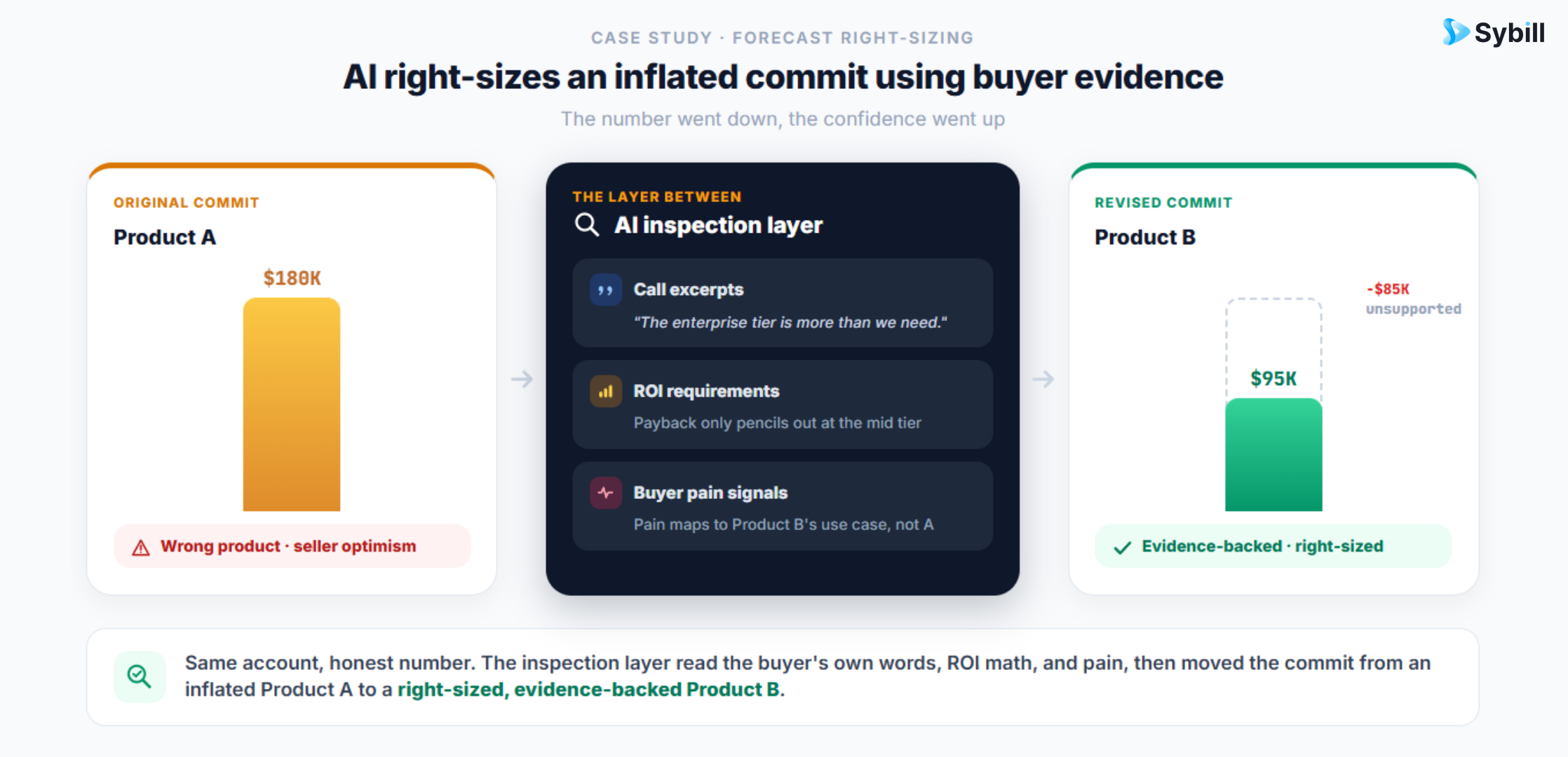
An Account Executive was working on an enterprise opportunity forecasted as a significant close.
While preparing the business case, she asked Sybill to analyse what the customer actually cared about, including the stated problems, potential ROI, and product requirements.
The answer challenged the existing forecast.
The opportunity was positioned around Product A, but the buyer’s own statements indicated that Product B, a different and less expensive product, was the stronger fit. Sybill supported the analysis with the customer’s pain points, relevant ROI context, and direct evidence from the conversation.
The AE took the finding back to the prospect. The buyer confirmed it.
The result was not a larger forecast. It was a more credible one. The inflated opportunity became a cleaner commit based on the product the customer was actually ready to purchase, and the close followed.
Sales teams often treat downward forecast adjustments like defeat. They are not.
A smaller deal supported by buyer evidence is more valuable than a large commit supported by wishful thinking. Accurate forecasting is not about protecting the biggest possible number. It is about identifying the number the business can responsibly plan around.
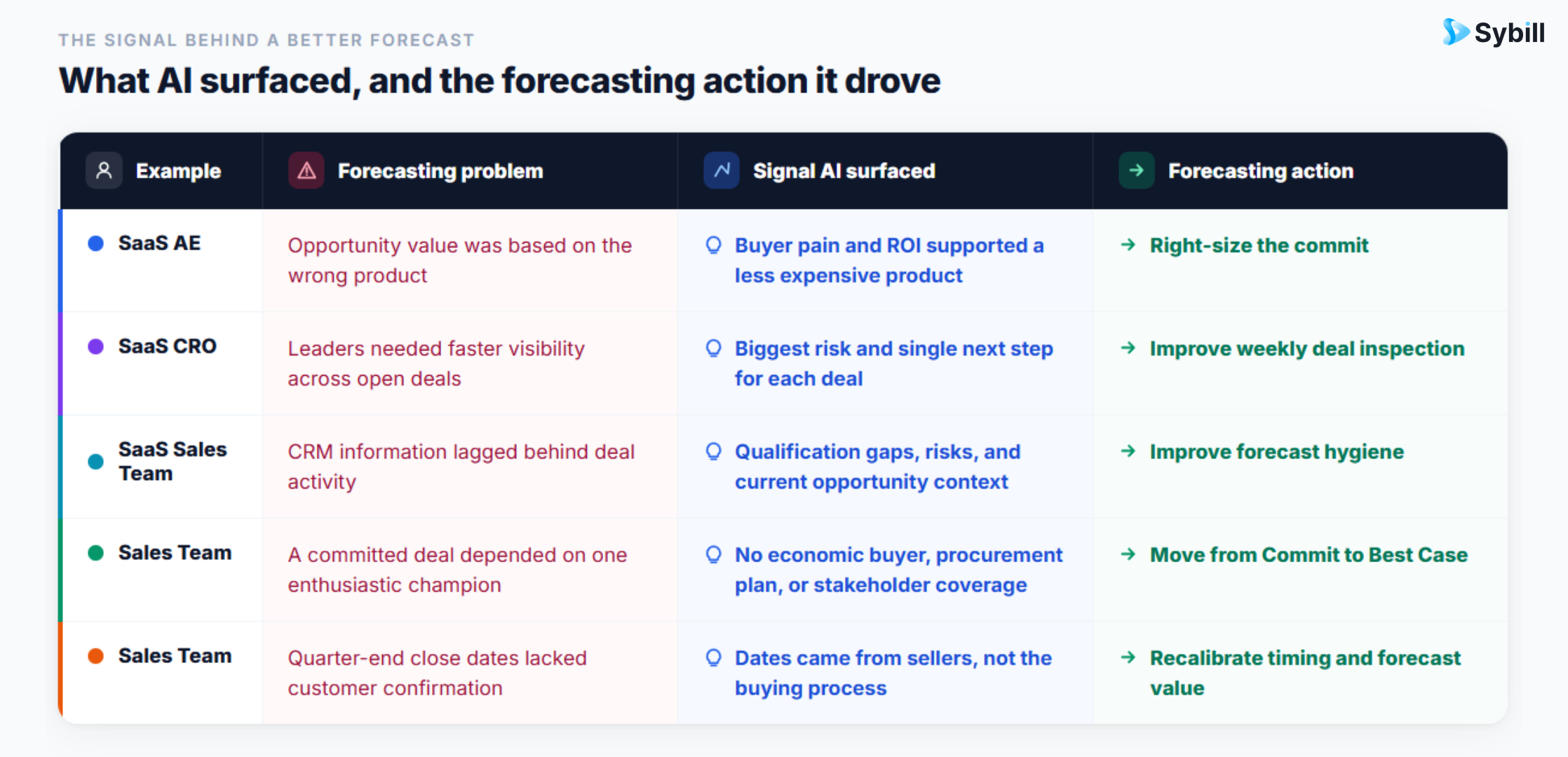
AI also gave the AE a repeatable way to fact-check her judgement. She now uses Sybill to run mid-deal pre-mortems, asking what she missed, which qualification gaps remain, and what could prevent an opportunity from closing.
Read how a real AE uses Sybill to fact-check forecasts and avoid deal surprises.
A CRO and Co-founder cannot spend Monday morning binge-watching recordings or interrogating reps about every opportunity.
Instead, she runs a scheduled Sybill prompt across every open deal. For each opportunity, Sybill answers two questions:
The answers arrive as two concise bullets per deal. The CRO describes the output as a “10,000-foot view” of the pipeline and uses it to bring sharper accountability into weekly sales meetings.
The company also uses weekly deal updates and a deal-risk dashboard to examine lead sources, use cases, and risks across the pipeline. That makes it easier to identify patterns, qualification problems, and areas where the pipeline may be weaker than it looks.
A forecast review should not begin with, “So, tell me what is happening with this deal.”
Leaders should enter the meeting already knowing what changed, where risk increased, and which next steps are vague or overdue. The conversation can then focus on decisions, coaching, and intervention instead of basic information retrieval.
That is the difference between a forecast call and expensive story time.
Read how a CRO uses scheduled deal gut checks and risk dashboards.
Forecast accuracy cannot survive stale opportunity data.
Before adopting Sybill, a company’s reps spent substantial time updating CRM fields, writing follow-ups, and completing other administrative work. Opportunity updates could lag by 48 to 72 hours, leaving managers to piece together deal health from CRM records, rep explanations, and call recordings.
The company reported that after adopting Sybill:
CRM hygiene is often described as a rep-discipline problem. Sometimes it is. More often, it is a workflow-design problem.
When updating 15 fields competes with taking another customer meeting, the customer meeting usually wins. Then leadership complains that the CRM cannot be trusted.
Automating the capture of qualification details, buyer concerns, next steps, and competitor information creates a fresher foundation for sales pipeline forecasting without asking reps to become part-time data-entry clerks.
For more on this problem, read how AI can create a single source of truth for every sales deal.
Read how a sales team automated CRM updates and accelerated deal reviews.
What is hiding inside your commit forecast?
Use Sybill to inspect buyer intent, stakeholder coverage, next steps, competition, qualification gaps, and the biggest risk across open opportunities. Explore Sybill’s AI forecasting prompt templates.
An account executive commits a USD 200,000 enterprise opportunity. The champion attends every call, praises the product, and requests a proposal.
The deal looks healthy until AI inspects the full history and finds:
The champion may genuinely love the product. Unfortunately, enthusiasm is not organisational consensus.
The manager moves the opportunity from Commit to Best Case and creates a recovery plan: engage the economic buyer, confirm the decision process, map procurement, and establish a mutual action plan.
Single-threaded opportunities can feel deceptively strong because one relationship produces plenty of activity. AI deal-risk analysis can separate contact enthusiasm from buying readiness.
A quarterly forecast contains eight opportunities expected to close during the final two weeks of the period.
AI reviews calls, emails, meeting notes, and CRM history. It finds that six of the eight close dates were never mentioned or confirmed by the buyers.
There is no evidence of:
The dates exist because the quarter ends, not because the buying process ends.
Leadership reclassifies the deals according to buyer-confirmed milestones and reduces the current-quarter forecast.
Painful? Briefly.
Useful? Extremely.
A CRM date is data. A buyer-confirmed timeline is evidence. Treating them as the same thing is how quarter-end fantasy becomes next-quarter carryover.
These examples involve different problems, but the principles are remarkably consistent.
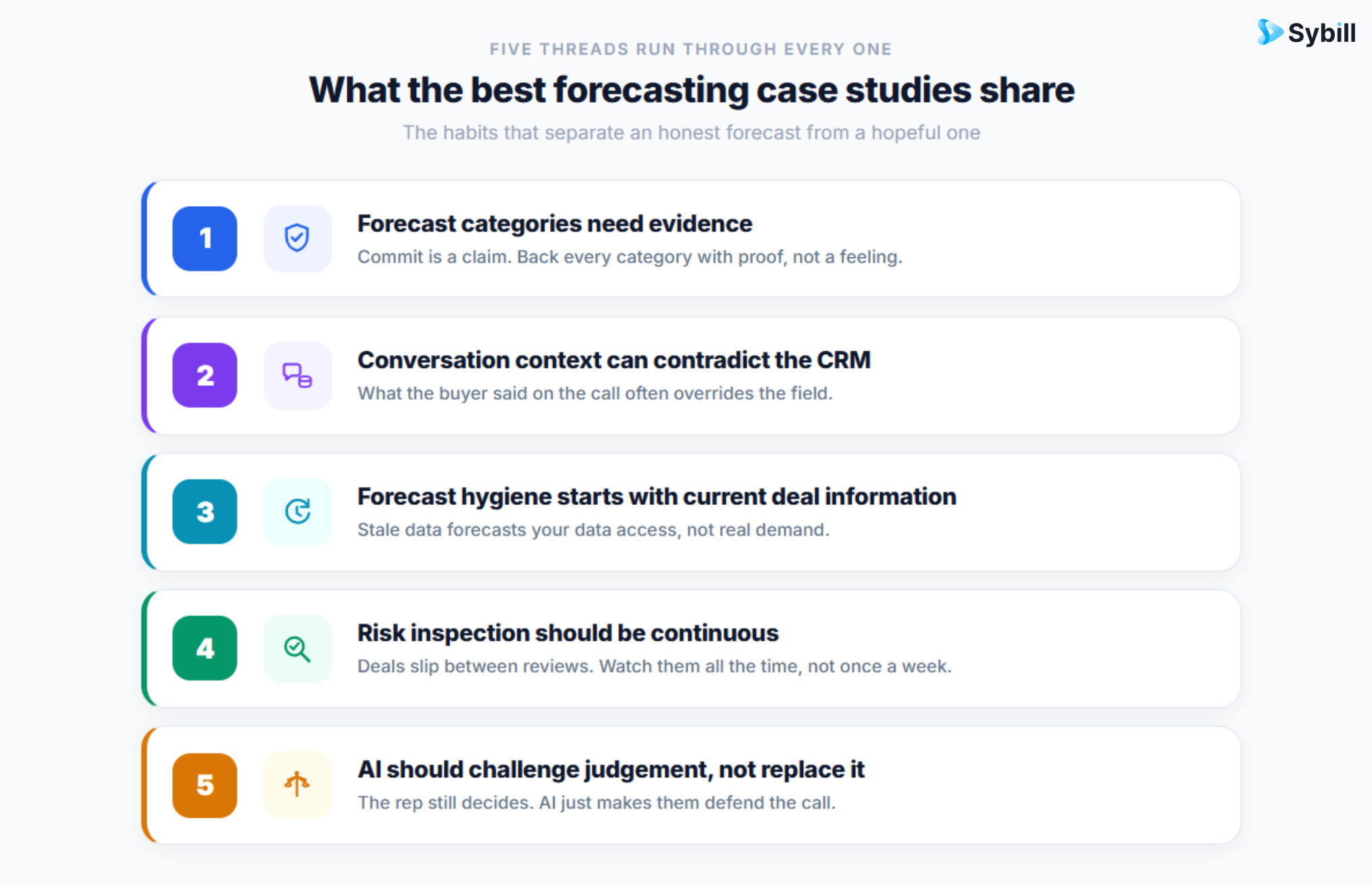
Commit should mean more than “the rep feels good.” Define the buyer evidence required for each category, such as economic-buyer access, confirmed need, decision criteria, procurement progress, and an agreed timeline.
A stage may say Evaluation while the buyer is still questioning whether the project should exist. An amount may reflect the seller’s preferred product rather than the buyer’s actual requirements. AI call analysis helps surface those contradictions.
Historical conversion rates and stage probabilities matter, but predictive models are only as useful as their inputs. Current qualification, stakeholder, competition, and next-step data must reach the CRM consistently.
Waiting for the forecast call to inspect deals is like checking the smoke alarm after the kitchen is on fire.
Run deal-risk checks after important meetings, when stages change, before leadership reviews, and throughout the quarter. AI-generated sales call summaries can turn conversations into structured deal intelligence while the information is still actionable.
The best AI sales forecasting system is not a mysterious machine announcing that a deal has a 72.4% probability of closing.
It is a relentless deal inspector. It finds missing proof, identifies contradictions, and shows leaders why a forecast may be fragile. The sales manager still owns the call.
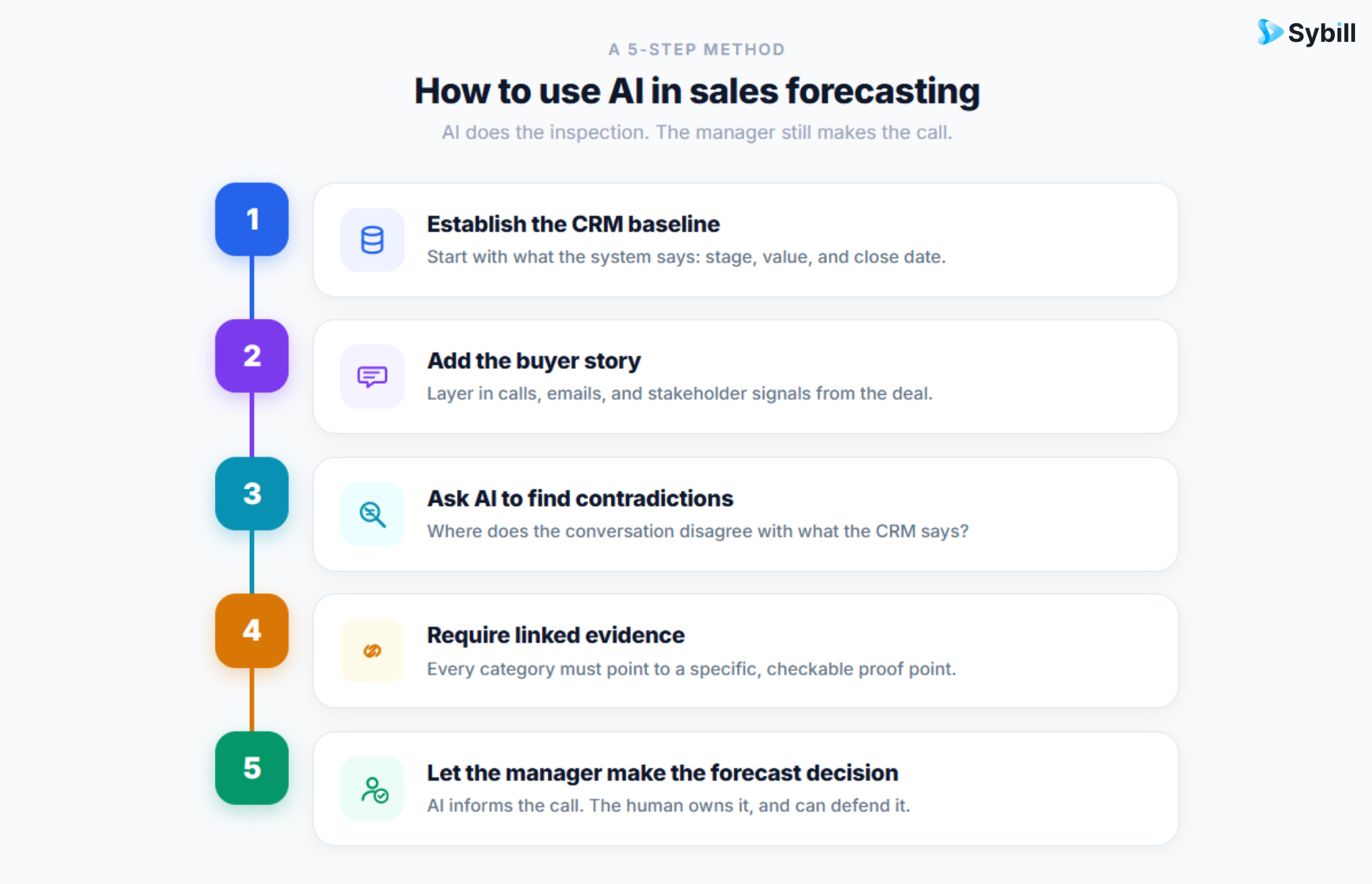
Start with the opportunity amount, stage, forecast category, close date, owner, activity, historical conversion rate, and expected sales cycle.
Bring in calls, emails, stakeholder activity, pain points, urgency, competition, product requirements, decision criteria, budget, procurement, and implementation timing.
Useful questions include:
An AI-generated risk label is not enough. Leaders should be able to examine the relevant conversation, email, CRM field, or activity history behind the conclusion.
AI provides inspection at scale. Managers provide context, commercial judgement, and accountability.
That combination is stronger than rep opinion alone and more realistic than pretending a model understands every political or strategic nuance inside a complex B2B purchase.
The goal of AI sales forecasting is not to make the forecast look smarter. It is to make the evidence behind it harder to ignore.
Sales teams use AI to right-size an inflated opportunity. They use scheduled analysis to surface risks and next steps across its pipeline. They automate much of the deal-data capture managers need for faster, better-informed reviews.
Different workflows. Same principle.
Stop asking whether the CRM says the deal will close. Ask whether the buyer evidence agrees.
See how Sybill helps sales leaders inspect deals, surface pipeline risk, and forecast with better context.
AI can analyse CRM records alongside calls, emails, engagement, stakeholder activity, objections, next steps, and buyer timelines. It helps teams identify stale data, missing evidence, and contradictions that could make a forecast category, value, or close date unreliable.
A B2B sales forecast should include opportunity value, stage, forecast category, close date, historical conversion rates, buyer engagement, stakeholder coverage, next steps, procurement status, competition, product fit, and evidence supporting the expected timeline.
Common causes include stale CRM data, inconsistent stage definitions, rep optimism, seller-created close dates, weak qualification, missing decision-makers, changing buyer priorities, and risks that appear in customer conversations but never reach the opportunity record.
A sales pipeline contains the open opportunities a team is pursuing. A sales forecast estimates how much revenue those opportunities are likely to generate during a defined period. A large pipeline does not guarantee a reliable forecast when deal quality, buyer commitment, or timing is unclear.
AI can analyse CRM records alongside calls, emails, engagement, stakeholder activity, objections, next steps, and buyer timelines. It helps teams identify stale data, missing evidence, and contradictions that could make a forecast category, value, or close date unreliable.
A B2B sales forecast should include opportunity value, stage, forecast category, close date, historical conversion rates, buyer engagement, stakeholder coverage, next steps, procurement status, competition, product fit, and evidence supporting the expected timeline.
Common causes include stale CRM data, inconsistent stage definitions, rep optimism, seller-created close dates, weak qualification, missing decision-makers, changing buyer priorities, and risks that appear in customer conversations but never reach the opportunity record.