Find us at booth #83, join us for a harbor side happy hour, or catch Gorish’s talk.

Sept, 16-18 > Learn more


Tamanna Mishra

August 27, 2026
%20(73).png)
SPICED only scales when buyer evidence is captured across calls and emails, structured consistently, carried forward, checked for gaps or contradictions, written into CRM fields, and converted into action. AI should handle that persistence and administration. Reps and managers should still judge whether the evidence is credible. Sybill connects deal memory, CRM updates, coaching, and execution so SPICED becomes part of how deals move, not another form sellers complete.
Most SPICED rollouts begin by certifying the team, adding CRM fields, updating discovery templates, and coaching managers to inspect the methodology.
Then selling starts.
Reps jump between calls, inboxes, CRM records, and follow-ups. One stakeholder explains the pain. Another quantifies its impact later. A procurement email changes the critical event. The decision process shifts after an executive joins. By the forecast call, the evidence is scattered across systems and memory.
That is an operational failure.
If you need a primer on the framework itself, start with Sybill’s complete SPICED sales guide. This article addresses the harder question: how do you make SPICED reliable across every active deal without turning sellers into full-time data-entry clerks?
The problem appears in three places:
The administrative burden matters too. Salesforce’s 2026 State of Sales research reports that the average seller already spends only about 40% of the workweek selling.
The answer is to remove the manual work required to keep the methodology current.
Winning by Design defines SPICED as Situation, Pain, Impact, Critical Event, and Decision. The official SPICED framework is designed to create a shared language across the revenue lifecycle, not merely a discovery-call checklist.
That distinction changes the implementation.
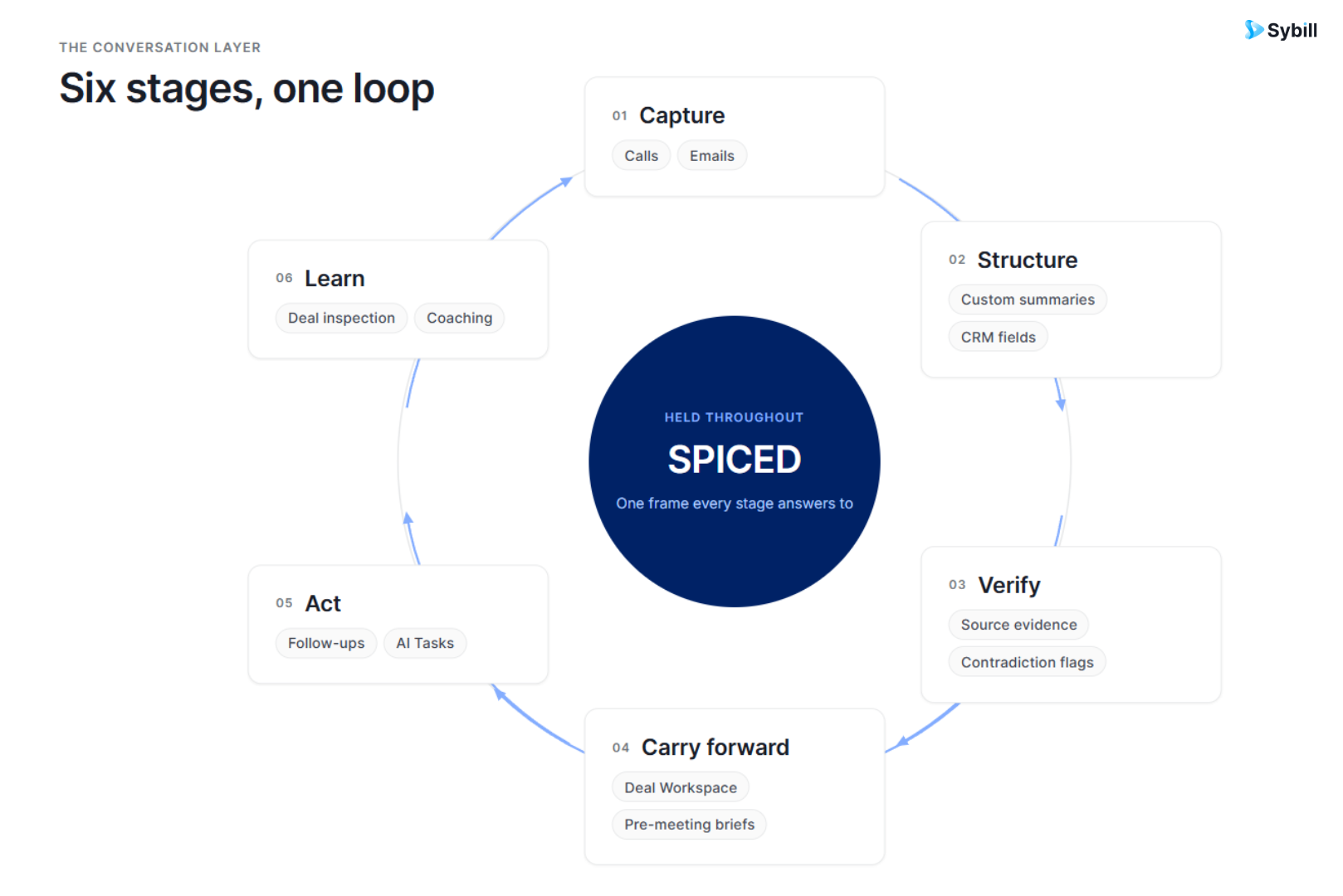
A CRM form stores a snapshot. An operating loop continuously does six things:
AI can preserve context across a multi-threaded deal and handle repetitive classification, summarization, CRM updates, and preparation. Humans remain responsible for deciding whether the pain, impact, deadline, and decision evidence are credible.
Sybill supports that full loop. It combines meeting and email intelligence, persistent deal context, CRM automation, deal inspection, coaching, follow-ups, and AI-assisted tasks. SPICED can therefore operate across the deal rather than living in a static template completed after one call.
Automation amplifies its operating standard. Vague fields produce consistently vague output at scale.
Start by defining what counts as credible evidence for each SPICED element and how the business will use it. The framework organizes buyer evidence into five areas: Situation, Pain, Impact, Critical Event, and Decision.
Each field also needs an evidence state: missing, mentioned but unverified, buyer-confirmed, contradicted, or stale. Store the source and last-confirmed date where possible.
SPICED evidence rarely arrives in acronym order. The AI workflow needs to follow the buyer’s journey instead of treating each meeting as an isolated event.
A seller should enter each meeting knowing what is established and what remains uncertain. Sybill’s Pre-Meeting Briefs draw context from previous calls, emails, CRM data, and other deal activity. Teams can customize briefs by meeting type.
For a SPICED workflow, the brief should answer:
A useful prompt is: “Which SPICED elements have been confirmed, which remain unclear, and what should I validate in this meeting?”
Sybill’s customizable Magic Summaries can capture different fields for discovery, demos, technical validation, or executive conversations. A team can configure SPICED sections and specify the evidence expected in each one.
CRM Autofill then reduces the copy-and-paste tax. Sybill can update supported standard and top-level custom fields after calls and emails, with a custom prompt for each field. It works with Salesforce, Pipedrive, HubSpot, Microsoft Dynamics 365, and Zoho CRM.
Configuration separates useful automation from polished noise. “Update Impact” is weak. “Record the buyer-confirmed operational or financial consequence, preserve any number and timeframe, and mark unquantified claims as unverified” sets a clear standard.
A single-call summary cannot represent a six-month buying process.
Sybill’s Deal Workspace brings meeting and email history, deal summaries, and custom properties into one view. Teams can map relevant fields back to the CRM while retaining the context needed to interpret them.
Consider a typical sequence:
The qualification picture changed four times. AI should preserve that evolution, not overwrite it with the latest sentence it heard.
Managers do not need more recordings to watch. They need to know where their attention will change an outcome.
Ask Sybill lets teams question deal context in plain English. Deal Inspection surfaces qualification gaps, decision-process risk, and momentum. Coaching and Performance helps leaders find patterns across reps and conversations.
Useful operating questions include:
These questions make adoption observable. “Improve discovery” is abstract. “You found pain in eight deals but established measurable impact in two” is coachable.
Qualification does not move a deal. Action does.
Sybill can generate personalized email follow-ups grounded in the conversation. AI Tasks can capture commitments from calls, prioritize them, and help execute approved work such as follow-ups, calendar invitations, reports, and collateral.
If Impact is unverified, the next action may ask the champion to validate the cost model. If the Critical Event lacks a consequence, the rep should ask what changes if the date slips. If the Decision process changed, the task may be to involve security or procurement.
AI closes the operational loop when it turns evidence gaps into approved work, not when it produces a longer summary.
Generative AI makes it easy to fill every field. That is precisely why governance matters.
Separate extraction from inference. Extraction records what the buyer stated. Inference proposes an interpretation for review. Never promote an inference to buyer-confirmed evidence silently.
Build these controls into the workflow:
Winning by Design’s Perfect Discovery Call blueprint emphasizes diagnosis before prescription and having the buyer articulate impact and urgency. AI can help locate and test that evidence. It cannot create a business case the buyer never expressed.
Choose the opportunity segment and sales motion for the pilot. Define each SPICED field, evidence state, source requirement, owner, freshness rule, and manager inspection behavior. Audit current CRM fields before adding new ones.
Configure summaries, CRM prompts, brief sections, and the deal view. Pilot with a small group across live opportunities. Review false positives, missing evidence, and fields that invite interpretation.
Replace generic pipeline questions with evidence-based inspection. Ask what changed, what remains unverified, and which next action resolves the highest-risk gap. Coach patterns across several deals, not isolated call moments.
Document pilot corrections, publish the standard, expand to the next team, and monitor adoption. Keep human review for high-impact fields and actions until quality is proven.
Do not jump from “our fields are fuller” to “SPICED increased win rate.” Track leading indicators first, then test lagging outcomes over a meaningful sample.
Compare similar teams, segments, stages, and time periods. Methodology adoption is one variable among many, so treat correlation as a signal for further analysis, not proof of causality.
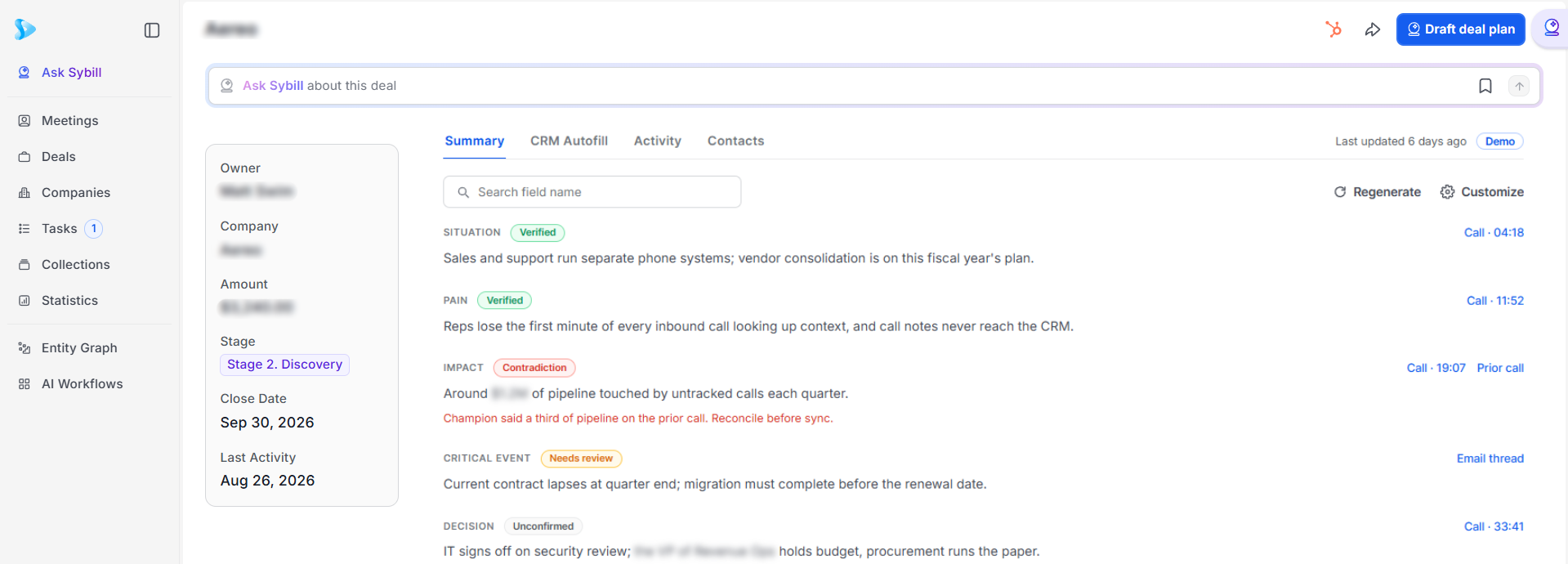
Summarizing one call is a low bar. A SPICED implementation must preserve and operationalize evidence across the buying process.
Use these questions during vendor evaluation:
The commercial value of SPICED comes from maintaining a trustworthy view of the buyer’s situation, pain, impact, critical event, and decision process as the deal changes.
AI can carry that evidence across interactions, reduce CRM administration, identify gaps, prepare sellers, focus coaching, and accelerate follow-through. The human team still decides what is credible and what to do next.
That division of labor is the scalable model: AI provides persistence; sellers provide judgment.
Want to see the workflow across a real opportunity? Book a Sybill demo to map your SPICED fields, inspect missing buyer evidence, and turn the next gap into action.
AI can automate evidence capture, classification, summaries, CRM updates, pre-meeting preparation, gap detection, follow-ups, and task creation. It should not independently decide whether buyer evidence is credible or invent missing qualification. Reps and managers remain accountable for verification and deal judgment.
Define one field or structured section for Situation, Pain, Impact, Critical Event, and Decision. Add evidence status, source, and last-confirmed date where practical. Specify what qualifies as useful evidence, what remains unverified, who owns corrections, and how each field changes the next action.
Humans should judge whether a pain is material, an impact is credible, a critical event is buyer-owned, and the decision process is sufficiently understood. They should also review contradictions, approve consequential actions, correct AI output, and decide how qualification evidence affects strategy and forecast confidence.
AI can automate evidence capture, classification, summaries, CRM updates, pre-meeting preparation, gap detection, follow-ups, and task creation. It should not independently decide whether buyer evidence is credible or invent missing qualification. Reps and managers remain accountable for verification and deal judgment.
Define one field or structured section for Situation, Pain, Impact, Critical Event, and Decision. Add evidence status, source, and last-confirmed date where practical. Specify what qualifies as useful evidence, what remains unverified, who owns corrections, and how each field changes the next action.
Humans should judge whether a pain is material, an impact is credible, a critical event is buyer-owned, and the decision process is sufficiently understood. They should also review contradictions, approve consequential actions, correct AI output, and decide how qualification evidence affects strategy and forecast confidence.