Find us at booth #83, join us for a harbor side happy hour, or catch Gorish’s talk.

Sept, 16-18 > Learn more


Tamanna Mishra

February 13, 2026
On paper, everything looks right.
Your ICP is defined.
Your tech stack is stacked.
Your reps are busy.
Your dashboards glow green.
But as deals move forward, something starts to slip. Buyers disengage. Sales cycles stretch. Forecasts feel optimistic until they suddenly are not. The strategy was sound. The execution just never kept up with buyer reality.
That gap is not caused by lack of effort or weak tooling. It comes from misalignment. Sales teams push based on internal timelines while buyers move according to their own risk, context, and decision pressure. Activity increases. Relevance drops.
The Vitruvian sales strategy is a response to this exact tension. Instead of doing more, it focuses on doing what fits. The right action, at the right moment, for the right buyer.
This blog breaks down the Vitruvian sales strategy as a modern sales strategy and an operating system for buyer-centric sales, showing how data-driven sales execution turns understanding into scalable revenue.
It is a buyer-aligned sales model built on balance, proportion, and execution discipline. Instead of pushing volume or rigid playbooks, it aligns sales actions to real buyer signals, decision readiness, and context. The strategy treats sales as a living system where data, technology, and human judgment work together to continuously optimize how teams engage, progress, and close deals.
At its core, the Vitruvian sales strategy focuses on understanding buyers deeply, interpreting intent through observable signals, and responding with the right level of effort at the right time. It prioritizes precision over pressure and relevance over activity, making it a balanced sales framework designed for complex, high-stakes B2B environments.
The Vitruvian sales approach is built on a simple belief. Sales performs best when it respects how buyers actually make decisions, not how teams wish they did.
Modern buyers do not move in straight lines. They evaluate risk, gather internal consensus, pause, revisit priorities, and reframe problems. A Vitruvian sales philosophy accepts this reality and designs execution around buyer intent, timing, and context rather than forcing momentum through activity.
At a structural level, the Vitruvian approach applies sales systems thinking. Sales is treated as an interconnected system, not a checklist of tasks. Feedback loops replace static playbooks, allowing teams to learn from real outcomes. Over time, sales becomes a learning engine that improves with every buyer interaction.
The Vitruvian sales strategy works because it is modular. Each component reinforces the others, creating a balanced system rather than disconnected tactics.
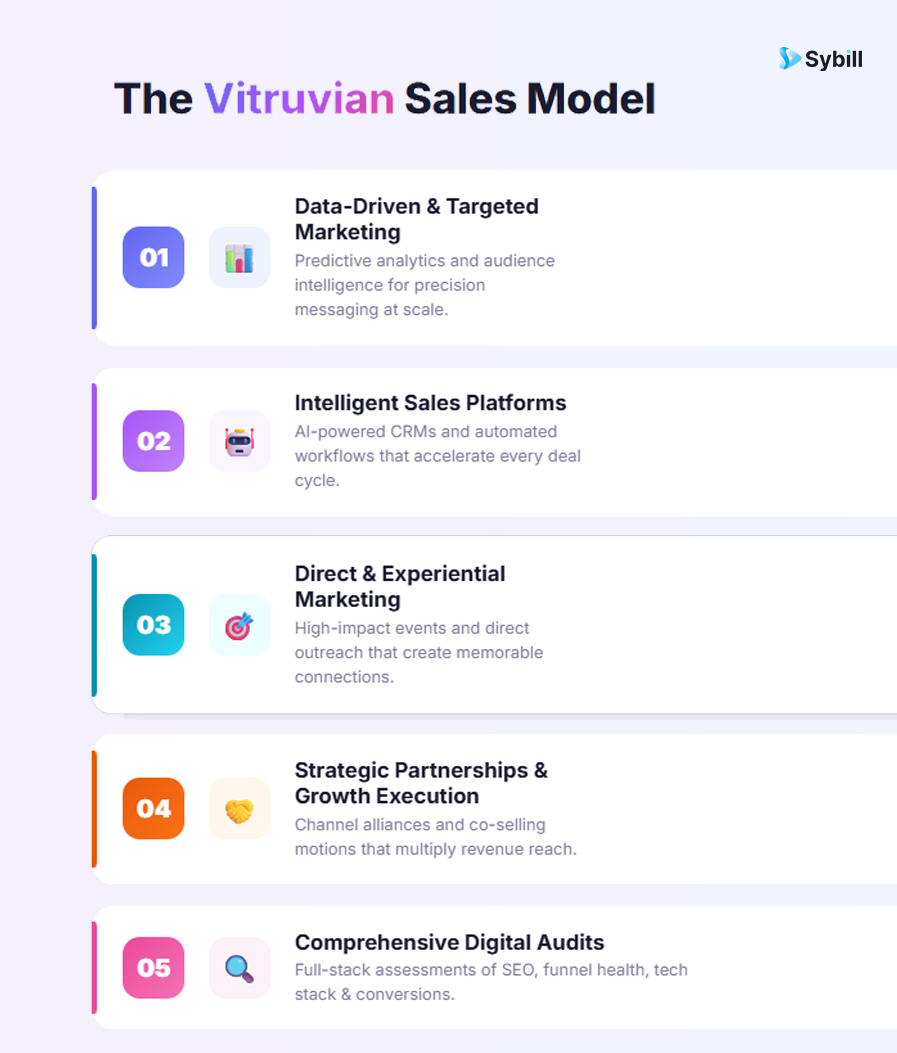
Vitruvian sales begin with buyer truth, not assumed personas.
This ensures data-driven sales execution stays focused on accounts most likely to move forward, not just those easiest to reach.
Insight without action is noise. The Vitruvian approach treats sales intelligence as an execution layer.
The result is AI-powered sales insights that inform what to do next, not just what already happened.
Not all touchpoints carry equal weight.
This shifts direct outreach strategy from interruption to participation, strengthening relationship-led selling.
Vitruvian sales recognizes that growth rarely comes from sales alone.
Growth becomes coordinated, not opportunistic.
Optimization is continuous, not periodic.
This keeps digital sales optimization grounded in reality as buyer behavior evolves.
Traditional sales models are built to maximize motion. The Vitruvian sales strategy is built to maximize meaning.
Where legacy approaches optimize for volume and velocity, Vitruvian sales optimizes for relevance and buyer readiness. It shifts execution away from rep-centric activity toward buyer-centric orchestration, aligning actions to intent, context, and decision risk. The result is fewer wasted touches and higher-quality conversions.
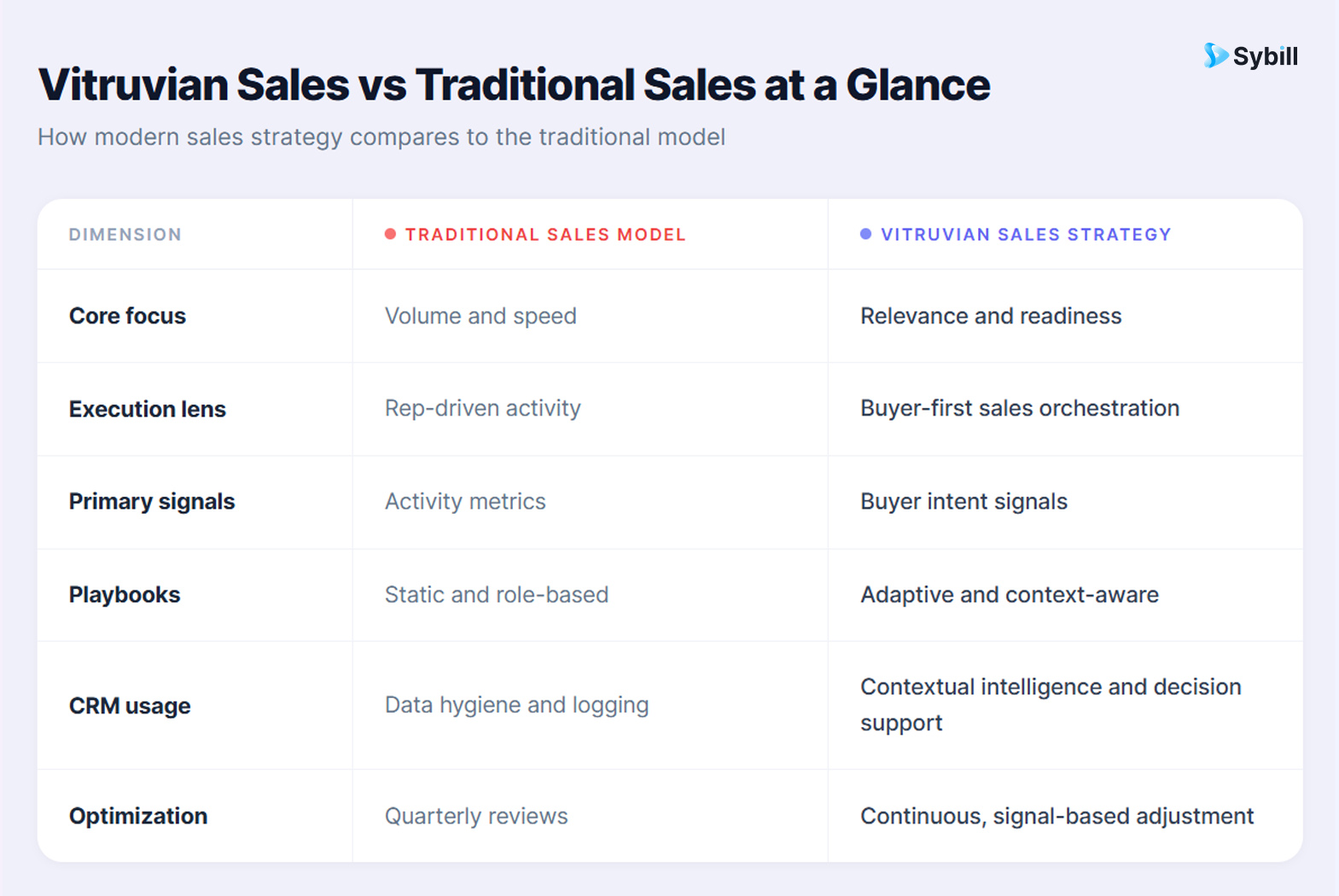
This adaptive sales strategy reflects how modern buyers behave, not how sales teams prefer to operate.
The Vitruvian sales strategy relies on precision, timing, and context. AI makes that possible at scale by turning raw buyer interactions into usable execution signals, without adding manual work.
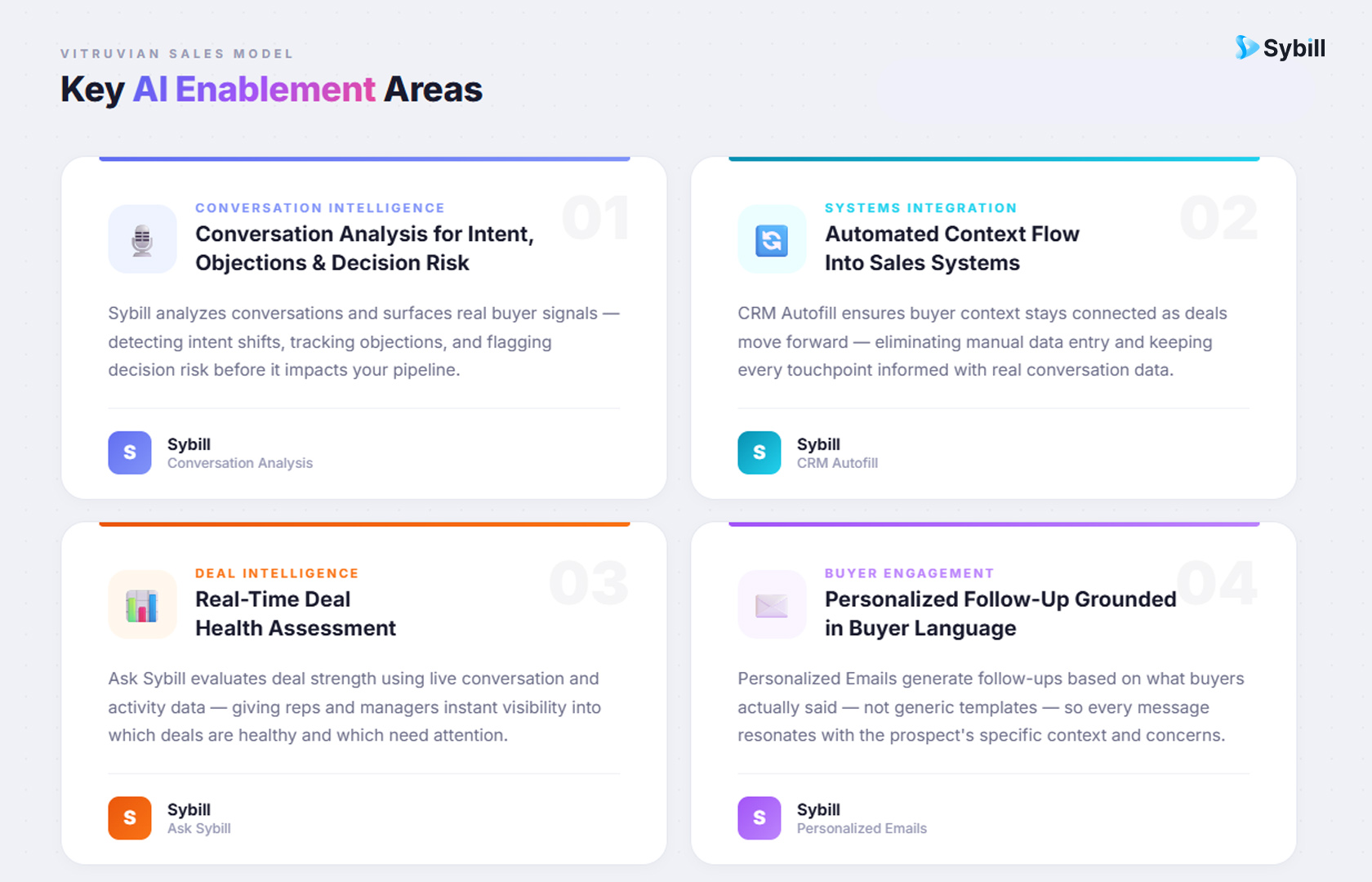
AI analyzes live and recorded sales conversations to detect intent, hesitation, objections, and buying signals that are easy to overlook in the moment.
Sybill’s Magic Summary and Buyer Needs & Intent extract buyer intent, objections, and interest signals directly from calls, creating a shared source of truth beyond rep notes.
Manual notes fragment context across tools and reps. AI consolidates insights automatically, keeping buyer reality intact as deals progress.
CRM Autofill automatically pushes structured context into CRM, eliminating insight loss and inconsistent deal updates.
AI enables reps to respond based on deal health and buyer readiness instead of habit or pressure.
Ask Sybill and Coaching & Performance provide deal-specific guidance, highlighting risks, gaps, and next best actions aligned to buyer signals.
AI surfaces patterns across conversations and pipelines, replacing gut feel with evidence-backed insights.
Ask Sybill helps leaders spot trends in objections, deal stalls, and winning behaviors across the entire team - all they have to do is ask.
The Vitruvian sales strategy is most effective when deal complexity and decision risk are high.
The Vitruvian sales strategy fits scenarios where guessing is expensive, pressure backfires, and understanding the buyer is the only sustainable advantage.
The Vitruvian sales strategy fails when teams treat it like a shortcut instead of a shift.
Most sales transformation challenges are not technical. They are behavioral, cultural, and measurement failures disguised as AI pitfalls.
Adopting the Vitruvian sales strategy is less about adding more processes and more about fixing what already breaks.
Step 1: Audit where buyer context is lost
Map the sales journey and identify where intent, objections, and decision logic disappear. This usually happens between calls, handoffs, and CRM updates.
Step 2: Identify signals that actually correlate with wins
Move beyond surface metrics. Look for buyer intent signals, language patterns, stakeholder engagement, and deal behaviors that consistently show up in closed-won deals.
Step 3: Redesign sales motions around decision readiness
Align outreach, discovery, follow-ups, and escalation to buyer readiness rather than internal timelines. Not every deal deserves the same intensity at the same time.
Step 4: Enable feedback loops across teams
Create tight feedback loops between sales, marketing, and RevOps so insights from live deals inform targeting, messaging, and forecasting.
When done right, implementing a Vitruvian sales strategy becomes an exercise in sales process optimization and durable RevOps alignment.
Buyers are overwhelmed because sales follow-ups arrive without context, timing, or relevance. More pressure does not create progress. Better timing does.
The Vitruvian sales strategy recognizes a hard truth about modern buying. The teams that win are not the loudest or the busiest. They are the ones that listen more carefully, interpret signals more accurately, and respond in proportion to buyer readiness. Precision consistently outperforms persistence.
If your team wants to move from activity-driven selling to signal-driven execution, Sybill helps make that shift real. By capturing buyer context from real conversations and turning it into clear next steps, Sybill enables sales teams to act with relevance, confidence, and timing instead of pressure.
The Vitruvian sales strategy works best once a startup has enough deal volume to identify repeatable buyer patterns. That said, it can be applied in a lighter form for founder-led sales by focusing on capturing buyer intent, objections, and decision logic early. Doing this creates a foundation that scales cleanly as the team grows.
Product-led sales focuses on adoption and self-serve entry points into the funnel. The Vitruvian sales strategy focuses on what happens after interest is established. It emphasizes decision orchestration, stakeholder alignment, and conversion depth, especially in complex B2B deals where buying decisions extend beyond product usage.
No. The Vitruvian sales strategy sits above methodologies as an execution framework. It does not replace SPIN, MEDDIC, or Challenger. It operationalizes them by ensuring the right questions, signals, and actions appear at the right moment based on buyer readiness.
The Vitruvian sales strategy works best once a startup has enough deal volume to identify repeatable buyer patterns. That said, it can be applied in a lighter form for founder-led sales by focusing on capturing buyer intent, objections, and decision logic early. Doing this creates a foundation that scales cleanly as the team grows.
Product-led sales focuses on adoption and self-serve entry points into the funnel. The Vitruvian sales strategy focuses on what happens after interest is established. It emphasizes decision orchestration, stakeholder alignment, and conversion depth, especially in complex B2B deals where buying decisions extend beyond product usage.
No. The Vitruvian sales strategy sits above methodologies as an execution framework. It does not replace SPIN, MEDDIC, or Challenger. It operationalizes them by ensuring the right questions, signals, and actions appear at the right moment based on buyer readiness.