Find us at booth #83, join us for a harbor side happy hour, or catch Gorish’s talk.

Sept, 16-18 > Learn more


Tamanna Mishra

May 22, 2026
.png)
Gap selling is a sales methodology focused on the gap between a buyer’s current situation and their desired future state.
Instead of leading with features, reps uncover what is broken, why it matters, what it costs, and what success should look like.
The core of gap selling is simple:
It works because buyers do not buy features. They buy a way out of a problem they can clearly understand and prioritize.
They go sideways because the rep starts pitching before the buyer has admitted the problem is expensive enough to fix.
That is the brutal little truth behind stalled deals, ghosted follow-ups, and “circle back next quarter” purgatory. The buyer may like your product. They may even agree the demo was solid. But if they do not clearly understand the gap between where they are today and where they need to be, your solution becomes optional.
And optional is where deals go to nap.
That is where gap selling comes in.
Gap selling is a sales methodology that helps reps identify the gap between a buyer’s current state and desired future state, then position their solution as the bridge between the two. It shifts the conversation away from “Here is what our product does” and toward “Here is the business problem you are living with, here is what it is costing you, and here is what changes when you fix it.”
In other words, gap selling makes the buyer care before you make them choose.
It is not about being pushy. It is about being precise. Great gap sellers diagnose before they prescribe. They ask better questions, surface the real pain, quantify the impact, and make the cost of inaction impossible to ignore.
Let’s break down what gap selling is, how the framework works, which discovery questions to ask, and how AI can help sales teams apply it consistently.
Also read:
Gap selling is a consultative sales methodology that focuses on identifying the gap between where a buyer is today and where they want to be.
That gap is where the deal lives.
The gap is the distance between:
Here is a simple example of gap selling.
A VP of Sales says, “Our reps are spending too much time on admin.”
A feature-led rep hears that and says, “Great, our platform has AI summaries and CRM automation.”
A gap seller slows down.
They ask:
Now the conversation is not about “AI summaries.” It is about lost selling time, weak follow-through, incomplete CRM data, and poor pipeline visibility.
That is the gap. And once the buyer sees it clearly, the solution becomes much easier to justify.
Also read:
Gap selling works because it creates urgency from the buyer’s reality, not from the seller’s pitch.
Most buyers are busy. They are juggling internal priorities, budget constraints, leadership pressure, competing tools, and ten people asking for “just a quick sync.” They do not wake up excited to buy another platform.
They act when staying the same feels riskier than changing.
That is the job of gap selling.
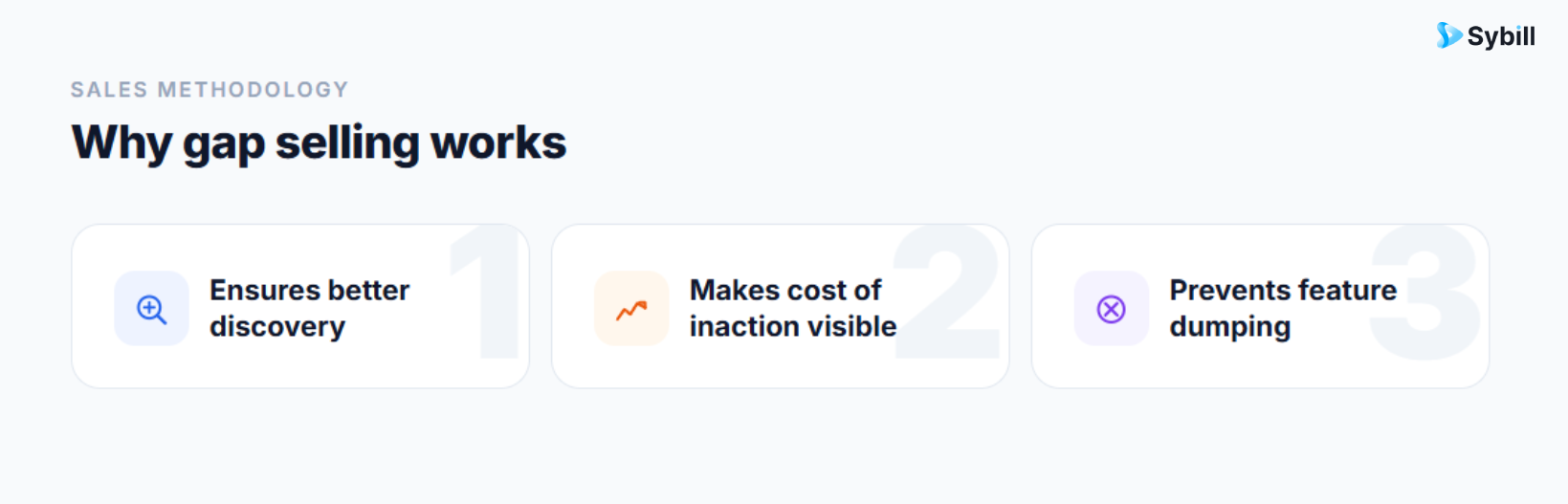
It helps the buyer see three things clearly:
Without that clarity, your deal is vulnerable. A competitor can undercut you. Finance can delay approval. Leadership can deprioritize the initiative. The buyer can agree there is a problem and still do absolutely nothing about it.
Gap selling gives the buyer a reason to move.
Bad discovery sounds like a polite survey.
“What are your priorities?”
“What tools are you using?”
“What challenges are you facing?”
“What is your budget?”
Fine questions. Not enough.
Gap selling pushes reps to go deeper. It turns discovery into business diagnosis. Instead of collecting answers, the rep investigates the problem.
That means asking what is happening, why it is happening, how long it has been happening, who it affects, what it costs, and what happens if nothing changes.
Buyers often underestimate the cost of staying where they are.
They may know a process is messy, but they have not calculated the hours lost. They may know follow-ups are inconsistent, but they have not connected that to deal slippage. They may know CRM data is incomplete, but they have not tied it to forecasting risk.
Gap selling makes the invisible visible.
And once the cost of inaction becomes clear, urgency becomes much easier to create.
Feature dumping is what happens when reps panic.
The buyer shares one vague pain point, and suddenly the rep opens the product floodgates.
“We have dashboards, workflows, integrations, analytics, templates, automation, alerts, reporting, forecasting, collaboration, and a mobile app.”
Lovely. Also exhausting.
Gap selling keeps the conversation anchored to the buyer’s problem. You only talk about the features that connect directly to the gap.
That is how you sound relevant instead of rehearsed.
Also read:
Traditional selling often starts with the product. Gap selling starts with the problem.
That difference changes everything.
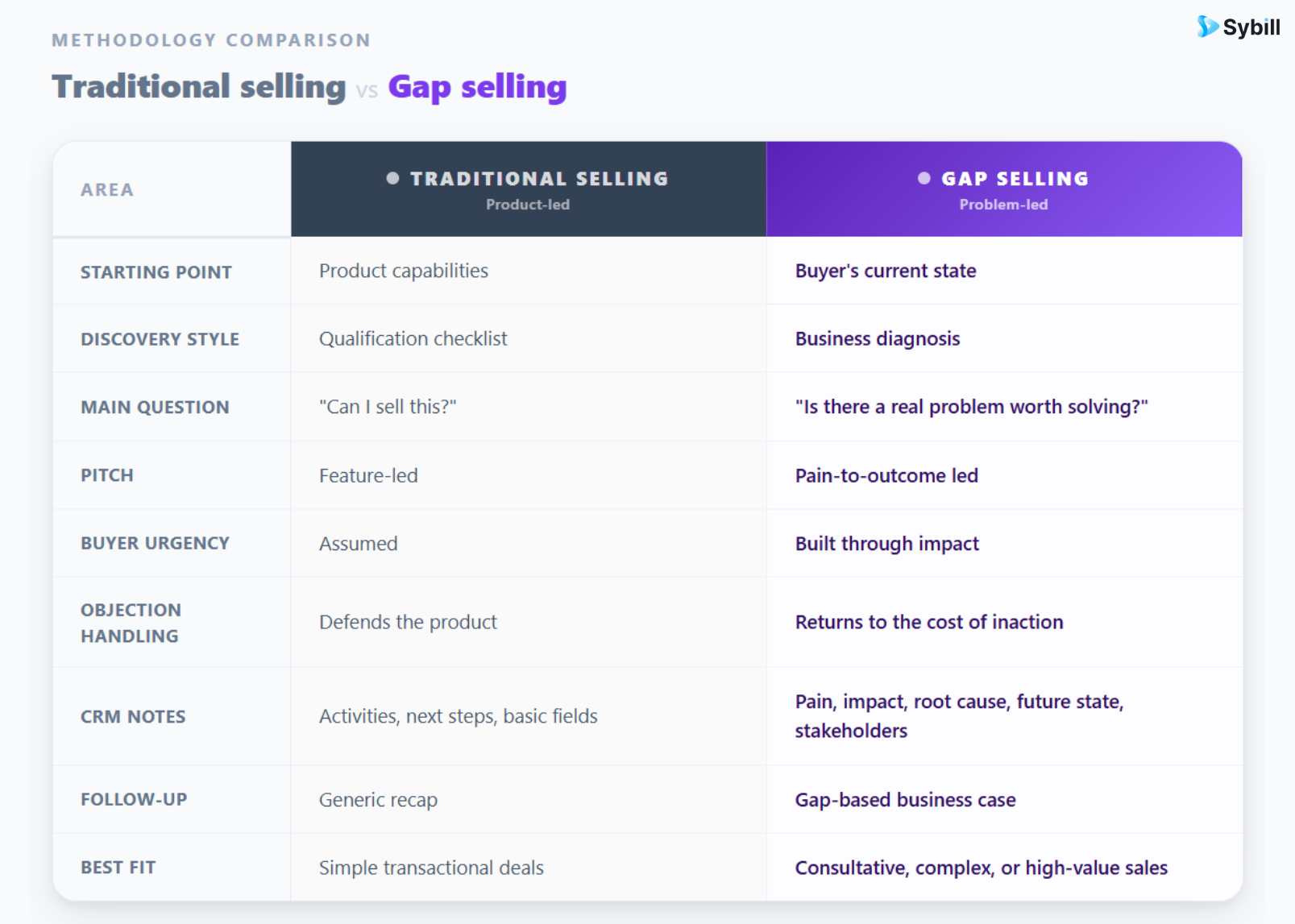
Traditional selling says, “Here is what we do.” Gap selling says, “Here is what is happening in your business, here is why it matters, and here is how you can get to a better state.”
One sounds like a pitch. The other sounds like help.
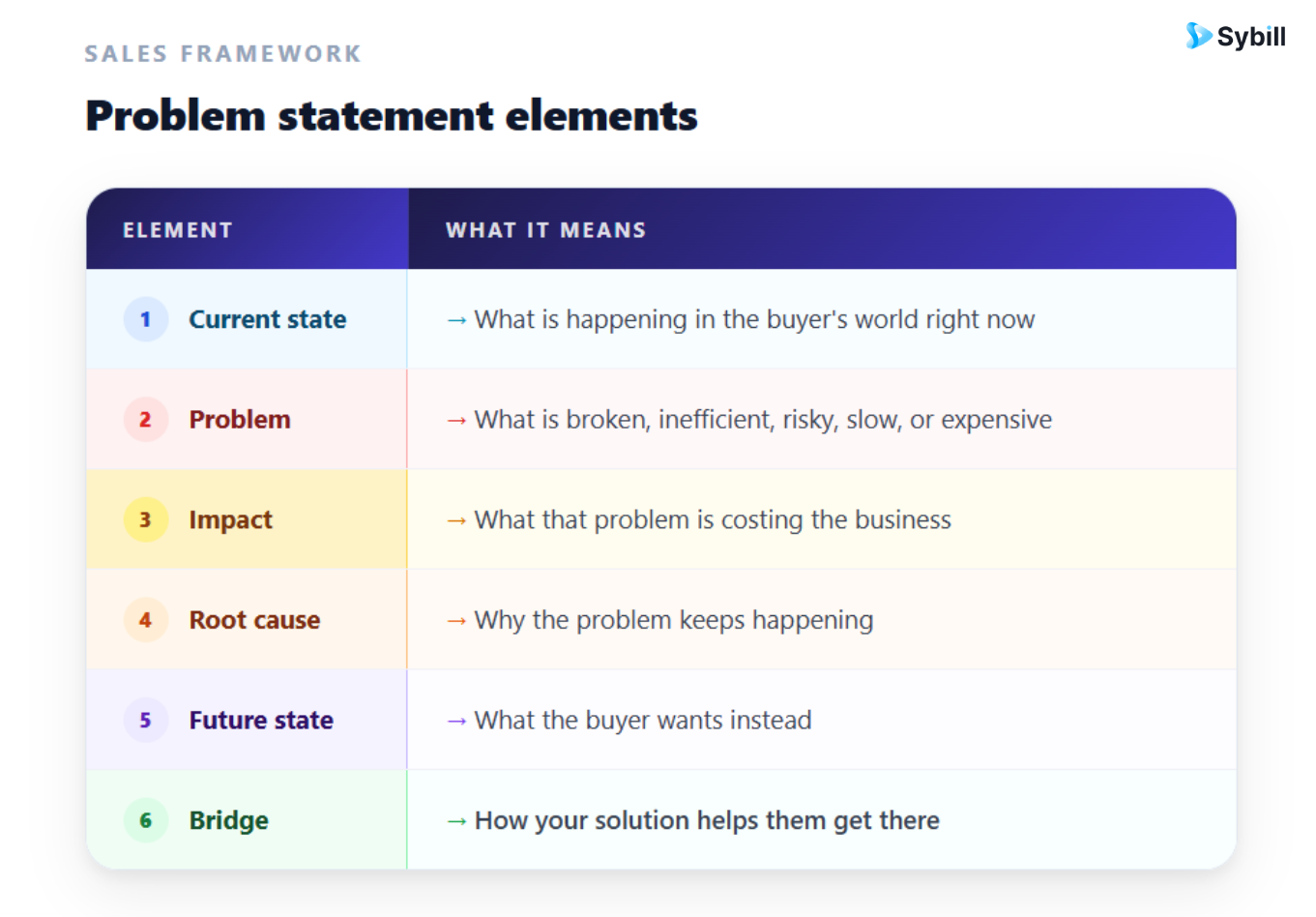
The gap selling framework is not complicated. The hard part is having the discipline to follow it instead of sprinting into demo mode like the product deck owes you money.
Here is the framework.
The current state is the buyer’s present reality.
It includes their workflows, tools, team structure, goals, frustrations, constraints, and performance gaps. This is where reps need to get specific.
Not:
“Our process is inefficient.”
Better:
“Our AEs spend 45 minutes after every discovery call writing notes, updating Salesforce, and drafting follow-ups. Most of them do it late, so managers do not have reliable deal context before pipeline reviews.”
That is a current state you can work with.
Your goal here is to understand how the buyer operates today and where friction already exists.
Ask about:
The sharper the current state, the sharper the gap.
A problem is not the same as a symptom.
A symptom is what the buyer notices. A problem is what needs to be fixed.
Gap selling requires reps to push past the first answer.
When a buyer says, “Our CRM data is messy,” do not stop there. Ask why. Ask what fields are missing. Ask who uses that data. Ask what breaks when it is wrong.
That is how you move from surface pain to sales intelligence.
This is where gap selling gets serious.
If the problem has no measurable impact, it will not become a priority. It may be annoying. It may be inefficient. It may deserve a dramatic Slack rant. But it will not automatically get budget.
Impact turns pain into business urgency.
Impact can show up as:
The goal is not to scare the buyer. The goal is to help them understand the real cost of the problem.
A rep might ask:
“Roughly how many discovery calls does your team run each week?”
“If each rep spends 45 minutes on post-call admin, what does that add up to across the team?”
“When follow-ups go out late, what usually happens to deal momentum?”
“How does incomplete CRM data affect your forecast meetings?”
Now the problem has weight.
And weighted problems get solved.
Root cause is where many sales conversations get lazy.
A buyer says, “Our reps need to be better at follow-up.”
The lazy answer is, “Great, we have email automation.”
The gap selling answer is, “Why are follow-ups weak in the first place?”
Maybe reps are rushing between calls. Maybe they do not have clean notes. Maybe call summaries are inconsistent. Maybe the CRM is not updated. Maybe managers cannot coach because they do not know what happened in the conversation.
The root cause matters because different causes require different solutions.
If the root cause is poor rep discipline, you need coaching. If the root cause is manual workflow overload, you need automation. If the root cause is missing buyer context, you need better conversation intelligence.
Without root cause, your pitch is a guess wearing a blazer.
The future state is the buyer’s desired outcome.
This is not a vague dream like “better productivity” or “more efficiency.” Those phrases sound nice, but they are basically scented candles for business meetings.
A useful future state is specific.
For example:
The future state should be measurable enough that the buyer can recognize success when they see it.
This matters because a clear future state gives your solution something to anchor to.
You are no longer selling “automation.”
You are selling a world where reps sell more, managers coach better, CRM data is usable, and deals do not quietly die after good calls.
Only after you understand the current state, problem, impact, root cause, and future state should you position your solution.
That is the bridge.
The bridge is not every feature you have. It is the specific path from pain to outcome.
A weak bridge sounds like this:
“Our tool has AI summaries, CRM sync, email generation, and pipeline insights.”
A strong bridge sounds like this:
“You mentioned your reps lose time after every call, CRM data is incomplete, and follow-ups often go out late. Sybill helps close that gap by capturing call context through Magic Summary, updating key CRM fields with CRM Autofill, and drafting Personalized Emails based on the actual conversation. So the workflow moves from manual memory-based admin to automated, context-rich execution.”
See the difference?
The second one connects the product to the buyer’s world. That is gap selling.
Also read:
Good gap selling depends on good questions.
Not random questions. Not twenty-seven discovery questions fired like a LinkedIn guru with espresso poisoning. The right questions, in the right order.
Use these categories as a practical question bank.
Use these to understand what is happening today.
Use these to move from general frustration to specific pain.
Use these to quantify the business cost.
Use these to uncover why the problem exists.
Use these to define the desired outcome.
Use these to understand priority.
Let’s say you sell an AI sales assistant to a VP of Sales.
A feature-led rep might say: “Sybill gives you AI meeting summaries, CRM updates, follow-up emails, and deal insights.”
That is accurate. But it is not enough.
A gap seller would first uncover the buyer’s world.
Current state:
The sales team runs dozens of discovery calls every week. Reps are expected to update CRM, send follow-ups, log next steps, and prepare managers for pipeline reviews.
Problem:
Reps delay CRM updates because they are jumping between calls. Follow-ups go out late or miss key buyer context. Managers do not trust the CRM because the notes are incomplete.
Impact:
Deals lose momentum. Pipeline reviews become interrogation sessions. Forecasts rely on rep memory. Coaching is reactive because managers do not have clean visibility into what actually happened on calls.
Root cause:
The team is relying on manual post-call admin and inconsistent note-taking.
Future state:
Reps finish calls and quickly have accurate summaries, CRM updates, and personalized follow-ups ready. Managers can inspect deal context without chasing reps. Pipeline reviews focus on strategy, not data cleanup.
Bridge:
Sybill helps close that gap by turning sales conversations into action. Magic Summary captures what happened. CRM Autofill updates key deal fields. Personalized Emails help reps send context-rich follow-ups. Ask Sybill lets reps and managers query deal context. AI Tasks helps turn commitments into action.
That is not a product dump.
That is a business case.
Gap selling sounds simple in theory. In real sales teams, it gets messy.
Calls move fast. Buyers ramble. Reps forget details. CRM fields stay half-empty. Follow-ups get written from memory. Managers only hear about deal risks after the deal has already started limping.
That is why AI is becoming useful for gap selling.
Not because it replaces discovery. It does not. Reps still need judgment, curiosity, and business sense.
AI helps by making sure the insights from discovery do not disappear after the call ends.
For example, Sybill helps sales teams turn gap selling into a repeatable workflow instead of a one-call performance.
Magic Summary captures the important parts of the conversation, including buyer pain, priorities, objections, and next steps.
CRM Autofill helps log critical deal context, so the gap does not live only in the rep’s head.
Personalized Emails turn the actual conversation into relevant follow-ups, instead of generic “great chatting today” emails.
Ask Sybill helps reps and managers query deal context, inspect risks, and understand what the buyer actually said.
AI Tasks helps teams act on commitments, so discovery turns into movement.
Deal Pipeline gives managers visibility into risks, deal health, and buyer signals across opportunities.
That matters because gap selling is not just about asking better questions. It is about preserving the answers, acting on them, and using them to move the deal forward.

Gap selling is powerful, but it can go wrong fast when reps treat it like a script.
Here are the mistakes to avoid.
This is the classic.
The buyer says one thing that sounds like pain, and the rep immediately starts selling.
Buyer: “Our follow-up process is inconsistent.”
Rep: “Great, let me show you our email automation feature.”
Too soon.
The better move is to ask what inconsistent means, how often it happens, what it affects, and why the current process has not fixed it.
Vague pain does not close deals.
“We need better visibility” is not enough. Visibility into what? For whom? How often? What decisions are delayed because visibility is missing?
Push for specificity.
If the buyer cannot explain the impact, they will struggle to justify the purchase.
A problem without impact becomes a complaint. A problem with impact becomes a priority.
Messy CRM data may be a symptom. The root cause may be manual updates, poor call capture, unclear ownership, or tools that do not fit the sales workflow.
Treating the symptom may win interest. Solving the root cause wins trust.
“More efficient” is not a future state.
“Reps spend less than five minutes updating CRM after calls, and managers can see deal risks before pipeline reviews” is much better.
Make the buyer define what fixed actually looks like.
A great discovery call is useless if the insights vanish into a messy notebook or half-filled CRM field.
Document the current state, pain, impact, root cause, future state, stakeholders, objections, and next steps.
This is especially important in complex deals where multiple people need to understand the business case.
This one hurts because it is so avoidable.
If your discovery call uncovered a strong gap, your follow-up should restate it clearly.
Bad follow-up:
“Great speaking today. Attaching more information.”
Better follow-up:
“Based on our conversation, the biggest issue is that reps are spending 45 minutes after calls on admin, which delays follow-ups and leaves managers without reliable deal context before pipeline reviews. The goal is to reduce manual admin, improve CRM completeness, and create faster next steps after every call.”
That is how you keep urgency alive.
Gap selling should not be reserved for your most experienced reps. It should be built into the sales process.
Here is a practical way to apply it.
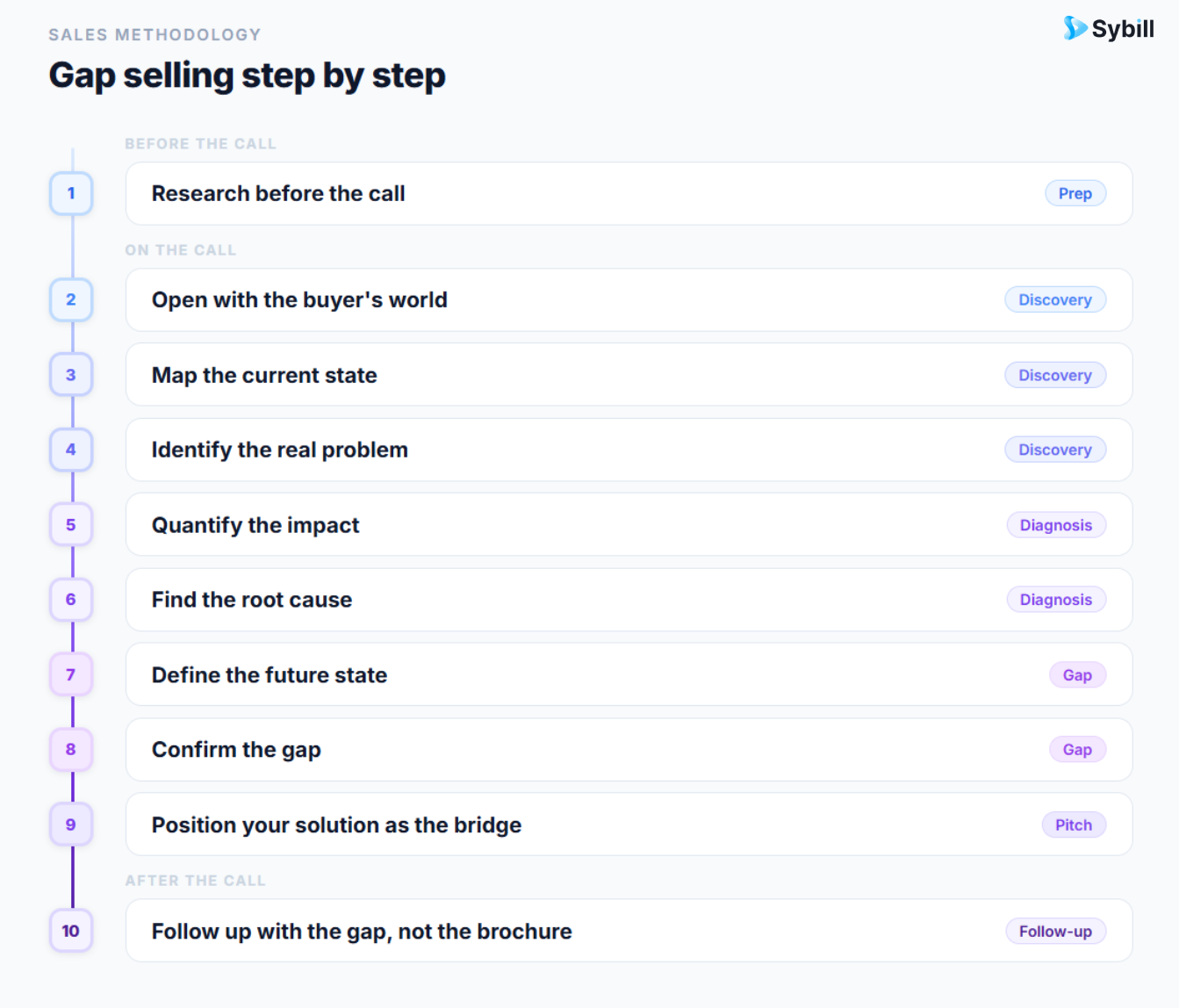
Start with a problem hypothesis.
Look at the company’s size, market, recent growth, hiring trends, tech stack, funding, leadership changes, or public priorities. You are not trying to prove you know everything. You are trying to enter the call with useful context.
Example:
“Based on your team size and growth, I imagine keeping CRM data consistent across reps may be getting harder. Is that something your team is dealing with?”
That is better than “Tell me about your business.”
Do not begin with a product monologue.
Start with the situation you think they may be facing. Let them correct you. That correction is often where the real discovery begins.
Understand how things work today. Ask about process, tools, people, timing, and handoffs.
Do not stop at symptoms. Keep asking until the buyer names the business issue underneath the frustration.
Help the buyer connect the problem to time, money, revenue, risk, customer experience, or leadership priorities.
Ask why the issue keeps happening. This prevents you from pitching the wrong solution.
Make success concrete. What should change? Who benefits? How will they measure it?
Summarize what you heard.
“Today, your reps are spending too much time on post-call admin, CRM updates are inconsistent, and managers lack reliable deal context. The goal is to reduce manual work, improve follow-up quality, and make pipeline reviews more accurate. Is that the right gap?”
This step is critical. It gets the buyer to confirm the business case in their own words.
Now you can show how your solution helps.
Keep it specific. Tie every capability to the gap.
Your follow-up should restate:
That is how you move from “nice call” to “clear business case.”
Gap selling works especially well in B2B sales where the buyer needs to justify change.
It is a strong fit for:
It is less useful for highly transactional purchases where the buyer already knows exactly what they want and the decision is mostly based on price, availability, or speed.
But for most modern sales teams, especially in SaaS, gap selling is not optional. Buyers are more informed, budgets are more scrutinized, and every deal has to survive internal debate.
A feature pitch rarely survives that debate.
A clear gap does.
Gap selling is not about dressing up discovery with a fancy methodology name.
It is about a basic sales truth that too many teams forget:
Buyers do not buy because your product is impressive. They buy because their current state is no longer acceptable and your solution gives them a credible path to something better.
That is why the best reps do not rush to pitch. They slow down. They diagnose. They ask sharper questions. They make the cost of inaction visible. They help the buyer see the gap so clearly that solving it becomes the obvious next move.
And that is where tools like Sybill can help.
Gap selling only works when discovery insights survive beyond the call. Sybill helps reps capture buyer pain, objections, next steps, and deal context, then turn that context into CRM updates, follow-ups, AI Tasks, and pipeline visibility.
Gap selling is a sales methodology that focuses on identifying the gap between a buyer’s current state and desired future state. Instead of leading with product features, reps uncover the buyer’s problems, quantify the business impact, identify root causes, and position the solution as the bridge to a better outcome.
An example of gap selling would be a rep selling an AI sales assistant to a sales leader. Instead of saying, “Our tool creates meeting summaries and follow-up emails,” the rep investigates the current state first. They uncover that reps spend too much time on admin, CRM data is incomplete, follow-ups go out late, and managers lack deal visibility. The rep then positions the solution as a way to reduce manual work, improve follow-up quality, and give managers better pipeline insight.
The four core parts of gap selling are current state, future state, the gap, and the solution bridge. In practice, sales teams often break this down further into current state, problem, impact, root cause, future state, and solution. This helps reps understand what is happening now, why it matters, what needs to change, and how their solution helps.
Solution selling focuses on matching a product or service to the buyer’s stated needs. Gap selling goes deeper by helping the buyer understand the distance between their current state and desired future state. Gap selling puts more emphasis on diagnosing the problem, quantifying impact, identifying root causes, and creating urgency around the cost of inaction.
Good gap selling questions help uncover the buyer’s current state, business pain, impact, root cause, future state, and urgency. Examples include: “How are you handling this today?”, “What is not working about the current process?”, “What does this cost your team?”, “Why does this problem keep happening?”, “What would an ideal future state look like?”, and “What happens if nothing changes this quarter?”
Yes, gap selling is especially useful for SaaS sales because most SaaS products require the buyer to change workflows, justify budget, and prove ROI. Gap selling helps reps connect the product to a real business problem, which makes it easier for buyers to build internal alignment and prioritize the purchase.
AI helps with gap selling by capturing sales conversations, summarizing buyer pain, identifying objections, logging CRM context, drafting relevant follow-ups, and helping managers inspect deal health. Tools like Sybill help reps preserve discovery insights and turn them into action, so the gap identified during the call does not disappear afterward.
Gap selling is a sales methodology that focuses on identifying the gap between a buyer’s current state and desired future state. Instead of leading with product features, reps uncover the buyer’s problems, quantify the business impact, identify root causes, and position the solution as the bridge to a better outcome.
An example of gap selling would be a rep selling an AI sales assistant to a sales leader. Instead of saying, “Our tool creates meeting summaries and follow-up emails,” the rep investigates the current state first. They uncover that reps spend too much time on admin, CRM data is incomplete, follow-ups go out late, and managers lack deal visibility. The rep then positions the solution as a way to reduce manual work, improve follow-up quality, and give managers better pipeline insight.
The four core parts of gap selling are current state, future state, the gap, and the solution bridge. In practice, sales teams often break this down further into current state, problem, impact, root cause, future state, and solution. This helps reps understand what is happening now, why it matters, what needs to change, and how their solution helps.