
Find us at booth #83, join us for a harbor side happy hour, or catch Gorish’s talk.

Sept, 16-18 > Learn more


Tamanna Mishra

March 4, 2026
Search interest for Gong competitors and Gong alternatives is climbing. Because buyers are evolving.
They are asking, “Is Gong still worth it?”
Gong earned its place as a category creator. It turned sales calls into data. It made coaching measurable. It gave leaders visibility into what used to be the black box of pipeline conversations. Many Gong reviews still praise that visibility.
But the same reviews consistently surface tension around pricing, adoption, AI depth, and the amount of manual admin work that still falls on reps. The conversation has moved from “Does Gong work?” to “Does it work hard enough for what we’re paying?”
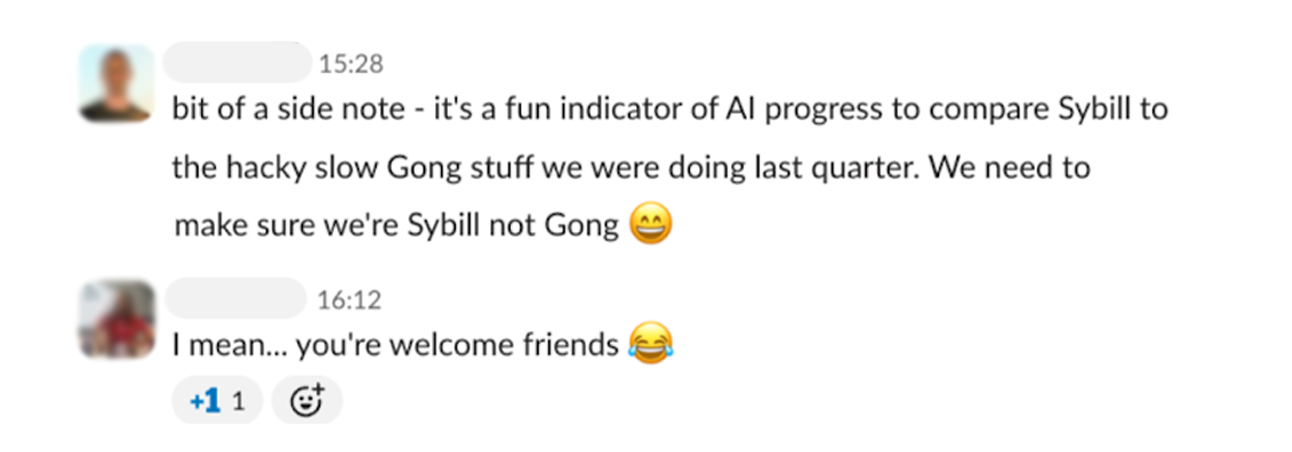
That conversation in the image above? That’s the real friction: category leader versus category evolution.
Over the last year, we spoke to hundreds of Gong users. When they begin evaluating Gong alternatives, their reasons are not random or emotional. They cluster into eight predictable friction points.
And once you see the pattern, you cannot unsee it.
Let’s break them down.
But first…
15–70 seat revenue teams: Large enough to feel enterprise pricing, small enough that ROI scrutiny actually matters.
Teams 60–90 days from Gong renewal: Budget reviews expose low adoption, underused modules, and rising cost pressure.
Budget-conscious but enterprise-ambitious orgs: They want forecasting, coaching, and CRM discipline without six-figure sprawl.
Sales leaders frustrated with manual CRM work: Reps are still updating fields, copying notes, and managing post-call admin manually.
Teams experiencing low rep adoption: Managers love the dashboards. Reps use it mainly for call recording.
AI-forward organizations with higher expectations: They use LLMs elsewhere and expect cross-deal querying, automation, and execution support.
We did not guess the themes.
We asked Ask Sybill to analyze our real sales conversations with buyers exploring Gong alternatives.
Here are the eight friction points that show up again and again.
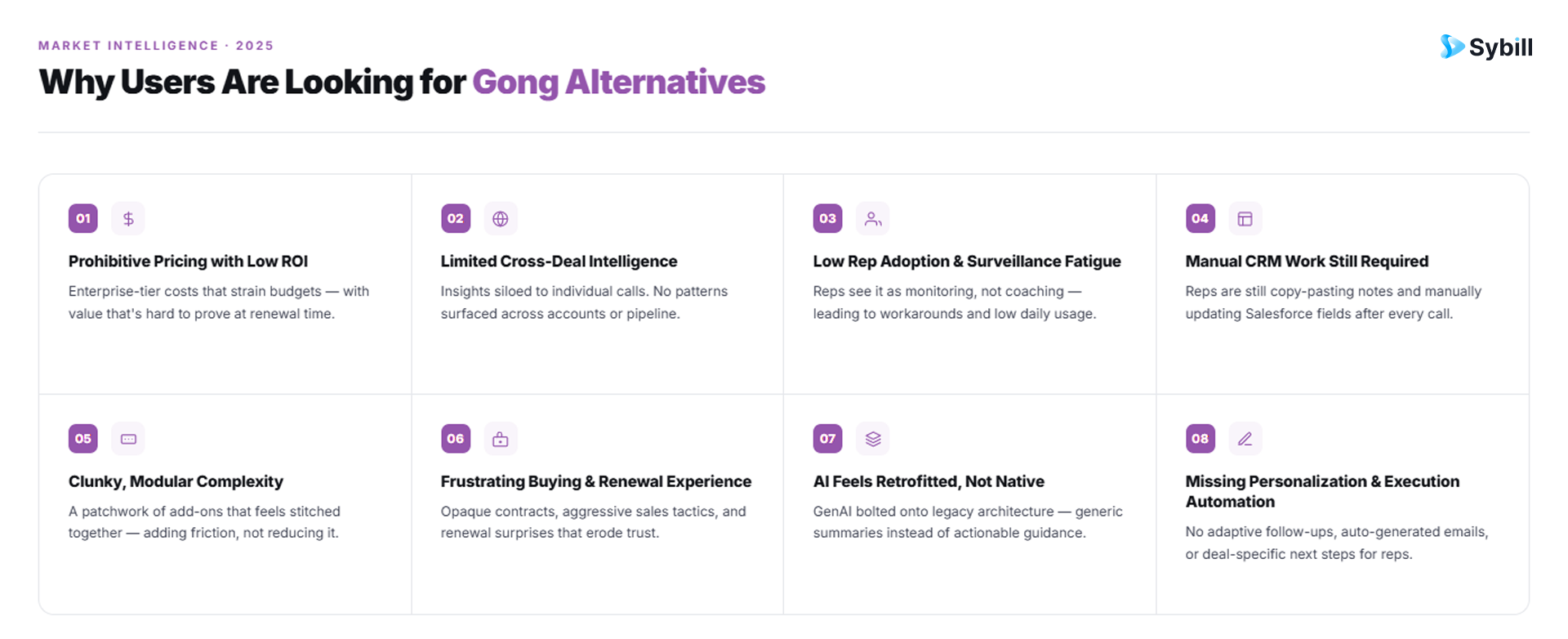
The first reason is almost always pricing.
Teams report spending $1,100–$1,500+ per seat annually, with small teams landing in the $35K–$98K per year range once platform fees and modules are included.
High price alone is not the issue. Enterprise software can justify enterprise pricing.
The tension comes when AI leverage does not feel proportionate to the spend.
Even publicly, pricing concerns surface repeatedly. For example, one G2 review flags surprise platform fees and cost concerns in this review.
When we speak to leaders approaching renewal windows, the question is rarely:
“Does Gong work?”
It is:
“Are we getting enough leverage for what we’re paying?”
When pricing starts to feel enterprise-heavy but AI feels lightweight, buyers begin exploring Gong alternatives.
Gong captures conversations.
But modern sellers want more than transcripts.
When we asked Ask Sybill to synthesize why teams look at Gong competitors, one phrase came up repeatedly:
“It’s a graveyard of calls.”
There is data. There are recordings. There are dashboards.
But reps cannot easily ask one question and query across:
Modern AI expectations are different.
Sellers want to ask:
“Where has pricing objection X come up in my pipeline?”
“Which closed-lost deals mentioned competitor Y?”
“Which renewal risks show the same pattern?”
If the tool cannot answer that instantly, intelligence becomes archival rather than operational.
That gap drives exploration of AI-native alternatives.
Another consistent theme in our conversations: adoption.
Leaders admit that reps often use Gong primarily for call recording.
Managers rely on dashboards. Reps tolerate the tool.
This dynamic occasionally shows up in public feedback as well. For example, one G2 review explicitly references “constant surveillance” concerns in this review.
The issue is value asymmetry.
If a tool creates insight for leadership but not daily leverage for sellers, adoption stagnates.
And when adoption stagnates, ROI discussions intensify.
That is one of the strongest triggers for evaluating Gong competitors.
This is where the switching conversations become concrete.
When we ask teams what frustrates reps most, the answer is almost always admin.
Reps still:
Some teams even export transcripts into other AI tools to generate summaries or emails.
If AI does not eliminate post-call admin, it does not feel like leverage.
Execution intelligence means:
When those workflows are not native, teams look for Gong alternatives that reduce workload rather than just analyze it.
Another recurring theme from the hundreds of Gong users we’ve spoken to: complexity.
Multiple modules. Separate add-ons. Forecasting, Engage, analytics, integrations.
Powerful? Yes.
Simple? Not always.
Enterprise-grade architecture can become enterprise-grade friction.
When sellers need multiple modules to unlock full value, and each module adds cost, adoption slows.
Friction reduces rep-level ROI.
That creates space for simpler, unified alternatives.
Interestingly, some teams start exploring Gong competitors before renewal purely because of the buying experience.
Common themes from our conversations:
When the purchase process itself feels complex, buyers become more open to alternatives that offer clarity and product-led access.
Sometimes the search for Gong competitors begins before dissatisfaction with the product fully forms.
This is less about features and more about architecture.
Gong was built as a conversation recording and analytics platform.
AI layers were added over time.
Modern buyers increasingly expect tools built LLM-first, not recording-first.
They expect:
When AI feels incremental rather than foundational, teams explore Gong alternatives built natively for automation.
Like Sybill. Specifically, Ask Sybill.
Finally, the shift from visibility to execution.
In dozens of switching conversations, leaders tell us they want:
Visibility is valuable.
Execution is revenue.
If a tool stops at analysis and does not help sellers act, buyers look elsewhere.
If you zoom out, the reasons Gong users look for alternatives cluster around one structural shift:
From revenue intelligence
To revenue execution intelligence
From dashboards
To automation
From oversight
To leverage
That shift is exactly what we see when we ask Ask Sybill to analyze conversations with hundreds of Gong users evaluating Gong competitors.
And it is why a new class of AI-native platforms is emerging as the strongest Gong alternatives.
The market shift we described earlier is not about replacing Gong out of frustration.
It is about evolution.
Gong built the revenue intelligence category. It normalized visibility. It gave leadership insight into pipeline conversations.
But modern revenue teams are now asking a different question:
Can AI help sellers execute, not just analyze?
That is where Sybill is gaining momentum as one of the strongest Gong alternatives.
Not because it tries to out-dashboard Gong.
Because it was built differently from the ground up.
Sybill is:
It is designed to reduce admin, accelerate decisions, and surface cross-deal intelligence instantly.
And importantly, it does not require a rip-and-replace motion.
Sybill can:
That flexibility alone makes Sybill one of the most evaluated Gong competitors today.
Gong optimizes for leadership insight. Sybill optimizes for seller leverage.
Here’s the cleanest way to see the Gong vs Sybill difference:
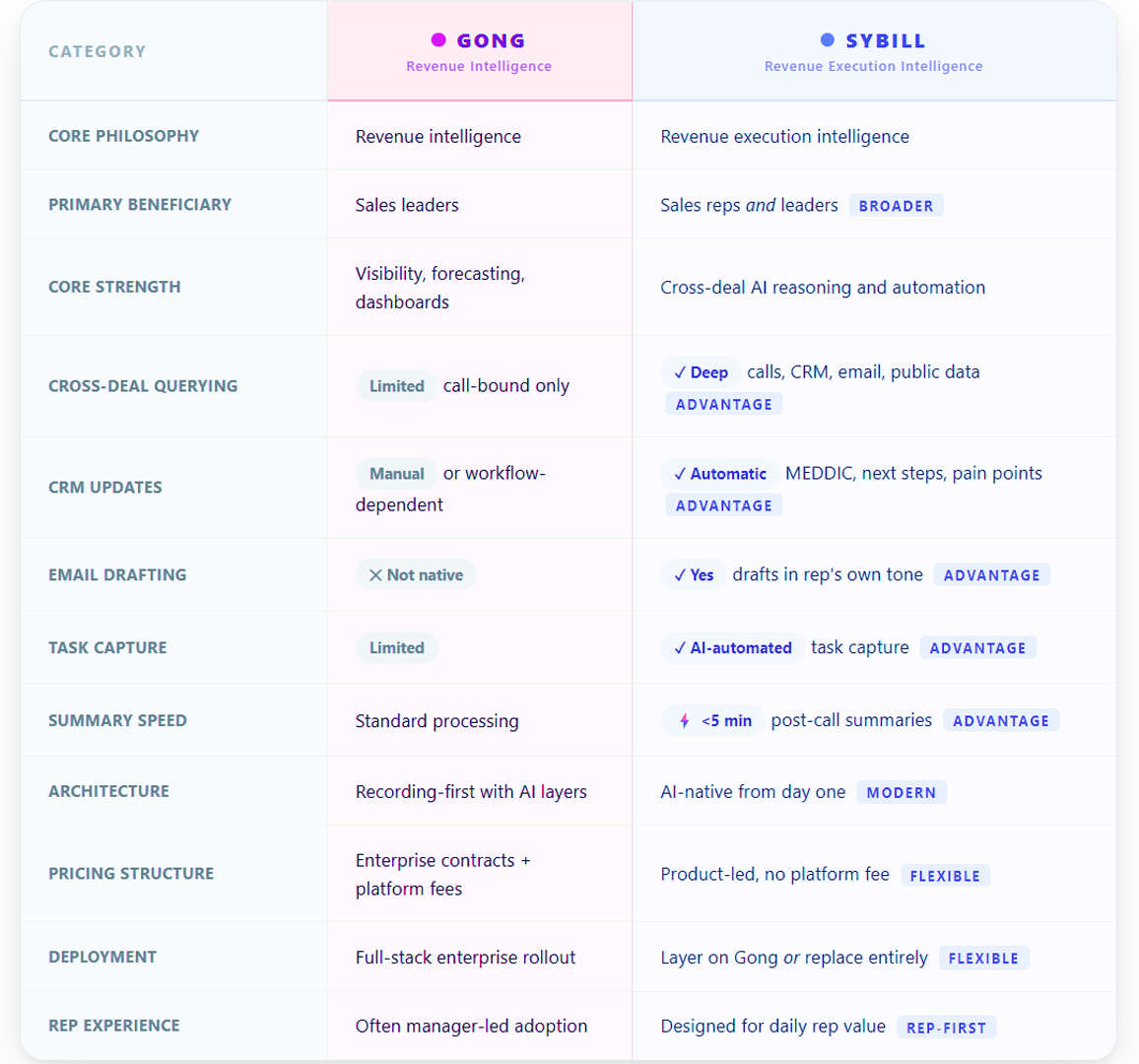
Users looking for Gong alternatives are recognizing that the category has split.
Visibility tools.
Execution tools.
The fastest-growing Gong alternatives are those that reduce seller workload while increasing deal intelligence.
That is the lane Sybill owns.
Click here for a deep dive Sybill vs Gong comparison.
Teams do not wake up randomly and switch. There is a pattern.
The highest-intent buyers evaluating Gong competitors typically look like this:
It usually starts with one internal question:
“What are we actually using Gong for?”
If the answer is primarily call recording and dashboards, the conversation shifts.
From renewal.
To alternatives.
And when that shift happens, AI-first execution platforms - like Sybill - naturally enter the conversation.
The decision is not simply whether Gong works.
It is whether your revenue stack is helping sellers execute or just helping leaders observe.
Gong built the visibility layer for modern revenue teams. That foundation still matters.
But the market is moving toward automation, cross-deal intelligence, and AI that eliminates admin instead of creating more analysis.
If you are evaluating Gong competitors because:
Then you are not alone.
That is exactly the switching window where Sybill thrives.
Not by replacing visibility.
By turning intelligence into execution.
If you are 60–90 days from renewal or simply questioning your current ROI, the best way to evaluate an alternative is not another comparison article.
It is to test the execution layer yourself.
Try Sybill free and see what happens when:
Revenue intelligence shows you what happened. Revenue execution helps you win what’s next.

From our conversations with hundreds of revenue teams and analysis using Ask Sybill, the reasons cluster into a few consistent themes:
Public Gong reviews echo some of these themes, particularly around pricing and AI depth. But the bigger shift is strategic. Teams are not just looking for conversation intelligence anymore. They are looking for AI that reduces workload and accelerates execution.
When visibility is strong but automation is weak, buyers begin evaluating Gong alternatives.
The right competitor depends on what you want Gong to do.
If you are looking for an AI-native execution layer that goes beyond recording and dashboards, Sybill is emerging as a leading alternative.
Sybill differentiates itself by focusing on:
If you are looking for sales engagement and sequencing, common Gong alternatives include:
The category is splitting between visibility tools and execution tools. The strongest Gong competitors are those built for automation-first workflows.
Yes.
Many teams layer Sybill on top of Gong rather than replacing it immediately.
Sybill can:
There is no forced rip-and-replace.
Teams often keep Gong for leadership dashboards and forecasting while using Sybill to eliminate rep admin, automate CRM updates, and unlock execution-level AI.
Over time, some teams consolidate. Others continue layering.
The flexibility is intentional.
From our conversations with hundreds of revenue teams and analysis using Ask Sybill, the reasons cluster into a few consistent themes: Pricing feels enterprise-heavy relative to usage Reps still do manual CRM updates and post-call admin Adoption is uneven, with managers using it more than reps AI capabilities feel incremental rather than execution-driven Public Gong reviews echo some of these themes, particularly around pricing and AI depth. But the bigger shift is strategic. Teams are not just looking for conversation intelligence anymore. They are looking for AI that reduces workload and accelerates execution. When visibility is strong but automation is weak, buyers begin evaluating Gong alternatives.
The right competitor depends on what you want Gong to do. If you are looking for an AI-native execution layer that goes beyond recording and dashboards, Sybill is emerging as a leading alternative. Sybill differentiates itself by focusing on: Cross-deal AI querying across calls, CRM, and email Automatic CRM autofill AI-powered follow-up drafting Task capture and execution automation If you are looking for sales engagement and sequencing, common Gong alternatives include: Outreach Salesloft Apollo The category is splitting between visibility tools and execution tools. The strongest Gong competitors are those built for automation-first workflows.
Yes. Many teams layer Sybill on top of Gong rather than replacing it immediately. Sybill can: Ingest historical Gong recordings Sync bidirectionally with your CRM Sit on top of your existing conversation data Add cross-deal querying and automation without disrupting forecasting workflows There is no forced rip-and-replace. Teams often keep Gong for leadership dashboards and forecasting while using Sybill to eliminate rep admin, automate CRM updates, and unlock execution-level AI. Over time, some teams consolidate. Others continue layering. The flexibility is intentional.








