Find us at booth #83, join us for a harbor side happy hour, or catch Gorish’s talk.

Sept, 16-18 > Learn more

%20(1).avif)
Mamta Tainwala

August 5, 2026
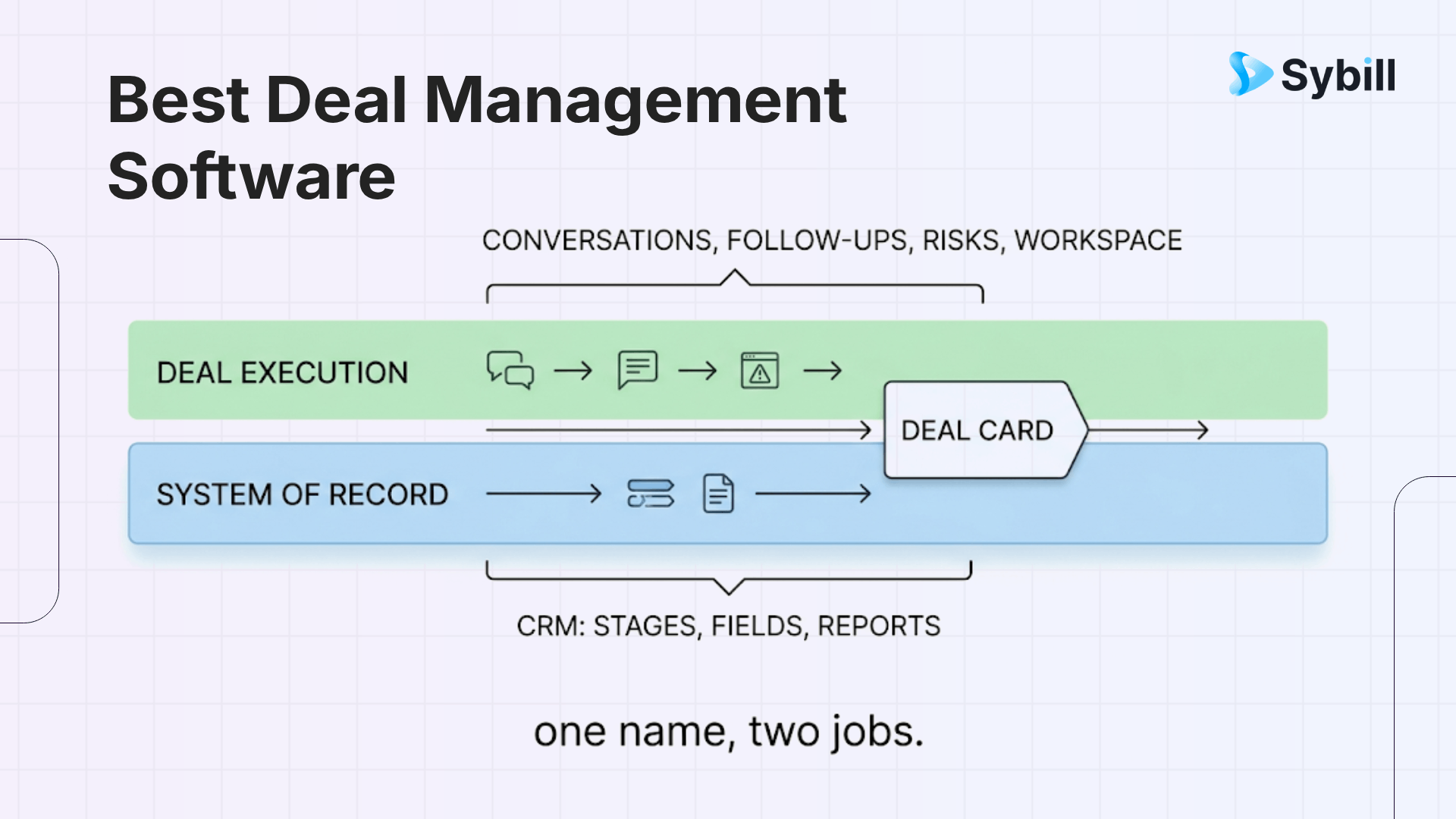
Deal management software tracks and advances sales opportunities from qualification to close, but the term covers two distinct layers: the CRM layer that stores deal records (Salesforce, HubSpot, Pipedrive, Zoho, Freshsales), and the deal execution layer that works the deals inside those records: capturing conversations, flagging risks, automating follow-ups and updates (Sybill). Most buying confusion in this category comes from vendors blurring which layer they sell.
The roundup below covers both layers honestly, including which one your team is actually shopping for, because that question decides everything else.
Deal management software gives teams visibility and control over every open opportunity: where it stands, what has happened, what must happen next, and where the risks are. In practice the category splits into a record layer (the CRM's pipeline, stages, fields, and reporting) and an execution layer (the tools that capture what happens in deals and act on it), and mature teams run one of each.
The distinction matters because the two layers fail differently, and buyers keep purchasing one to fix the other's problem.
The record layer organizes deals into pipelines and stages, enforces process, and reports upward. Its classic failure: it only knows what someone types into it, so records drift from reality the moment reps get busy, which is always.
The execution layer lives where deals actually happen: the calls, the emails, the commitments. It captures the substance (what the buyer said, promised, objected to), turns it into follow-ups, updated records, and risk flags, and gives reps a working view of each deal. Its role is making the record layer true and the deal motion fast; it is the deal-level expression of the broader CRM automation shift, and the layer RevOps platforms increasingly assume exists when they model the pipeline.
Those opening frustrations every rep knows ("I'll update the CRM after this call," "which email thread had the pricing discussion?") are execution-layer problems. Buying a bigger CRM does not fix them; it gives the fiction more fields. Which is exactly why this roundup covers both layers instead of pretending five CRMs are the whole answer, the way the previous version of this post quietly did.
Three structural pressures make it non-optional: buying committees have grown (Gartner puts typical complex B2B purchases at 6 to 10 decision-makers, each with their own concerns to track), revenue leaks through process gaps (World Commerce & Contracting estimates companies lose an average of 9.2% of revenue to poor deal and contract management), and deal velocity now depends on same-day execution that manual tracking cannot sustain.
Concretely, the failure pattern without it: stakeholder priorities scattered across inboxes and memory, follow-ups slipping from today to never, three versions of the proposal in circulation, and a pipeline review that runs on narration because nobody can check the record against reality. Every one of those leaks compounds across a quarter, and none of them announces itself until the deal is already gone.
The flip side, with both layers running: every stakeholder mapped and current, every commitment captured with an owner, one source of truth per deal, and forecasts built on evidence instead of optimism.
The record layer: Salesforce Sales Cloud for enterprise customization, HubSpot Sales Hub for growing teams wanting simplicity, Pipedrive for visual pipeline management, Zoho CRM for budget-conscious feature depth, and Freshsales for built-in multichannel communication. The execution layer: Sybill for conversation-driven deal management: capturing every call, automating CRM updates and follow-ups, and flagging deal risks from evidence.
The honest rundown, layer by layer.
Salesforce Sales Cloud: best for large, complex sales organizations. The enterprise standard, with customization depth nothing else matches, the largest integration ecosystem, and reporting that satisfies any board. The honest costs: a steep learning curve, dedicated admin headcount as a near-requirement, and pricing that punishes small teams. Buy it when your process complexity genuinely demands it, not as a status purchase.
HubSpot Sales Hub: best for growing teams that value simplicity. The most approachable serious CRM: clean pipeline management, excellent marketing integration, a generous free tier, and adoption that happens without a change-management program. The trade: customization ceilings versus Salesforce, and tier pricing that climbs steeply as you scale into the features you eventually want.
Pipedrive: best for visual pipeline management. The SMB favorite for a reason: the drag-and-drop pipeline is genuinely the category's most intuitive, setup takes an afternoon, and the mobile app is strong. The trade: lighter reporting and fewer advanced capabilities; teams with complex multi-product motions will outgrow it.
Zoho CRM: best for budget-conscious teams wanting breadth. The most functionality per dollar in the category, with solid automation and natural fit inside the wider Zoho suite (and Sybill integrates with Zoho directly). The trade: an interface that trails competitors in polish and support that can run slow.
Freshsales: best for built-in multichannel communication. Phone, email, and chat native to the platform, AI-assisted lead scoring, and competitive pricing make it a tidy all-in-one for mid-sized teams. The trade: a thinner third-party ecosystem than the big two, and key features gated to higher plans.
Sybill: best for conversation-driven deal execution. Full disclosure, this is our product, so judge the claims on their checkability. The execution layer's job is everything the CRM cannot see: Sybill sits in every sales conversation and turns it into magic summaries, CRM fields that fill themselves, follow-up emails in the rep's tone, and captured tasks, then gives reps a dedicated deal workspace and managers deal inspection that flags risk from what buyers actually said. Sybill has analyzed around 33 million sales conversations, and the honest lane marker: Sybill is not a CRM replacement. It runs on top of Salesforce, HubSpot, Zoho, and others, making whichever record layer you chose above actually true.
The pairing logic, stated once: pick one record layer for your size and complexity, add the execution layer, and the classic deal-management failure (a beautifully configured CRM describing a fictional pipeline) becomes structurally impossible, because the record updates from the conversations themselves.
Your CRM stores the deal. Sybill moves it. Every call captured, every field updated, every follow-up sent, and every risk flagged, automatically. Get started for free with Sybill.
Choose in this order: identify which layer your pain lives in (records messy versus deals slipping), match the record layer to team size and process complexity, confirm integration fit with your existing stack, model total cost including admin time rather than sticker price, and pilot your top two choices on live deals for two weeks before committing.
The selection questions that actually discriminate:
Which layer hurts? If your problem is "we cannot see our pipeline," you need the record layer configured properly. If it is "we can see it but it is fiction, and follow-ups slip," no CRM upgrade will help; that is execution-layer pain. Most teams discover they have the second problem wearing the first one's costume.
.png)
What does your size demand? Sub-20-seat teams are almost always better served by Pipedrive, HubSpot, or Freshsales than by enterprise platforms whose power they will pay for and never use. Enterprise-complexity motions (multi-product, territory management, approval chains) justify Salesforce and its admin overhead.
What must it talk to? Map the stack first: email, calendar, engagement platform, billing, and the execution layer. Native integrations beat connector chains, and every manual re-entry point between systems is a future leak.
What is the real cost? Per-seat price is the visible fraction. Add implementation, admin headcount (Salesforce especially), training time, and tier-upgrade pressure as needs grow. A cheaper platform your team actually uses beats a powerful one they route around; adoption is the metric that decides ROI, and dirty data is the tax on getting it wrong.
Does the pilot survive contact? Two weeks, top two candidates, real deals, and one pass/fail question: did the team keep using it without being chased? Tools that require nagging in week two require nagging forever.
Here is the category's uncomfortable open secret: deal management software fails far more often on adoption than on capability. Every platform above can model your pipeline beautifully; none of them can make a rep with six back-to-back calls type up what happened in each one. For two decades the industry answered that with training, dashboards, and nagging, and the records stayed fictional anyway.
The two-layer architecture is the actual fix. Let the record layer do what it is good at (structure, process, reporting) and hand the feeding of it to an execution layer that captures deals at the source: the conversations. The reps sell, the record stays true, the manager inspects evidence, and the "I'll update the CRM after this call" era quietly ends.
Pick your CRM with the guide above. Then make it honest.
Get started for free with Sybill or book a demo and give whichever CRM you choose a perfect memory.
The CRM is the most common form of deal management software: the record layer holding pipelines, stages, and deal data. Full deal management adds an execution layer on top: tools that capture conversations, automate follow-ups and CRM updates, and flag deal risks. The CRM stores deals; the execution layer moves them and keeps the records true.
Pipedrive, HubSpot Sales Hub, and Freshsales lead for small teams: fast setup, intuitive pipelines, and pricing that fits early budgets. HubSpot's free tier is the lowest-risk starting point. Pair whichever you choose with conversation-driven automation early, because small teams have the least spare capacity for manual data entry.
For enterprise organizations with complex, multi-stage processes, genuinely yes: its customization and reporting depth remain unmatched. For smaller teams, usually not: the admin overhead, learning curve, and cost outweigh benefits they will not use. The honest test is whether your process complexity demands the power, not whether the brand reassures.
Record-layer pricing runs from free tiers (HubSpot) through roughly $15 to $30 per user monthly for SMB platforms (Pipedrive, Zoho, Freshsales) to enterprise pricing for Salesforce that grows with editions and add-ons. Model total cost of ownership: implementation, admin time, and tier upgrades typically exceed the sticker price within two years.
AI now handles the deal-management mechanics reliably: capturing what happened in conversations, updating CRM records, drafting follow-ups, tracking commitments, and flagging at-risk deals from evidence. The judgment calls (strategy, prioritization, when to walk away) remain human; AI's role is ensuring those calls run on complete, current deal truth.
The CRM is the most common form of deal management software: the record layer holding pipelines, stages, and deal data. Full deal management adds an execution layer on top: tools that capture conversations, automate follow-ups and CRM updates, and flag deal risks. The CRM stores deals; the execution layer moves them and keeps the records true.
Pipedrive, HubSpot Sales Hub, and Freshsales lead for small teams: fast setup, intuitive pipelines, and pricing that fits early budgets. HubSpot's free tier is the lowest-risk starting point. Pair whichever you choose with conversation-driven automation early, because small teams have the least spare capacity for manual data entry.
For enterprise organizations with complex, multi-stage processes, genuinely yes: its customization and reporting depth remain unmatched. For smaller teams, usually not: the admin overhead, learning curve, and cost outweigh benefits they will not use. The honest test is whether your process complexity demands the power, not whether the brand reassures.