On one side: bigger quotas, more complex buying groups, and prospects who show up having already read your competitors’ entire website. On the other: the same old reality of scattered notes, half-filled CRM fields, 37 open tabs, and a calendar that looks like a game of Tetris.
Sybill's AI agent for Account Executives acts as a personal sales coordinator, research analyst, and deal strategist that automates the repetitive work between and after meetings — generating pre-call briefs with stakeholder context and likely objections, producing Magic Summaries with key moments and next steps, drafting personalized follow-up emails in the rep's voice within minutes of each call, auto-filling CRM fields including custom MEDDPICC properties, and maintaining a Deal Workspace that tracks risks, blockers, and multi-threading status across every active opportunity. The result is that AEs reclaim 5-10 hours per week previously spent on admin work while maintaining more accurate pipeline data and faster deal velocity.
That’s why we built Sybill’s AE AI Agent - a stack of templates, workflows, and automations that acts like a personal sales coordinator, research analyst, and deal strategist rolled into one.
Instead of just recording calls or spitting out generic summaries, your AE agent sits across every stage of the deal and answers one simple question:
“What should I do next to move this deal forward?”
The AE role used to be framed as: run calls → send proposals → close deals. Cute.
In 2025, a great AE is doing all of this at once:
Running multi-threaded deals across email, Slack, LinkedIn, and calls
Coordinating with SDRs, SEs, CS, RevOps, and product
Forecasting their own book of business
Keeping CRM hygiene clean enough that their manager doesn’t ping them every Friday at 4:55 pm
Personalizing outreach and assets while every prospect expects Netflix-level relevance
Core Responsibilities of Today’s AE
Discovery & Qualification Running sharp discovery, mapping buying committees, and qualifying using frameworks like BANT, SPICED, MEDDPICC, FAINT, and CHAMP.
Deal Orchestration Managing next steps, mutual action plans, stakeholders, budget alignment, and timelines across a messy reality of shifting priorities.
Pipeline Ownership Building, managing, and defending their pipeline and not just logging opportunities, but understanding where risk lives and which deals are truly winnable.
Collaboration & Handoffs Partnering with CS for smooth handoffs, and giving product/marketing real voice-of-customer insight (not just “they liked feature X”).
It’s no surprise AEs are drowning in busywork that doesn’t actually move deals. That’s the gap Sybill’s AE agent is built to close.
Life Before an AE AI Agent
Let’s be honest about the “old normal”:
Pre-call prep = tab soup You’ve got your CRM open, LinkedIn for every attendee, a notes doc, last call transcript, Slack search, and maybe Gong/Zoom recordings. You skim, you skim some more, and you still join the call feeling 70% ready.
During calls = split brain One half of your brain is having a human conversation. The other half is silently panicking: “Did I capture that objection? Was that the real decision maker? What did they just say about timeline?”
After calls = admin hour You re-type notes you already said out loud. Craft custom follow-ups from scratch. Push next steps into CRM. Then your manager pings:
“Update the opp with MEDDPICC fields before forecast, please 🙏.”
Pipeline review = “vibes” forecasting Deals are “green” because the champion likes you. Another one is “commit” because the prospect said “this looks great” once. But you know you haven’t really run a tight qualification lens across the whole book.
Templates & frameworks live in wikis, not workflows Qualification frameworks and sales plays exist… as nice PDFs. They rarely show up in the moment when you’re prepping for a call or trying to salvage a slipping deal.
That’s exactly the world Sybill was built to escape, and we are not the ones to claim this.
Enter Sybill’s AE AI Agent
Instead of yet another “AI notetaker,” Sybill acts like an AE-specialized agent that:
Learns from your calls, emails, CRM, Slack, and calendar.
Thinks in sales frameworks (BANT, MEDDPICC, SPICED, CHAMP, FAINT) and real win/loss patterns.
Acts by summarizing calls, writing follow-ups, filling CRM, and generating deal assets automatically.
And the Template Library is where your AE agent really grows muscles. It’s packed with:
CRM (so your opp is fully updated without manual notes)
Email (you reuse elements straight into your follow-up)
3. Post-Meeting: Follow-ups write themselves
A call ends. Sybill already knows:
What was promised
Which slide/feature got real energy
What the buying process looks like
Who needs to be looped in next
Your AE agent leans on Email follow-up templates from the library, including specialized ones like Closed/Won kickoff follow-up and tailored mid-cycle follow-ups.
You get:
A draft follow-up email in your tone, with accurate recap + clear next steps
Links to relevant collateral (or a prompt to generate them)
Auto-logged tasks and dates
You tweak 10%, send, move on to the next call.
4. Deal Inspection: MEDDPICC, BANT & friends on Autopilot
Instead of manually running frameworks in a notebook, you ask:
“Ask Sybill: Inspect my Acme Corp deal with MEDDPICC.”
Your AE agent uses deal inspect templates like:
MEDDPICC deal inspect: Are metrics clear? Have we identified the real economic buyer? Are decision criteria explicit or fuzzy?
BANT deal inspect: Is there verified budget? Is authority confirmed or assumed? Is the need anchored in real pain? Is the timeline real or aspirational?
SPICED / CHAMP / FAINT deal inspections: Different views depending on stage, segment, and complexity.
For the whole pipeline, you can run 360° templates:
MEDDPICC 360°: Where are risks across late-stage deals?
BANT 360°: Which “commits” are actually missing budget or authority?
SPICED 360°: Where urgency is weak and needs a critical event.
The output isn’t just a pretty report. It’s a to-do list:
“You have 4 deals in Commit without a confirmed decision process.”
“3 SMB deals show strong pain but no identified champion, here’s how to fix that.”
5. Coaching yourself like a top rep
With templates like:
Rep win/loss report: Top win/loss themes from your last 10 opportunities, with recommendations.
Discovery call scorecard: Exactly where your discovery is falling flat.
Competitor objection coaching: The competitor your team struggles with + suggested enablement and talk-tracks.
You get the kind of feedback that used to only show up in quarterly reviews and ad-hoc call listens, now delivered every week, on demand.
How the AE AI Agent Uses Sybill’s Template Library
Under the hood, your AE agent uses the Sybill Template Library as its “playbook shelf.”
You don’t need to memorize every framework nuance.
You don’t need to build your own prompts in a random doc.
You just ask Sybill in natural language, and it reaches into the right template, fuses it with your actual sales data, and gives you something you can act on immediately.
Getting Started: Building Your AE AI Agent Stack in Sybill
You don’t need to “implement AI” as a giant project. Start small, but start smart.
Step 1: Turn on the Basics
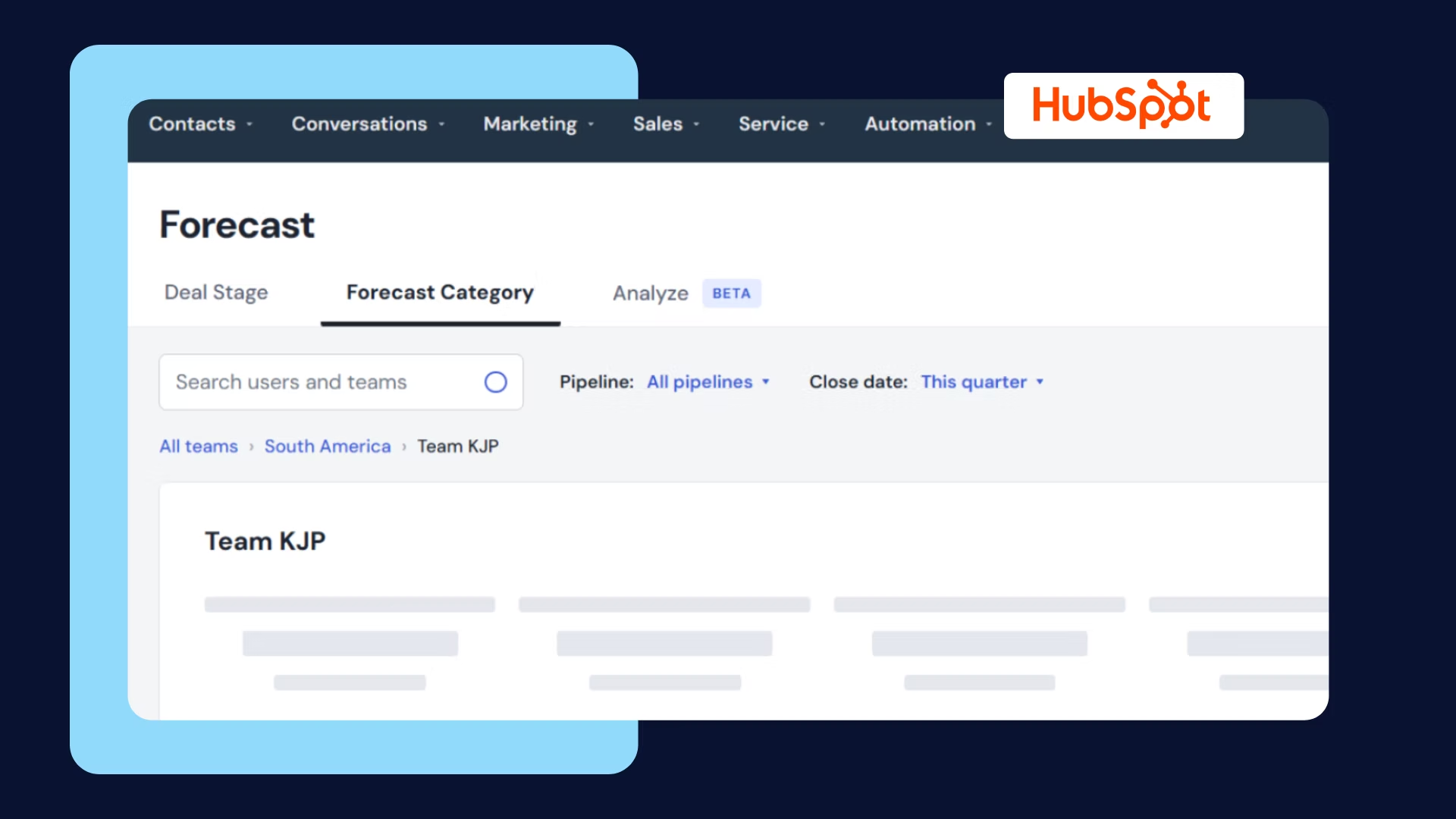
Connect email, calendar, and CRM (HubSpot, Salesforce, Pipedrive, etc.).
Enable call recording & Magic Summaries for your sales meetings.
Now Sybill can see your deals and hear your calls.
Step 2: Add AE Templates for Your Day-to-Day
From the Template Library, favorite a starter “stack” for yourself:


%20(1).avif)