AI & Automation

AI Agents for Sales Managers

How Sybill helps Managers coach better, forecast cleaner, and run a tighter pipeline

The introduction of AI agents into the Sales Manager role is changing how frontline sales leadership operates day to day. Instead of being limited to dashboards, spreadsheets, and ad-hoc call reviews, managers now have access to digital teammates that continuously analyze pipeline, deals, and rep performance, and surface the patterns that matter.

AI agents for sales managers are specialized AI systems that continuously analyze pipeline, deals, and rep performance across calls, emails, CRM, and calendar data to surface coaching opportunities, forecast risks, and deal-level recommendations — replacing the manual work of listening to call recordings, chasing reps for CRM updates, and assembling pipeline review data from multiple tools. Sybill's AI agent for sales managers provides automated deal inspection with risk signals, rep performance patterns with timestamped evidence, forecast confidence scoring based on conversation signals rather than rep self-reporting, and natural-language pipeline Q&A that answers questions like "which deals mentioned budget concerns this week" with linked call evidence.

At Sybill, we think of  how a Sales Manager can use AI Agent as a specialized layer on top of your calls, emails, CRM, and calendar. It is built on the same foundation as Sybill’s AI sales assistant and Ask Sybill, but configured explicitly for the questions a manager asks every day:

  • Which deals in this quarter’s commit are actually at risk?
  • Where is each rep losing control of the sales process?
  • How accurate is our current forecast, and why?
  • What should I coach on this week if I only have 60 minutes?

By combining Sybill’s data model (calls, emails, CRM, Slack, and more) with a library of manager-oriented templates like deal inspection, slippage analysis, coaching reports, and pipeline reviews, the Sales Manager Agent becomes a persistent, opinionated partner in how you run your team.

You can see the underlying product in action here:

Understanding the Modern Sales Manager Role

The Sales Manager role sits between individual execution and company-level revenue strategy. Managers are accountable for team performance, pipeline quality, and forecast accuracy, while also handling coaching, hiring, onboarding, and cross-functional coordination.

In practice, this means a Sales Manager is responsible for:

  • Pipeline governance – ensuring there is enough coverage, identifying unhealthy deals early, and maintaining realistic stages and probabilities.
  • Forecasting and inspection – sanity-checking commit and best-case numbers, validating timelines, and challenging deals that depend on assumptions rather than proof.
  • Coaching and development – reviewing discovery calls, helping reps navigate complex buying groups, and turning patterns in win/loss data into coaching plans.
  • Cross-functional communication – sharing customer insights with product and marketing, coordinating with customer success on handoffs, and advocating for the team with leadership.
  • Process and hygiene – keeping CRM fields complete, enforcing qualification frameworks such as MEDDPICC or BANT, and making sure the team follows a consistent sales process.

The tension is that much of this work is still done manually. Managers have to dig through CRMs, search call recordings, and chase updates in Slack threads to form a coherent view of what is happening in the business.

What Sales Managers Used Before AI Agents

Before tools like Sybill, Sales Managers relied on a patchwork of systems:

  • CRM reports and custom dashboards
  • Ad-hoc spreadsheets created for each quarter
  • One-off call listens, often on the loudest or most recent deal
  • Reps’ written notes and status updates in Slack or email
  • “Manager intuition” built from partial data

Preparing for a forecast call meant exporting spreadsheets, filtering deals by stage or owner, and hoping the underlying data was both complete and accurate. Coaching often started from a blank page: managers would pick a random call to review or a single deal to dissect because they lacked an aggregated view of where each rep was actually struggling.

This manual approach had several consequences:

  • Forecasts depended heavily on rep sentiment and recent activity.
  • At-risk deals were often discovered too late, when timelines had already slipped.
  • Coaching time gravitated toward the most vocal reps or the noisiest deals, not necessarily the most leveraged opportunities.
  • CRM hygiene remained a constant point of friction between managers and sellers.

What Changes With a Sales Manager AI Agent from Sybill

Sybill’s Sales Manager Agent is built on top of the Sybill platform and Ask Sybill. It continuously ingests meeting recordings, emails, CRM updates, and other GTM data, then uses sales-specific reasoning to answer questions and generate reports for managers.

The core shift is from manual inspection to agentic oversight:

  • Instead of manually checking 50 opportunities, you ask:
    “Which deals in this quarter’s commit have no clear champion identified?”
  • Instead of skimming through call summaries, you ask:
    “Show me where this rep is consistently losing pricing conversations.”
  • Instead of building spreadsheets each week, you ask:
    “Generate a pipeline risk summary for my team and group it by rep, stage, and risk type.”

Under the hood, the agent uses Sybill’s template library, pre-built workflows for deal inspection, coaching, pipeline analysis, and asset creation to combine them with your own data.
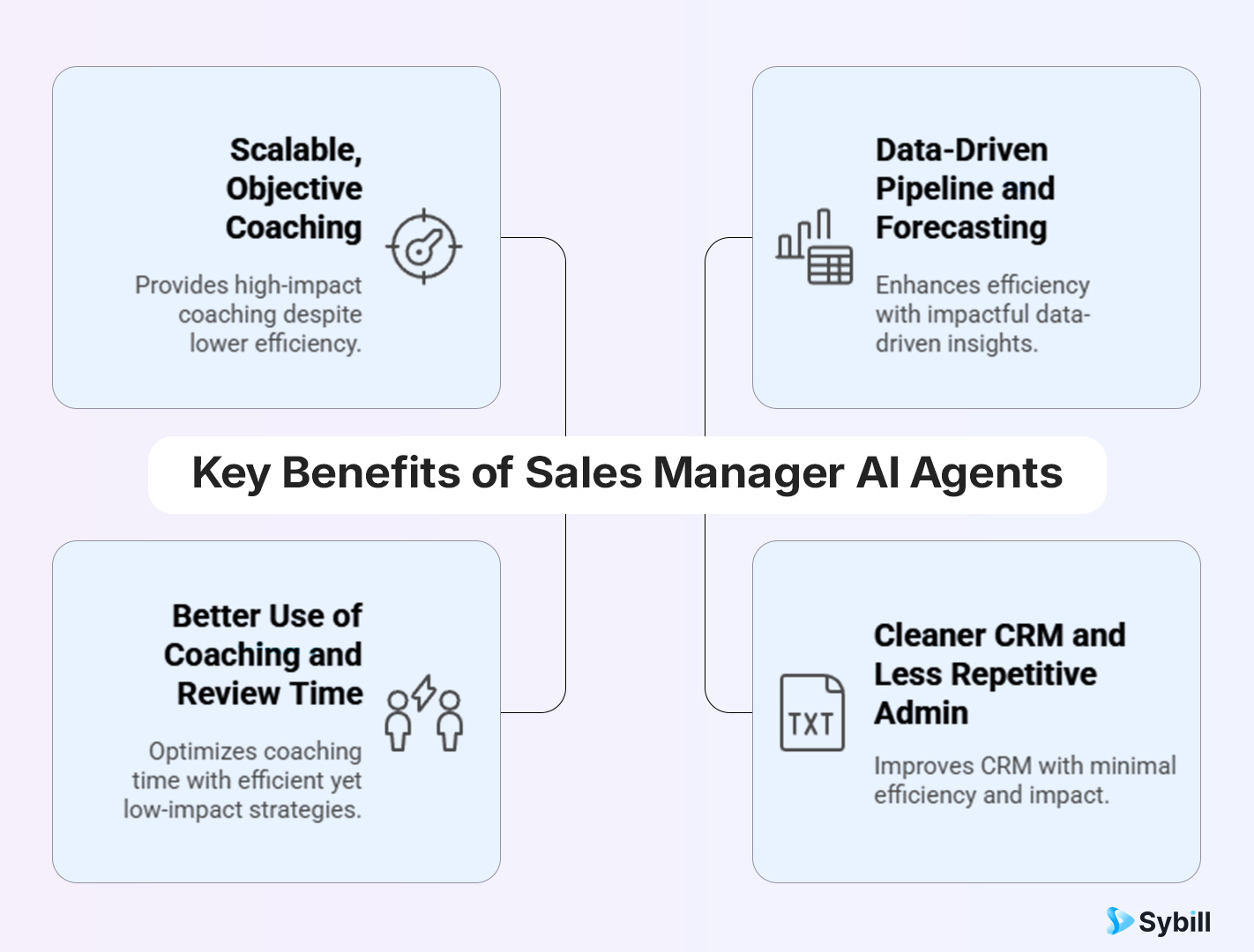
Key Benefits of Sales Manager AI Agents

__wf_reserved_inherit

1. Data-Driven Pipeline and Forecasting

The Sales Manager Agent can continuously review your open pipeline and closed-won/lost deals to identify patterns that would be hard to see manually:

  • Deals in commit with weak or missing MEDDPICC fields.
  • Stalled opportunities that show declining engagement on recent calls or email.
  • Segments or territories with systematically slower velocity.
  • Forecast scenarios based on historical conversion rates and current stage distribution.

This moves forecasting away from “in my experience” judgments and toward a more stable, data-backed process. Managers can still apply their judgment, but they start from a richer, more accurate picture.

2. Scalable, Objective Coaching

Because Sybill already analyzes calls, notes, and buyer reactions, Ask Sybill can generate coaching views that cut across individual meetings and deals:

  • The top objections a specific rep struggles with, and how those differ from the rest of the team.
  • Common patterns in that rep’s discovery calls: where they skip depth, miss follow-up questions, or jump to demo too quickly.
  • A summary of product feedback and competitor mentions that keeps showing up in this rep’s pipeline.

The Sales Manager Agent packages this into:

  • Rep-level win/loss reports
  • Discovery scorecards
  • Objection-handling performance summaries
  • Suggested coaching plans over a defined period

This gives managers a more consistent, objective foundation for 1:1s, and helps them scale coaching beyond just the few calls they have time to manually review.

3. Cleaner CRM and Less Repetitive Admin

Sybill already supports automated meeting summaries, follow-up drafting, and CRM autofill for AEs.

From a Sales Manager perspective, that means:

  • Opportunities are more likely to have complete fields, including qualification, next steps, and key stakeholders.
  • Notes from important calls are normalized into a consistent structure instead of being buried in different formats.
  • Follow-ups and tasks are less likely to be missed because they are generated and tracked automatically.

Managers spend less time policing hygiene and more time interpreting data.

4. Better Use of Coaching and Review Time

Because the Sales Manager Agent can prioritize where attention is most needed, managers can use their limited time on leverage points:

  • Reps with high volume but low conversion at a specific stage.
  • Deals above a certain threshold that show risk on timeline, budget, or authority.
  • Segments where the team is underperforming versus historical benchmarks.

Instead of scanning a large number of deals at shallow depth, managers can go deep on the opportunities and patterns that create the most upside.

Potential Use Cases of Sales Manager AI Agents with Sybill

The same underlying agent can support several workflows that Sales Managers run repeatedly:

Pipeline and Forecast Reviews

  • Analyze the current quarter’s pipeline for coverage, risk, and stage progression.
  • Flag deals in commit that lack confirmed next steps, champions, or budget signals.
  • Generate summary views by rep, segment, or region to guide forecast calls.

1:1 Coaching and Performance Reviews

  • Produce a consolidated view of a rep’s last few weeks of calls and emails.
  • Highlight repeated patterns in lost deals, such as failing to handle specific objections or not establishing clear value.
  • Suggest targeted areas for practice with call snippets and examples.

Deal Strategy Support

  • Inspect a single opportunity using frameworks like MEDDPICC or SPICED, based on call recordings and CRM data.
  • Identify missing stakeholders or weakly defined success criteria that could threaten the close.
  • Recommend next actions or talk tracks to strengthen the deal.

Onboarding and Ramping New Reps

  • Surface exemplary calls from top performers to use as training material.
  • Generate checklists and learning paths for new reps based on real deal patterns.
  • Track how quickly new hires are improving across discovery quality and opportunity conversion.

Tasks the Sales Manager AI Agent Can Take Over

Drawing from Sybill’s capabilities and template library, typical tasks the Sales Manager Agent can handle include:

  • Pipeline data analysis – continuously scanning for stage aging, risk indicators, and inconsistent probabilities.
  • At-risk deal identification – finding opportunities likely to slip based on engagement patterns and missing decision criteria.
  • Forecast scenario modelling – projecting outcomes under different win-rate and cycle-time assumptions.
  • Win/loss pattern analysis – aggregating reasons for wins and losses across the team.
  • Coaching pack preparation – assembling key insights and examples for each rep’s 1:1.
  • Training content discovery – locating calls where specific objections were handled particularly well or poorly.
  • Meeting summary and follow-up generation – ensuring that key actions and decisions are captured and distributed after pipeline and forecast meetings.

In each case, the agent does the heavy analytical and summarization work, while the Sales Manager retains decision-making authority.

The Growth Loop Perspective for Sales Managers

As with executive-level revenue agents, the value of a Sales Manager Agent compounds over time.

Each cycle looks like this:

  1. More connected data – calls, emails, CRM updates, and meeting notes feed into Sybill.
  2. Richer pattern detection – the agent refines its understanding of what a healthy deal and a healthy rep pipeline look like in your specific environment.
  3. More targeted coaching and intervention – managers act on better insights, improving close rates and cycle times.
  4. Improved outcomes feed back into the model – successful strategies, rebuttals, and sales plays become part of the playbook the agent can recommend.

Over time, the manager’s role shifts from “manual inspector of deals” to “designer of systems and plays,” with the agent providing the analysis required to keep those systems honest.

Implementation Strategy: How to Introduce a Sales Manager Agent with Sybill

Successful implementations usually follow a stepwise rollout, rather than switching everything on at once.

  1. Connect the core systems
    Start by integrating your CRM, meeting recordings, and email/calendar with Sybill so the agent has a complete view of deals and activities.
  2. Choose a single high-impact use case
    For most Sales Managers this is either:
    • improving pipeline review quality, or
    • improving the structure and impact of coaching 1:1s.
  3. Adopt a small set of templates
    Use a focused subset of Sybill’s templates for Sales Managers, such as a quarterly pipeline review report, a rep performance summary, and a deal risk inspector to establish trust in the outputs.
  4. Document early wins
    Capture examples where the agent surfaced a risk that would have been missed, or where a coaching insight led directly to a saved or accelerated deal. This makes it easier to expand usage across the team.

  5. Gradually extend to additional workflows
    Once the basics are reliable, layer in more advanced use cases: segment-level analyses, territory reviews, onboarding programs, and recurring Ask Sybill prompts for weekly reports.

See It in Practice

If you want to see how this looks in a live environment, you can explore:

  • Ask Sybill: Get Instant Answers with AI-Powered Insights – product overview and examples of how teams query their deals and pipeline.
  • Personal Coach: The Sales Mentor You Can Ask Anything – how managers use Ask Sybill for scalable coaching.
  • Sybill YouTube channel – demos and walkthroughs of Sybill in real sales teams.

‍

Get started with Sybill

Accelerate your sales with your personal assistant

Get Started Free

Frequently Asked Questions

What is an AI Agent for Sales Manager in Sybill?

It is a specialized layer built on top of call recordings, CRM data, emails, and meeting activity. It continuously analyzes deals, pipeline health, rep performance, and buyer signals to give managers structured insights, coaching recommendations, risk analysis, and forecast support. It functions as an analytical partner that helps managers make more consistent and data-driven decisions.

How can AI help Sales Managers run more accurate forecasts?

AI helps review each opportunity against qualification frameworks and historical patterns, highlighting missing information, and deals with weak champions or unclear success criteria. Sybill’s AI in particular is very accurate and reliable, thereby reducing burden on intuition and improving feedback across stages, segments, and reps.

What coaching capabilities does a Sales Manager AI Agent provide?

Sybill aggregates insights from calls, emails, objections, and win/loss trends to generate rep-level coaching packs. These include discovery scorecards, objection-handling patterns, deal execution gaps, competitive insights, and specific examples pulled from real meetings. Managers can structure 1:1s around measurable patterns rather than isolated calls, allowing more targeted and scalable coaching programs.

Get started with Sybill

Once you try it, you’ll never go back.