Find us at booth #83, join us for a harbor side happy hour, or catch Gorish’s talk.

Sept, 16-18 > Learn more


Richa Sharma

March 30, 2026
.avif)
Modern problems require modern solutions.
Sales coaching used to be simple. Your manager listened in on a few calls, gave you vague feedback like "Be more confident" or "Ask better questions," and sent you back into the wild. But let’s be real: That is like trying to win a boss fight with a wooden sword.
Sales is evolving to be faster, smarter, and way more unpredictable. Buyer behaviors shift overnight, competitors up their game, and one wrong move can tank a deal. Old-school coaching methods are too slow, too generic, and, honestly, useless in a world where data-driven decision-making prevails.
Enter AI-powered sales coaching. Your personal Yoda, Sherlock Holmes, and Jarvis rolled into one. Imagine an AI that listens to every call, analyzes every email, and gives you instant feedback without bias or delay. Instead of waiting for your manager to eventually review your performance, AI tells you what worked, what flopped, and how to fix it in real time.
AI-powered sales coaching uses machine learning, natural language processing, and real-time data analysis to deliver personalized, scalable coaching that traditional methods cannot match. The key benefits include: personalized coaching at scale (analyzing each rep’s calls, emails, and performance data for tailored feedback), data-driven strategy insights (identifying winning patterns across thousands of interactions), faster onboarding (reducing ramp-up time by up to 36% and increasing closed deals by 46%), real-time performance monitoring (instant feedback during live calls rather than delayed post-call reviews), improved rep retention (through continuous, adaptive learning paths and gamified progress tracking), and consistent coaching across global teams regardless of team size. Unlike traditional coaching that relies on subjective observations and sporadic one-on-ones, AI coaching provides continuous, bias-free feedback rooted in actual performance data — making it the foundation of modern B2B sales team development.
This is not the future of sales coaching. It is the present, and the teams that adopt it will dominate. This guide breaks down how AI for sales coaching is helping reps close more deals, train faster, and turn into absolute closers. If you still rely on outdated methods, it's time to upgrade.
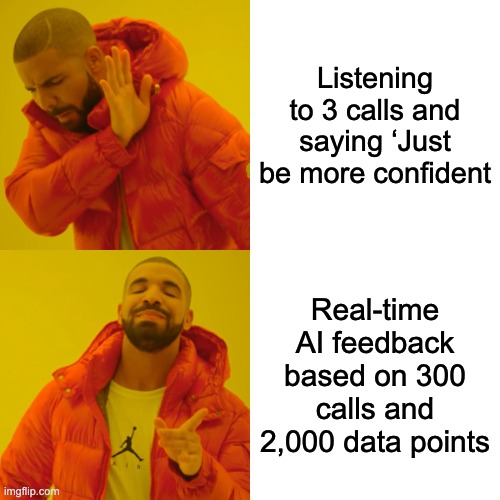
AI in sales coaching enhances the training, coaching, and development of sales teams. Unlike traditional coaching, which often relies on subjective observations and sporadic feedback, AI sales coaching leverages data, machine learning, and natural language processing (NLP) to provide actionable insights at scale.
Imagine having a sales coach who is always available, listens to every call, analyzes every email, and provides instant, personalized feedback to every salesperson. Sounds futuristic? It’s already happening.
Key components of AI for sales coaching include:
This means that B2B sales coaching is not just about gut instinct but also about data-driven decision-making.
Sales coaching has always been crucial for building high-performing teams, but traditional methods often fall short. Generic training sessions, delayed feedback, and one-size-fits-all coaching fail to keep up with today’s fast-moving sales environment. AI-powered sales coaching changes the game.
By leveraging data, machine learning, and real-time insights, AI enhances coaching effectiveness, delivering personalized guidance on a large scale. It helps reps refine their strategies, close deals faster, and continuously improve—without waiting for quarterly reviews or post-call debriefs.
Let’s break down the key benefits of AI sales coaching and why sales teams with supersellers are making the switch.
Traditional B2B sales coaching faces a fundamental challenge: providing consistent, individualized attention becomes impossible when a team grows beyond a specific size. According to Salesforce, only 26% of sales professionals receive weekly one-on-one coaching, revealing a significant gap in sales training within many organizations.
Using AI, sales teams can provide personalized coaching at scale by analyzing each representative's calls, emails, and performance data to offer real-time feedback and recommendations. Instead of isolated, generalized training, reps receive continuous, custom insights that help them refine their approach instantly.
Sales coaching should be rooted in data, not guesswork. AI-powered analytics empowers sales managers by identifying patterns and strategies that drive successful deal closures. AI analyzes thousands of sales interactions, calls, emails, and CRM data and provides actionable insights that human coaches might overlook.
For instance, AI tools like Sybill.ai analyze successful sales conversations to pinpoint winning tactics, such as specific language patterns, response timing, and objection-handling strategies. These insights allow you to refine your sales processes based on accurate performance data, not just intuition.
Onboarding a new sales rep is costly and time-consuming, often taking months before they reach peak performance. According to industry reports, AI-driven sales coaching accelerates onboarding, reducing ramp-up time by 36% and increasing the number of closed deals by 46%.
How does AI achieve this?
Traditional sales coaching relies on reviewing past interactions, but AI analyzes and coaches in real time, allowing sales teams to pivot strategies instantly. AI tools track live sales calls, emails, and CRM activity, identifying areas where reps struggle and offering immediate feedback.
For example, AI-powered assistants like Sybill.ai generate instant meeting summaries, highlighting key takeaways, next steps, and follow-up actions. This ensures seamless workflow integration with CRM platforms, such as Salesforce or HubSpot.
This proactive approach ensures faster course correction, improving sales effectiveness and reducing lost opportunities.
Sales turnover is a significant challenge, often stemming from inadequate training and a lack of support. AI-driven coaching enhances rep engagement and retention by making training personalized, interactive, and continuous.
One of AI’s most significant advantages is scalability. Unlike human coaches, AI can simultaneously provide personalized coaching to an unlimited number of sales representatives, ensuring consistent training across the entire sales team.
.png)
Evolving from traditional coaching to AI sales methods requires more than new tools. It requires a strategic approach that leverages actionable, real-time insights, enabling sales reps to refine their skills and close more deals. However, simply adopting AI in sales isn’t enough; you need the right strategies to make the most of it.
Here are some effective AI sales coaching tips:
AI can analyze past sales data to predict future sales trends, helping reps focus on high-probability prospects. This foresight enables more strategic planning and resource allocation, while helping sales representatives prioritize their efforts.
A sales tech stack helps ensure your CRM can access quality data, such as lead behavior, conversion rates, and historical sales trends. It allows the AI to generate actionable insights. You can use Sybill.ai to get real-time sales predictions.
AI listens to sales calls and analyzes tone, word choice, and engagement levels to recommend improvements in communication. AI can assess the effectiveness of communication and suggest improvements by analyzing the language used in sales calls and emails.
Tip: AI sales tools like Sybill.ai can help you generate personalized follow-up emails with one click after a meeting. It writes in your style and immediately after the call to ensure timely follow-ups.
Here's how to effectively use these models to enhance your sales coaching:
Prompt: “You are a [specific buyer persona] evaluating [product type]. Create a realistic conversation scenario including common objections about [specific concern: budget/implementation/ROI].”
Value: Reps can practice handling diverse scenarios, from skeptical CFOs to technical decision-makers, each with unique concerns and communication styles.
Prompt: “Take on the role of a prospect concerned about us [specific objection]. Respond naturally to my handling of this objection, and then provide feedback on my approach.”
Value: Sales reps can test multiple response strategies and receive immediate feedback, helping them build a robust toolkit for handling objections.
Prompt: “Help me develop a sequence of discovery questions for [specific industry] buyers focusing on [pain point]. Include follow-up questions based on potential responses.”
Value: Helps reps build more effective question frameworks and anticipate conversation flows.
Prompt: “Act as a prospect comparing our solution [product details] with [competitor]. Challenge me on key differentiators and make me articulate our unique value.”
Value: Reps learn to articulate value propositions more effectively while handling real-world competitive scenarios.
Prompt: “Review this sales email: [paste email]. Analyze its effectiveness from the point of view of personalization, value proposition, clear CTA, and engagement factors.”
Value: Helps reps develop stronger written communication skills with instant, detailed feedback.
AI-driven coaching platforms frequently utilize leaderboards, rewards, and gamified challenges to enhance the interactivity of training.
Introducing gamification elements, such as leaderboards or rewards, into AI-powered sales training can significantly enhance engagement and motivation. These methods make the learning process more fun and competitive, encouraging higher participation and better retention of the training material.
Tip: Implement AI-driven sales contests where reps earn points for completing training modules or closing deals.
Integrating AI into your sales coaching strategy requires careful planning and execution to make sure it complements your existing systems rather than disrupts them. Here’s how you can ensure a smooth transition:
Before implementing AI, evaluate your existing coaching methods to identify areas that could benefit from automation and data analysis.
Identify gaps in your current coaching approach. Are sales reps struggling with objection handling, deal closing, or customer engagement? AI can provide solutions tailored to these needs.
There are several AI-driven sales coaching tools on the market. Some of the best include:
Select AI-powered sales coaching tools that align with your organization's goals and integrate seamlessly with your current systems.
Even the best AI tools can not help if your sales reps don’t know how to use them. You need to ensure that your sales representatives and managers receive proper training. It includes understanding how to interpret AI-generated insights and apply them in real-world scenarios. Provide training sessions on interpreting AI-driven insights and applying them in real-world sales scenarios.
AI coaching is not a one-time implementation; it’s an ongoing process. Track performance, gather feedback, and adjust your approach based on what’s working. Monitor the effectiveness of AI-driven coaching and be prepared to make adjustments as needed. Collect feedback from your sales team to identify challenges and refine the coaching process.
Not long ago, sales coaching relied on periodic training and gut instinct. Reps had to wait for feedback, often missing key moments to turn a “maybe” into a “yes. The evolution of sales coaching has moved beyond sales teams relying on quarterly reviews and intuition-based feedback. AI isn't just an incremental change; it fundamentally shifts how we develop and empower sales professionals.
The future of sales coaching is here, powered by AI. The question isn't whether to adopt these AI sales tools but how quickly you can integrate them to transform your sales team into a force of supersellers. The time to act is now because your competition might already be ahead.