Find us at booth #83, join us for a harbor side happy hour, or catch Gorish’s talk.

Sept, 16-18 > Learn more


Mamta Tainwala

June 10, 2026
AI adoption in B2B sales is no longer optional. 83% of sales teams using AI saw revenue growth in the past year versus 66% of teams without it. Teams using AI automation report up to 36% faster deal cycles and 33% lower cost of sales.
But buyers are pushing back on over-automation just as hard. 51% of consumers say AI in their sales interactions feels robotic. 69% still prefer to validate AI-generated insights with a human rep at key decision points (Gartner, 2026). And Gartner predicts that by 2030, 75% of B2B buyers will specifically prefer sales experiences that prioritize human interaction over AI.
The tension is real, and the teams losing deals are the ones who picked a side instead of a system.
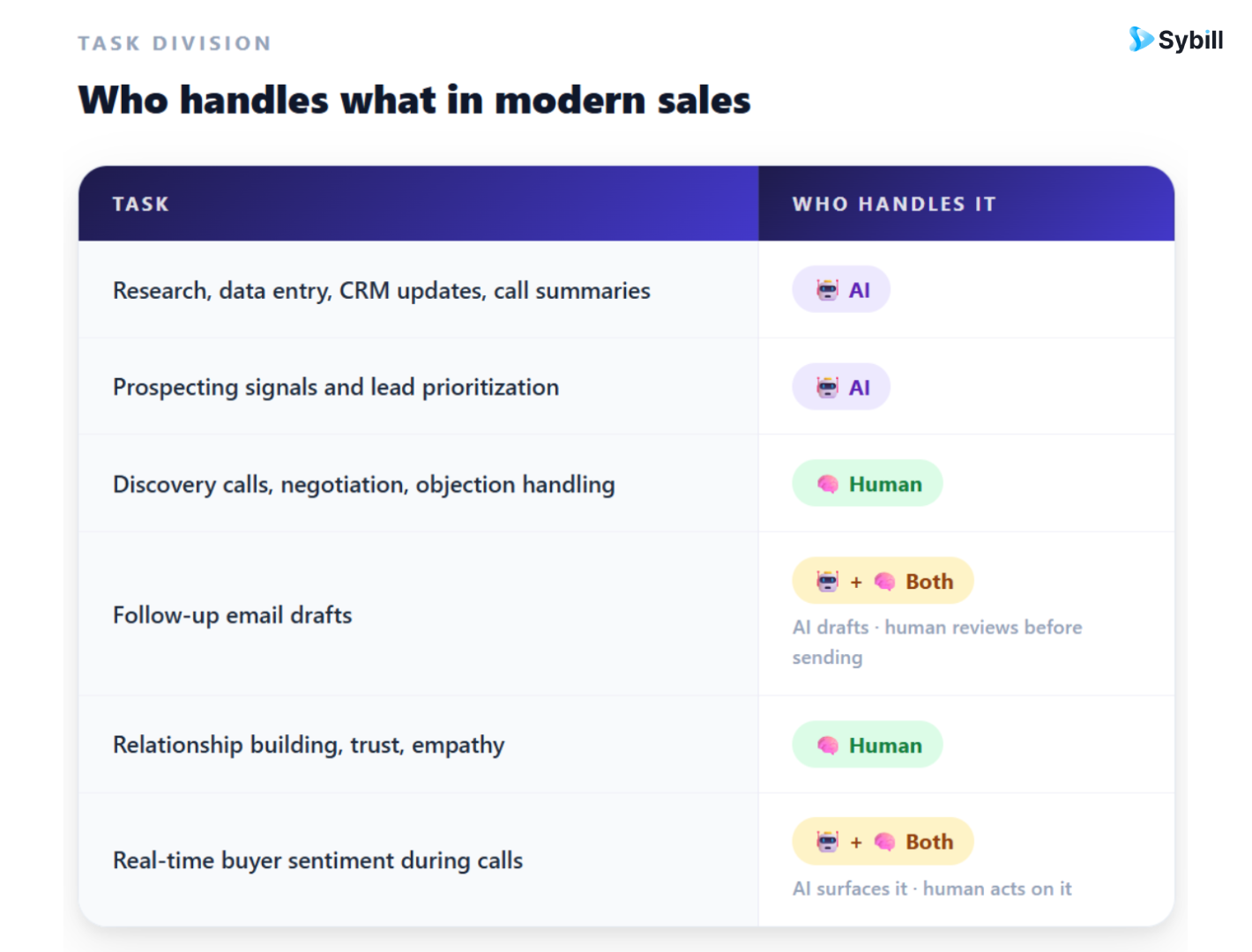
The formula is simple to say and hard to execute: let AI handle the 70% of sales work that does not require human judgment so humans can focus on the 30% that does. Sybill is built specifically for that division of labor. It reads the emotional pulse of every sales call, automates admin and follow-ups, and gives reps the context they need to show up as the most prepared person in the room, not the most automated one.
Here is a tension playing out in B2B sales right now that does not get named clearly enough.
On one side: AI is genuinely transforming sales performance. Teams using it are closing faster, building bigger pipelines, and spending less time on admin. The productivity gap between AI-augmented reps and everyone else is widening by the quarter.
On the other side: buyers are increasingly good at detecting when they are being processed rather than sold to. Outreach that reads like it was written by an algorithm. Follow-ups that repeat the same script. Demo calls where the rep clearly did not listen to the previous conversation. These experiences do not just fail to convert. They actively damage trust.
Gartner put the paradox plainly in its 2026 research: 61% of B2B buyers currently prefer a rep-free buying experience for simple transactions, yet by 2030, 75% are expected to prefer sales experiences that prioritize human interaction over AI. Buyers want the efficiency of automation right up until the moment a real decision has to be made. Then they want a human.
The sales teams winning in 2026 are the ones who have figured out where that line is and built their workflow around it. This post explains exactly how to do that.
The original concept of the uncanny valley describes a phenomenon from robotics: as machines become more human-like, people find them more relatable up to a point, and then the experience flips. When something is almost-but-not-quite human, it triggers discomfort and distrust rather than connection. The same dynamic plays out in sales automation.
A CRM that auto-updates is useful. An email drafted from real call context is useful. A chatbot that books a meeting is useful. But a fully automated outreach sequence that sends five "personalized" touches to a prospect using only their first name and company, a sales call where the rep is clearly reading from an AI-generated script in real time, a follow-up email that says "per our conversation" and then summarizes things that were never discussed, these cross the line from assistance into creepiness. Prospects feel it immediately.
The data backs this up. In 2026:
The problem is not AI. The problem is AI deployed in contexts where it cannot do the job well because that job requires human judgment, empathy, or relationship history. When teams use AI to appear human rather than to amplify humans, the result is the worst of both worlds: the efficiency gains of automation without the trust of a genuine interaction.
The buyers who ghost you after a demo, who respond warmly to cold outreach and then go cold, who pick a competitor that "just felt like a better fit" despite your product being objectively stronger, these outcomes often trace back to automation that crossed the line.

Being honest about where AI is genuinely better than humans is the foundation for using it well.
Pre-call research. A rep spending 45 minutes manually researching a prospect before a discovery call is not doing something AI cannot. It is doing something AI can do in 90 seconds. Sybill's pre-meeting briefs pull attendee profiles, company context, recent news, prior call history, email threads, and a suggested agenda before every meeting. The rep arrives more prepared than they could have managed manually, with time freed up to actually think about the conversation.
CRM hygiene. CRM data quality is one of the most persistent operational problems in sales, and it is almost entirely a human behavior problem. Reps forget to log calls. They enter incomplete information. They update stages optimistically. AI that listens to a call and populates the CRM automatically from what was actually said does not just save time. It produces better data. Sybill's CRM autofill eliminates the manual entry problem at the source.
Call summaries and next steps. A rep finishing a 45-minute discovery call who then has to spend 20 minutes writing up the summary and logging action items is a rep who is not thinking about the next call. AI that generates a structured Magic Summary with outcomes, objections, buyer signals, and next steps within minutes of the call ending does not replace the rep's judgment. It frees it up.
Follow-up email drafting. Writing a post-call follow-up from scratch is a genuinely difficult task, not because it requires creativity but because it requires accurate recall of a conversation that happened two hours ago across three stakeholders while you were taking another call. AI that drafts the follow-up from actual call context, in the rep's voice, is not a shortcut. It is a structural improvement to the workflow.
Lead prioritization and deal risk signals. Identifying which deals are quietly going stale, which prospects are showing buying intent, which accounts have gone three weeks without a meaningful touchpoint: this is pattern recognition across large data sets, and it is exactly what AI is built for. Sybill's deal inspection surfaces risk signals before they become lost deals.
In all of these cases, AI is not replacing a human skill. It is handling work that no one would argue requires human involvement, so humans can apply themselves where it actually counts.
The discovery call. A great discovery conversation is an exercise in active listening, real-time hypothesis testing, and adaptive questioning. The rep hears something unexpected and knows to pull on that thread. They notice the prospect's tone shift when a certain competitor comes up and file it away. They build genuine rapport by sharing something real about themselves. These are judgment calls made in real time from a foundation of human experience and emotional intelligence. No automation touches this.
Negotiation and objection handling. Complex B2B deals involve buying committees, competing priorities, budget cycles, internal politics, and nuanced objections that do not appear in any playbook. The rep who navigates this well is drawing on pattern recognition from dozens of similar deals, creative problem-solving, and the ability to hold trust while delivering difficult news. AI can surface relevant data points and flag similar past objections. The judgment call about what to actually do with that information is human.
Building a champion. The internal stakeholder who will advocate for your product when you are not in the room is not built through automation. They are built through consistent, genuine investment in that person's success. That relationship lives in trust, not in a sequence.
Reading the room. A rep who can sense that a decision-maker on a call is skeptical even though they are not saying so, who notices that the energy in the room has shifted and slows down rather than pushes forward, who uses silence as a tool rather than filling it, is doing something that no current AI can replicate. Sybill can flag engagement signals and sentiment shifts during a call, giving the rep additional data to work with. But the human has to be the one who decides what to do with it.
High-stakes relationship moments. When a deal is at risk, when a customer is frustrated, when you are asking for a referral or an executive introduction: these moments require a human who the other person trusts. The fastest path to winning and keeping B2B business is still a relationship between two people.
The practical question most sales teams struggle with is not whether to use AI but how to allocate it without crossing into territory that erodes trust. Here is a working framework.
The rule of judgment. If completing the task well requires context, nuance, empathy, or a decision that could go multiple ways and the outcome depends on reading the situation, it stays human. If completing the task well requires accuracy, recall, speed, or pattern recognition across data, it goes to AI.
The rule of perception. Ask whether the prospect would feel comfortable knowing this interaction was AI-assisted. An AI-drafted follow-up email reviewed and sent by a rep who was on the call: almost certainly fine, and often better than what the rep would have written under time pressure. A fully automated cold email sequence with no human review, sent to 500 people with minimal personalization: this is the kind of thing that lands in spam and burns your domain.
The rule of stakes. Higher-stakes interactions warrant more human involvement. An early-stage cold email can be AI-assisted. A final proposal negotiation cannot. The relationship between AI involvement and deal stage should move inversely: more AI early on for efficiency, more human involvement as the deal develops and trust becomes the variable.
The rule of the voice. AI assistance is most effective when it preserves the rep's authentic voice. Sybill learns how individual reps write and speak, so generated drafts do not homogenize the team's outreach into a single corporate register. A rep who writes with warmth and humor should not suddenly produce formal robotic summaries because AI drafted them. Authenticity scales when the AI is amplifying the human, not replacing them.
Most AI sales tools solve one side of the problem well and create new problems on the other. Pure automation tools drive efficiency but homogenize outreach and disconnect reps from deal context. Pure intelligence tools surface insights but leave the admin burden in place.
Sybill is built around the principle that AI should make reps more human in the interactions that matter, not less human across the board.

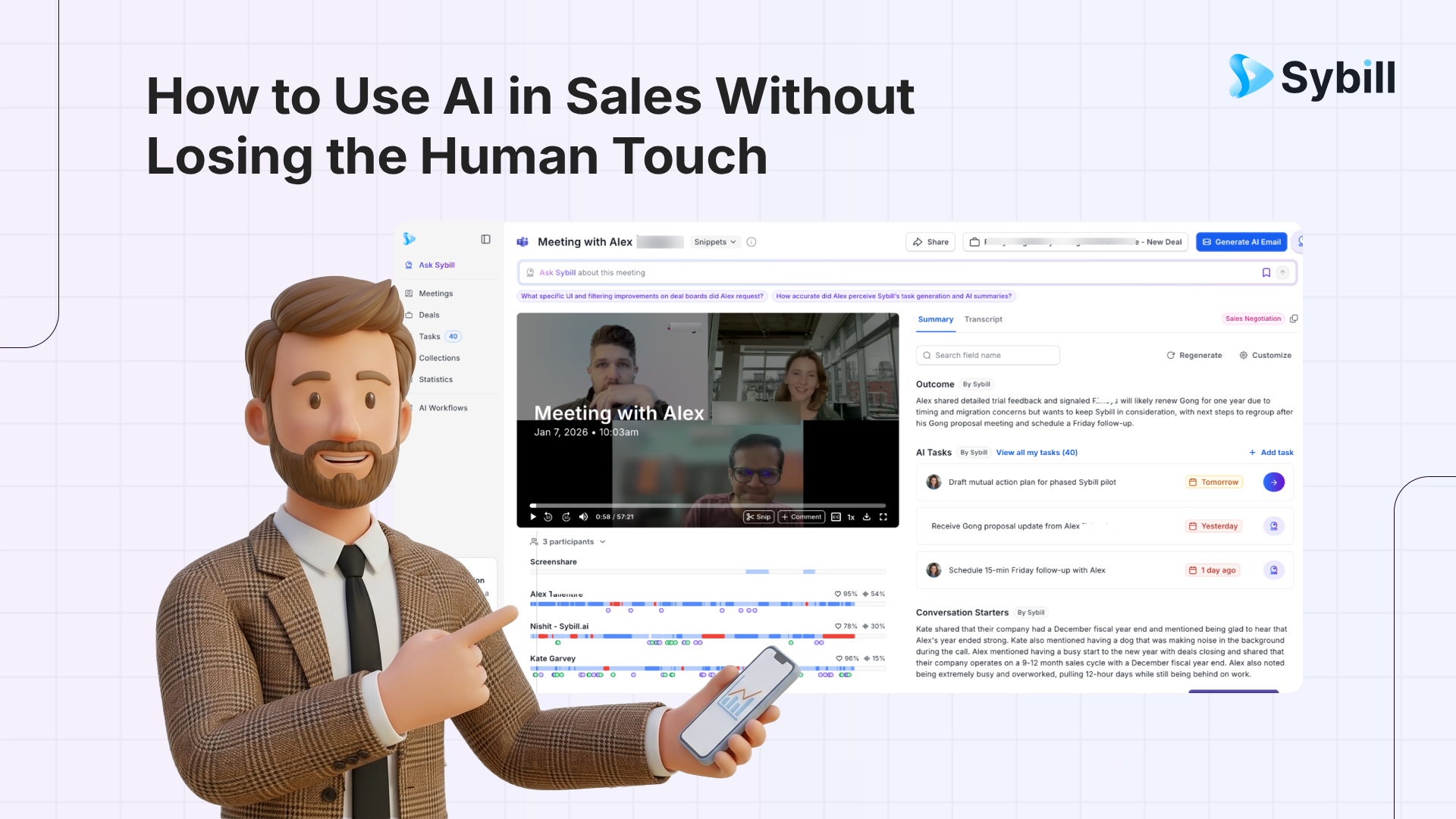
Buyer intelligence from every call. Sybill analyzes verbal and non-verbal cues during sales calls, tracking engagement levels, emotional signals, and moments of hesitation or enthusiasm. This data surfaces in the rep's interface as real-time context, helping them adapt their approach in the moment rather than after the fact. The rep still reads the room. Sybill just gives them better data to read it with.
Magic Summaries that capture what actually happened. Every call generates a structured summary covering key discussion points, objections raised, buyer signals, next steps, and deal-relevant context. This is not a transcript. It is a distilled picture of what mattered in that conversation, formatted for the rep's workflow. For managers, it is a real-time window into deal health without requiring call reviews.
Follow-ups that sound like the rep, not like AI. Sybill drafts post-call emails that reference what was actually discussed, in the rep's writing style, with the next steps from that specific deal. The rep reviews it, adds whatever personal context only they could contribute, and sends it in minutes instead of an hour. The buyer receives something that clearly reflects a human who was paying attention.
Coaching without waiting for a review cycle. Sybill's coaching and performance features analyze every call for talk-to-listen ratio, engagement patterns, objection handling, and rep performance relative to what wins deals on their specific team. Reps get feedback after every call. Managers get a team-level picture without sitting in on sessions.
Ask Sybill for cross-deal intelligence. Instead of digging through recordings and CRM fields to find patterns, reps and managers can ask Sybill natural language questions: "Which deals have stalled in the last two weeks?", "Where is pricing coming up as an objection this quarter?", "What talk tracks are working with enterprise ICPs right now?" The answer comes back in seconds from data across the entire team's call history.
The result is a workflow where AI absorbs the tasks that drain time and attention, and humans show up to every interaction with more context, better preparation, and enough mental bandwidth to actually connect.
7:50 AM. Rep opens Sybill before the first call of the day. The pre-meeting brief is already there: company context, recent news, prior call history, outstanding action items from the last conversation, and a suggested agenda. The rep spends five minutes personalizing the approach rather than 45 minutes building it from scratch.
10:00 AM. Discovery call. The rep is fully present. Sybill is noting engagement signals in the background. The rep does not take a single note. They listen, ask questions, and build rapport.
10:50 AM. Call ends. Sybill's Magic Summary is ready within minutes. Objections raised, buyer signals, next steps, deal stage update. CRM is already updated. A draft follow-up email is queued in the rep's voice.
11:05 AM. Rep reviews the draft, adds one personal line referencing something the prospect mentioned about their team restructuring, and sends it. The whole post-call process takes ten minutes instead of an hour.
3:00 PM. Rep checks Ask Sybill: "Which of my deals have gone quiet this week?" Two accounts surface with no meaningful activity in eight days. Rep makes two calls. One re-engages.
End of day. No CRM updates to do. No summary writing. The rep has coached interactions today rather than administrative ones.
This is not a vision for 2028. This is how Sybill users work today.
What does "AI in sales automation" mean?
AI in sales automation refers to using artificial intelligence to handle repeatable, data-intensive tasks in the sales process: CRM updates, lead scoring, call transcription, follow-up email drafting, pre-meeting research, and deal risk flagging. The goal is to free up rep time for the high-judgment work that requires human skills: discovery, relationship building, negotiation, and closing.
Will AI replace salespeople?
No. The data consistently shows the opposite: AI augments sales performance rather than replacing the people doing it. Salesforce's State of Sales research found that 80% of reps believe AI helps them close more deals. Gartner projects that by 2030, 75% of B2B buyers will prefer sales experiences that prioritize human interaction over AI, meaning the human element is becoming more important, not less. What AI is replacing is the administrative portion of the sales role.
What is the uncanny valley in sales?
The uncanny valley in sales describes the discomfort buyers experience when sales interactions feel almost human but are visibly automated. When outreach is clearly templated, when follow-ups do not reflect what was discussed, when a rep's responses lag in ways that suggest an AI is generating them in real time, buyers recognize it and trust erodes. The concept comes from robotics, where humanoid machines that are almost-but-not-quite lifelike trigger more discomfort than clearly artificial ones.
How do you balance automation and human touch in sales?
The practical framework: use AI for any task where accuracy, speed, and data recall matter more than judgment, and keep humans in any interaction where empathy, creativity, and relationship history are the deciding variables. Pre-call research, CRM hygiene, and call summaries go to AI. Discovery conversations, negotiation, and relationship moments stay human. AI-drafted follow-ups reviewed and sent by the rep who was on the call represent the ideal middle ground.
What is conversation intelligence in sales?
Conversation intelligence refers to technology that records, transcribes, and analyzes sales calls to surface actionable insights: which topics generated engagement or hesitation, how talk-to-listen ratios compare to top performers, which objections came up and how they were handled, and what buyer signals indicate deal health. Sybill extends this to include non-verbal cues, cross-deal pattern analysis, and real-time deal intelligence rather than just call documentation.
How does Sybill balance AI and human touch?
Sybill is built on the principle that AI should amplify the rep's human qualities rather than substitute for them. It handles research, summaries, CRM updates, and follow-up drafting in the rep's voice. It surfaces buyer sentiment and engagement signals during calls so reps can adapt in real time. It gives managers coaching data from every call without requiring manual review. The rep remains the relationship. Sybill removes the friction that makes it hard to show up fully to that relationship.
What tasks should never be fully automated in sales?
Discovery calls, negotiation, handling high-stakes objections, building internal champions, executive relationship management, and any interaction where the prospect's trust in a specific human is the asset being built. These require judgment, emotional intelligence, and accountability that AI cannot replicate.
The sales teams losing deals to over-automation are not failing because they adopted AI too early. They are failing because they did not think carefully enough about where the line is.
The sales teams leaving performance on the table by avoiding AI are not being more human. They are just slower, more tired, and less informed going into every conversation.
The teams winning in 2026 have settled the question: AI owns the work that does not require a human. Humans own the moments that do. The combination produces something neither can achieve alone: reps who show up to every conversation with perfect context and no administrative debt, who have the attention and the energy to actually build trust.
That is the version of AI-augmented sales that closes deals. And it is exactly what Sybill is built to enable.
Ready to see the division of labor in action? Try Sybill free and spend your next sales call actually selling.
AI in sales automation refers to using artificial intelligence to handle repeatable, data-intensive tasks in the sales process: CRM updates, lead scoring, call transcription, follow-up email drafting, pre-meeting research, and deal risk flagging. The goal is to free up rep time for the high-judgment work that requires human skills: discovery, relationship building, negotiation, and closing.
No. The data consistently shows the opposite: AI augments sales performance rather than replacing the people doing it. Salesforce's State of Sales research found that 80% of reps believe AI helps them close more deals. Gartner projects that by 2030, 75% of B2B buyers will prefer sales experiences that prioritize human interaction over AI, meaning the human element is becoming more important, not less. What AI is replacing is the administrative portion of the sales role.
The uncanny valley in sales describes the discomfort buyers experience when sales interactions feel almost human but are visibly automated. When outreach is clearly templated, when follow-ups do not reflect what was discussed, when a rep's responses lag in ways that suggest an AI is generating them in real time, buyers recognize it and trust erodes. The concept comes from robotics, where humanoid machines that are almost-but-not-quite lifelike trigger more discomfort than clearly artificial ones.