Find us at booth #83, join us for a harbor side happy hour, or catch Gorish’s talk.

Sept, 16-18 > Learn more


Tamanna Mishra

May 15, 2026
.png)
AI sales enablement uses artificial intelligence to help sales teams prepare better, personalize outreach, coach reps, update CRM, inspect deals, and act faster across the sales cycle. Unlike traditional sales enablement, which gives reps more content and tools, AI sales enablement turns buyer conversations and deal context into next steps. The best AI sales enablement software should reduce admin, improve rep performance, and help teams move deals forward without making reps live in yet another dashboard.
Most teams do not have a content problem. They have an execution problem.
The deck exists. The case study exists. The pricing FAQ exists. The battlecard exists. The sales methodology exists. The CRM fields exist. The coaching notes exist.
And still, reps walk into calls underprepared, send follow-ups too late, forget key objections, miss buying signals, and update CRM like they are filling out a tax form at 11:58 pm.
That is why AI sales enablement is becoming such a big deal.
Not because sales teams need more software. Please, nobody needs another tab quietly judging them from the browser bar. AI sales enablement matters because it connects the messy reality of selling with the work that helps deals move: preparation, personalization, coaching, CRM hygiene, follow-ups, and deal inspection.
Traditional sales enablement says, “Here is a library. Good luck.”
AI sales enablement says, “Here is what this buyer cares about, what happened on the last call, what you should send next, what risk just showed up, and what needs to be updated in CRM.”
That is a very different game.
And for modern sales teams, it is quickly becoming the difference between reps who are busy and reps who are dangerous.
AI sales enablement is the use of artificial intelligence to help sales teams prepare, engage, coach, automate, and execute more effectively across the sales cycle.
That includes things like:
In plain English, AI sales enablement helps reps know what to do before, during, and after every buyer interaction.
Traditional sales enablement gives sales teams assets, training, and processes. AI sales enablement adds intelligence and execution to that foundation.
The shift is simple:
.png)
That last line is the important one.
AI sales enablement is not just about helping reps do more. It is about helping them do the right things faster.
Traditional sales enablement was built for a world where the main challenge was access.
Reps needed access to decks. Access to talk tracks. Access to case studies. Access to messaging. Access to product updates. Access to competitive intel.
So teams built portals, libraries, training hubs, playbooks, and documentation systems.
Useful? Absolutely.
Enough? Not anymore.
Because today’s sales problem is not just access. It is timing, context, and action.
A rep does not need “the enterprise deck.” They need the three slides that matter to a CFO in manufacturing who asked about implementation risk after seeing a competitor.
That is a much harder problem.
Traditional enablement often assumes reps have the time and judgment to dig through libraries and pick the right asset. But selling rarely works like a calm Sunday library visit. It works like a kitchen during dinner rush.
Everything is moving. Everyone wants something. The buyer’s objection from five minutes ago matters more than the battlecard from five months ago.
AI sales enablement helps by reading the context and surfacing what matters now.
CRM updates are where sales joy goes to die.
Reps know CRM matters. Managers need visibility. RevOps needs clean data. Leadership needs forecasts. But manual CRM updates are still admin work, and admin work usually loses to live selling work.
That creates the usual mess: incomplete notes, vague next steps, missing stakeholders, outdated deal stages, and pipeline reviews built on vibes.
AI sales enablement software can capture key details from calls and emails, then push structured updates into CRM. This is not just a productivity win. It is a data quality win.
Traditional sales coaching is often retrospective.
A manager listens to a call after the deal has stalled. A rep gets feedback after the bad habit has repeated 19 times. A team reviews win-loss notes after the quarter is already cooked.
AI sales coaching changes the rhythm.
It can spot talk ratio issues, missed discovery questions, objection-handling gaps, pricing friction, buyer disengagement, and recurring competitor mentions. More importantly, it gives teams a way to coach based on actual selling behavior instead of anecdotal “I think the call went well” updates.
That is not surveillance. Done right, it is enablement with receipts.
Sybill is built for teams that want AI sales enablement to do more than summarize calls and decorate dashboards.
Sybill helps reps prepare with Pre-MeetingBriefs, capture conversations with Magic Summary, update CRM with CRM Autofill, draft contextual follow-ups with Personalized Emails, inspect deals with Ask Sybill, and turn next steps into action with AI Tasks.
The bigger point: Sybill connects buyer conversations to sales execution.
That matters because the most valuable sales data does not live in static enablement content. It lives in the calls, emails, objections, pauses, questions, next steps, and deal signals that happen every day.
Sybill helps teams turn that context into action before it gets lost in someone’s notebook, memory, or post-call panic.
Not every tool with an AI label is useful. Some are genuinely powerful. Some are glorified autocomplete with a venture-backed haircut.
If you are evaluating AI sales enablement software, look for features that improve execution, not just aesthetics.
.png)
The best AI sales enablement platform should answer three questions:
Most tools can answer the first question. Fewer can handle the second. The strongest ones help with the third.
That is where commercial value shows up.
AI sales enablement sounds broad because it is. But in practice, the value shows up in a few high-impact workflows.
Great sales calls rarely start when the Zoom room opens.
They start before the call, when the rep understands the account, the buyer, the problem, the previous interactions, and the likely objections.
But manual pre-call research is a time sink. Reps jump between CRM, LinkedIn, email threads, call notes, company websites, and old decks. By the time they have the full picture, they are already late to the next call.
AI sales enablement fixes this by creating fast, contextual prep.
For example, a rep should be able to see:
Sybill’s Pre-Meeting Briefs help reps walk into meetings with relevant context instead of half-remembered notes and blind optimism.
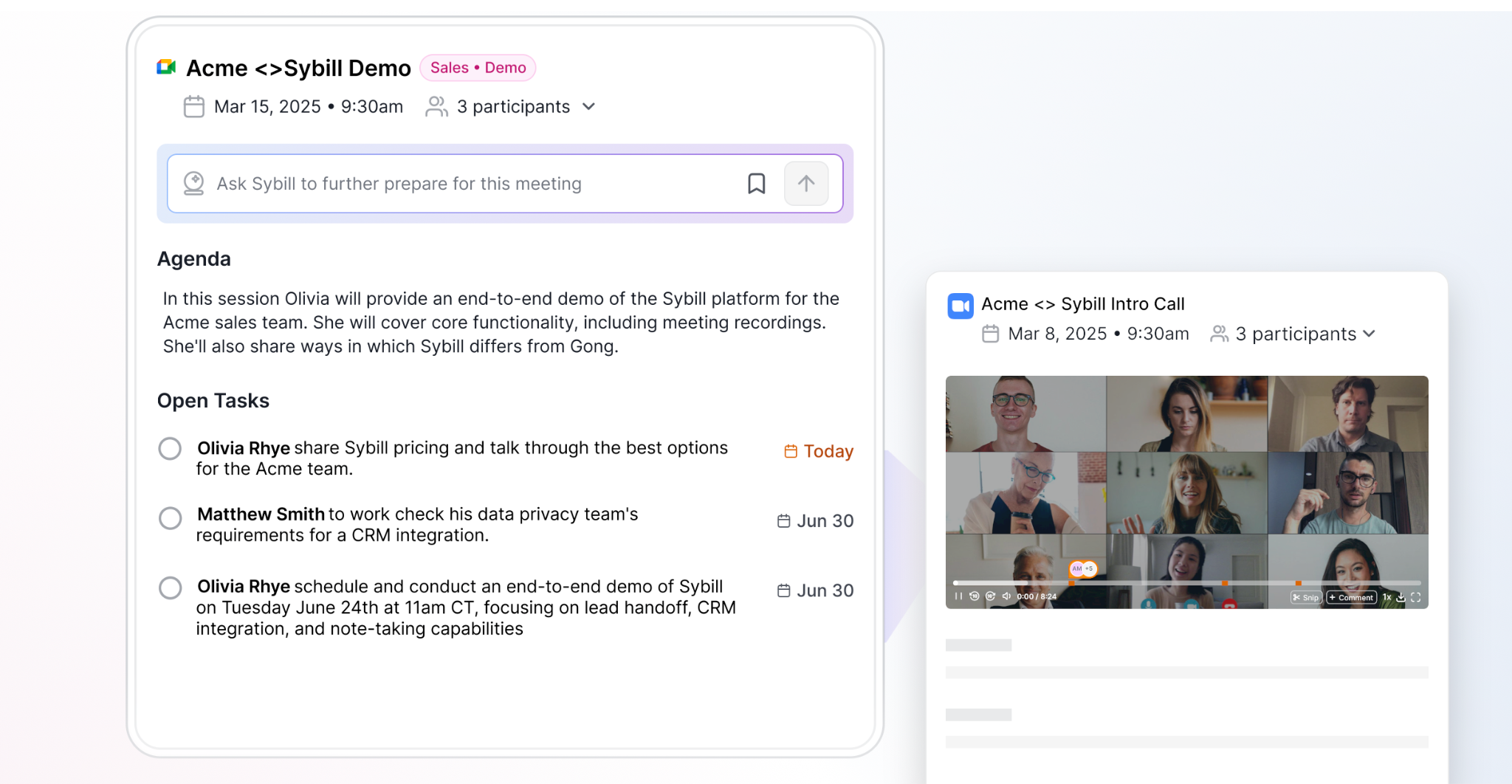
That matters because buyers can smell generic discovery from across the internet.
Personalization is one of those words sales teams have loved into meaninglessness.
“Hi [First Name], I noticed your company exists” is not personalization. It is mail merge wearing a fake mustache.
Real personalization reflects the buyer’s actual world: their priorities, concerns, language, timing, role, and previous interactions.
AI sales enablement helps reps personalize outreach at scale by analyzing buyer conversations, CRM history, email context, engagement signals, and deal stage.
The obvious use case is follow-up emails.
After a call, reps often need to send:
The problem is that post-call time disappears fast. One call runs over. Another starts. Slack pings. CRM sulks in the background. The follow-up gets delayed, then watered down, then sent with the energy of a receipt.
Sybill’s Personalized Emails help reps draft follow-ups based on what actually happened in the conversation. That makes the email faster, sharper, and more relevant.
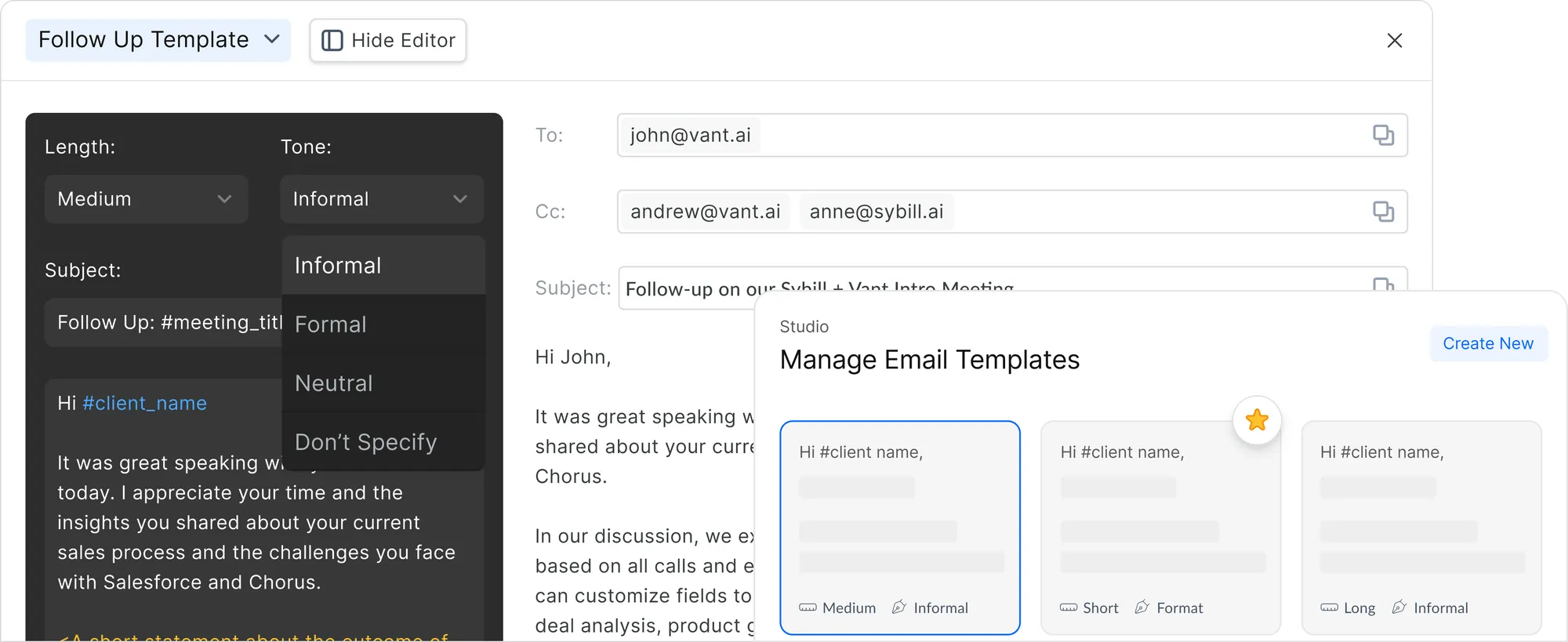
The win is not just speed. It is buyer trust.
A strong follow-up tells the buyer, “I heard you.” A weak one tells them, “You are somewhere in my sequence.”
Sales calls contain the gold.
Buyer pain. Budget clues. Competitor mentions. Decision criteria. Objections. Stakeholders. Timelines. Legal concerns. Implementation fears. Next steps.
Then, somehow, all that gold gets reduced to a CRM note that says, “Good call. Follow up next week.”
Tragic.
AI sales enablement software helps by turning conversations into structured summaries and CRM-ready data.
Sybill’s Magic Summary captures the key moments from calls, while CRM Autofill helps update fields such as pain points, next steps, buyer needs, objections, stakeholders, and deal context.
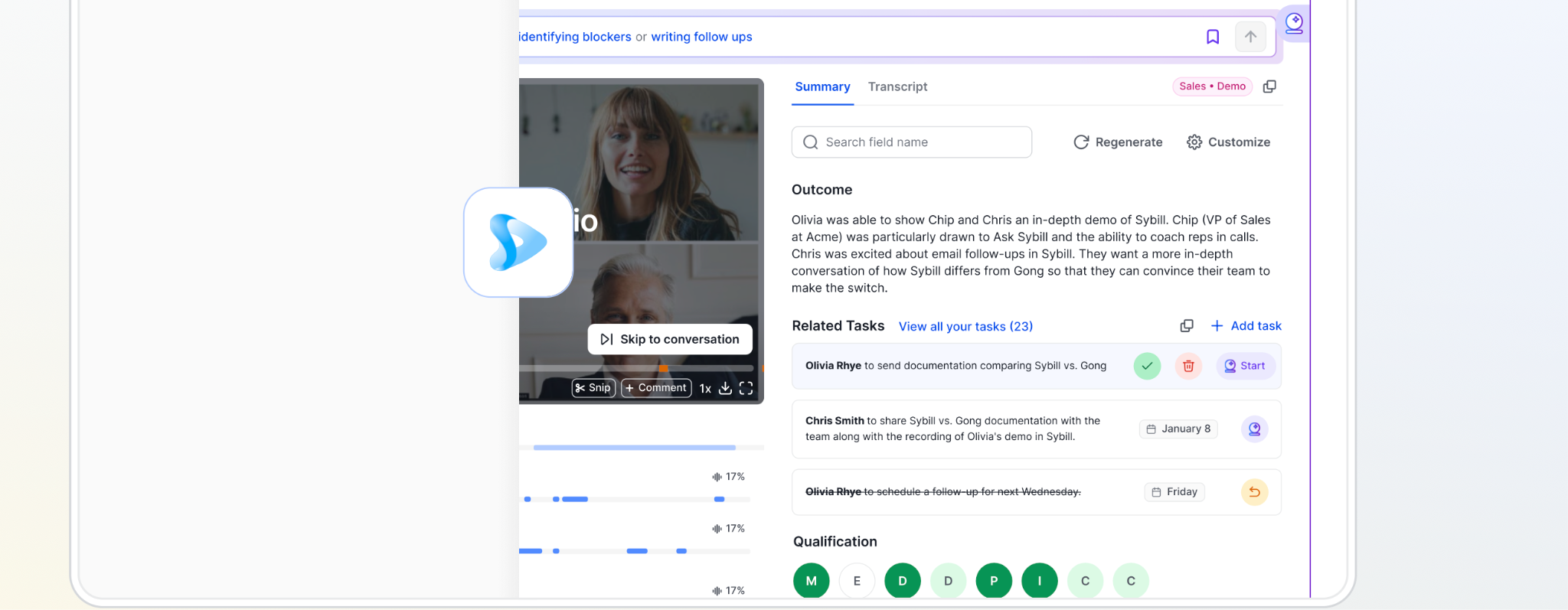
This matters for three groups: Reps save time and avoid post-call admin. Managers get cleaner visibility into deal reality. RevOps gets better data without begging reps to fill fields like it is a hostage negotiation.
The hidden benefit is consistency. When every rep logs notes differently, the pipeline becomes impossible to compare. AI creates a more consistent layer of deal intelligence across the team.
Sales coaching should not depend on whoever has the loudest opinion in the pipeline review.
It should be grounded in actual buyer interactions.
AI sales enablement tools can analyze calls for patterns that are difficult to catch manually, especially at scale.
For example:
Sybill’s Personal Coach helps surface these moments so reps can improve based on real conversations, not vague feedback.
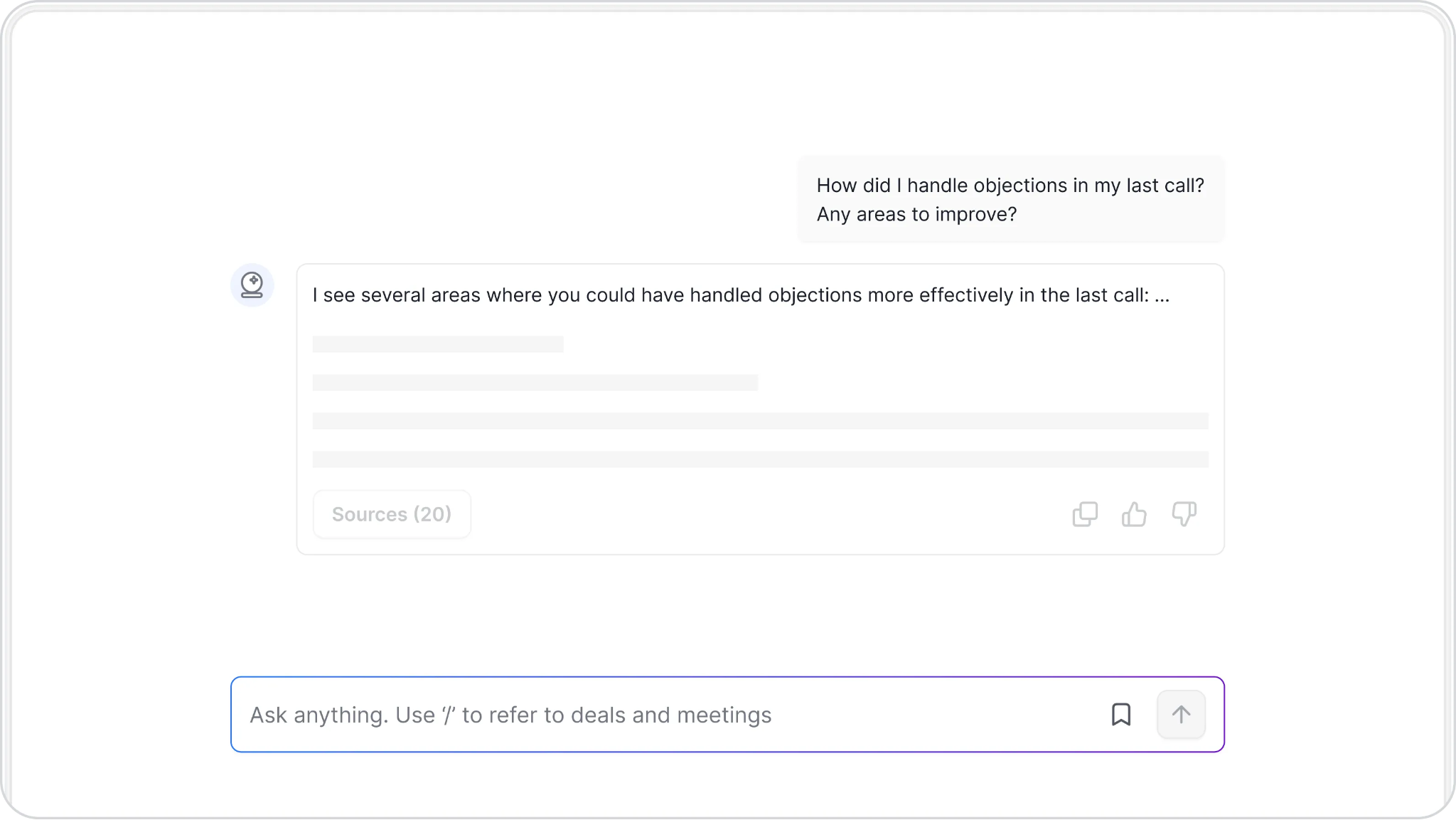
This is especially useful for frontline managers. Most managers do not have time to listen to every call in full. AI helps them see where coaching is needed and which patterns are repeating across reps or deals.
The point is not to turn sales into a robot Olympics.
The point is to help good reps improve faster and help managers coach with precision.
Pipeline reviews often have a theatre-kid problem.
Everyone performs confidence.
The rep says the deal is looking good. The manager asks about next steps. The close date remains suspiciously cheerful. The CRM stage says “proposal.” The buyer has not replied in 12 days.
AI sales enablement brings more reality into the room.
By analyzing calls, emails, CRM activity, buyer engagement, and deal history, AI can surface risks that are easy to miss.
For example:
With Ask Sybill, sales teams can query deal context conversationally. Managers and reps can ask about red flags, buyer concerns, next steps, stakeholder gaps, and deal health.
Sybill’s Deal Pipeline and Deal Workspace help teams understand where deals stand and what needs attention.
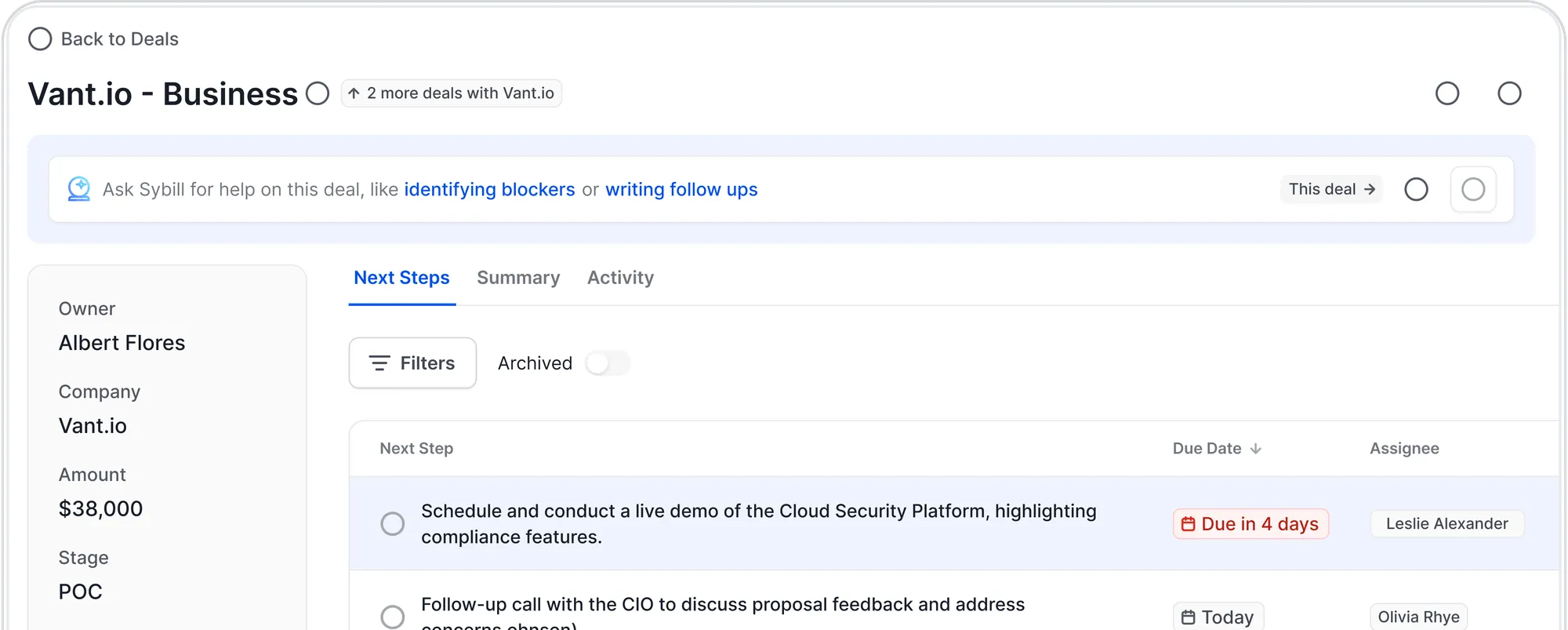
This is where AI sales enablement becomes bigger than rep productivity. It becomes revenue intelligence for day-to-day execution.
Sales enablement content is only useful when it appears at the right time.
A case study sent too early feels random. A security document sent too late slows the deal. A generic deck sent after a detailed discovery call tells the buyer you were not listening.
AI sales enablement helps match content and actions to deal context.
If a buyer is worried about implementation, the rep may need a customer story, onboarding overview, or technical FAQ.
If the economic buyer is missing, the rep may need an executive summary or ROI narrative.
If pricing hesitation shows up, the rep may need value reinforcement, not a discount.
This is where next-best actions matter.
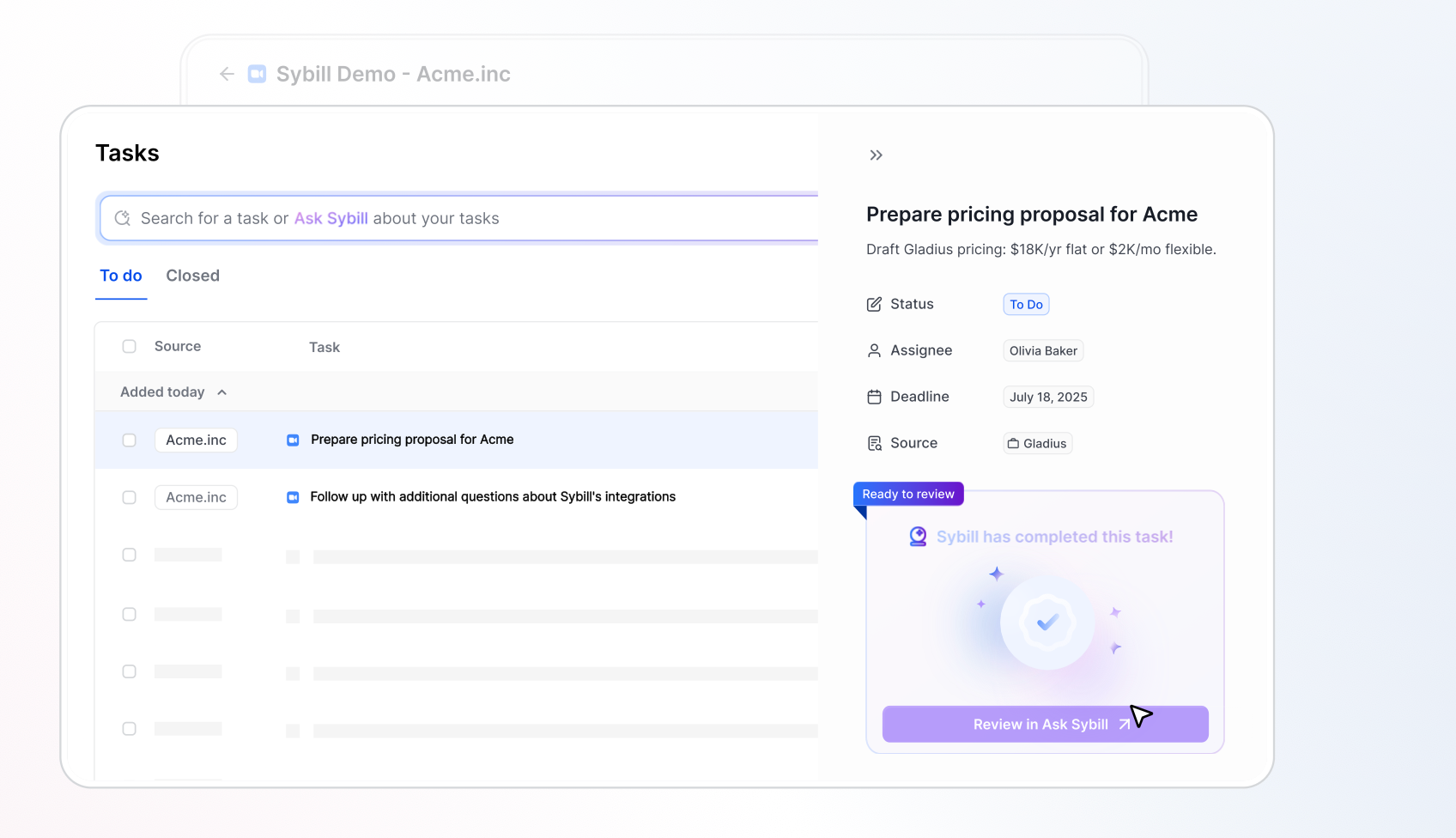
Sybill’s AI Tasks can help reps stay on top of follow-ups, reminders, and next steps so that deal momentum does not depend on memory alone.
Buying AI sales enablement software should not start with a feature checklist. It should start with a workflow audit.
Where are reps losing time? Where are deals slowing down? Where is data getting lost? Where does coaching arrive too late? Where does enablement content fail to influence the deal?
Once you know that, evaluate tools against the actual work.
A tool that captures calls but still makes reps write follow-ups, update CRM, inspect deals, and create tasks manually is only solving half the problem.
Look for AI sales enablement software that moves from insight to execution.
Generic AI can write a decent email. Sales enablement AI should know the buyer, the account, the call, the opportunity, the stage, and the next step.
Without context, AI creates polished nonsense. With context, it creates usable sales support.
The graveyard of sales technology is full of tools leadership loved and reps quietly ignored.
The best AI sales enablement platform should fit naturally into the rep’s day. It should make preparation, follow-up, CRM updates, and coaching easier without asking reps to become part-time system administrators.
AI sales enablement should help managers see what is really happening across calls and deals.
That means surfacing patterns, risks, skill gaps, and deal blockers. Not just giving them more recordings to “circle back on.”
If the CRM remains messy, your AI sales enablement system is not finished doing its job.
CRM automation is one of the clearest ROI areas because it saves rep time while improving pipeline visibility.
The future of sales enablement is not a bigger content library. It is not another dashboard. It is not another weekly reminder asking reps to update CRM.
The future of sales enablement is context-aware execution. It is giving reps the right information before the call, capturing what happened during the call, automating the admin after the call, and helping teams make smarter decisions while deals are still alive.
That is what AI sales enablement should do.
The winning platforms will not be the ones that simply summarize conversations or generate generic emails. They will be the ones that help sales teams prepare better, personalize faster, coach smarter, inspect deals earlier, and act with more precision.
Sybill is built for that version of AI sales enablement. With Pre-Call Briefs, Magic Summary, CRM Autofill, Personalized Emails, AI Tasks, Personal Coach, Ask Sybill, Deal Pipeline, and Deal Workspace, Sybill helps revenue teams turn buyer conversations into action.
Because reps do not need more busywork. They need a smarter way to sell.

AI sales enablement uses artificial intelligence to help sales teams prepare for calls, personalize outreach, summarize meetings, update CRM, coach reps, inspect deals, and automate next steps. It improves sales execution by turning buyer and deal context into timely actions.
AI is used in sales enablement for pre-call research, personalized follow-up emails, meeting summaries, CRM automation, sales coaching, content recommendations, pipeline inspection, and next-best actions. It helps reps spend less time on admin and more time selling.
The best AI sales enablement tools are the ones that improve the full sales workflow, not just one task. Look for tools that support call preparation, meeting summaries, CRM autofill, personalized emails, coaching, deal inspection, and task automation. Sybill is a strong option for teams that want AI to connect buyer conversations with real sales execution.
No. AI should not replace sales enablement teams. It should make them more effective. Enablement teams still define messaging, training, playbooks, competitive positioning, and sales process. AI helps deliver those resources in context and makes it easier to see what reps actually need.
Traditional sales enablement software usually helps teams manage content, training, and resources. AI sales enablement software adds intelligence and automation. It can analyze sales conversations, recommend next steps, draft follow-ups, update CRM, surface coaching moments, and identify deal risks.
AI improves sales productivity by reducing manual work across research, note-taking, CRM updates, follow-ups, and task management. It also helps reps focus on the right deals, personalize communication faster, and act on buyer signals before opportunities stall.
AI sales enablement uses artificial intelligence to help sales teams prepare for calls, personalize outreach, summarize meetings, update CRM, coach reps, inspect deals, and automate next steps. It improves sales execution by turning buyer and deal context into timely actions.
AI is used in sales enablement for pre-call research, personalized follow-up emails, meeting summaries, CRM automation, sales coaching, content recommendations, pipeline inspection, and next-best actions. It helps reps spend less time on admin and more time selling.
The best AI sales enablement tools are the ones that improve the full sales workflow, not just one task. Look for tools that support call preparation, meeting summaries, CRM autofill, personalized emails, coaching, deal inspection, and task automation. Sybill is a strong option for teams that want AI to connect buyer conversations with real sales execution.