Find us at booth #83, join us for a harbor side happy hour, or catch Gorish’s talk.

Sept, 16-18 > Learn more

%20(1).avif)
Mamta Tainwala

April 27, 2026
.png)
Your to-do list is actively sabotaging your quota.
Not because you are lazy or bad at sales, but because you are burning cognitive energy deciding what to do instead of executing the actions that actually move deals forward. Modern sales requires juggling dozens of opportunities, each with different stakeholders, timelines, objections, and signals that rarely live in one place.
AI sales task prioritization uses machine learning to analyze deal signals, buyer engagement patterns, CRM data, and conversation context to automatically rank which tasks, follow-ups, and deals a rep should focus on next — replacing the cognitive overhead of manually scanning pipelines and inboxes to decide what matters most. Sybill delivers AI task prioritization for sales by surfacing deal risks and next steps from every conversation, auto-generating follow-up emails so they're ready to send, updating CRM fields without manual entry, and maintaining a Deal Workspace that shows reps exactly what needs attention and why, eliminating the decision fatigue that causes reps to default to reactive inbox work instead of proactive deal advancement.
That mental overhead adds up. You start the day with good intentions, but by mid-morning you are reacting to inbox noise, jumping between tools, and prioritizing whatever feels most urgent. You stay busy, but progress feels slower than it should.
This is exactly the problem AI sales task prioritization is designed to solve. Not by replacing human judgment, but by removing decision fatigue from selling. At its best, it functions like a sharp sales manager who never forgets context and always knows which actions matter most right now.
In this guide, we will break down what AI sales task prioritization really is, why traditional systems fail, how AI decides what matters, how Sybill turns prioritization into execution, and how to implement this without losing the human side of selling.
AI sales task prioritization is your to-do list with memory, context, and pattern recognition built in. Instead of manually deciding which deal or follow-up deserves attention next, AI analyzes your sales activity and ranks tasks based on urgency, deal risk, and likelihood to close.
In practice, AI monitors calls, emails, meetings, and follow-ups. It understands what was actually said, not just what was logged in the CRM. From that understanding, it automatically creates tasks and orders them based on what historically moves deals forward.
For example, a prospect might mention that they need a demo next week, that they are evaluating competitors, and that they have an internal presentation coming up. In a traditional workflow, you would need to capture all of that, remember it later, and decide how to prioritize it. AI-powered platforms like Sybill capture these signals automatically and turn them into ranked, actionable tasks.
What makes this fundamentally different from traditional task management is that AI does not evaluate tasks in isolation. It learns from thousands of past deals to understand which actions correlate with closed-won outcomes. When AI recommends focusing on one deal over another, it is drawing from real data rather than instinct.
AI task prioritization starts with conversation intelligence. AI analyzes sales calls, emails, and meeting summaries to extract intent, sentiment, and emphasis.
This matters because most buying signals never make it into CRM notes. Urgency shows up in phrasing. Risk shows up in hesitation. Momentum shows up when prospects discuss internal buy-in, budget approvals, or timelines. AI captures these details consistently, even when humans are multitasking.
If you are interested in how conversation data fuels better pipeline management, this connects closely with how to identify deal risk early.
Beyond individual deals, AI analyzes patterns across your historical pipeline. It learns which behaviors correlate with success and which indicate risk.
Common patterns AI detects include:
These insights feed directly into task prioritization. Instead of relying on intuition, AI ranks actions based on what has worked before.
Traditional task lists are static. AI-driven prioritization is dynamic.
As new signals appear, engagement drops, or a proposal gets reopened, task rankings update automatically. Deals that quietly become at risk rise to the top. Low-impact tasks fade into the background.
This ensures your daily priorities reflect what is actually happening in your pipeline, not what was true three days ago.
Sales reps make thousands of decisions every day before selling even begins. By the time they look at their task list, mental energy is already depleted. The result is reactive work.
Reps respond to the most recent email, focus on the loudest deal, or gravitate toward tasks they enjoy. This feels productive, but it is rarely strategic.
AI reduces this cognitive load by making prioritization automatic and consistent.
Traditional CRMs capture only a small fraction of what actually happens in sales conversations. Tone, urgency, hesitation, and internal dynamics rarely translate into structured fields.
This forces reps to rely on memory to prioritize. Over time, those gaps compound. Deals look healthy on paper while quietly stalling in reality.
AI fills this gap by analyzing the full conversation, not just what gets typed into the CRM. This pairs well with automated CRM updates that reduce manual data entry.
Tasks live in too many places. Email, CRM, calendar, Slack, notes apps, and mental reminders all compete for attention. Every context switch costs focus.
AI sales task prioritization centralizes decision-making so reps stop acting as the integration layer between disconnected tools.
Most tools focus on one part of the problem. AI sales task prioritization addresses all three.
Creating tasks means capturing next steps consistently from conversations. Prioritizing tasks means ranking those actions based on urgency and deal impact. Executing tasks means having enough context to act quickly and effectively.
This is where many systems fall short. Knowing what to do is not enough if execution still requires digging through call recordings or notes.
Sybill AI Tasks is designed to close the gap between knowing and doing.
Sybill automatically creates tasks from sales conversations and organizes them into a single prioritized view. Each task is tied directly to conversation context, so you understand why it matters and what to address next.
Instead of seeing a vague reminder like “follow up with Marcus,” you see what Marcus cared about, what objections he raised, and what was agreed to on the last call. You can also ask Sybill questions such as what concerns came up, who else needs to be involved, or what the next logical step should be.
This transforms task prioritization from a passive list into an execution engine.
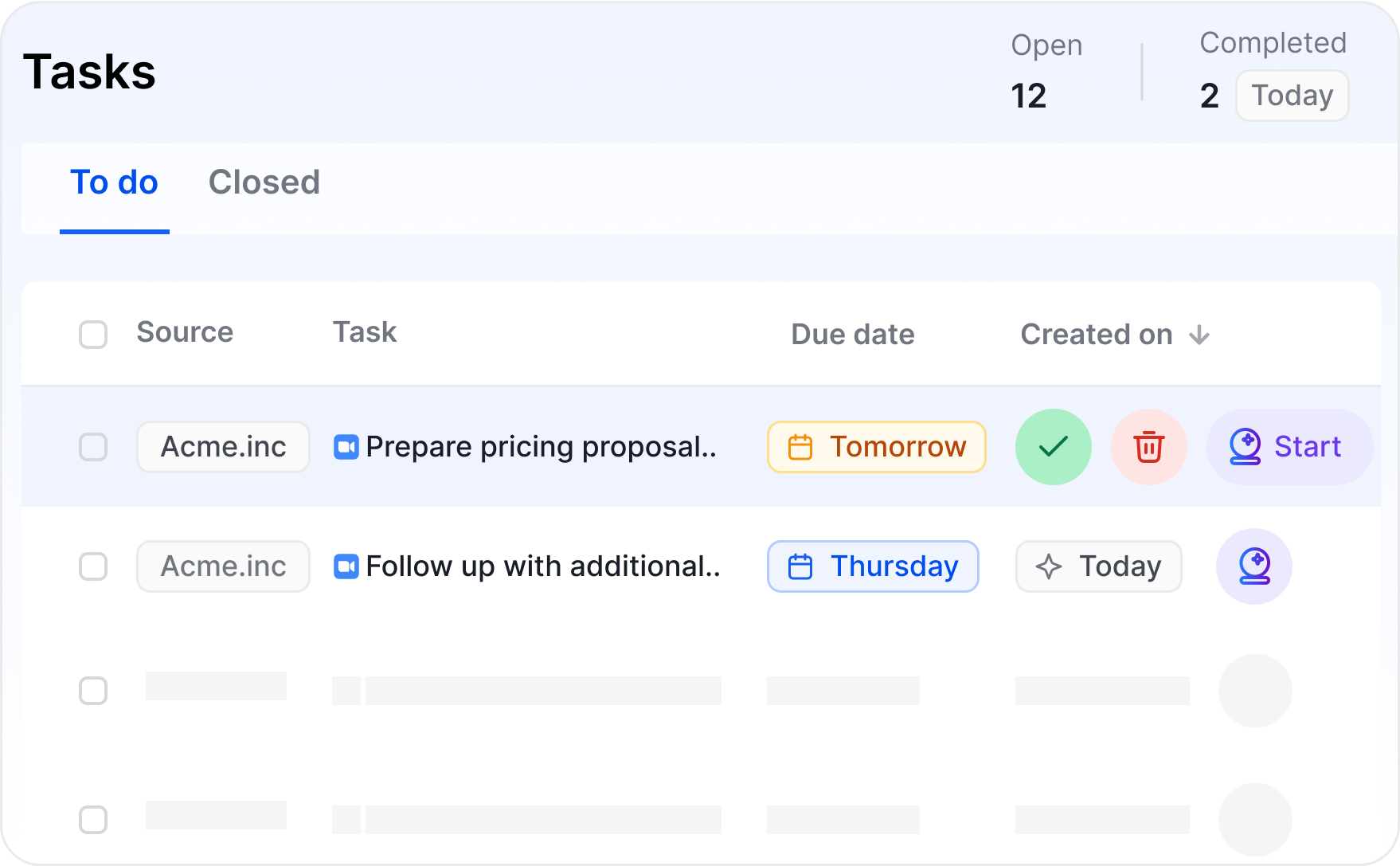
Learn more about the feature here: https://www.sybill.ai/ai-tasks
It works alongside Magic Summary and Deal Summaries to keep context intact across your workflow.
The most noticeable shift is clarity. Mornings stop feeling chaotic because reps start with a ranked list of what actually matters today.
Deals move faster because high-intent opportunities get attention earlier. Risks surface sooner. Follow-ups happen when momentum is high rather than after it fades.
Reps also stop dropping balls. AI does not forget commitments or deadlines. If something matters, it stays visible.
Most importantly, reps reclaim time. When AI handles prioritization, task creation, and CRM updates, more hours go toward selling rather than managing tools.
No. Better context enables more personalized, relevant conversations. AI removes admin work so reps can focus on relationships.
Start by connecting systems where real signals live, including calls, email, and calendar. AI cannot prioritize what it cannot see.
Trust the system while verifying results. For the first few weeks, follow AI recommendations even when they challenge your instincts. Track outcomes and adjust.
Customize prioritization to your sales motion. The signals that matter most vary by product and deal cycle. The better AI understands your process, the better it performs.
Finally, remember that AI supports judgment. It does not replace it. AI handles memory and analysis so reps can focus on relationships, problem solving, and value creation.
The future moves from reactive prioritization to predictive guidance. AI will increasingly flag deals likely to stall before momentum is lost and recommend corrective action.
The next evolution is team-level intelligence, where AI learns from collective performance to optimize workflows across the organization.
Eventually, prioritization will disappear as a visible tool and simply become part of how sales teams work.
AI sales task prioritization is not about doing more. It is about doing the right things at the right time, consistently.
When prioritization stops living in your head, selling becomes calmer, more focused, and more effective.
That is how quotas get hit without burning out.
Most teams see impact within weeks. Faster follow-ups, fewer stalled deals, and better focus typically show up quickly.
Most modern AI platforms integrate directly with major CRMs to keep data synchronized and reduce manual updates.
Yes. AI learns from your historical deals and can be tuned to match your sales motion, whether transactional or enterprise.