Find us at booth #83, join us for a harbor side happy hour, or catch Gorish’s talk.

Sept, 16-18 > Learn more

Tamanna Mishra

April 17, 2026
Smart planner apps are here to stay. But remember back when your productivity planner had color-coded tabs, motivational stickers, and pastel covers that promised “a more productive you”? The planner aesthetic of the 2010s was an Instagram phenomenon. Bullet journals, washi tapes, and perfectly outlined to-do lists that felt like progress, even if you never actually got through the list.
Fast-forward to 2025, and those once-beloved tools feel like relics from a slower era. Handwritten planners couldn’t keep up with the pace of modern work - scattered meetings, shifting priorities, and endless digital inputs. You can’t flip through pages fast enough when your tasks live across Slack, Notion, Gmail, and Zoom.
The three best AI productivity planners in 2026 are Sybill (which replaces manual planning by auto-capturing meeting outcomes, drafting follow-ups, and updating CRM fields from conversations), Reclaim.ai (which auto-schedules tasks and habits around your calendar), and Motion (which uses AI to prioritize and reschedule tasks dynamically). Smart note-taking tools have effectively replaced old-school planners for knowledge workers because AI handles the capture-organize-act cycle that manual planners required humans to do, turning meetings and conversations into structured action items without the overhead of handwritten to-do lists.
Enter digital planners - and their smarter cousin, the AI-powered productivity planner. The new generation of tools doesn’t just store your schedule; it synthesizes it. They don’t remind you what you wrote down. They remind you what matters. And the smartest ones? They get your stuff done.
By merging note-taking, scheduling, and intent recognition, today’s AI note takers act as true productivity planners. They are not passive record-keepers, but proactive partners that capture context, organize priorities, and nudge you toward action.
Because productivity today is about optimizing attention. And that’s exactly what the smartest digital planners are built to do.
Once upon a time, productivity lived between two covers - bound in leather, dated in months, and filled with your best intentions. The paper planner was simple, reliable, and deeply personal. But it was also static. Once you closed it, your plans stayed locked on the page.
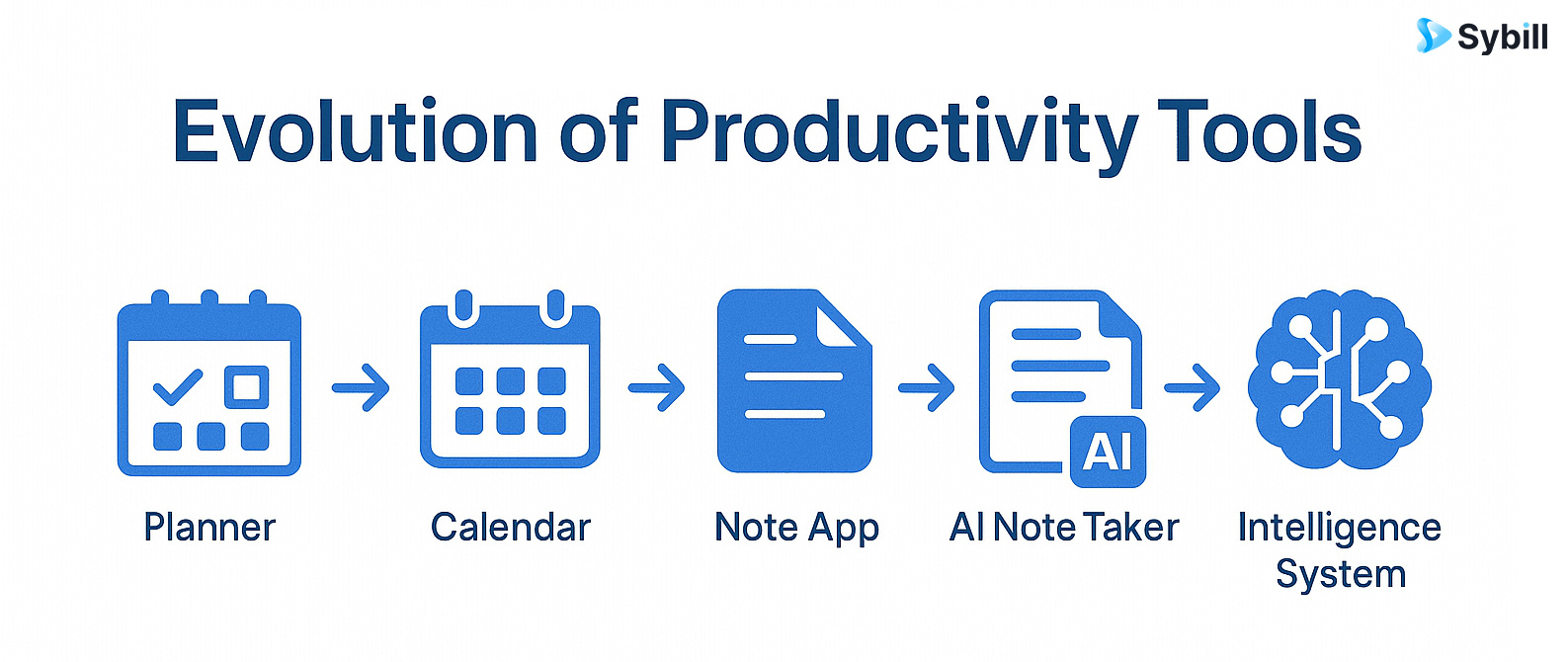
Then came the digital revolution. Calendar apps like Google Calendar and Outlook promised convenience. Your meetings, reminders, and deadlines finally synced across devices. Yet, they still lacked one thing: context. They could tell you when to do something, but not why it mattered.
Next came project management tools like Asana, Trello, and ClickUp. They gave structure to team workflows and visibility into progress. But even those tools required constant manual updates - more clicking, less doing. The burden of productivity fell back on humans juggling endless notifications.
That’s when AI note takers and digital productivity planners changed the game. Tools like Sybill don’t just record what’s said. They interpret tone, intent, and priority. They capture not only the what but also the why behind every meeting or task.
In other words, the planner has evolved from writing and reminding to recording and acting.
A planner used to tell you what to do. Now it tells you why and when to do it - thanks to AI context. And often, tools like Sybill end up doing it for you too.
This evolution marks the biggest leap in personal and professional productivity since the invention of the calendar. Today’s AI note takers and digital planners are intelligent systems that learn your patterns, predict your needs, and execute tasks so you can focus on what actually drives results.
AI note takers help you decide what to do next. And sometimes, they even do it for you. The new generation of AI recording note takers are more than digital scribes. They’re intelligent productivity systems that listen, learn, and act in real time.
Old-school planners captured instructions:
“Call Alex at 4 PM.”
An AI note taker transforms that into insight:
“Call Alex to finalize pricing before the Q4 review to address hesitance about ROI in the last call.”
That’s the difference between a tool that records and one that interprets. AI note takers like Sybill analyze conversations during meetings, so your notes reflect not just what was said but how it was said.
By detecting intent and emotional signals, Sybill helps you prioritize your follow-ups with precision. Instead of skimming through hours of recordings, you instantly know who’s ready to buy, who needs nurturing, and who’s slipping away. That’s next-level productivity - driven by empathy and data.
Traditional planners lock you into static boxes: 9 AM meeting, 2 PM call, 5 PM follow-up. But life (and sales) rarely stick to a schedule.
AI-powered productivity planners are dynamic - they evolve with your day. An AI recording note taker like Sybill integrates with your email, calendar, and CRM, constantly reshuffling priorities based on what’s actually happening.
If a key client raises an objection in a call, your follow-up moves to the top of your list. No more copy-pasting notes or dragging tasks around. Your planner now thinks and adapts like you do.
The biggest weakness of traditional productivity planners? The gap between what’s written down and what gets done.
AI note takers eliminate that gap. They automatically turn meeting notes into next steps - assigning tasks, scheduling reminders, or even drafting personalized follow-up emails.
That’s where Sybill’s AI Tasks and Personalized Emails come in. After every recorded call, Sybill instantly identifies action items, populates your CRM, and sends context-rich follow-ups that sound like you.
Sybill acts like your productivity partner, capturing context, prioritizing intelligently, and automating execution.
Because in the modern workplace, the best productivity planners aren’t the ones that remind you to act. They’re the ones that act with you.
The best planner apps in 2026 will not just organize your day. They are the ones that understand how you work. They combine AI, automation, and analytics to help you stay focused, efficient, and always one step ahead. Here are five must-have features that make today’s digital planners truly indispensable.
Your calendar should learn from you. Smart digital planners like Motion and Sunsama automatically schedule tasks based on your habits and deadlines. Miss a meeting? It reshuffles your entire day. Overbooked? It finds time for deep work by analyzing your priorities.
Modern planners use AI to detect patterns - when you’re most productive, when you tend to get distracted, and how long you really take to complete tasks. The result? A personalized, self-adjusting schedule that works with you, not against you.
That’s why smart scheduling is at the heart of every modern productivity planner - it transforms your time from something you manage to something that manages itself.
The best digital planners help you think smarter. Tools like Reclaim AI, for example, combine note-taking with analytics to show where your time actually goes and what drains your focus.
They analyze your tasks, meetings, and even recorded conversations to pinpoint your biggest time sinks. Imagine knowing exactly which activities contribute to results - and which ones you can automate or delegate.
This data-driven approach turns productivity from guesswork into strategy. You’re not just keeping busy. You’re working on what actually moves the needle.
If you’re jumping between apps to find notes, reminders, and CRM updates, you’re not being productive. You’re being distracted. The best digital planners unify your entire workflow.
Tools like Sybill keep everything in one place: notes, meeting summaries, CRM updates, and next steps. When a meeting ends, your notes auto-sync to the right deal, the right contact, and the right task list, all instantly.
This kind of cross-platform integration is what makes a planner truly digital. It eliminates tool fatigue and gives you a single command center for your day.
Typing every idea, note, or meeting takeaway is so 2020. In a world of hybrid work and constant calls, the best planner apps now come with voice and AI recording note taker capabilities.
For sales and meeting-heavy teams, this feature is a lifesaver. Tools like Sybill automatically record, transcribe, and summarize every conversation. But it doesn’t stop there. It detects tone, engagement, and sentiment, turning spoken words into actionable insights and actual action.
Here’s the ultimate productivity flex: a planner that knows what matters before you tell it.
The best digital planners use natural language processing (NLP) and behavioral data to automatically rank tasks by urgency, importance, and emotional tone. For example, Sybill doesn’t just list your to-dos. It prioritizes them based on deal stage and conversation context.
In 2026, the best planner apps will no longer be about time management anymore. They’re about attention management. With AI at the core, your planner now listens, learns, and acts, making every minute count.
The world doesn’t need more productivity tools. But it sure needs smarter ones. Whether you’re a planner purist, a systems thinker, or a fast-moving sales pro, the best planner apps in 2026 go beyond task lists. They think, adapt, and act with you. Here are three that actually earn their spot on your desktop.

If you still believe the secret to productivity lies in your calendar, Sunsama is your minimalist paradise. It’s the digital planner that makes daily planning feel intentional again. The interface is beautifully simple. Drag your tasks from Trello, Asana, or email straight into your calendar and time-block your day like a pro.
Strength: Focus and time-blocking. Sunsama forces you to be realistic about your bandwidth. By visually mapping out your day, it helps you stop overcommitting and start finishing.
Weakness: Manual task entry. Sunsama shines in structure but lacks automation. You still have to tell it what to do, and it won’t chase you down if you forget.
Verdict: For those who crave clarity and calm, Sunsama is one of the best productivity planners to reclaim your focus, provided you’re willing to put in a few extra clicks.
If Sunsama is a daily planner, Notion AI is an entire productivity universe. It’s endlessly customizable — you can design dashboards, manage projects, and now, with AI, summarize pages or generate task lists instantly.
Strength: Flexibility and integrations. Notion AI connects with almost every tool in your workflow - from Slack to Google Drive - and molds itself around your style. You can use it as a content planner, client tracker, or even a second brain.
Weakness: Can get cluttered without discipline. The power of Notion AI is also its biggest trap. Without strict organization, your “productivity hub” can quickly spiral into chaos.
Verdict: The best planner app for makers, freelancers, and systems lovers who crave full control. But be warned, it rewards structure and punishes mess.
If Notion AI helps you plan your day, Sybill helps you close your quarter.
Sybill isn’t your typical planner app. It’s an AI note taker, CRM auto-filler, and intelligent task engine designed for sales and revenue teams. It records meetings, identifies buyer intent, and automatically turns insights into next steps.
Strength: Context-based automation. After every call, Sybill’s Magic Summary and AI Tasks convert discussions into actionable tasks, follow-up emails, and CRM updates, no manual input required.
Weakness: Less suited for non-sales teams. If you’re not managing deals or clients, Sybill’s power may feel like overkill.
Verdict: For modern revenue teams, Sybill is more than a productivity planner. It’s your AI deal strategist.
If Notion helps you plan your day, Sybill helps you close your quarter.
We’ve officially outgrown the checkbox era. Productivity planners are no longer about how many tasks you tick off. It’s about how much leverage you create with your time. The best digital planners go beyond helping you stay organized. They help you think, decide, and act smarter.
By blending automation, emotional intelligence, and contextual awareness, tools like Sybill are rewriting the rules of planning. They capture what matters in your meetings, translate it into actions, and close the loop, turning scattered notes into measurable outcomes.
A productivity planner focuses on optimizing how you spend your time, energy, and attention. A digital planner, on the other hand, replaces traditional paper systems with smart software. The newest generation - like Sybill - takes it a step further by integrating AI note taker technology to analyze meetings, track goals, and automate next steps.
The best planner apps include Sunsama, Notion AI, Motion, and Sybill. While Sunsama and Notion help structure your day, Sybill stands out as a next-generation AI productivity planner, combining meeting recording, automatic summaries, and CRM automation for sales and revenue teams who want more than just organization.
Absolutely. Modern AI note takers like Sybill already capture meeting context, generate summaries, and recommend actionable next steps. They transform passive note-taking into proactive planning, making them smarter and faster than any traditional productivity planner.