Find us at booth #83, join us for a harbor side happy hour, or catch Gorish’s talk.

Sept, 16-18 > Learn more

%20(1).avif)
Mamta Tainwala

September 18, 2026
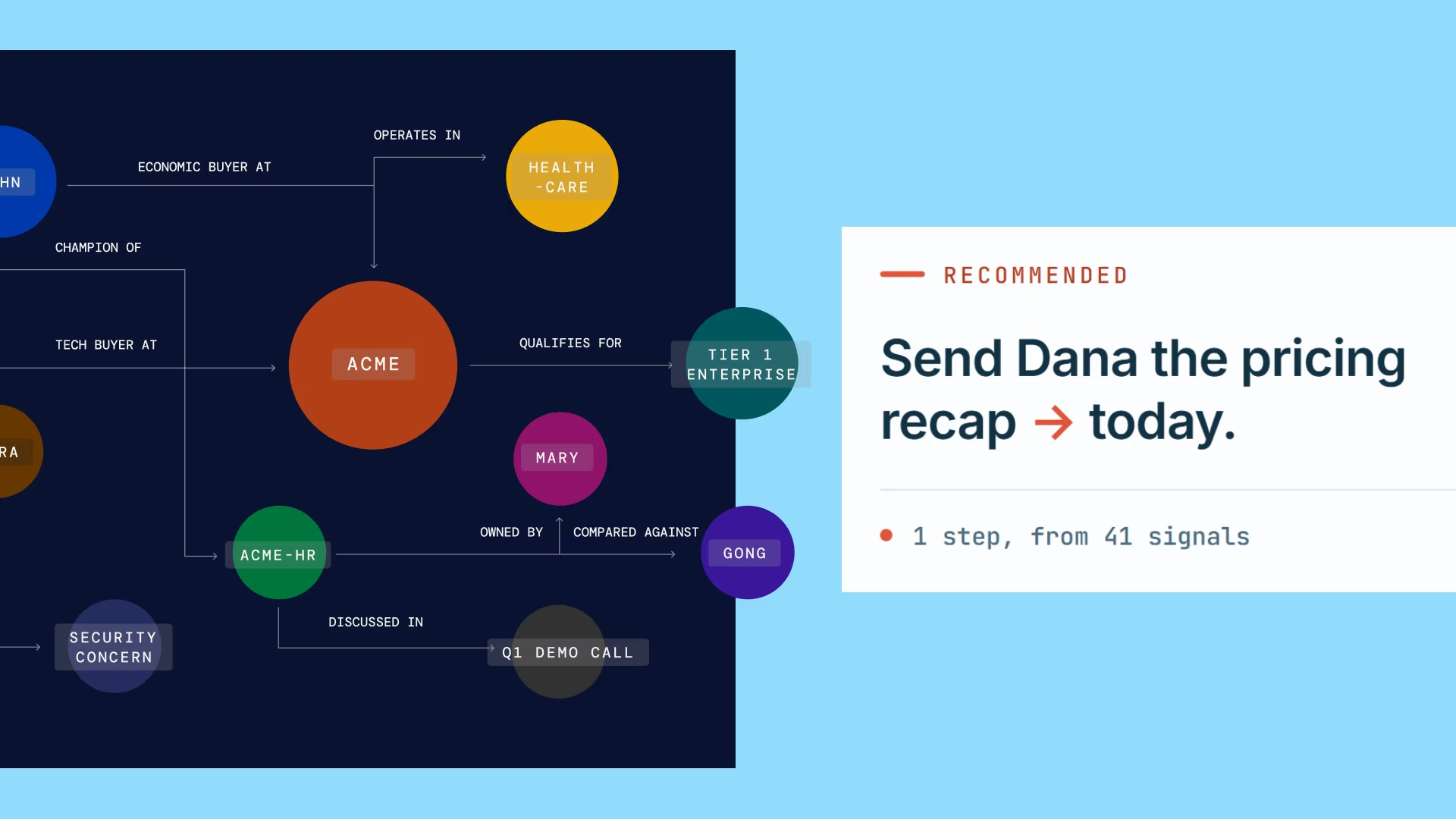
Revenue context helps sellers and leaders make better decisions. It connects what buyers said, who cares about what, what changed, which commitments were made, and what happened in similar deals. When teams can use that history, reps prepare faster, managers coach from evidence, forecasts reflect current buyer behavior, and follow-up becomes more relevant.
Most companies already hold this information, but it is divided among calls, email, CRM records, calendars, Slack, content libraries, and individual experience. And when using LLMs, chats, agents, and other AI systems, the output depends on the context it can access. Partial or outdated context produces answers that may sound credible while missing the details that determine whether a deal moves forward.
The strongest revenue AI tools apply different forms of context to different business goals. Sybill connects customer interactions, deal history, sales processes, and outcomes so teams can move from context to judgment and execution. Other products apply governed company knowledge or specialized workflow data to jobs such as seller readiness, pipeline creation, and product demonstrations.
The five recommendations below cover distinct revenue AI categories. Each applies a different form of context to a specific job, from understanding deals to preparing sellers, creating pipeline, and delivering product demonstrations. Sybill is our recommendation for teams seeking an AI sales assistant and revenue context layer that can help people understand deals, decide what to do, and complete the next step.
Sybill is an AI sales assistant and revenue context layer for teams that want their customer interactions and sales data to become a shared system of understanding. Depending on the plan and connected systems, Sybill brings together calls, email, CRM records, calendars, Slack conversations, people, products, playbooks, and deal outcomes so reps and leaders can understand what is happening and act on it.
Revenue data rarely lives in one place. Meeting assistants capture conversations, CRMs store fields and activity, email contains buyer commitments, and Slack holds internal discussions about risk, pricing, and next steps. The rep or manager often has to assemble those fragments before making a decision.
Sybill's context graph is designed to preserve the relationships among buyers, deals, products, playbooks, and sales processes across those systems. It creates an institutional memory of what happened, what changed, which objections appeared, how the team responded, and which patterns are associated with won, lost, or stalled deals. That memory is built on scale: Sybill has analyzed around 33 million sales conversations across the meeting, dialer, and CRM systems it connects to.
Sybill records and summarizes customer conversations, connects email and CRM data, and carries captured information forward into later interactions. A rep preparing for a meeting can review buyer priorities, previous commitments, stakeholder history, qualification gaps, recent activity, and open tasks without rebuilding the account history from several tools, with pre-meeting briefs assembling that picture before the call.
That connected history can support the wider revenue team. Managers can inspect the evidence behind a deal, RevOps can identify incomplete CRM data, customer success can review buyer expectations before a handoff, and leaders can examine patterns across reps, segments, timeframes, and groups of opportunities.
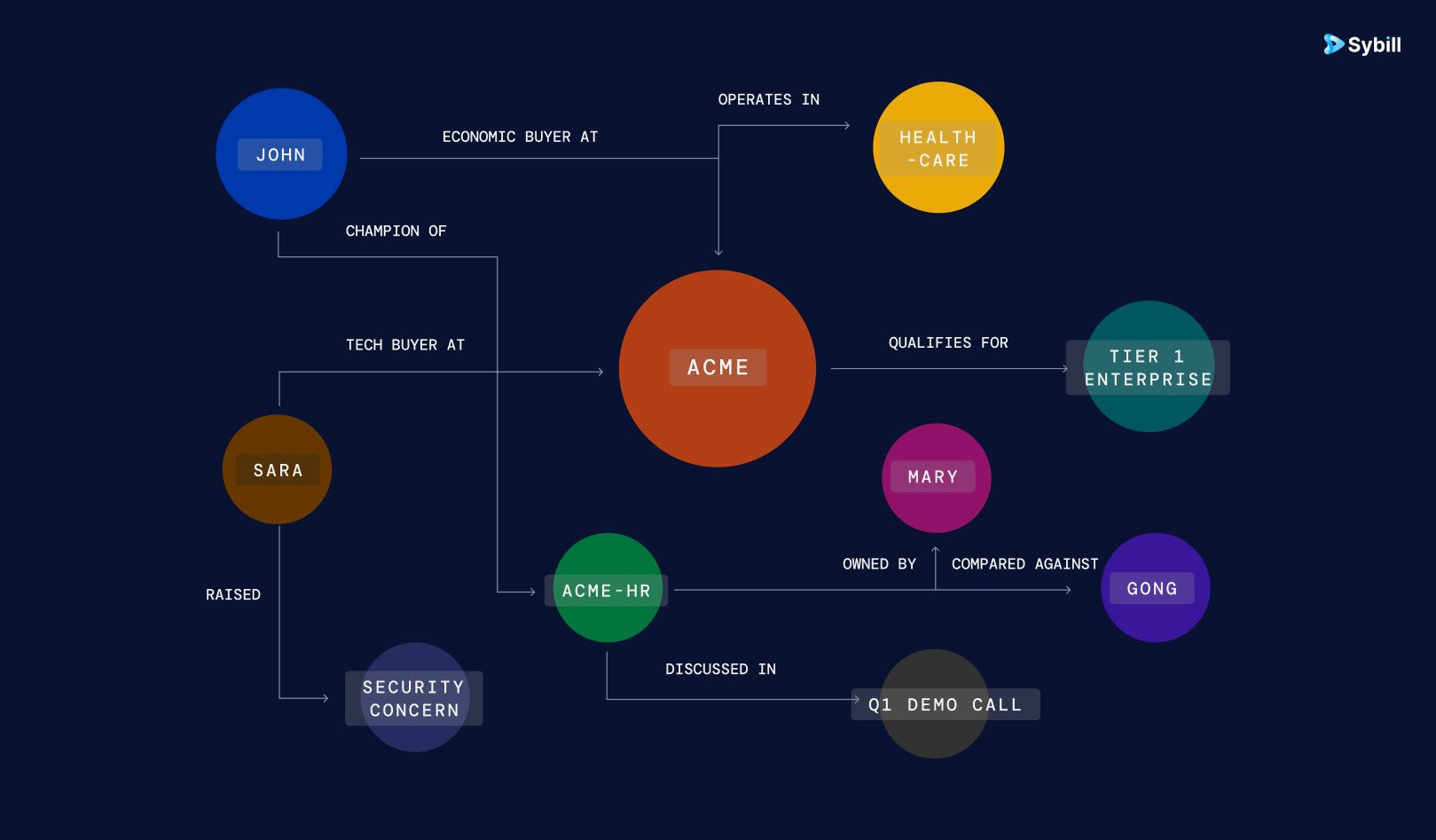
Ask Sybill lets people ask questions in plain language across calls, email, CRM, calendar, and Slack. The questions can address one deal or patterns across the pipeline:
A generic AI model can suggest common reasons a deal might stall. Sybill grounds its answers in the history of the opportunity, the stakeholders involved, the company's sales process, and patterns from previous outcomes. Managers get evidence they can use for coaching, while reps get guidance tied to the deal in front of them.
Sybill's agentic AI sales assistant supports pre-meeting briefs, meeting and deal summaries, follow-up emails, CRM autofill, tasks, and sales assets. It can fill qualification fields based on conversation evidence, draft a follow-up in the rep's tone, build a mutual action plan, prepare a deck, or schedule a recurring Ask Sybill prompt.
When the same system retains deal history, identifies a missing step, and helps complete the response, the team spends less time transferring information between recording, analysis, CRM, and content tools.
Sybill also learns from edits, prompts, deal outcomes, and repeated use. The goal is a system that becomes more specific to how the company sells over time, allowing successful messages, objection responses, and deal patterns to inform future work.
Best fit: B2B revenue teams with substantial customer-conversation data, complex deals, and recurring manual work around meeting preparation, follow-up, CRM updates, deal inspection, coaching, and pipeline analysis.
Context is only useful when it becomes action. Sybill turns your team's calls, emails, and CRM history into answers, follow-ups, and filled fields, automatically. Get started for free with Sybill.
Spekit® is an AI-first revenue enablement platform and a governed content library powered by an AI-first GTM Knowledge Engine. It helps teams create, manage, and govern GTM content, learning, and digital sales rooms, then delivers approved knowledge, coaching, and actions inside the tools where reps work as Enablement in the Flow of Work®.
Spekit is a fit when the company has created a library of content and training, yet reps cannot reliably find, trust, or apply it during a deal. Spekit combines governed GTM knowledge with live deal context so reps and agents can apply approved guidance during execution.
Governance is more important than ever, because an AI model can write a polished response using outdated pricing or an old competitive claim. Connecting several sources can make the problem worse when they contain conflicting versions. Spekit's GTM Knowledge Engine provides one governed source of truth for reps and AI agents, with content ownership, permissions, version history, similarity detection, decay detection, and freshness controls.
Its capabilities include:
Spekit brings governed content and knowledge, learning, Unified Deal Context, Agentic Coaching & Actions, and Personalized Buyer Experiences together as Enablement in the Flow of Work. Teams can manage the source material and support its use during real work in one system.
Spekit is especially relevant when a revenue team changes quickly. New pricing, positioning, product releases, processes, and competitive information create several downstream updates. When those updates occur in disconnected documents and courses, reps and AI systems can continue using old information. Spekit is designed so the governed source supports guidance, learning, generated content, and buyer experiences together.
Best fit: High-growth, mid-market, and enterprise B2B companies with frequent product or messaging changes and a need to connect content governance, learning, rep guidance, AI agents, and buyer experiences.
Second Nature is an AI sales role-play and coaching platform for teams that need reps to practice customer conversations at scale. Its AI-driven role-plays simulate discovery calls, cold calls, objection handling, needs assessments, product demonstrations, and other scenarios, then provide automated feedback.
It is especially useful when training completion looks healthy but managers still hear inconsistent discovery, messaging, or objection handling on customer calls. A rep may pass a knowledge check and still struggle to ask a useful follow-up question in a live conversation. Role-play shows whether the rep can apply the message under realistic conditions.
The quality of the simulation depends on the buyer persona, product, skill being assessed, likely objections, and the company's scoring criteria. When those inputs reflect the real sales motion, a rep can rehearse a difficult conversation and receive consistent feedback before a manager or buyer is involved.
Second Nature allows enablement teams to build scenarios, assign programs, and review performance data. It also connects with learning systems through standards such as SCORM and LTI, which can make role-play part of a broader onboarding or certification program. Managers can reserve their time for targeted coaching because the system handles repeatable practice and initial feedback. Second Nature also offers Deal Coach, which applies AI-driven coaching to live opportunities.
The product can support ongoing readiness as well as onboarding. Teams can create new scenarios for a product launch, a change in positioning, a new competitor, or a conversation that repeatedly creates problems in active deals. This connects training with the situations reps are expected to handle.
Best fit: Large, growing, or distributed teams with repeatable sales conversations, frequent hiring, certification requirements, new product launches, or limited manager capacity for one-to-one practice.
Nooks is an agent workspace for intelligent outbound where reps and AI work together on research, prioritization, sequencing, dialing, and coaching. It brings AI Sequencing, an AI Dialer, Signals and Intelligence, AI Coaching, and a Virtual Salesfloor into one outbound workspace.
Nooks is a fit when a defined outbound team needs more conversations and pipeline from its accounts, people, and calling time. Reps still need to know which accounts deserve attention, why a buyer may be relevant now, what message fits the situation, and which action should occur next. Nooks uses AI to support that preparation and coordination while a human rep conducts the conversation.
Research, list management, prioritization, and administrative work can consume much of an outbound rep's day. Automating parts of that work gives the rep more time for calls and allows managers to focus coaching on conversation quality and conversion.
Nooks also connects outbound activities that are often split across separate products. A team can build and test plays, coordinate sequences, use parallel dialing, review buyer signals, and coach reps in one workspace. The combined activity helps managers see whether targeting, messaging, activity, or conversation skill is limiting pipeline creation.
Nooks has a more specialized purpose than a broad revenue enablement platform. It serves the pipeline-creation stage and is most relevant when a company has a defined outbound team, sufficient call volume, and clear account ownership.
Best fit: B2B companies with structured SDR or BDR teams that want to increase outbound capacity and improve execution across targeting, sequencing, calling, and coaching.
Demostack is an enterprise product simulation and demo automation platform with agentic AI capabilities. Software companies can use independent cloned environments or overlays on a live product for live demos, training, interactive tours, and buyer leave-behinds.
Demostack is a fit when live product demos are unreliable, difficult to tailor, or creating too much work for sales engineers. An effective demonstration needs realistic data, a clear story, a path suited to the buyer, and enough flexibility for the presenter to respond to questions. Live environments often contain unsuitable data, unfinished features, security concerns, or unpredictable behavior. They can also require technical teams to prepare and maintain several versions for different industries, personas, and use cases.
Demostack gives teams a controlled simulation layer. Sellers can use approved demo templates, customize data and presentation details, follow in-context guidance, and share interactive experiences with buyers. Engagement data can show how prospects use a leave-behind and can inform later follow-up.
Builder Agent and Demo Partner extend AI across the simulation lifecycle. Builder Agent applies natural-language instructions to create or modify a product simulation. Demo Partner sits on top of an interactive demo and presents a defined product story for self-guided buyer exploration, training, customer education, or partner onboarding.
Reps and partners can learn how to present the product, then use the same controlled experience with buyers. When common demonstrations require less custom preparation, sales engineers have more capacity for complex technical validation.
Best fit: B2B software companies with complex products, constrained sales-engineering capacity, partner programs, security-sensitive demos, or several buyer segments that require different product stories.
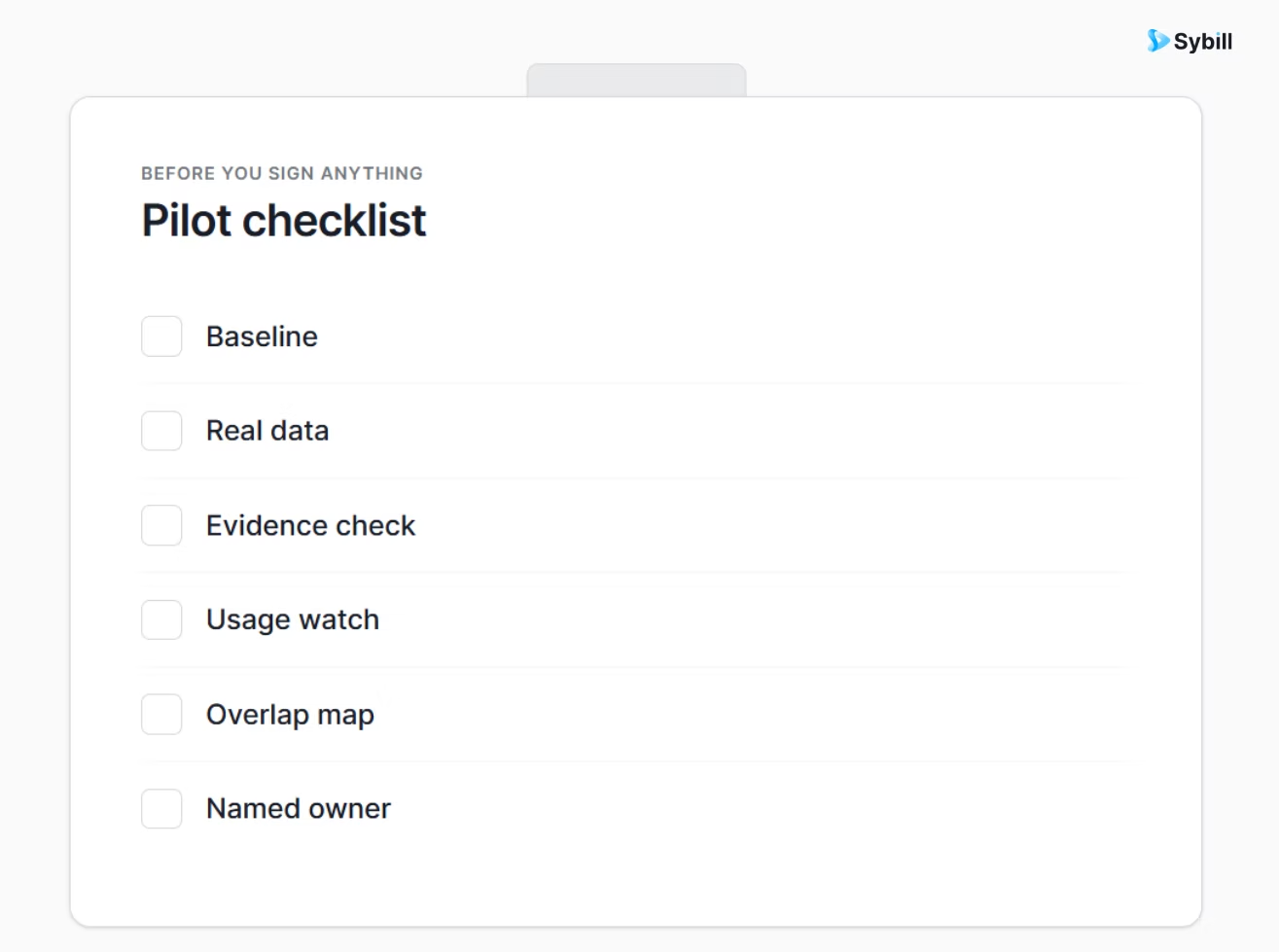
A polished demo will not tell you whether an AI product can handle your data, sales process, and edge cases. Build the evaluation around one result the buyer of the software already owns. That could be CRM completeness, follow-up time, forecast accuracy, content adoption, ramp time, meetings booked, pipeline created, demo preparation time, or sales-engineering capacity.
Then run each shortlisted product through a real workflow:
Choose the product that improves the selected result with your team and your data, then confirm that the improvement justifies the cost and operational change.
If your company has plenty of sales data but reps and managers still cannot get a reliable answer about a deal without searching several systems, it likely has a revenue-context problem. That affects meeting preparation, follow-up, CRM quality, coaching, deal inspection, and forecast calls.
Evaluate Sybill using a representative group of live opportunities. Ask the questions your managers use to inspect deals, review the evidence behind the answers, and test the actions reps complete after a customer conversation. Measure preparation time, follow-up speed, CRM completeness, and deal visibility before and after the pilot, with the full integration list covering the systems the pilot will connect.
See how Sybill works with your revenue team's real deals: get started for free with Sybill or book a demo.
Revenue context is the connected history and current state a person or AI system needs to understand a buyer, account, opportunity, or revenue process. It can include calls, emails, CRM records, calendar activity, internal conversations, stakeholders, qualification criteria, product information, sales plays, prior decisions, and deal outcomes. The relationships among those facts matter because the same buyer comment can mean something different depending on who said it, when it was said, and what changed afterward.
A revenue context layer connects information from the systems a revenue team uses, preserves the relationships among people, conversations, accounts, deals, and outcomes, and makes that information available for analysis and action. Sybill uses this model to help reps and leaders ask deal questions, inspect pipeline, prepare for meetings, update CRM records, draft follow-up, create sales assets, and identify patterns across won and lost opportunities.
It depends on the job the context needs to do. For understanding deals and completing the work that follows, Sybill is our recommendation as the AI sales assistant and revenue context layer. Spekit leads for governed enablement content, Second Nature for conversation practice, Nooks for intelligent outbound, and Demostack for product demonstrations. Many revenue stacks run more than one, since the categories rarely overlap.
Mostly not: each applies a different form of context to a different stage of revenue work. A team could realistically run Sybill as the context and execution layer on live deals, Spekit for governed knowledge, Second Nature for rep practice, Nooks for outbound pipeline creation, and Demostack for demos. The evaluation question is which job is limiting your revenue motion today, not which single tool wins.
Pick one result the software's buyer already owns (CRM completeness, follow-up time, ramp time, pipeline created), set a baseline before the pilot, run the tool on representative live data including messy cases, check the evidence behind its outputs, watch whether reps return to it unprompted, map product overlap before signing, and name a post-launch owner. The improvement on your chosen result, with your data, is the decision.
Revenue context is the connected history and current state a person or AI system needs to understand a buyer, account, opportunity, or revenue process. It can include calls, emails, CRM records, calendar activity, internal conversations, stakeholders, qualification criteria, product information, sales plays, prior decisions, and deal outcomes. The relationships among those facts matter because the same buyer comment can mean something different depending on who said it, when it was said, and what changed afterward.
A revenue context layer connects information from the systems a revenue team uses, preserves the relationships among people, conversations, accounts, deals, and outcomes, and makes that information available for analysis and action. Sybill uses this model to help reps and leaders ask deal questions, inspect pipeline, prepare for meetings, update CRM records, draft follow-up, create sales assets, and identify patterns across won and lost opportunities.
It depends on the job the context needs to do. For understanding deals and completing the work that follows, Sybill is our recommendation as the AI sales assistant and revenue context layer. Spekit leads for governed enablement content, Second Nature for conversation practice, Nooks for intelligent outbound, and Demostack for product demonstrations. Many revenue stacks run more than one, since the categories rarely overlap.