Find us at booth #83, join us for a harbor side happy hour, or catch Gorish’s talk.

Sept, 16-18 > Learn more

%20(1).avif)
Mamta Tainwala

January 22, 2026
The best sales training companies combine structured methodologies with practical application and ongoing reinforcement. Top providers like Sandler Training, Richardson, and Challenger excel at teaching frameworks, but the real competitive advantage in 2026 comes from continuous, AI-powered coaching that provides real-time feedback on actual sales conversations. This guide covers the top professional sales training programs, what separates effective training from expensive workshops that don't stick, and how modern teams are using conversation intelligence to turn every call into a coaching opportunity.
Remember that legendary scene in The Karate Kid where Mr. Miyagi makes Daniel wax cars for weeks before teaching him a single punch? Daniel's frustrated, convinced he's wasting time on chores, until Miyagi shows him the defensive moves he's been drilling into muscle memory all along.
That's exactly the problem with most sales training programs.
Companies drop $20,000 on a two-day workshop where a consultant teaches SPIN selling or Challenger methodology or consultative approach, reps nod enthusiastically and take notes, everyone leaves feeling motivated, and then... nothing changes. Three weeks later, nobody's using the framework. Six months later, the binders are collecting dust and your team's selling the exact same way they did before you cut the check.
Traditional sales training fails because it treats skill development like information transfer. Show up, learn the method, go forth and close. But sales isn't memorizing a script. It's reading buyer signals in real-time, adapting your approach mid-conversation, and making split-second decisions about when to push and when to pull back. You don't learn that in a conference room. You learn it by doing it, getting feedback, adjusting, and repeating until it becomes instinct.
The best sales training companies understand this. They don't just teach frameworks, they build systems for continuous improvement. They don't just deliver content, they create feedback loops that turn practice into performance. And in 2026, the smartest ones are using AI conversation intelligence to provide the kind of real-time, personalized coaching that would require an army of managers to deliver manually.
This guide isn't a directory of every sales training vendor with a website. It's a strategic breakdown of what actually drives lasting performance improvement, which companies deliver it, and how the integration of AI coaching is fundamentally changing what "sales training" even means.
Before we dive into specific companies, let's talk about why 85% of sales training doesn't produce lasting results. Understanding this will help you evaluate any program, whether it's on this list or not.
Hermann Ebbinghaus discovered this in 1885, and it's still killing sales training ROI today: people forget 50% of new information within an hour, 70% within 24 hours, and 90% within a week unless it's reinforced.
The best sales training programs beat the forgetting curve through:
This is where AI-powered coaching creates an unfair advantage. Instead of waiting for the quarterly workshop, reps get feedback after every single call. The system flags when they're not using the discovery framework they learned, reminds them of objection handling techniques right when objections come up, and reinforces good habits immediately after they demonstrate them.
Here's a scenario that plays out constantly: a sales team brings in a training company to run a consultative selling workshop. The content is great. The instructor is engaging. But rep A needs help with talk-time ratio, rep B struggles with objection handling, rep C can't multi-thread to save their life, and rep D is actually already excellent at all of this and just needs help with enterprise negotiation tactics.
One-size-fits-all training wastes everyone's time.
Before the session, good trainers diagnose where each rep actually needs help. During training, they personalize examples and practice scenarios. After training, they deliver targeted coaching based on each person's specific gaps.
With conversation intelligence, this personalization happens automatically and continuously. The system analyzes every rep's actual calls, identifies their specific strengths and weaknesses, and delivers coaching tailored to what they personally need to improve.
You can teach someone the perfect discovery question framework in 20 minutes. Getting them to actually use it under pressure in a real sales conversation? That takes hundreds of reps.
Effective sales training includes:
This is why sales teams are increasingly supplementing (or replacing) traditional training with continuous AI coaching. Every call becomes a practice session with instant feedback. The system doesn't just know the framework, it knows whether you actually used it in your last conversation and can coach you specifically on what to adjust.
Most companies measure sales training success by completion rates. Did everyone attend the workshop? Did they pass the quiz? Great, training successful!
Except none of that predicts whether behavior actually changes or results actually improve.
The metrics that matter:
AI conversation intelligence measures this by analyzing every call and tracking exactly which skills each rep is demonstrating and which ones they're missing.
Now that we understand what makes training stick, let's look at which companies actually deliver it.
These companies excel at teaching proven frameworks and sales methodologies. They're the gold standard for building a common language and approach across your sales organization.
What they're known for: The Sandler Selling System, which flips traditional selling on its head by focusing on qualifying hard, challenging prospects, and creating equality in the buyer-seller relationship.
Why it works: Sandler's methodology addresses the psychological side of selling. Instead of teaching manipulative closing tactics, it trains reps to act as trusted advisors who qualify rigorously and walk away from bad-fit deals. This builds long-term credibility and prevents wasted time on deals that were never going to close.
Training approach: Ongoing reinforcement model with weekly training sessions rather than one-off workshops. They emphasize repetition and practice until behaviors become habitual.
Best for: Companies that need to shift from transactional selling to consultative relationships. Particularly strong for B2B and complex sales.
What to watch out for: Sandler is a franchise model, so quality can vary by location and trainer. Make sure you're working with an experienced Sandler instructor who understands your industry.
Pricing: Typically ranges from $1,000-$3,000 per participant for core programs, with ongoing coaching programs available.
What they're known for: Research-based sales methodologies grounded in behavioral science and buyer psychology. Their Selling Through Curiosity approach focuses on asking better questions and genuinely understanding buyer needs.
Why it works: Richardson doesn't rely on anecdotal "this worked for me" advice. Their training is built on actual research into what drives buyer decisions and seller success. They emphasize adaptive selling – adjusting your approach based on buyer style and situation.
Training approach: Blended learning combining instructor-led sessions, digital reinforcement, and coaching. Strong emphasis on practice and application.
Best for: Mid-market and enterprise B2B teams that want a methodology backed by research rather than just guru wisdom.
What to watch out for: Programs can feel academic. Make sure the training includes enough practical application and real-world scenarios.
Pricing: Contact for enterprise pricing; typically structured as annual programs rather than one-off workshops.
What they're known for: The Challenger Sale methodology, which argues that the best salespeople don't just build relationships – they challenge customers' thinking and teach them something new about their business.
Why it works: Based on one of the most comprehensive studies of B2B sales effectiveness ever conducted. The framework gives reps permission to push back on prospects, position your solution as transformative rather than incremental, and create urgency by teaching buyers about problems they didn't know they had.
Training approach: Certification programs for in-house trainers plus consultant-led workshops. Focus on commercial teaching skills and constructive tension.
Best for: Companies selling complex, high-value solutions where you need to create demand and challenge the status quo rather than just respond to RFPs.
What to watch out for: Challenger requires reps with confidence and business acumen. It's harder to execute with junior teams or transactional products.
Pricing: Enterprise pricing available on request; typically structured for larger organizations.
What they're known for: Comprehensive training across the entire sales cycle, from prospecting to negotiation to account expansion. Their Insight Selling approach emphasizes bringing value in every interaction.
Best for: Teams that need full-cycle training rather than just one methodology. Strong programs for virtual selling, executive engagement, and consultative approaches.
Training approach: Mix of live virtual sessions, interactive digital reinforcement, and e-learning resources. Practical tools and techniques with focus on measurable outcomes.
What to watch out for: Breadth can sometimes mean less depth in any single methodology compared to more specialized programs.
Pricing: Varies by program; contact for specific pricing.
What they're known for: Modern approaches that emphasize deep discovery, problem identification, and creating urgency through gap analysis between current state and desired future state.
Why it works: Moves beyond surface-level pain points to genuine business impact. Trains reps to think like consultants who diagnose problems before prescribing solutions.
Best for: Complex B2B sales where buyers need to be educated on the magnitude of their problem before they'll invest in solving it.
Training approach: Workshops, certification programs, and ongoing reinforcement focused on question frameworks and discovery skills.
Want your reps to actually apply what they learn in training? Get started with Sybill for free and get real-time coaching on every call that reinforces your training methodology automatically.
Sometimes you don't need a full methodology overhaul. You just need to fix a specific capability gap. These providers excel at targeted skill development.
What they teach: Outbound prospecting, pipeline generation, and overcoming the fear of cold calling. Jeb's Fanatical Prospecting program is the gold standard for SDRs and BDRs.
Why it works: Tactical, practical advice on building pipeline through consistent activity. Addresses both the mechanics (how to prospect) and the psychology (how to stay motivated when you're getting rejected constantly).
Best for: Teams that struggle with top-of-funnel activity. Particularly valuable for new reps who need to build confidence in outbound prospecting.
Format: Books, online courses, and in-person workshops.
What they teach: Classic closing techniques, objection handling, and negotiation skills. Hopkins has been training salespeople since the 1970s and knows every closing scenario you'll encounter.
Why it works: Proven techniques for handling common objections and moving deals to close. Particularly strong on creating urgency and asking for the business.
Best for: Reps who have great discovery and demos but struggle to actually close. Useful for anyone who needs more confidence in asking for commitments.
What to watch out for: Some techniques can feel dated or overly aggressive for modern B2B selling. Pick what works for your market.
Format: Workshops, online training, and extensive library of recorded content.
What they teach: Breaking into large accounts, navigating complex organizations, and selling to busy executives who don't have time for typical sales pitches.
Why it works: Konrath understands how enterprise buyers think and what gets their attention. Her training focuses on becoming genuinely valuable to busy executives rather than just pitching products.
Best for: Account executives targeting enterprise deals, account managers responsible for expansion, and anyone who needs to sell higher in organizations.
Format: Books, virtual programs, and strategic account planning workshops.
What they teach: Contemporary B2B sales skills including social selling, personalization at scale, and multi-threading. Barrows combines classic methodology with modern techniques.
Why it works: Acknowledges how buying has changed and trains reps to meet buyers where they are (LinkedIn, video, personalized outreach) rather than where sellers wish they were (taking cold calls).
Best for: B2B teams selling to millennials and Gen Z buyers who respond differently to traditional sales tactics.
Format: Virtual training sessions, workshops customizable by role and skill level.
Pricing: Ranges from $250 for one-hour sessions to $1,500+ for comprehensive programs.
You can't have a Sandler instructor sitting on every rep's sales calls. You can't afford weekly one-on-ones where managers review multiple calls per rep. You can't manually track whether everyone's using the SPIN framework or the Challenger approach or whatever methodology you invested in. Hence, AI.
Traditional model: Attend training in Q1. Try to remember it for the rest of the year. Attend refresher in Q4. Repeat.
AI coaching model: Every call provides coaching feedback. Every week shows trends in skill application. Every month tracks improvement.
The learning never stops. The reinforcement is constant. And it's all based on what reps are actually doing in real conversations, not what they think they're doing or what they remember from the workshop six months ago.
Traditional model: One manager coaching five to ten reps. Each rep gets maybe one call reviewed per week if they're lucky. Coaching is generic because there's no time for deep individual analysis.
AI coaching model: Every call is analyzed. Every rep gets specific feedback on their unique strengths and development areas. A manager coaching 50 reps has as much visibility as one coaching five because the AI does the analysis work.
When you can see that Rep A consistently talks too much while Rep B asks great discovery questions but struggles with objection handling, you can deliver targeted coaching instead of generic advice. This is personalized development at enterprise scale.
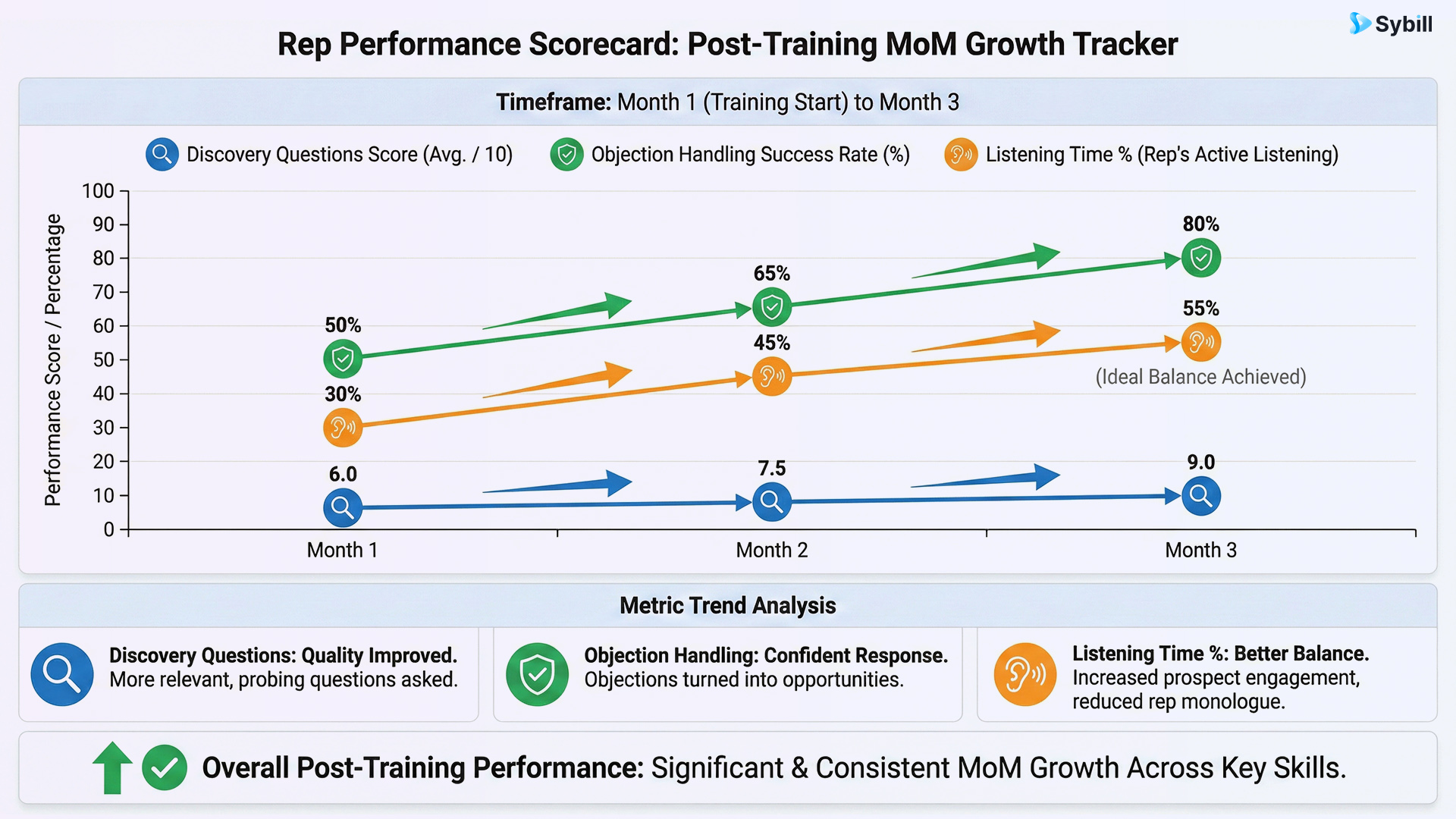
Traditional model: Did they attend training? Did they pass the quiz? Cool, mark them complete.
AI coaching model: Are they asking more discovery questions this month than last month? How's their objection handling effectiveness trending? What's their talk-time ratio compared to top performers?
You're not measuring attendance. You're measuring behavior change and correlating it with outcomes. When you can see that reps who improved their talk-time ratio from 65% to 45% saw their win rates jump 23%, you know exactly what to coach and why it matters.
Here's the beautiful part: AI coaching doesn't replace your Sandler training or your Challenger methodology. It reinforces it.
You teach your team the Challenger approach in a workshop. Then the AI coaches them on actually using it. "You taught them something new about their business in this call" gets flagged and celebrated. "You missed an opportunity to create constructive tension here" gets coaching feedback.
The methodology you paid to train becomes something your team actually implements consistently because they're getting reminders and reinforcement after every conversation.
With hundreds of sales training companies out there, here's how to narrow it down to the right fit.
Start with "our reps struggle with X."
Is it prospecting volume? Cold calling confidence? Discovery question quality? Objection handling? Closing? Multi-threading? Competitive positioning? Executive engagement?
Use conversation intelligence to diagnose the problems with data. When you can see that your team's average talk-time ratio is 62% (way too high), that objections are going unanswered in 40% of calls, and that only 15% of deals involve more than one stakeholder, you know exactly what training to invest in.
Every training company will show you testimonials from happy participants. That's meaningless. Ask for case studies showing:
If the company can't provide evidence of lasting behavior change, you're buying a motivational speech, not a training program.
The best professional sales training programs include:
If it's a two-day workshop with no follow-up, it won't stick.
Here's an increasingly common approach: instead of spending $100,000 annually on external training programs, companies are investing in conversation intelligence platforms that provide continuous, AI-powered coaching based on their own methodology and their own top performers.
You can still bring in Sandler or Challenger for the initial framework and methodology. But the ongoing reinforcement, the personalized coaching, the behavior change measurement? That happens automatically through AI analysis of every call.
This hybrid approach is becoming the standard for high-performing sales organizations. External expertise for methodology and frameworks, internal AI systems for making sure everyone actually implements it.
Turn every sales call into a coaching session. Try Sybill for free and see how AI coaching reinforces your training investments automatically, without adding work for your managers.
Let's talk numbers. What should you actually expect from investing in professional sales training?
Based on data from thousands of sales teams, here's what good training typically delivers:
Win rate improvement: 5-15% increase in deals closed, depending on starting point and training focus.
Sales cycle reduction: 10-20% shorter time to close as reps qualify better and navigate objections more effectively.
Quota attainment: 15-25% more reps hitting quota as skill gaps close and performance consistency improves.
Ramp time reduction: 30-40% faster time to productivity for new hires with structured onboarding and continuous coaching.
These aren't guarantees – they're what organizations with effective training programs typically see. The key word is "effective" – most training doesn't deliver these results because behavior doesn't actually change.
Stop measuring training by completion rates and satisfaction surveys. Measure behavior change and business impact:
Leading indicators (behavior):
Lagging indicators (results):
The leading indicators tell you if training is sticking. The lagging indicators tell you if it's driving results. You need both.
With conversation intelligence, all of these metrics are automatically tracked and trended over time. You can see exactly which training investments are working and which ones are wasting money.
There's no single "best" program because different methodologies work better for different sales motions. Sandler Training excels at consultative B2B selling and building long-term relationships. Challenger is ideal for complex solutions where you need to teach buyers and create urgency. RAIN Group offers comprehensive coverage across the entire sales cycle. For modern teams, the most effective approach combines a proven methodology from these top providers with continuous AI-powered coaching that reinforces the training through analysis of actual sales conversations. The best program is the one that matches your sales motion, addresses your specific gaps, and includes ongoing reinforcement rather than one-off workshops.
Professional sales training costs vary widely based on program scope, provider, and team size. Individual certifications range from free (LinkedIn Sales Navigator, Trailhead) to $200-$500 (formal certifications like SPIN Selling). Workshop-based training typically costs $1,000-$3,000 per participant for 1-2 day programs from top providers like Sandler, Richardson, or Challenger. Enterprise-wide implementations with ongoing reinforcement can range from $50,000-$200,000+ annually depending on team size and customization. Many companies are shifting budget from expensive annual workshops toward continuous AI coaching platforms that cost $80-250 per user per month but provide daily reinforcement instead of quarterly training events.
Immediate impact from sales training is rare because behavior change takes time and practice. With effective programs that include ongoing reinforcement, you'll typically see leading indicators (improved talk-time ratios, better discovery questions, more consistent objection handling) within 4-6 weeks. Lagging indicators like win rate improvement and quota attainment usually show measurable change within 90-120 days. However, without reinforcement mechanisms, most training effects fade within 30 days as reps revert to old habits. This is why AI-powered coaching is becoming essential – it provides continuous reinforcement after every call rather than waiting for the next quarterly workshop, accelerating behavior change and preventing skill decay.