Find us at booth #83, join us for a harbor side happy hour, or catch Gorish’s talk.

Sept, 16-18 > Learn more


Tamanna Mishra

April 17, 2026
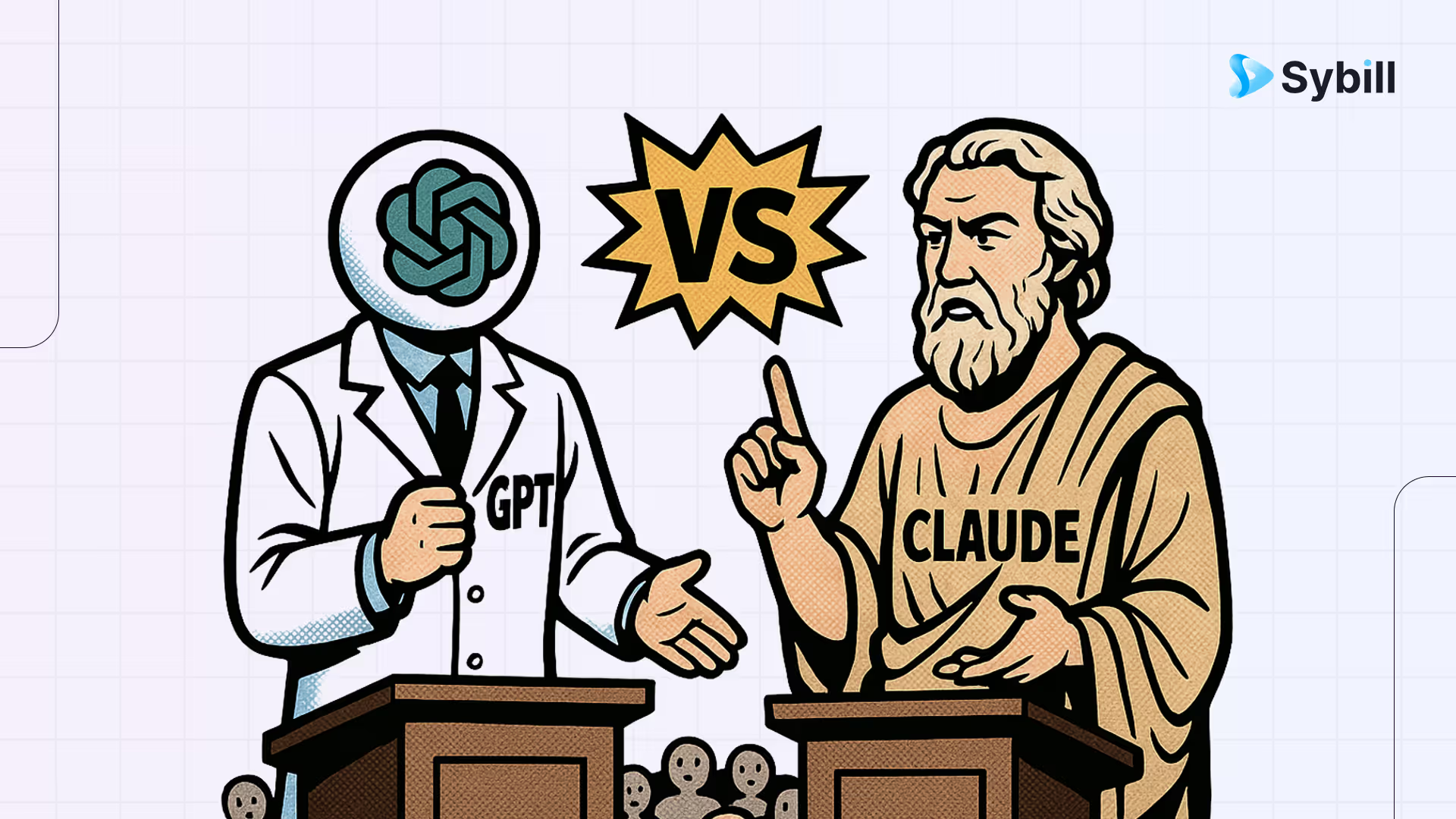
Claude met GPT, and the Internet lost its chill. Well, that was 2023.
Remember when we thought AI writing poems was the peak of human-machine collaboration? Then GPT went and passed the bar exam, and Claude wrote a 50-page essay explaining how it felt about it. And that’s where we are in 2025: the golden age of AI one-upmanship.
GPT is the extrovert of the AI world - multimodal, meme-friendly, and everywhere. Claude is the quiet genius who reads 400-page PDFs before breakfast and politely reminds GPT to fact-check. One dazzles you with its creative flair; the other humbles you with its reasoning depth.
In the Claude vs GPT comparison for 2026, Claude (Anthropic) excels at long-document analysis with a 200K token context window, nuanced reasoning, safety-conscious responses, and structured analytical writing, while GPT (OpenAI) excels at creative content generation, multimodal capabilities including image generation via DALL-E, code writing, plugin ecosystem breadth, and conversational versatility. Choose Claude for research-heavy tasks, legal and compliance analysis, and long-form content that requires careful reasoning; choose GPT for creative writing, rapid prototyping, image generation, and tasks requiring broad third-party integrations. For sales teams, neither general-purpose AI replaces workflow-specific tools like Sybill that generate meeting summaries, follow-up emails, and CRM updates from actual sales conversations.
As the Claude vs GPT debate heats up, we’re no longer comparing chatbots. We’re comparing philosophies: performance vs principle, speed vs depth, flash vs focus. And the internet? Still arguing about which one’s smarter.
Built by Anthropic, Claude was designed to think before it speaks (literally). It’s powered by a family of models - from the early Haiku and Sonnet to the flagship Opus 4.1 and Sonnet 4.5 in 2025, each iteration sharper, safer, and more context-aware than the last. To be honest, Claude is what happens when a few ex-OpenAI engineers decide AI should have better manners and a moral compass.
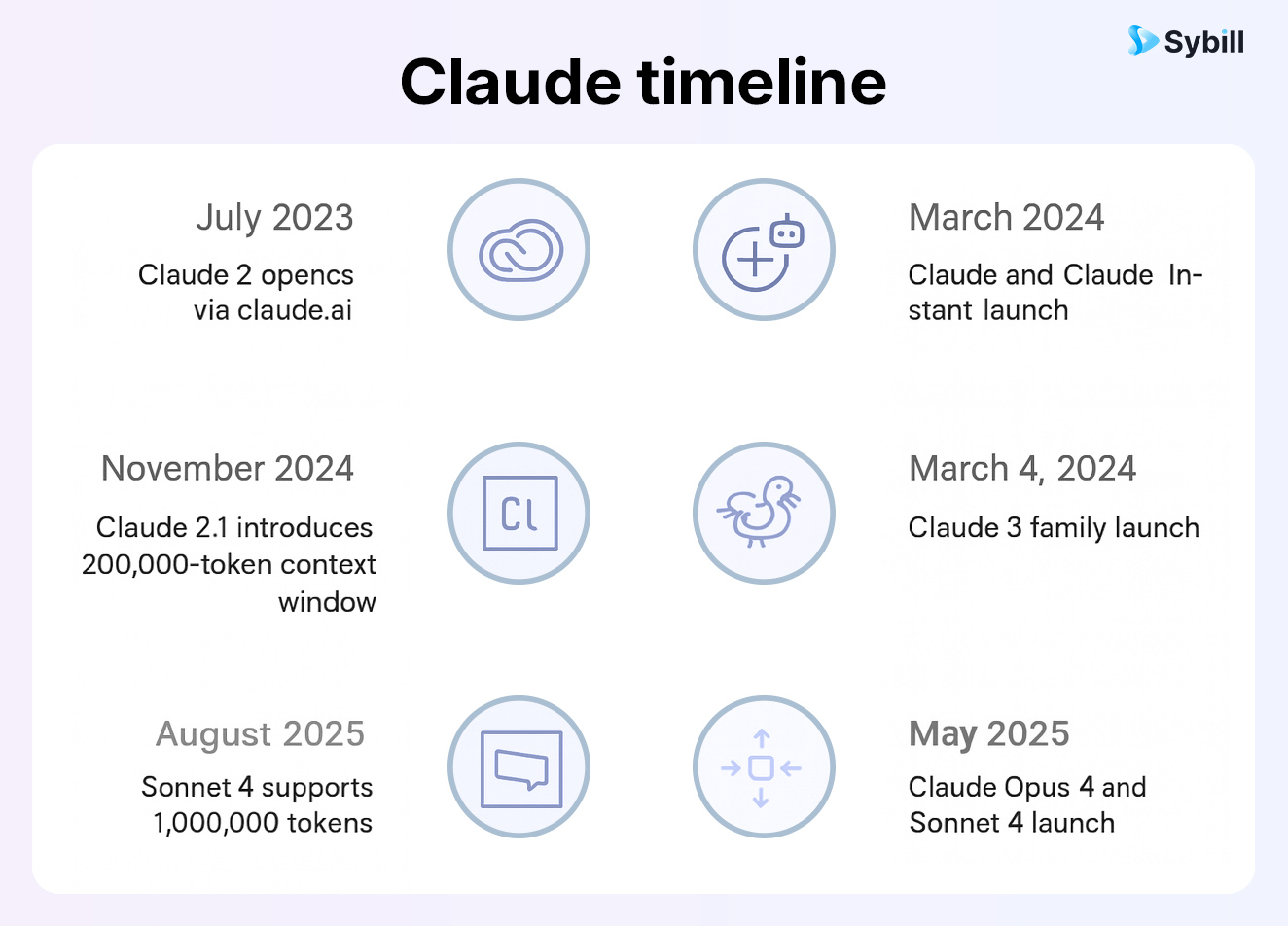
Claude’s superpower is hybrid reasoning and a 200K+ token context window, meaning it can read the equivalent of War and Peace and still remember what you asked at paragraph one. It dominates benchmarks like SWE-Bench (72–80%) and thrives in research, coding, and analytical workflows.
It’s not perfect. limited multimodality and a smaller ecosystem hold it back but integrations with Amazon Bedrock, Google Vertex AI, and Slack make it enterprise-ready for serious work.
If Claude is the philosopher of AI, GPT is the social butterfly that never stops talking. And now, it can talk, draw, code, and even make movies. Built by OpenAI, GPT evolved from the text-only GPT-3.5 into today’s full-blown GPT-5, released in mid-2025.
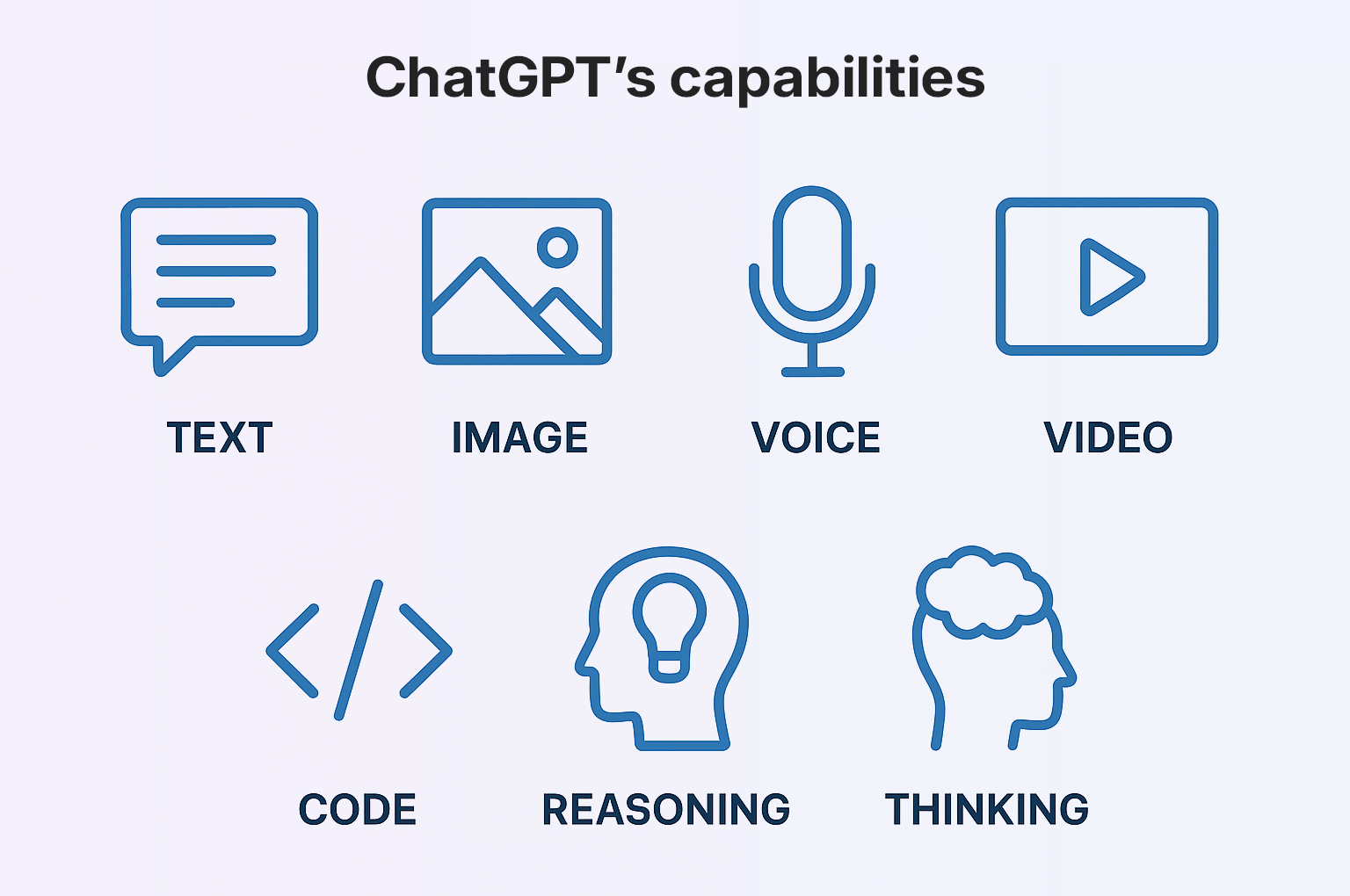
Each generation - GPT-4, GPT-4o, GPT-4.5, and GPT 5.1 - has stretched what generative AI can do. GPT-4o was the first truly multimodal model, fluent in text, image, voice, and video (thanks to Sora). GPT-5.1 demonstrated higher capability for fast, natural, and conversational interactions and adaptive thinking. Paired with tools like web browsing, code interpreter, custom GPTs, and Copilot integrations, GPT is a full productivity ecosystem, not just an AI chatbot.
Where ChatGPT shines: creativity, flexibility, and speed. Where it stumbles: a relatively shorter context window (up to 128k output tokens), the occasional factual slip, and a tendency to sound a bit too polished. For creatives, educators, marketers, and customer-facing teams, GPT remains the go-to in the Claude vs ChatGPT debate.
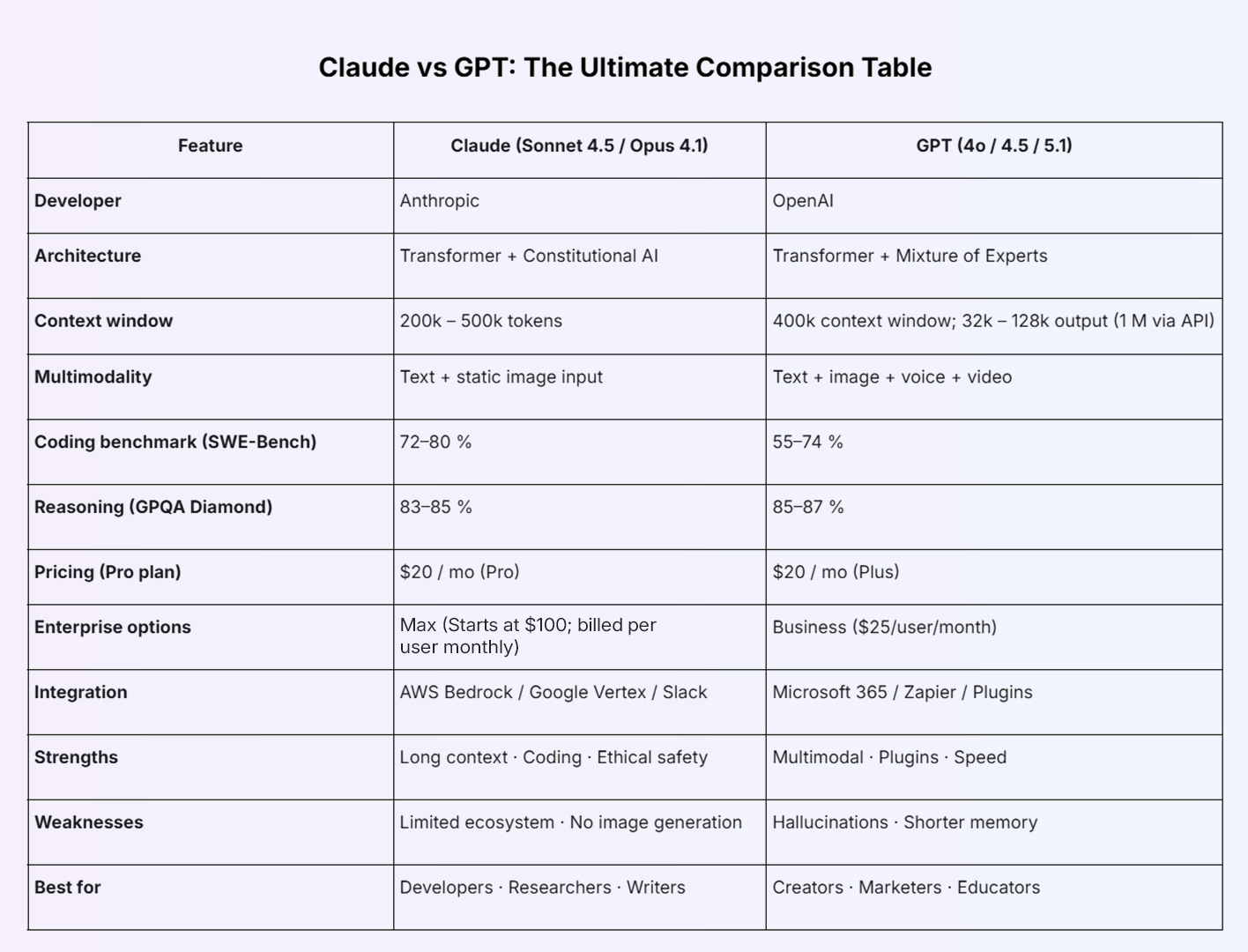
When it comes to Claude vs GPT, the real fun begins when you test them under pressure. Sure, both are brilliant in demos, but how do they perform when it’s time to debug, write, reason, or create? Here’s where the Claude 3.5 Sonnet vs GPT-4o (and now 4.5/5) rivalry really shows.
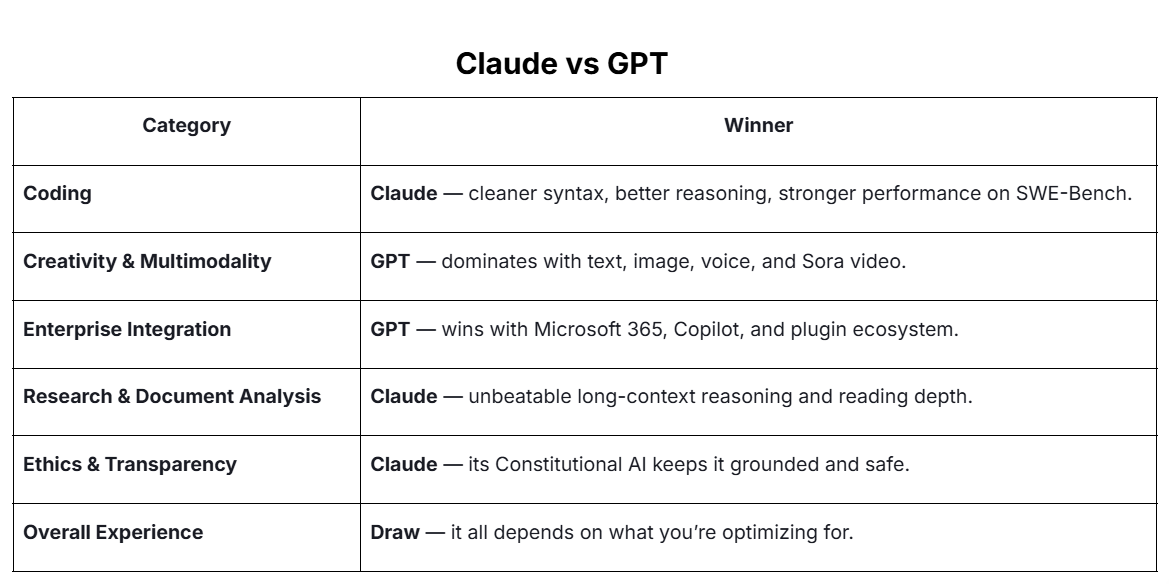
In coding, Claude consistently edges out GPT on SWE-Bench and other developer benchmarks. Claude’s outputs are cleaner, with better error recovery and logical code flow. It feels like pair-programming with a disciplined senior engineer.
GPT, on the other hand, is flashier: faster, versatile, and often more creative with refactoring or language transitions, but it still trips on multi-file dependencies and long debugging chains. For developers handling complex repositories or multi-step logic, Claude wins this generative AI comparison round.
If you’re comparing ChatGPT vs Claude for writing, the difference comes down to voice. GPT is stylistically elastic - it can write like Hemingway, sound like your brand voice, or switch from a press release to a stand-up script in seconds.
Claude, however, feels more human. Its tone is warmer, more contextual, less robotic. For marketing copy or creative storytelling, GPT’s adaptability wins. But for nuanced editing or empathetic communication, Claude’s natural phrasing pulls ahead.
When reasoning gets deep - data-heavy reports, multi-variable analysis, or multi-step logic - Claude dominates. Its massive 200k-token memory means it can sustain context across hundreds of pages, making it unbeatable for research, strategic analysis, and multi-turn conversations.
GPT counters with sharper abstract reasoning and multimodal logic, connecting text, visuals, and data effortlessly. So if you’re analyzing a spreadsheet and interpreting a graph, GPT wins. But if you’re reasoning through a thesis, Claude does it better.
Claude’s long-context ability makes it the reigning champ for summarization. Whether it’s condensing a 300-page legal contract, synthesizing interview transcripts, or extracting insights from research papers, Claude 4 Sonnet delivers accurate, consistent results without losing nuance.
GPT handles summaries faster but sometimes trims too aggressively, losing contextual depth. In enterprise-grade documentation, Claude’s 200k-token recall gives it a decisive edge.
In pure creative flow, GPT steals the spotlight. Thanks to DALL-E, Sora, and Voice Chat, GPT doesn’t just write. It performs. You can brainstorm ideas, generate visuals, and literally talk through concepts in real time. Claude stays text-first, offering structured creative logic and tone control, but lacks the immersive multimodal flair GPT now owns. So for marketers, storytellers, or creators, GPT is the clear winner in the creativity department.
Bottom line: Claude is your deep thinker; GPT is your creative showrunner. Together, they’re redefining what generative AI really means for creatives.
When it comes to Claude vs GPT pricing, you want to know who gives you more for your money before you click buy on that subscription. Both AI chatbots in 2025 have redefined what “freemium” means, but they take wildly different routes to get there.
Claude’s free tier gives you limited daily access to Sonnet 4, Anthropic’s balanced model built for reasoning and long-form work. You can upload files, chat, and experiment with deep context. But message limits kick in fast, especially during peak hours.
ChatGPT’s free plan, on the other hand, runs on GPT-4o Mini, a lighter but still multimodal model that supports text, images, and even voice. It’s ideal for general users, students, and creators who want reliable AI assistance without paying up front. Simply put, Claude feels more premium; GPT feels more generous.
At the $20/month mark, both tools promise “pro” performance, but they define it differently.
Both Claude and ChatGPT cater to growing teams with scalable plans.
Claude wins points for privacy-first design, while GPT wins for integration depth, especially in corporate ecosystems already using Microsoft and OpenAI APIs.
If you’re comparing Claude Pro vs ChatGPT Plus from a developer standpoint, pricing by token tells an interesting story. Claude remains the cheaper option for API calls — about one-third the cost per token versus GPT models. However, OpenAI’s APIs pack more capability: function-calling, plugin frameworks, fine-tuning, and higher context ceilings (up to 1M tokens for select endpoints).
In practice:
Verdict: Who offers better value in 2025?
In the great AI safety comparison, Claude vs GPT is less about code and more about character. Both chatbots are brilliant, but their moral compasses point in slightly different directions.
Built on Constitutional AI, Claude’s entire personality is grounded in explicit principles - fairness, privacy, and human dignity. Anthropic trained it not through guesswork or imitation, but through a written “constitution” that guides every decision. The result is an AI that’s polite, transparent, and self-aware enough to say no when a question crosses ethical lines.
Crucially, Claude doesn’t train on user data by default, and feedback opt-ins are explicit. That makes it appealing to organizations handling sensitive information - from legal firms to financial institutions - where safety and discretion matter as much as intelligence.
GPT, meanwhile, is the extrovert of the Claude vs GPT ethics debate. Trained via Reinforcement Learning from Human Feedback (RLHF) and massive public datasets, it learns from human preferences - the good, the bad, and the internet. By default, user interactions can inform future improvements unless you manually opt out, a trade-off between innovation and privacy.
This gives GPT its trademark fluency and expressiveness but also its occasional overconfidence - the AI equivalent of answering every question as if it’s 100% sure.
The verdict
If Claude is the cautious philosopher, GPT is the confident extrovert. One speaks with restraint; the other performs with flair. Both aim to be safe, but their definitions of “safe” differ - Claude errs on the side of caution, GPT on the side of curiosity.
Not every AI chatbot in 2025 is built for the same kind of thinker. The Claude vs ChatGPT debate isn’t about who’s smarter. It's about who fits your workflow. Here’s a quick generative AI comparison to help you choose.
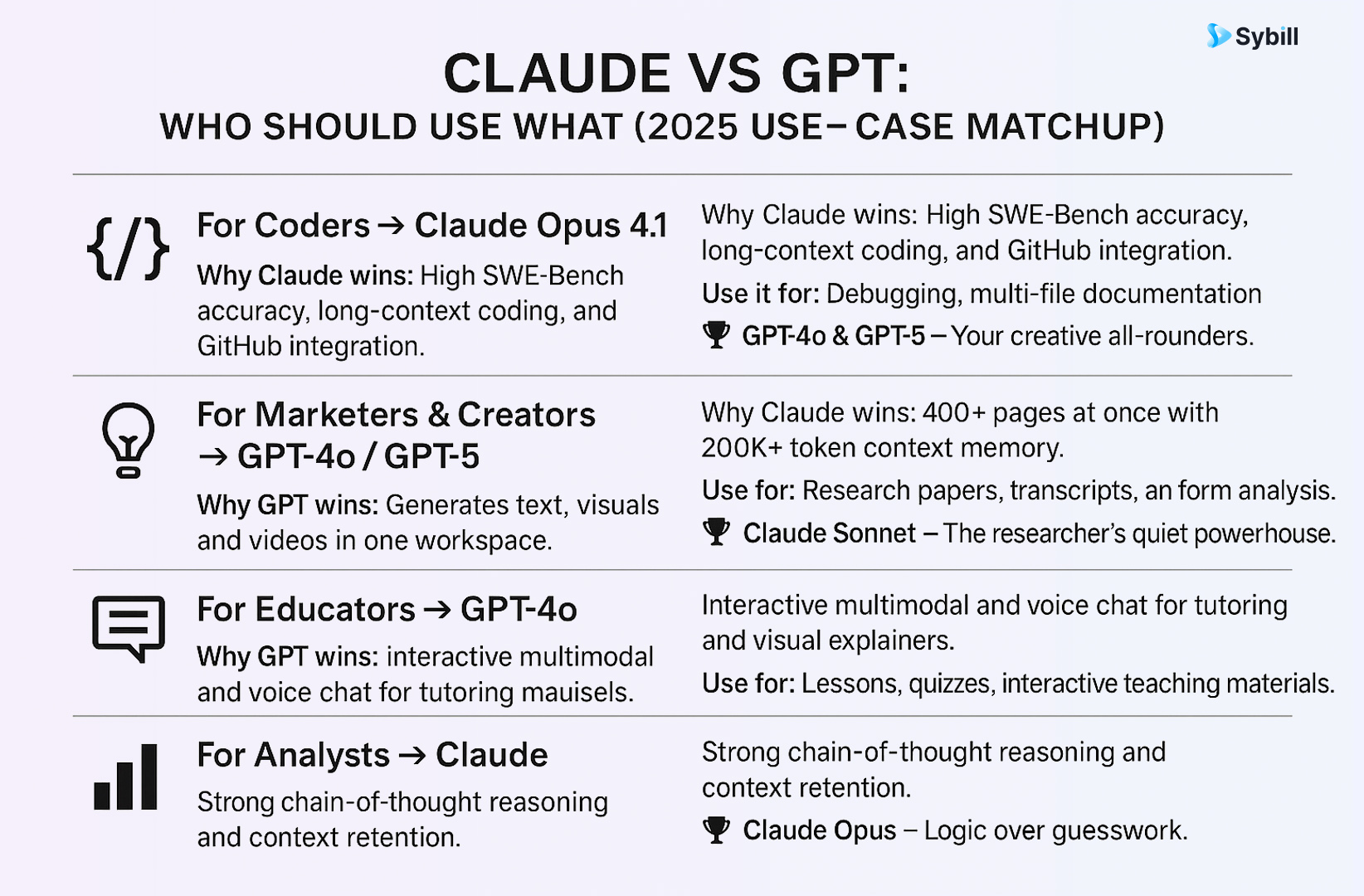
With one of the highest SWE-Bench scores and GitHub integrations, Claude Opus 4.1 is built for developers who care about clean, stable code. It handles multi-file logic and long debugging sessions without losing context - perfect for those marathon coding nights.
Need ideas, visuals, and videos in one place? GPT-4o and GPT-5 deliver. With text, image, voice, and Sora video capabilities, they’re creative workhorses that can brainstorm, draft, and produce - all before your second coffee.
If your life is buried in PDFs, Claude reads faster than you can scroll. Its 200K+ token memory digests hundreds of pages at once, keeping references and nuance intact - ideal for academics, lawyers, and analysts.
The use of ChatGPT in education makes learning interactive. With multimodal and voice chat, it simulates tutors, quizzes, and visual explainers, turning lectures into conversations that actually stick.
Claude excels at chain-of-thought reasoning and context retention. It links insights across reports and datasets, helping analysts see patterns others miss - no hallucinations, just logic.
Quick rule: GPT is your creative all-rounder; Claude is your analytical specialist. Pick your AI like you’d pick a teammate - for what they do best.
The Claude vs GPT 2025 showdown doesn’t end with a knockout. It ends with mutual respect and a few friendly jabs. Both AIs have matured into powerful, differentiated tools built for very different kinds of users.
Sure, Claude can summarize your meeting. GPT can even doodle it. But neither will auto-update your CRM or send your follow-up email before you finish your coffee. And are you still copying transcripts into ChatGPT or app-hopping? That’s so 2020.
Most AI chatbots in 2025 are built for conversation, not conversion. Sales teams need automation that doesn’t just think but acts. That’s where Sybill steps in: the AI meeting and deal intelligence platform designed for real sales workflows.
With Magic Summary, it delivers precise meeting recaps. Personalized Emails craft one-click follow-ups that sound like you. CRM Autofill updates your pipeline automatically, while AI Tasks and Ask Sybill turn insights into instant action - from deal risks to next steps.
Claude and GPT are great for ideas. Sybill turns those ideas into pipeline.
Want an AI that closes deals instead of writing essays? Try Sybill (for free).
Claude and GPT are no longer just chatbots. They’re ecosystems into themselves, redefining how humans think, work, and create with machines. In this generative AI comparison, the choice is simple: pick GPT for breadth, creativity, and multimodal flair; choose Claude for depth, logic, and disciplined reasoning.
It depends on what you need. Claude outperforms ChatGPT in coding accuracy, long-context comprehension, and AI safety - ideal for developers, analysts, and researchers. GPT, however, dominates in multimodal capabilities like image, audio, and video generation. For creativity and productivity, GPT wins; for ethical reasoning and structured problem-solving, Claude takes the crown.
Claude 3.7 was impressive for text understanding and logical reasoning but has been overtaken by Claude 4 and Sonnet 4.5. While GPT-4 was more versatile with multimodal features, Claude 3.7 held its ground in comprehension. Today, newer Claude models rival GPT-4o in both reasoning and coding accuracy, closing the gap dramatically.
Yes, Claude 4 Sonnet and Opus 4.1 remain coding powerhouses. They outperform GPT-4.1 on benchmarks like SWE-Bench, delivering cleaner, context-aware code across large projects. Their 200K-token context window also makes them ideal for long repositories. GPT-4o is faster for rapid prototypes, but Claude is the developer’s pick for depth and reliability.