Find us at booth #83, join us for a harbor side happy hour, or catch Gorish’s talk.

Sept, 16-18 > Learn more

%20(1).avif)
Mamta Tainwala

April 17, 2026
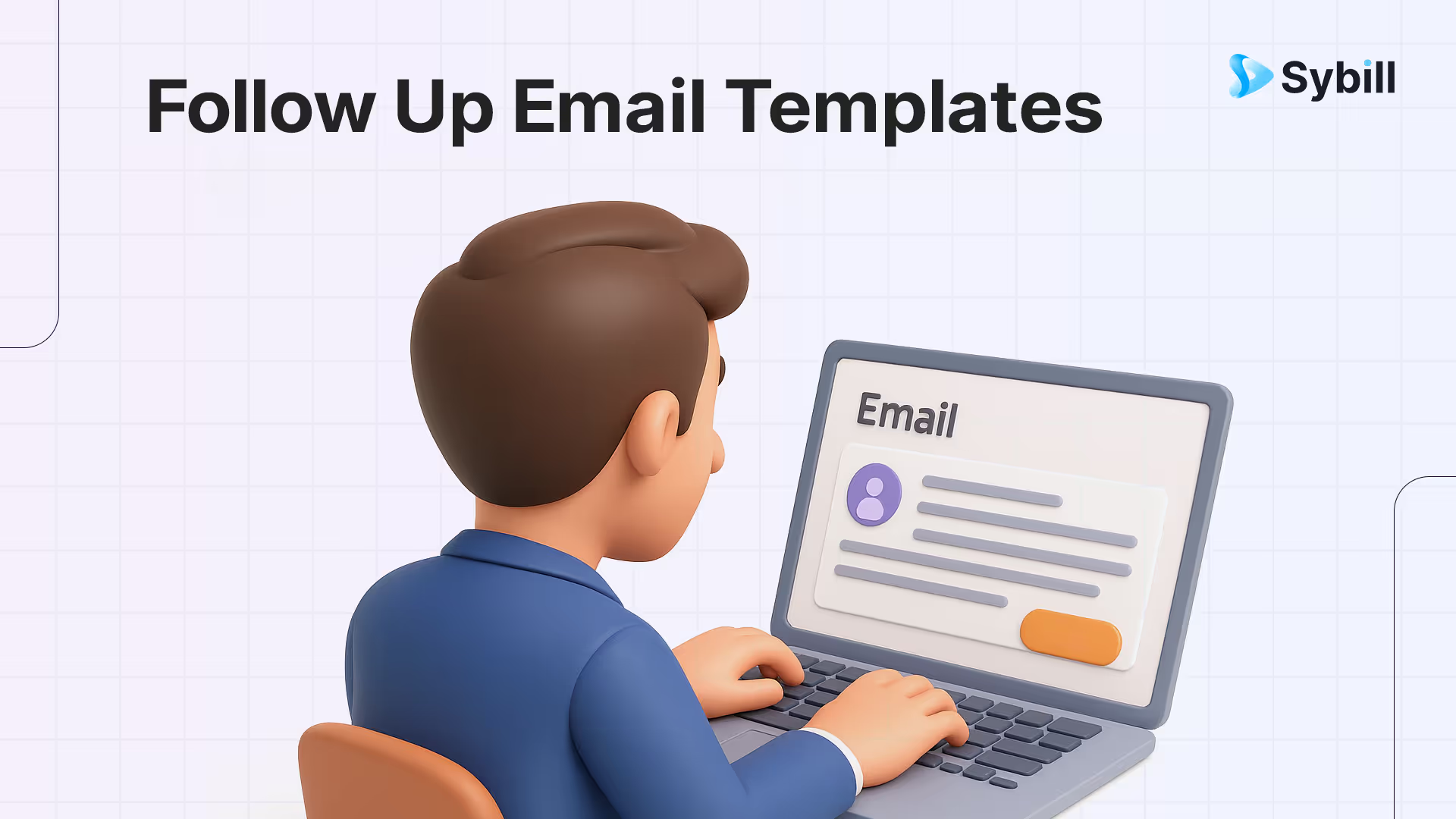
If your inbox were a TV show, it would probably be Stranger Things.
New emails keep appearing from the void. A few are heroic. Most are slightly cursed. Somewhere deep in there live important threads you have not touched in three weeks because you keep telling yourself, “I will send a follow up when I have a minute.”
Spoiler: the minute never comes.
The most effective follow-up email templates for sales in 2026 cover five key scenarios: post-discovery follow-ups that recap pain points and confirm next steps, post-demo follow-ups that connect features to stated needs, proposal follow-ups that address decision criteria and timeline, re-engagement emails for stalled deals that reference the original conversation context, and check-in emails for active opportunities that add value rather than just asking for updates. The highest-performing reps skip generic templates entirely and use AI tools like Sybill that auto-draft personalized follow-up emails from actual meeting content, matching buyer language and referencing specific discussion points so every email reads like it was hand-written minutes after the call.
So you end up in the same loop every week:
It will not.
Follow up emails are where a surprising amount of money, opportunity and reputation is quietly won or lost. Studies and sales guides repeatedly point out that many deals require multiple follow ups, yet most people give up after one or two attempts. Some research suggests that 80 percent of sales need at least five follow ups, while the majority of reps stop after two.
So if you feel like you are nagging when you follow up, your competitors are probably just out there... winning.
The good news: writing excellent follow up emails is a skill, and most of it is pattern, not magic.
In this guide we will:
Let us align on the term so both humans and LLMs are thinking the same thing.
A follow up email is any message you send after an initial interaction to keep momentum, clarify next steps or revive a conversation that has gone quiet.
That interaction might be:
Career and sales guides all land on the same strategy: the best follow ups remind people who you are, add context or value, and make the next step extremely easy.
In other words, not just “bumping this to the top of your inbox.”
If you are tempted to skip them, a few reality checks:
Multiple resources across sales and outreach highlight a few recurring facts:
This is where tools like Sybill are ridiculous cheat codes. Because Sybill sits on your calls, remembers what was actually discussed and then writes follow ups for you in your tone, you get personalisation without spending your entire afternoon rewriting the same email 15 times. You can see this in action in Sybill’s personalized emails feature and in templates across the engagement and follow up category.
Before we jump into templates, it is useful to know the building blocks. After reviewing a bunch of guides and template libraries, the pattern looks like this:
If your follow up hits these six, you are well ahead of most “just checking in” messages.
And yes, you can automate a lot of this. Sybill’s smart follow up email generator is literally a prebuilt prompt that pulls call transcripts, notes and CRM fields into this structure so you get personalised follow ups on autopilot.
You can adapt these for any industry. I will keep them written in a natural voice that you can stiffen or loosen to match your brand.
Whenever you see a hashtag style token like #first_name, think of it as a placeholder that Sybill or your own brain will fill in. Several of these map directly to Sybill templates, so I will point that out where relevant.
When to use it:
You had a solid intro call. Everyone nodded a lot. You want to lock in a next step before the energy fades.
Subject: Great talking today, #first_name
Hi #first_name,
Thanks again for taking the time today. I enjoyed hearing more about how your team is handling #problem_area right now, especially the part about #specific_detail_from_call.
As a quick recap, we discussed:
- Your goal of #main_goal (especially by #timeframe)
- The bottlenecks with #current_process
- How #your_product could help with #top_3_benefits
Here is the short recap deck I mentioned: #link.
Would you be open to a #duration follow up next week to walk through a concrete plan with #stakeholder_names?
I am free #two_time_slots, but happy to work around your schedule.
Thanks again,
#your_name
You can also turn this into a reusable workflow inside Sybill by pinning it as a template in the email follow ups section of the template library.
When to use it:
You just did a demo. The buyer asked for examples, collateral or internal enablement material.
Subject: Resources from today’s demo
Hi #first_name,
Really enjoyed walking through #product_name with you and the team today. Your questions around #topic_you_discussed were spot on.
As promised, here are the resources:
- Short summary of what we covered: #summary_doc_link
- Case study on #similar_customer: #case_study_link
- One pager your team can share internally: #one_pager_link
Based on our conversation, I see two possible next steps:
1) A quick call with #technical_stakeholder to confirm feasibility, or
2) A working session to map #product_name to your #team_name workflow.
Which of these would be more useful for you this week?
Best,
#your_name
A lot of sales teams use Sybill’s engagement and follow up templates to standardise this kind of post demo email so reps do not reinvent the wheel every time.
When to use it:
You sent an initial email or proposal, heard nothing, and want to nudge without sounding needy.
Guides consistently say that a polite follow up a few days after no response can meaningfully increase reply rates, especially when you restate value rather than guilt trip.
Subject: Quick nudge on #topic
Hi #first_name,
Hope your week is going well.
Just wanted to quickly follow up on the note I sent about #short_description_of_offer. I know inboxes get intense, so resurfacing it here.
In a sentence, the main value for your team is:
#one_sentence_value_prop.
If this is still on your radar, would you be open to a brief call sometime next week to see if it is a fit?
If not, no worries at all, just let me know so I can close the loop on my side.
Thanks,
#your_name
If Sybill was on your last call, you can improve this with a one line reminder pulled from the meeting summary, something like “When we spoke last Tuesday you mentioned that reducing onboarding time by 20 percent is a key Q3 goal.”
When to use it:
You sent pricing or a proposal. They said they needed to review internally. Silence so far.
Subject: Any questions on the proposal?
Hi #first_name,
Hope things are going smoothly on your side.
Checking in to see how the team is feeling about the proposal I sent on #date. I know aligning on #key_concern (for example budget, security, rollout) is a big part of your decision.
Often at this stage, it helps to:
- Clarify any line items that are unclear
- Talk through trade offs between options A and B
- Align on an implementation timeline that works for both sides
Would you find it helpful to jump on a short call with you and #stakeholder_name to walk through questions together?
Either way, if you have any concerns or internal feedback, I am all ears.
Best,
#your_name
If you are deep in negotiation mode, you can also use Sybill’s dedicated negotiation alignment follow up template which is designed to mirror back terms, priorities and outcomes from the call.
When to use it:
You have followed up a few times with no clear response. Time to gracefully step back while leaving the door open.
Sales guides show that a well written final follow up can surface hidden objections or at least end things on a professional note.
Subject: Should I close this out, #first_name?
Hi #first_name,
I have reached out a few times about #solution_name and have not heard back, so I want to respect your inbox.
Totally understand if:
- The timing is not right
- You chose another solution
- Priorities shifted on your side
If you are still interested, happy to keep the conversation going and answer any open questions.
If not, I will go ahead and close this out on my side for now. Either way, I have really appreciated learning more about how you are tackling #problem_area and would be glad to reconnect in the future if things change.
Wishing you a smooth #quarter_or_year_end,
#your_name
You can save this as a “closed lost re entry” variant in Sybill’s email follow up templates or pull inspiration from the library’s own closed lost re entry template to keep the relationship warm.
When to use it:
You met someone at a conference, live event or virtual meetup. You want to nurture the connection without sounding like a pitch bot.
Career and sales blogs emphasise three elements here: remind them where you met, mention something specific you talked about, and suggest a small concrete next step.
Subject: Great meeting you at #event_name
Hi #first_name,
Loved meeting you at #event_name yesterday, especially our chat about #specific_topic_you_discussed.
I have been thinking more about your point on #insight_they_mentioned and would love to keep the conversation going.
If you are open to it, how about a quick #duration virtual coffee sometime next week to swap notes on #shared_interest?
No agenda beyond getting to know each other’s work a bit better.
Here is my calendar: #calendar_link, or feel free to share yours.
Cheers,
#your_name
You can adapt this one for partnership, hiring or peer networking simply by tweaking the “reason to connect again” line.
When to use it:
You just had a cross functional meeting. People made decisions. Action items are flying. You want everyone on the same page.
Meeting productivity guides agree that a clear summary plus next steps dramatically increases follow through.
Subject: Summary and next steps from today’s meeting
Hi all,
Thanks for a productive session today on #topic.
Here is a quick recap of what we agreed on:
Goal
- #overall_goal
Key decisions
- #decision_1
- #decision_2
Next steps
- #owner_1 to #action_1 by #date
- #owner_2 to #action_2 by #date
If I missed anything or misrepresented a decision, please reply all so we can fix it.
Otherwise, looking forward to checking in on progress at our next touchpoint on #next_meeting_date.
Thanks,
#your_name
If you use Sybill in internal meetings too, its Magic Summary can give you this structure in a few seconds; you just tweak wording and hit send.
When to use it:
You had an interview, you want to stay top of mind and show you are thoughtful.
Career sites like The Muse and others heavily recommend sending a thank you follow up within 24 hours that references specifics from the conversation.
Subject: Thank you for today, #first_name
Hi #first_name,
Thank you again for taking the time to speak today about the #role_title role.
I especially enjoyed our discussion about #topic_you_discussed and how your team is approaching #project_or_challenge. It reinforced my excitement about the possibility of contributing to #company_name’s work on #impact_area.
As we discussed, I would bring:
- #relevant_experience_1
- #relevant_experience_2
Please let me know if I can share any additional examples or references.
Either way, I appreciate the chance to learn more about the team and the role.
Best,
#your_name
Even though Sybill is focused on sales and customer calls, you can absolutely drop this template into your own Sybill templates dashboard as a “candidate follow up” if you run a lot of interviews.
When to use it:
You had a quarterly business review or check in with an existing customer. You want to reinforce value and lock in the next steps.
Subject: Recap and next steps from our QBR
Hi #first_name,
Thank you for the thoughtful conversation today. It was great to step back and look at how #product_name is supporting #customer_company over the last quarter.
Highlights we walked through:
- #result_1 (for example: onboarding time down 22 percent)
- #result_2
- #result_3
We also agreed on a few priorities for the next quarter:
- #priority_1
- #priority_2
Next steps:
- #your_company to #action_1 by #date
- #customer_company to #action_2 by #date
I have attached the QBR deck here: #link.
If anything looks off, please reply and we can adjust. Otherwise, excited to keep building on this momentum.
Best,
#your_name
If you are using Sybill across your customer calls, this kind of email almost writes itself by pulling from the summaries and metrics you reviewed. You can mix it with templates from the engagement and follow up bucket so every CSM does not start from zero.
When to use it:
The deal is signed. You want to celebrate, recap and create a smooth handoff into onboarding.
Sybill’s template library has a dedicated closed won kickoff follow up template for this scenario. Here is a version you can customize.
Subject: So excited to get started with #customer_company
Hi #first_name,
Thrilled to officially welcome #customer_company as a #your_company customer.
Quick recap of what we aligned on:
- Start date: #start_date
- Initial focus: #focus_area
- Success in the first 90 days looks like: #definition_of_success
Introducing your core team on our side:
- #onboarding_owner – onboarding lead
- #cs_owner – ongoing customer success
- #support_contact – support
Next steps:
- We will send calendar invites for the kickoff and training sessions by #date.
- Please share the list of stakeholders who should be invited to onboarding by #date.
We are really excited to help you achieve #main_outcome.
Warmly,
#your_name
This kind of follow up does triple duty: it feels good, reduces confusion and makes your CS team love you.
When to use it:
You lost a deal months ago, but circumstances have changed and you want to reopen the conversation without being weird.
Subject: Checking in post #quarter decision
Hi #first_name,
Hope you have been well and that #their_company is having a smooth #quarter_or_year.
Last time we spoke, you decided to go with #competitor_or_alternative for #problem_area, which made sense given #reason_they_chose_them.
I am reaching out because:
- We have since launched #new_feature_or_capability
- We have seen strong results with #similar_customer (for example: #result)
If it would be useful, I would be happy to share what we are seeing and explore whether it is worth revisiting the conversation, now or in the future.
If the current setup is working great, that is genuinely good to hear too, and I appreciate the consideration either way.
Best,
#your_name
You can save and adapt this inside Sybill as a “closed lost re-entry” template, and combine it with call insights captured at the time of loss so you reference their original criteria accurately.
When to use it:
Prospect said “circle back in Q3” or “ping me in a few months.” You were responsible and set a reminder. Future you is now here.
Subject: As promised, circling back in #month
Hi #first_name,
When we spoke in #previous_month, you mentioned that revisiting #topic would be better in #current_month once #condition_was_true.
A quick update since then on our side:
- #relevant_change_or_win
- #new_capability_or_case_study
How are things looking on your side in terms of #problem_area?
If it is helpful, I would be glad to schedule a short call to reconnect and see whether the timing is better now.
Either way, hope everything has been going well with #their_company.
Best,
#your_name
You can set up this kind of “time travel follow up” as a Sybill workspace ritual: tag calls with “revisit” and let Sybill remind you and auto draft when the date comes. The Sybill templates hub and all templates page are where you can browse and clone existing versions for your team.
When to use it:
They did not show up to the call. Stuff happens. You want to be kind, not passive aggressive.
Subject: Sorry we missed each other
Hi #first_name,
Looks like we missed each other for our call earlier today. Totally understand that things come up, especially with #relevant_context (for example: quarter end, launch week).
If you are still interested in chatting about #topic, here is a link to reschedule at a time that works better for you: #calendar_link.
If priorities have shifted and this is no longer a focus, just let me know so I can update my notes.
Either way, hope your day is going as smoothly as possible.
Best,
#your_name
With Sybill watching your calendar and call logs, you can even set up a workflow that suggests this email automatically whenever a meeting is missed.
When to use it:
You are waiting on a colleague or another team so you can move forward. You want to follow up without nagging.
Subject: Quick check in on #project_name
Hi #first_name,
Hope your week is going ok.
Reaching out about #specific_item, since it is currently blocking #your_task_or_project. Once we have:
- #thing_you_need_from_them
We can:
- #result_your_work_will_achieve
Is there anything I can clarify or do on my side to make this easier?
If the timeline has changed, let me know what is realistic and I will adjust our plan accordingly.
Thank you,
#your_name
Even though this is internal, following the same “context, impact, next step” structure keeps it respectful and effective.
When to use it:
You do not want to just poke them again. You want to send something genuinely useful that ties back to their problem.
Many follow up guides recommend mixing value based follow ups with direct asks, especially for colder or longer sales cycles.
Subject: Thought of you when I saw this
Hi #first_name,
You mentioned during our call that #specific_challenge was a big focus for your team this quarter.
I came across this piece on #topic and immediately thought of you:
#link_to_article_or_resource
Highlights that might be relevant for you:
- #insight_1
- #insight_2
No need to reply, just wanted to pass it along in case it is useful for your planning.
And if it sparks new questions about how we could support #their_company with #problem_area, happy to chat.
Best,
#your_name
All these templates are nice, but in real life you are not writing one follow up. You are writing dozens every week, often between back to back calls.
That is where Sybill quietly changes the game:
If you want to see this in action, the article on how Sybill’s AI auto drafts follow up emails walks through the workflow: you hang up, Sybill writes, you skim, tweak and hit send.
And if you like stealing workflows from people who already figured this out, the Sybill templates hub and template creators collection are basically a public folder of “how top sellers follow up” that you can clone in one click.
The next time you hover over an old thread and think “ugh, I should follow up,” you can scroll back here, grab the right template, or let Sybill do the honors while you go handle the fun parts of your job.
Most experts recommend sending a follow up within 24 hours while the conversation is still fresh, especially for sales and interviews. Some guides call this the “24 hour golden window” for follow ups.
It depends on the context and relationship, but multiple sources suggest that a gentle sequence of three to five follow ups over a few weeks often performs better than a single ping. The key is to vary the content and add value, not send the same “just checking in” every time.
It can, and it should help. The best results come when AI has context. Sybill, for instance, uses your call transcripts, notes and CRM data plus its follow up templates to draft personalised emails that sound like you and reflect what actually happened on the call. You still give it a quick human review and tweak, then enjoy getting that time back.