
Find us at booth #83, join us for a harbor side happy hour, or catch Gorish’s talk.

Sept, 16-18 > Learn more

%20(1).avif)
Mamta Tainwala

February 25, 2026
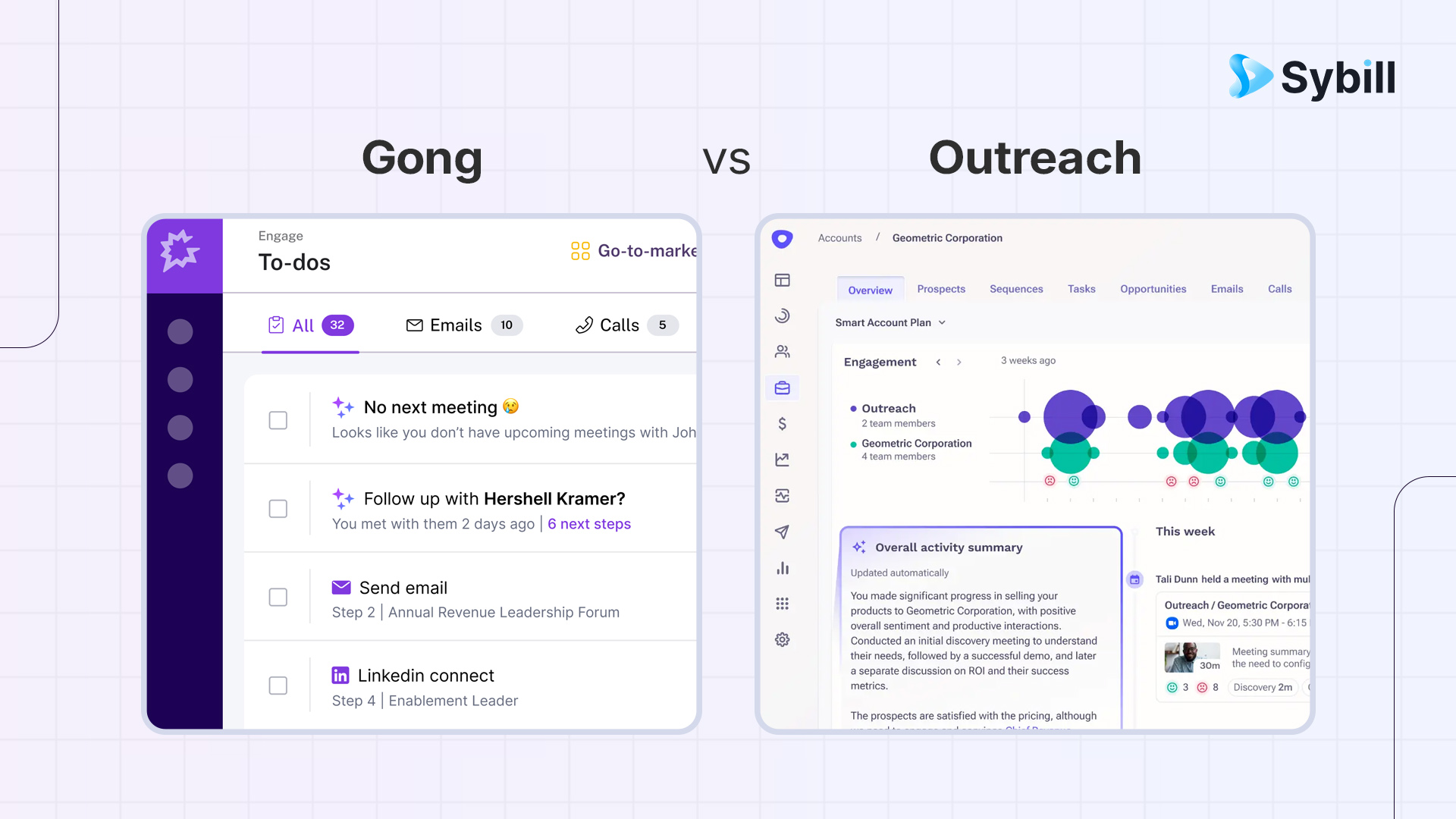
If you've been tasked with picking between Gong and Outreach, welcome to one of the most common debates in B2B sales tech. You're probably sitting in a browser tab with a vendor demo request open in one, a pricing page in another, and this article in a third. Good instinct on the research.
Here's the short version: Gong is a revenue intelligence platform built around conversation analysis and leadership visibility. Outreach is a sales execution platform built around sequencing, task automation, and outbound workflows. They're not quite apples to apples. But they overlap enough to create real confusion, especially if your budget can only stretch to one.
What you'll learn in this guide:
Let's get into it.
![A sales leader reviewing conversation intelligence analytics on a dashboard] Alt text: Sales leader analyzing Gong conversation intelligence dashboard with call recording and deal insights
Gong started as a call recording tool with a very smart pitch: what if you could analyze every sales conversation with AI and actually learn from it at scale? That pitch worked. Today, Gong describes itself as a Revenue Intelligence platform, and it has earned that label.
The platform captures calls, emails, and meeting data, then runs them through AI to surface patterns, coaching opportunities, deal risks, and forecast signals. For sales leaders who want to understand what's actually happening across their pipeline, Gong gives them a window they never had before.
Conversation intelligence is where Gong genuinely shines. It records and transcribes calls, identifies key moments (competitor mentions, pricing discussions, objection patterns), and builds a searchable library of your team's conversations. Managers can jump to the moments that matter without listening to full recordings.
Deal intelligence gives leaders a cross-deal view. You can see which accounts have gone quiet, which have multiple stakeholders engaged, and which deals are at risk based on activity signals, not just what your reps self-report in the CRM.
Coaching workflows let managers bookmark call moments, leave comments, and build coaching libraries from real conversations. New reps can learn from top performers. It's genuinely useful for scaling good habits across a team.
Gong also recently added Engage (for outbound sequencing) and Forecast (for pipeline management), though both are add-ons. The core product is still very much built around conversation analytics.
Gong is expensive. Pricing is custom only, but per-user costs typically fall between $1,300 and $1,600 annually, plus a platform fee that can run $5,000 or more. For a mid-sized team, you're looking at a serious six-figure commitment before you've done anything else.
The tool is also built for leadership. Sales reps often describe it as something that watches them, not something that helps them. CRM updates, follow-up emails, and post-call tasks still land squarely on the rep. Gong tells you what happened. It doesn't do much about it.
If you're interested in how conversational intelligence tools work and what to look for when evaluating them, that's a good place to start building context before any demo call.
Gong does not publish pricing publicly. Based on widely reported figures and user reviews:
For a 20-person team, total annual cost can easily exceed $30,000 to $40,000 before add-ons.
Gong is a strong fit if you are:
![SDR using Outreach sales engagement platform to manage email sequences and prospect touchpoints] Alt text: SDR managing multi-channel sales sequences and prospect outreach workflows in Outreach platform
Outreach was built for the rep who is juggling a hundred prospects at once. Its core strength is sequencing. You build a multi-step cadence of emails, calls, and social touches, and Outreach manages the timing, the personalization tokens, and the task queue so nothing falls through the cracks.
It's a sales execution tool. Where Gong answers "what's happening in my deals?", Outreach answers "how do I make sure my reps are running their plays consistently?"
Email sequencing and automation is Outreach's home turf. You can build sophisticated multi-touch cadences with conditional logic, A/B testing on subject lines, and automatic pausing when a prospect replies. For SDR teams running high volumes, this is genuinely time-saving.
Task management keeps reps organized. Outreach surfaces what needs to happen today, whether that's a call, an email, or a LinkedIn touch, in a prioritized queue. Reps spend less time figuring out who to contact and more time actually contacting them.
Kaia, Outreach's AI assistant, provides real-time coaching during live calls. It surfaces relevant battlecards, notes objections, and suggests next steps, which is useful for reps who are still building pattern recognition.
Deal management and forecasting are also part of the platform, giving managers a way to inspect pipeline and run reviews without jumping between tools.
For more context on how sales engagement platforms stack up against CRM tools, Sybill's guide on sales engagement platforms vs CRM breaks down the functional differences clearly.
Outreach has a UI reputation problem. G2 reviews are polarized. Some users love it. Others describe the interface as cluttered and hard to navigate, especially for new reps who haven't been trained on it. Onboarding can take weeks.
Integrations can also be finicky. HubSpot syncs, in particular, have been flagged by multiple users as unstable. If your CRM hygiene depends on reliable two-way sync, that's worth testing carefully before you commit.
Pricing, while more transparent than Gong, is still substantial. And once you add implementation costs and potential onboarding fees, a 20-person team deployment can run $30,000 or more annually.
A 20-person team at the base rate would pay approximately $24,000/year before implementation and add-ons.
Outreach makes the most sense if you are:
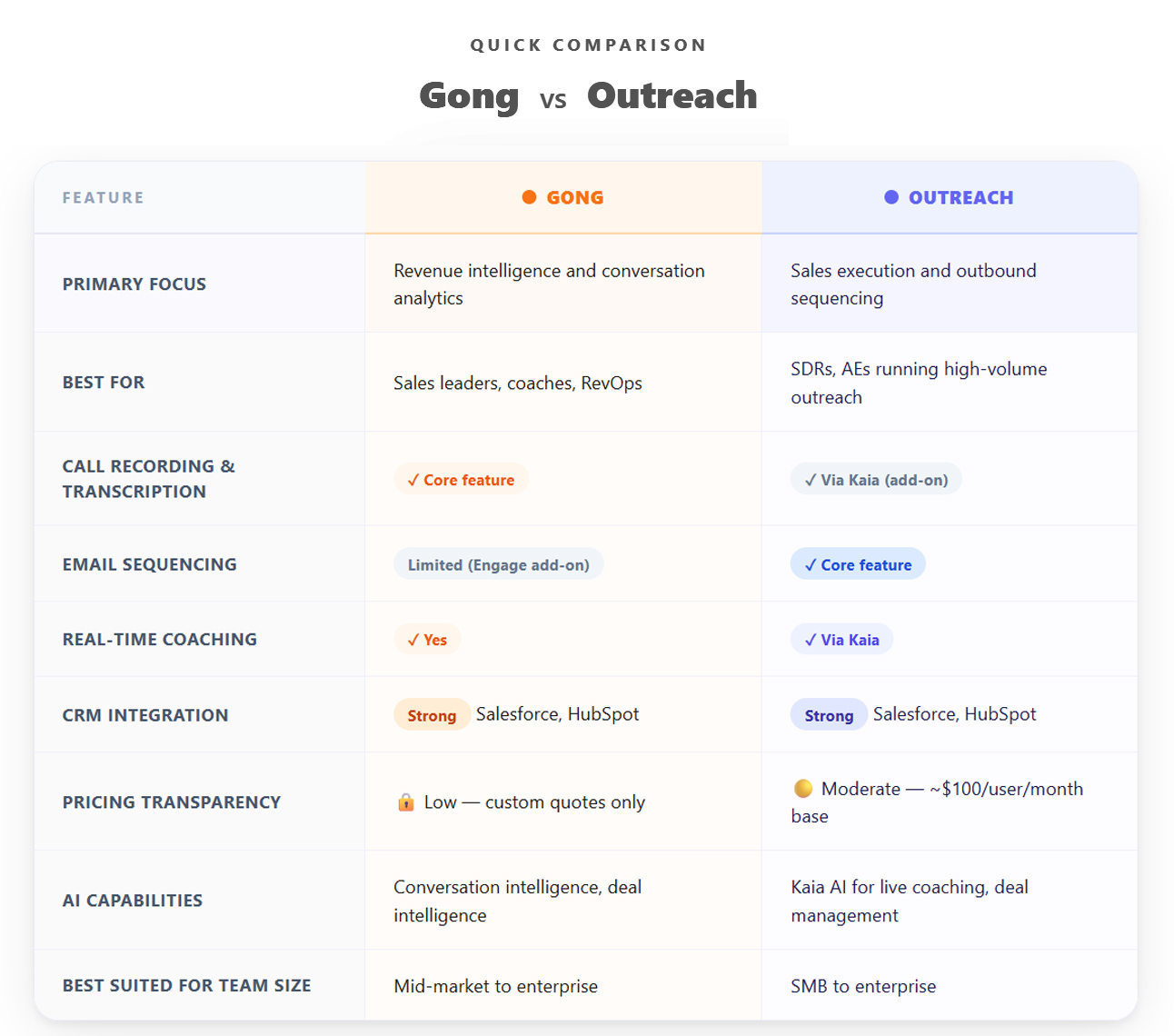
Gong wins this decisively. Call recording and AI-powered conversation analysis is its entire reason for being. The depth of its analytics — topic detection, talk time, sentiment analysis, competitor mentions — is hard to match.
Outreach records calls through Kaia, and the feature is functional, but it's clearly a secondary capability. Outreach's calling features were originally built for volume and task management, not deep analysis.
If conversation intelligence is your primary buying criteria, Gong is the stronger choice between the two.
Outreach wins this one just as clearly. Multi-channel cadences, conditional logic, A/B testing, and task automation are what Outreach was built for. Gong added Engage, but it's a newer product and still catching up in terms of depth and rep adoption.
If your SDR team lives and dies by sequencing efficiency, Outreach is the more mature tool.
Both platforms integrate with Salesforce and HubSpot. Both have experienced users who praise the integration and users who have had sync issues. Gong's CRM integration tends to be deeper on the analytics side. Outreach's is more workflow-focused.
The honest answer here is that neither platform fully solves the CRM hygiene problem, because CRM fields still rely on reps and managers to keep data current. If automated CRM updates are a priority for you, that's worth understanding before you evaluate either tool.
Both platforms have invested heavily in AI, though in different directions.
Gong's AI is retrospective. It analyzes what happened in calls, surfaces patterns, and gives managers better data for coaching and forecasting. It's excellent at answering "what went wrong in that deal?"
Outreach's Kaia is real-time. It surfaces coaching cues during live calls, suggests next steps, and helps reps navigate objections in the moment.
Neither platform has built AI that takes action after the call ends. That's the gap that next-generation tools are starting to fill.
Gong is more expensive, less transparent about pricing, and designed for enterprise scale. Outreach is more accessible for smaller teams but adds up quickly once you factor in implementation and add-ons.
Neither tool is known for being budget-friendly. Both require a meaningful organizational commitment to get value from.
![Sales team decision-making flowchart for choosing between sales intelligence tools] Alt text: Visual decision guide helping sales teams choose the right revenue intelligence or sales engagement platform
Here's what a lot of comparison articles won't tell you: many teams end up needing both. Gong gives leaders visibility. Outreach gives reps structure. But together, they're expensive, and the rep-side busywork — CRM updates, follow-up emails, post-call admin — still largely falls on the human.
That gap, where insight ends and action begins, is where teams are increasingly looking for a third option.
Both Gong and Outreach generate a lot of data and surface a lot of insights. What they don't do well is take action on your behalf after the call ends.
Your reps still have to manually update the CRM. Still have to write the follow-up email. Still have to prep for the next call from scratch. That's three tasks that happen after every single sales conversation, and both tools largely leave them on the rep's plate.
This is exactly where Sybill is built differently. Sybill is an AI sales assistant that doesn't just record and analyze your calls. It actually does the work that comes after. It writes your follow-up emails in your tone, auto-fills your CRM fields (including custom fields and qualification frameworks like MEDDPICC and BANT), and preps you for the next meeting with a brief that knows the full deal history.
Where Gong answers "what happened?" and Outreach answers "what should reps do next?", Sybill answers "consider it done."
Sales teams describe it as going from having a smart observer to having an extra teammate. One sales manager put it plainly: "I no longer spend 90% of 1:1s chasing CRM updates. Now I coach."
Get started with Sybill for free and see how much of your post-call admin you can hand off this week.
Gong and Outreach are both serious platforms with real strengths. They're not interchangeable, which means the first step is being honest about where your actual pain is.
If your biggest problem is leadership visibility and coaching quality, Gong is the more natural fit. If your biggest problem is rep consistency and outbound execution, Outreach is the more natural fit. If your biggest problem is the mountain of admin work that accumulates after every sales conversation, neither platform was built to solve that for you.
That's a gap worth closing. Your reps know it. Your managers know it. And if you've read this far, you probably know it too.
Try Sybill for free and find out how much time your team gets back when the post-call work takes care of itself.
Gong is a revenue intelligence platform focused on analyzing sales conversations and giving leaders visibility into deal health, rep performance, and pipeline. Outreach is a sales execution platform focused on automating outbound sequences, managing rep task queues, and running structured outreach. Gong is built primarily for sales leaders. Outreach is built primarily for the reps in the field.
Yes, and many enterprise teams do. Gong handles call analysis and coaching while Outreach manages sequencing and task execution. The two platforms integrate with each other and with CRMs like Salesforce and HubSpot. That said, using both is a significant budget commitment and doesn't eliminate the post-call admin burden on reps.
For larger sales teams with dedicated RevOps and a real coaching program, Gong's conversation intelligence can deliver meaningful ROI through improved win rates and faster rep ramp times. For smaller teams or those without the bandwidth to actually use its analytics depth, the cost can be hard to justify. Most users find Gong valuable but expensive, and a two-year contract is a big commitment if your needs change.
Outreach's base pricing starts at approximately $100 per user per month, billed annually. That's before a one-time implementation fee (starting around $1,000) and potential onboarding costs that can reach several thousand dollars depending on team size and complexity. Full deployments for mid-sized teams often exceed $30,000 to $45,000 per year.
Yes. Outreach includes call recording and transcription through its Kaia AI feature. However, conversation intelligence is not Outreach's primary strength. If deep call analysis and coaching are your main need, Gong's call recording and analytics are significantly more advanced.
Teams looking for an AI-powered tool that combines call intelligence with actual post-call execution, like automated CRM updates, follow-up email drafting, and deal workspace management, are increasingly turning to Sybill. It's designed to help reps spend more time selling and less time on admin, with pricing that scales better for teams that can't absorb enterprise-level costs.
Outreach is the stronger fit for SDR teams. Its sequencing engine, task automation, and outbound workflow management are purpose-built for high-volume prospecting. Gong is more useful further along in the sales cycle, where conversation analysis and deal coaching add more value.
Gong can push some data to CRM systems, but it does not automatically update custom fields or populate qualification frameworks like MEDDPICC. Reps still largely own CRM data entry. If fully automated CRM hygiene is a priority, look at tools built specifically around that use case, like Sybill's CRM Autofill feature.
Gong is a revenue intelligence platform focused on analyzing sales conversations and giving leaders visibility into deal health, rep performance, and pipeline. Outreach is a sales execution platform focused on automating outbound sequences, managing rep task queues, and running structured outreach. Gong is built primarily for sales leaders. Outreach is built primarily for the reps in the field.
Yes, and many enterprise teams do. Gong handles call analysis and coaching while Outreach manages sequencing and task execution. The two platforms integrate with each other and with CRMs like Salesforce and HubSpot. That said, using both is a significant budget commitment and doesn't eliminate the post-call admin burden on reps.
For larger sales teams with dedicated RevOps and a real coaching program, Gong's conversation intelligence can deliver meaningful ROI through improved win rates and faster rep ramp times. For smaller teams or those without the bandwidth to actually use its analytics depth, the cost can be hard to justify. Most users find Gong valuable but expensive, and a two-year contract is a big commitment if your needs change.








