Find us at booth #83, join us for a harbor side happy hour, or catch Gorish’s talk.

Sept, 16-18 > Learn more

%20(1).avif)
Mamta Tainwala

April 27, 2026
.png)
So you got promoted to sales manager. Congratulations! You crushed quota, closed the impossible deals, and now you're being rewarded with... less time selling and more time in meetings about meetings.
Welcome to management, where your biggest win used to be landing a whale account, and now it's getting your team to actually update the CRM before your VP asks about it (again).
The best sales managers in 2026 succeed by mastering five disciplines: coaching reps with evidence from actual calls rather than gut feel, building a pipeline review cadence based on accurate CRM data rather than optimistic self-reporting, hiring for coachability and curiosity over pure closing ability, creating a culture of accountability through transparency rather than micromanagement, and using AI tools to eliminate the admin burden that prevents both managers and reps from focusing on revenue-generating activities. Tools like Sybill give managers timestamped evidence from every rep's calls, auto-filled CRM fields for trustworthy pipeline data, and deal risk signals that make coaching conversations specific and actionable rather than vague and retrospective.
Here's the thing nobody tells you when you take that promotion: being good at sales doesn't automatically make you good at managing salespeople. It's like being great at playing guitar and suddenly being asked to conduct an orchestra. Same general domain, completely different skill set, and if you screw it up, everyone can hear it.
The best sales managers aren't just glorified quota trackers or pipeline hall monitors. They're coaches, strategists, therapists, cheerleaders, and sometimes the only thing standing between a burnt-out rep and a resignation letter. They understand that their job isn't to be the hero anymore. It's to build heroes.
This guide isn't going to give you generic LinkedIn inspiration about "leading from the heart" or whatever. We're going deep on the actual, tactical skills that separate managers who inspire quota-crushing teams from those who inspire job searches. We're talking real-world scenarios, the uncomfortable conversations, the unsexy administrative stuff that actually moves needles, and the modern tools (yes, including AI) that are changing the game.
Whether you're a brand-new manager trying not to mess up your first quarter, a seasoned leader looking to level up, or an ambitious rep wondering if management is even worth it, buckle up. This is going to be a ride.
Let's get one thing straight before we dive into skills: management in 2025 is fundamentally different than it was even three years ago.
Remote and hybrid work has killed the "management by walking around" approach. Your reps aren't at desks you can casually swing by. They're in home offices, coffee shops, or their parents' basements (no judgment, rent is insane). The old playbook of overhearing calls and giving instant feedback is dead.
Meanwhile, buyer expectations have evolved faster than most sales orgs. Your prospects are doing more research, involving more stakeholders, and expecting more personalized interactions. This trickles down to what you need from your team and how you need to coach them.
And then there's AI. Some managers are terrified it'll replace them. Smart managers realize it's the ultimate force multiplier. The managers who figure out how to blend AI capabilities with human coaching and strategy are the ones building unstoppable teams.
Your job as a sales manager in this new landscape? It's not to be everywhere or know everything. It's to create an environment where your team can do their best work, give them the tools and insights to win, and remove the obstacles that slow them down.
Now let's talk about how you actually do that.
There's a scene that plays out in sales orgs everywhere. A rep loses a deal. The manager swoops in and says, "Here's what you should have done..." The rep nods, says "got it," and then promptly doesn't internalize a single word because they weren't part of discovering the solution.
This is the difference between coaching and telling. And if you can't master this distinction, you're going to build a team of order-takers, not hunters.
Real coaching means asking questions that lead reps to their own insights. When a deal stalls, instead of diagnosing the problem yourself, try: "What do you think caused the prospect to go quiet?" or "If you were the buyer in this situation, what would concern you most?"
The best coaches I've seen use the Socratic method without being annoying about it. They guide reps through a thought process that builds pattern recognition. Over time, your reps start coaching themselves because you've trained their internal dialogue.
Here's what effective sales coaching actually looks like:
Call Review Sessions That Don't Suck
Most call reviews are painful. The manager talks 80% of the time, the rep feels defensive, and nothing changes. Flip the script. Have your rep self-assess first. "On a scale of 1-10, how would you rate your discovery questions?" Then dig into the gap between their self-perception and reality.
Modern tools have made this infinitely easier. Instead of listening to every call yourself (impossible if you have more than three reps), use AI-powered call analysis to identify coachable moments. Tools that automatically surface when reps miss buying signals, talk too much, or fail to multi-thread give you a coaching superpower: data-backed examples without the manual slog.
Ask Sybill is actually killer for this because you can literally ask it questions like "When did my rep miss an objection?" or "Show me where the prospect expressed urgency" and get timestamped moments. This means your coaching sessions focus on the right 5 minutes of a 45-minute call instead of you guessing what to review.
The 30-60-90 Day Coaching Plan
If you're not creating individual development plans for each rep, you're managing, not coaching. Every person on your team has different strengths, weaknesses, and career goals. Your top performer needs different coaching than your struggling newbie.
Create a simple framework:
Review progress weekly. Adjust based on what's working. This isn't busy work. This is how you systematically build capability instead of hoping reps just "figure it out."
Role-Playing Without the Cringe
Yes, role-playing is awkward. Yes, your reps will hate it at first. Yes, you should do it anyway because it's the only way to practice high-stakes conversations without real consequences.
Make it less painful by focusing on specific scenarios your team is actually facing. Lost a deal last week because nobody could answer a technical question? Role-play that. Struggling to get past gatekeepers? Practice it.
The key is making it safe. When a rep messes up in role-play, that's the point. That's where learning happens. Celebrate the screw-ups in practice so they don't happen with real prospects.
You know what makes or breaks a sales team? Communication. Not the quality of your CRM, not your comp plan, not your tech stack. Communication.
When communication is tight, everything flows. Reps know what's expected, deals move faster, problems get solved before they become crises. When communication is broken, you get surprises at the end of quarters, rep turnover, and deals dying in late stages because everyone had different information.
As a sales manager, you're the central communication node. You're translating between leadership and frontline reps. You're aligning cross-functional teams. You're setting expectations, giving feedback, and making sure everyone's rowing in the same direction.
Here's how to level up your communication game:
Overcommunicate Priorities (And Actually Stick to Them)
Your reps are drowning in requests. Marketing wants them to test new messaging. Product wants feedback on features. Leadership wants more pipeline. You want better forecasting. Everyone wants something.
Your job is to filter this noise and give your team crystal clear priorities. "This quarter, we're focused on three things: 1) Expansion in existing accounts, 2) Shortening our sales cycle, 3) Improving our close rate on qualified opps." That's it. Everything else is secondary.
Then, and this is the hard part, you actually have to protect them from scope creep. When someone asks your team to do something outside these priorities, you push back. This is how you build trust. Reps need to know you're running interference so they can focus on what matters.
Master the Different Communication Channels
Slack for quick questions. Email for documentation. Video calls for complex discussions. 1:1s for coaching and feedback. Team meetings for alignment and morale.
Bad managers treat all communication the same. They send paragraphs in Slack that should be emails. They schedule meetings that should be Slack messages. They give critical feedback in public channels.
Learn when to use each channel. Urgent pipeline issue? Slack. Important feedback? 1:1 video call. Celebrating a win? Public channel where everyone can see it. Process change? Email with clear subject line and action items.
The Weekly Email That Nobody Hates
Most manager emails are bloated, confusing, and get immediately archived. Here's a template that actually works:
Subject: Week of [Date] - Wins, Priorities, Needs
Wins: [Celebrate specific achievements with names]
This Week's Focus: [2-3 clear priorities]
Important Updates: [Keep it brief]
How I Can Help: [What you're working on to support them]
Team Needs: [What you need from them]
That's it. Five sections, scannable in 60 seconds, everything they need to know. Send it Monday morning. Be consistent. Watch how often people reference it in meetings.
Feedback That Actually Lands
Most managers are terrible at giving feedback. They're either too harsh (demotivating) or too soft (confusing). They wait until quarterly reviews (too late) or give it randomly (anxiety-inducing).
Here's the framework: Situation, Behavior, Impact, Next Steps.
"In yesterday's call with Acme Corp [situation], I noticed you jumped straight to pricing without understanding their current process [behavior]. This made the prospect defensive and they pushed back on value [impact]. Next time, let's spend more time in discovery before introducing pricing. Want to role-play this scenario? [next steps]"
Specific. Timely. Actionable. Not personal. That's feedback that improves performance instead of creating resentment.
Here's where a lot of sales managers fall short. They get so caught up in the daily grind of pipeline reviews and forecast calls that they forget to think strategically about how to win.
Strategy isn't just for executives. As a frontline sales manager, you need strategic thinking at multiple levels: account strategy, competitive strategy, team development strategy, and territory optimization.
Account Strategy Beyond the CRM
Your best reps don't just work opportunities. They orchestrate campaigns. They map organizational structures, identify champions and blockers, understand political dynamics, and execute multi-threaded engagement strategies.
Your job is to coach this level of strategic thinking. In account reviews, don't just ask "what's the next step?" Ask "who else needs to be involved?" and "what could derail this?" and "how are we differentiating from competitors?"
Great account strategy means understanding:
This is where AI tools are becoming genuinely useful. When you can automatically track which contacts your reps are engaging with and identify gaps in multi-threading, you can coach more strategically. "I see you've talked to the VP three times but haven't engaged anyone in finance yet. That's a risk because they're always involved in procurement."
Competitive Intelligence as a Team Sport
Your reps are hearing competitive intelligence every day. Prospects mention other vendors, share what competitors are pitching, reveal why they chose or didn't choose alternatives. But if this information stays siloed in individual rep heads, you're missing a huge opportunity.
Create a system for capturing and sharing competitive intel. Could be a Slack channel, a shared doc, a weekly debrief. The format matters less than the habit.
What should you track?
The best competitive strategy is proactive, not reactive. Don't just defend against competitor attacks. Shape the buyer's evaluation criteria to favor your strengths before competitors even enter the conversation.
Territory and Account Segmentation
Not all accounts are created equal. Not all opportunities deserve the same effort. Strategic managers know how to segment their territory and allocate resources accordingly.
Create a simple framework:
Your best reps should focus on Tier 1. Your developing reps can cut their teeth on Tier 2 and 3. This isn't about writing off smaller accounts, it's about being intentional with your scarcest resource: time.
Thinking Three Quarters Ahead
Great sales managers aren't just managing this quarter's pipeline. They're building next quarter's pipeline while coaching reps who will close deals two quarters from now.
This requires thinking in layers:
If you're only focused on this quarter, you're going to have a feast-or-famine pipeline forever. Strategic managers are constantly balancing short-term execution with long-term pipeline building.
Every sales manager has access to data. The best sales managers know what data actually matters and how to use it to drive behavior.
There's a huge difference between looking at dashboards and extracting actionable insights. Most managers drown in metrics without improving performance. You need to cut through the noise.
The Metrics That Actually Matter
Forget vanity metrics. Here's what you should obsess over:
Activity Metrics (Leading Indicators):
Pipeline Metrics (Current State):
Outcome Metrics (Lagging Indicators):
The magic happens when you connect these. If a rep has great activity numbers but low conversion rates, that's a qualification or skills issue. If they have low activity but high conversion, they need help with top-of-funnel generation.
Weekly Pipeline Reviews That Don't Make Everyone Miserable
Most pipeline reviews are terrible. Managers grill reps about every opportunity. Reps get defensive. Everyone leaves stressed. Nothing improves.
Here's a better approach: Focus on deals that are either (a) closing this month, (b) at risk of stalling, or (c) unusually large or strategic. Skip the deals that are progressing normally.
Use the "stoplight" method:
This way you're not wasting 45 minutes reviewing deals that are fine. You're spending time where you can actually add value.
Better yet, use tools that automagically identify at-risk deals based on patterns. If a deal hasn't had meaningful activity in two weeks, hasn't engaged multiple stakeholders, or is stuck in one stage too long, that's a yellow or red light. You don't need to discover this manually in a meeting.
Using AI to Spot Patterns You'd Miss
Here's where modern sales managers have a huge advantage: AI can analyze patterns across thousands of interactions that would be impossible for humans to spot.
Which discovery questions correlate with closed-won deals? What verbal cues indicate a prospect is ready to buy? Which reps consistently miss key buying signals? How do top performers structure their demos differently?
This isn't about replacing your judgment. It's about augmenting it with insights you literally couldn't get any other way.
For example, if your AI analysis shows that deals where you engage procurement early close 30% faster, that becomes a coaching point for every rep. If it shows that prospects who ask about implementation timelines in the first call are 3x more likely to close, you can train reps to recognize and respond to that signal.
The managers winning right now are using these insights to create playbooks based on what actually works, not what they think works.
Culture isn't free lunch and ping pong tables. Culture is what happens when you're not in the room. It's how your team treats each other, how they respond to adversity, and whether they're energized or demoralized.
As a sales manager, you're the primary culture-setter for your team. Leadership can talk about company values all day, but if you're toxic, burnt out, or apathetic, your team will be too.
Celebrating Wins (The Right Way)
Most managers either over-celebrate (ringing gongs for every small deal) or under-celebrate (barely acknowledging when someone crushes quota). Neither extreme is ideal.
Celebrate meaningfully:
Make celebration a habit, not an afterthought. It's positive reinforcement that actually drives behavior.
Creating Psychological Safety
Your team will never bring you bad news if they're afraid of your reaction. They'll hide pipeline risks, avoid admitting mistakes, and let problems fester until they explode.
Psychological safety means reps can say "I screwed up and lost the deal" without fearing consequences. It means they can disagree with your strategy without being labeled difficult. It means they can ask "stupid" questions without judgment.
How do you build this?
When reps feel safe, they're more likely to take intelligent risks, try new approaches, and communicate honestly about pipeline. That's how you build an adaptive, high-performing team.
Managing Different Personality Types
Your team isn't homogeneous. You've got:
You cannot manage all of these people the same way. Great managers adapt their style to what each person needs.
The cowboy needs accountability and structure. The perfectionist needs encouragement and permission to fail. The steady performer needs appreciation and clear goals. The newbie needs coaching and protection from getting overwhelmed.
This is exhausting, by the way. Managing humans is the hardest part of the job. But it's also where you have the most impact.
Nobody likes difficult conversations. But avoiding them doesn't make them go away. It makes them worse.
As a sales manager, you're going to have to deliver bad news, give critical feedback, manage out poor performers, and navigate interpersonal conflicts. Your ability to handle these conversations with clarity and empathy will define your leadership.
The Performance Improvement Conversation
When a rep is consistently underperforming, you have three options: coach them up, move them to a different role, or manage them out. Avoiding the conversation just delays the inevitable and hurts team morale.
Here's the framework:
Start with empathy: "I've noticed you're struggling to hit quota the last three months. I want to understand what's going on."
Get their perspective: Listen more than you talk. Maybe they're dealing with personal issues. Maybe they feel they're getting poor quality leads. Maybe they're in the wrong role.
Be direct about expectations: "Here's where I need you to be by [date]. We're going to work together on [specific improvements], and I'll provide [specific support]."
Create accountability: "Let's check in weekly on progress. If we're not seeing improvement by [date], we'll need to discuss whether this role is the right fit."
This isn't mean. This is kind. Letting someone flounder without clear feedback and expectations is the cruel option.
Dealing with Team Conflict
Sales teams have drama. Reps compete for deals, credit, resources, and attention. Personalities clash. Egos bruise.
Your job isn't to be everyone's friend. It's to create an environment where conflict gets resolved professionally.
When conflict arises:
Sometimes you need to make hard decisions about who stays and who goes. A toxic high performer who destroys team morale is often more harmful than a mediocre performer who uplifts everyone. Choose culture.
Advocating for Your Team to Leadership
Your reps can't advocate for themselves in leadership meetings. That's your job.
When leadership asks for stretch goals, you push back if they're unrealistic. When your reps need resources, you fight for budget. When someone above you makes a decision that will hurt your team, you speak up.
This requires political capital and courage. But if your team doesn't believe you have their back, they'll never have yours.
The best sales managers are translators. You translate leadership's vision into actionable plans for reps. You translate frontline feedback into strategic insights for leadership. You're the buffer and the bridge.
Process is a double-edged sword. Good process removes friction and creates consistency. Bad process adds bureaucracy and slows everyone down.
Your challenge as a sales manager: create enough structure to drive predictable outcomes without suffocating your team with admin work.
The CRM Battle
Let's be honest: most reps hate updating the CRM. They see it as admin work that takes time away from selling. And they're not entirely wrong.
But an updated CRM is how you forecast accurately, identify at-risk deals, and spot opportunities for coaching. So you need compliance.
Here's how to get it:
Modern tools can automatically update CRMs after sales calls, pulling key information from conversations and syncing it to the right fields. This eliminates 80% of manual data entry. If you're not using automation here, you're wasting your team's time.
Deal summaries that automatically populate after every call mean your reps spend less time typing and more time selling. That's the kind of process improvement that actually helps instead of hinders.
The Qualification Framework Everyone Actually Uses
BANT, MEDDIC, CHAMP... there are a million qualification frameworks. Most sales orgs pick one, train everyone on it, and then nobody uses it consistently.
The problem isn't the framework. It's that most frameworks are too complex for everyday use.
Create a simple qualification checklist:
That's it. Five questions your reps can answer about any opportunity. If they can't answer these, the opportunity isn't qualified.
Train your team to qualify hard and disqualify fast. A smaller pipeline of qualified opportunities is infinitely better than a bloated pipeline full of tire-kickers.
Stage Definitions That Actually Mean Something
Most CRM stage definitions are vague: "Discovery," "Proposal," "Negotiation." What do these actually mean? When should a deal move from one stage to the next?
Create clear stage exit criteria:
When everyone uses the same criteria, your pipeline accuracy skyrockets. No more deals sitting in "Demo" for six months because nobody defined what Demo actually means.
Sales tech has exploded. There are tools for everything: prospecting, email sequencing, call recording, conversation intelligence, deal forecasting, sales enablement, you name it.
The challenge: more tools don't automatically equal better results. In fact, too many tools create confusion, fragmentation, and wasted budget.
The Tech Stack That Actually Works
Focus on tools that either:
Everything else is noise.
Your core stack should probably include:
That's it. Five categories. Don't buy tools just because they're trendy or a competitor uses them.
The AI Revolution in Sales Management
AI isn't going to replace sales managers. But sales managers who use AI effectively are going to replace those who don't.
Here's what AI actually does well right now:
What AI doesn't do well (yet):
Smart managers use AI to handle repetitive analysis and admin work, freeing up time for the high-value human stuff: coaching, strategy, relationship building.
For example, instead of listening to every call yourself, you can use AI to flag calls where reps struggled with objections, missed buying signals, or failed to multi-thread. You review those specific moments and coach on them. That's 10x more efficient than hoping you randomly pick the right calls to review.
AI coaching tools are getting genuinely good at providing personalized suggestions for each rep based on their actual performance data, not generic advice. This doesn't replace your coaching, but it augments it significantly.
Integration Over Proliferation
The best tech stacks aren't the ones with the most tools. They're the ones where tools talk to each other seamlessly.
Before buying any new tool, ask:
Most sales tech purchases fail because of poor adoption, not poor functionality. Make sure you have a change management plan before implementing anything new.
Accurate forecasting is one of the most important and most difficult parts of sales management. Get it wrong and you're constantly in fire drill mode, scrambling to close gaps or explaining misses to leadership.
Why Most Forecasts Suck
Forecasting fails for a few predictable reasons:
Optimism bias: Reps are naturally optimistic (it's what makes them good salespeople). They overestimate their chances and underestimate what could go wrong.
Sandbagging: Some reps deliberately underforecast so they look like heroes when they overperform. This makes your aggregate forecast garbage.
Lack of data discipline: If your CRM data is messy, your forecast will be messy. Garbage in, garbage out.
No accountability: If there are no consequences for consistently bad forecasting, reps won't get better at it.
Building a Forecast You Can Defend
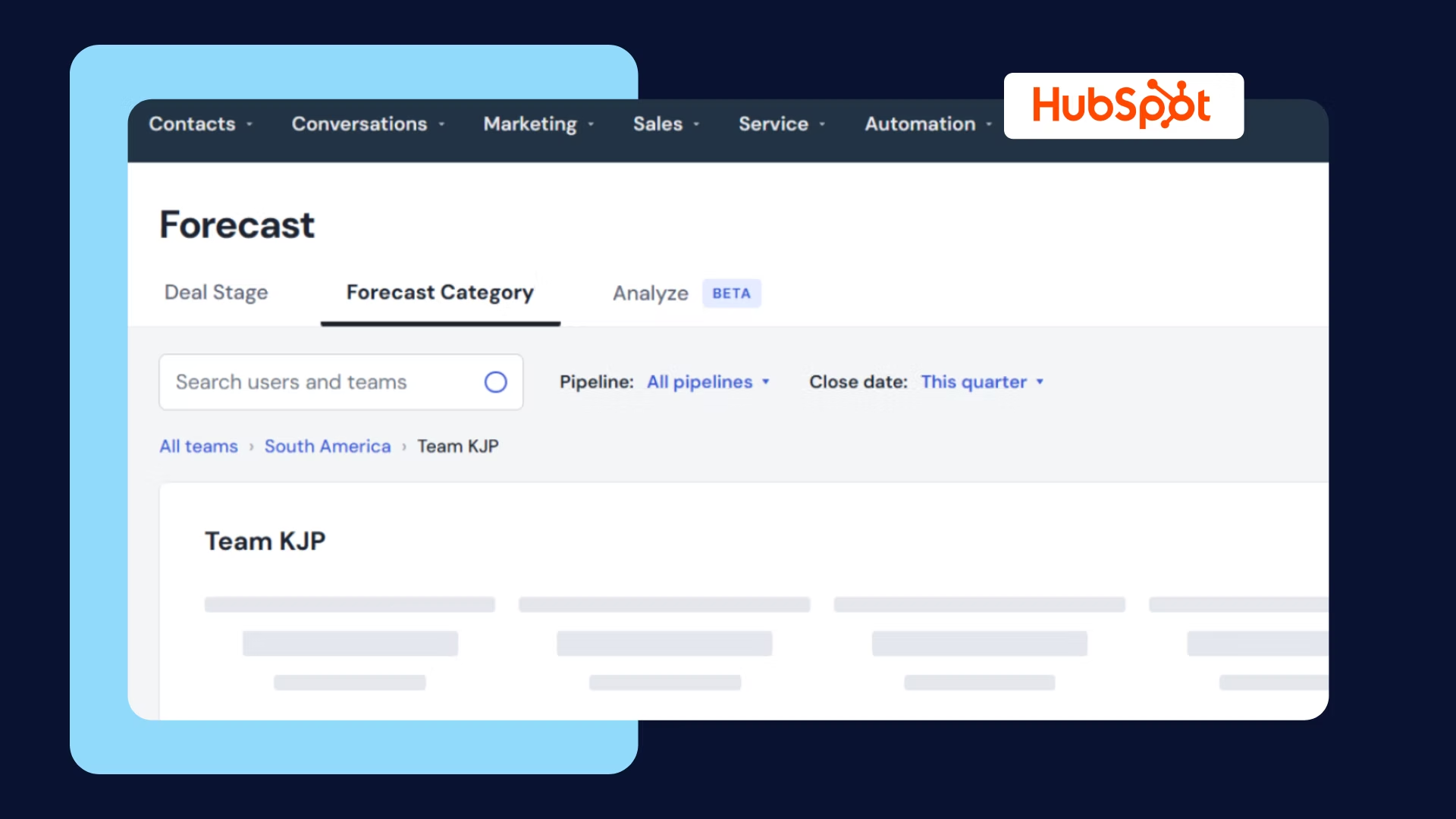
Start with clear forecast categories:
Commit should be sacred. If a rep calls something Commit and it doesn't close, you need to understand why. Either they misjudged the deal or something unexpected happened. Both are learning opportunities.
Use historical data to calibrate your forecast. If your team historically closes 60% of what they call Commit, you know to adjust. If they close 90%, you can trust the number more.
Layer in objective deal health signals:
When you combine rep input with objective data, your forecast accuracy improves dramatically. You're not just taking their word for it, but you're also not ignoring their on-the-ground intelligence.
The Weekly Forecast Rhythm
Don't just forecast once at the end of the month when leadership demands it. Create a weekly rhythm:
Monday: Review Commit category deals, identify any risks Wednesday: Update Best Case deals, move things around as needed Friday: Lock forecast for the week, communicate any changes up
This weekly cadence keeps forecasting front of mind instead of a quarterly fire drill. It also forces earlier conversations about at-risk deals when you can still do something about them.
Using AI for Deal Risk Detection
One of AI's genuine superpowers right now: spotting at-risk deals before you realize they're at risk.
Patterns humans miss:
AI can flag these patterns across your entire pipeline simultaneously. You get alerted to risks early enough to course-correct instead of discovering problems during forecast calls.
This isn't about replacing your judgment. It's about giving you an early warning system so you can investigate before deals slip.
Here's an uncomfortable truth: as a sales manager, you're probably responsible for pipeline generation even if you have an SDR team or inbound marketing. Reps need opportunities to work, and "more leads" is always top of mind.
Balancing Inbound, Outbound, and Expansion
Most teams over-rely on one channel. Inbound-heavy teams panic when marketing underperforms. Outbound-focused teams burn reps out on cold prospecting. Expansion-focused teams plateau when they max out existing accounts.
The best teams have a balanced motion:
Your mix will depend on your ICP, product, and market. But relying too heavily on any single channel creates fragility.
As a manager, your job is to ensure each channel is optimized:
Teaching Reps to Prospect (Without Hating Their Life)
Prospecting is hard. It's rejection-heavy, time-consuming, and most reps would rather do literally anything else.
But your best reps are good prospectors. Not because they love it, but because they're strategic about it.
Teach your team:
Quality over quantity: 20 highly researched, personalized outreach messages beat 200 generic templates.
Trigger-based prospecting: Don't prospect randomly. Prospect when something changes (funding, leadership change, product launch, competitor news).
Multi-channel approach: Email, LinkedIn, phone, video messages. Different prospects prefer different channels.
Referral mining: Your happy customers know other people with similar problems. Ask for introductions.
Pattern interrupts: Generic cold emails get ignored. Personalized, specific, valuable messages get responses.
Create a prospecting playbook with templates, examples, and best practices. Make it easy for reps to do it well instead of forcing them to reinvent the wheel.
Sales teams are meeting-heavy. Pipeline reviews, forecast calls, 1:1s, team meetings, training sessions, QBRs. If you're not careful, your reps spend more time in meetings than actually selling.
The 1:1 That Actually Matters
Your 1:1 with each rep is the most important recurring meeting you have. This is where coaching happens, problems surface, and trust builds.
Structure your 1:1s:
Never cancel 1:1s. Even if you're slammed, a 30-minute 1:1 is sacred time. Canceling it tells your rep they're not a priority.
Team Meetings That Don't Suck
Most team meetings are a waste. Long, unfocused, dominated by the loudest voice, and everyone multitasks through them.
Here's how to fix it:
Have a clear agenda (and share it beforehand so people can prepare)
Time-box everything (15 minutes for wins, 20 for training, 10 for updates, that's it)
Make it interactive (don't just talk at people, get them involved)
End with clear action items (who's doing what by when?)
Start and end on time (respect people's calendars)
One format that works well: Wins, Learns, Burns
.
Keep it to 45 minutes max. Any longer and you lose people.
Skip Meetings That Should Be Emails
Before scheduling any meeting, ask: "Could this be an email, Slack message, or Loom video instead?"
If yes, don't schedule the meeting. Your reps will thank you.
Reserve synchronous time for:
Everything else can be asynchronous.
Sales management is fundamentally a people job. You can have perfect processes, great tools, and solid strategy, but if you can't read people, build relationships, and navigate emotions (yours and theirs), you'll struggle.
Self-Awareness: Know Your Triggers
Every manager has triggers. Situations that make them overreact, shut down, or handle things poorly.
Maybe it's reps missing forecast. Maybe it's being blindsided by bad news. Maybe it's conflict between team members. Maybe it's pressure from your own manager.
The first step to managing your reactions is knowing your triggers. When you feel yourself getting frustrated or stressed, pause. Take a breath. Respond intentionally instead of reacting emotionally.
Your team is watching how you handle pressure. If you panic every time pipeline dips, they'll panic too. If you stay calm and focused on solutions, they'll mirror that.
Empathy: See Things From Their Perspective
Your reps are dealing with rejection daily. They're managing difficult prospects, competing for deals, and carrying quota stress. They have personal lives with problems you may not know about.
Before jumping to judgment when someone underperforms or messes up, try to understand what's going on. "Hey, I noticed you've seemed off the last couple weeks. Everything okay?"
Sometimes the answer is just work stress. Sometimes it's a sick parent, relationship problems, or financial pressure. You can't fix everything, but you can be a human being who cares.
Empathy doesn't mean lowering standards. It means understanding context while still holding people accountable.
Social Awareness: Read the Room
Great managers pick up on subtle cues. They notice when team energy is low. They sense tension between reps. They recognize when someone's quiet in a meeting because they're nervous, not disengaged.
This requires paying attention. Really paying attention. Not just to what people say, but how they say it. Body language, tone, patterns of behavior.
When you notice something's off, address it. "Team seems tired today. What's going on?" Often just acknowledging what everyone's feeling creates space to deal with it.
Relationship Management: Build Real Connections
You don't have to be best friends with your reps. But you do need genuine relationships built on trust and respect.
This means:
The best managers I've seen treat their reps like whole humans, not just quota-carrying units. That doesn't mean being a pushover. It means leading with humanity.
Here's a hard truth: the skills that got you promoted to manager aren't the skills that will make you great at management. You need to actively develop yourself.
Stay Current on Sales Methodology
Sales is evolving. New methodologies, frameworks, and approaches emerge constantly. SPIN Selling, Challenger Sale, Gap Selling, MEDDIC, Command of the Message...
You don't need to adopt every new framework. But you should understand them. Your reps might learn something at a training or from a book and want to try it. You need to be conversant enough to guide them.
Read books. Listen to podcasts. Attend conferences. Join communities of other sales leaders. Stay curious.
Learn From Your Best Reps
Your top performers are doing something right. Instead of assuming you know what it is, ask them. Shadow their calls. Understand their process.
Then, translate what they do into something teachable for the rest of your team. Often, top performers succeed through intuition. Your job is to make that intuition explicit and repeatable.
Get Your Own Coach or Mentor
Management is isolating. You can't always be vulnerable with your team. You can't complain to your boss about your boss. You need someone outside your reporting structure who can give you honest feedback and perspective.
This could be a formal executive coach. Could be a peer manager. Could be a former manager who's further along in their career.
Having someone to talk through challenges with, get feedback from, and learn from is invaluable. Don't try to figure everything out alone.
Seek Feedback Relentlessly
Ask your team: "What should I keep doing, stop doing, and start doing as your manager?"
Ask your boss: "What do you wish I did differently?"
Ask your peers: "Where do you see me struggling?"
This is uncomfortable. Nobody likes hearing criticism. But you can't improve what you don't know is broken.
The best managers create a culture of feedback by modeling it themselves. They seek it, they receive it graciously, and they act on it.
Sales doesn't exist in a vacuum. The best sales managers understand how their team's performance impacts the broader business.
Learn How Your Company Makes Money
Beyond just revenue, understand:
When you understand the business model, you make better decisions about which deals to pursue, how to structure pricing, and where to invest your team's time.
Partner With Other Functions
Sales often has adversarial relationships with other departments. Sales blames marketing for bad leads. Marketing blames sales for not following up. Product blames sales for selling vaporware. Sales blames product for missing features.
Break this cycle. Build genuine partnerships:
With Marketing: Collaborate on ICP definition, provide feedback on campaign quality, share win/loss insights.
With Product: Give them real customer feedback (not just feature requests), help them understand buyer priorities, facilitate customer conversations.
With Customer Success: Create smooth handoffs, share context on customer expectations, jointly plan expansion strategies.
With Finance: Help them forecast accurately, explain deal structure nuances, partner on pricing strategy.
When these relationships are strong, your job gets easier and your team wins more.
Think Like a CEO (Of Your Territory)
Pretend your team is a small business within the larger company. You have revenue targets, expenses (headcount, tools), and resources to allocate.
How would you run this business to maximize outcomes? Where would you invest? What would you cut? How would you differentiate? What risks would you take or avoid?
This mental model forces strategic thinking beyond just "hit quota." It makes you a better business leader, not just a sales manager.
Management is draining. You're responsible for other people's success, dealing with constant problems, and carrying significant pressure. If you burn out, your team suffers.
Set Boundaries
Just because you can work 12-hour days doesn't mean you should. Model healthy boundaries for your team.
Take your PTO. Disconnect on weekends (mostly). Don't send emails at 11 PM expecting responses.
Your team watches your behavior more than they listen to your words. If you're always on, they'll feel pressure to always be on. That leads to burnout.
Find Your Stress Relief
Whether it's exercise, hobbies, time with family, meditation, whatever. You need activities that recharge you.
Management is a marathon, not a sprint. You can't operate at maximum stress for years without consequences. Find ways to sustainably manage the pressure.
Celebrate Your Wins Too
Managers are great at celebrating their team but terrible at acknowledging their own successes.
When your team hits quota, that's partly because of your coaching. When a rep lands a big deal, that's partly because you helped them strategize. When pipeline is healthy, that's partly because of the processes you built.
Take a moment to acknowledge your contribution. You're doing hard work that matters. Don't let imposter syndrome convince you otherwise.
Know When to Ask for Help
If you're drowning, overwhelmed, or struggling, ask for help. From your boss, from peers, from HR, from a therapist.
There's zero shame in needing support. Actually, recognizing when you need help and seeking it out is a sign of strength and self-awareness.
You can't pour from an empty cup. Take care of yourself so you can show up fully for your team.
Okay, you've made it through 3,000+ words of sales management wisdom. Your brain is probably full. Now what?
You can't implement everything at once. That's a recipe for overwhelm and half-assed execution. Instead, pick a few areas to focus on each month.
Month 1: Foundation
Month 2: Systems
Month 3: Culture and Development
Don't try to be perfect. Try to be 1% better each week. Small, consistent improvements compound into massive results over time.
Being a great sales manager isn't about being the hero anymore. It's about building heroes.
It's about creating an environment where talented people can do their best work. It's about coaching them to discover their own solutions instead of handing them answers. It's about protecting them from chaos while pushing them toward excellence.
It's about using data to drive insights, not just generate reports. It's about building genuine relationships while maintaining accountability. It's about staying current with methodology and technology while never forgetting that sales is fundamentally a human endeavor.
It's exhausting. It's frustrating. You'll have days where you question whether you made the right decision taking this promotion.
But it's also incredibly rewarding. When a struggling rep finally breaks through because of your coaching, when your team crushes quota because of the systems you built, when someone tells you that you're the best manager they've ever had... that's what makes it worth it.
You're not just hitting numbers anymore. You're building careers. You're shaping how people think about work. You're creating a culture that people will remember long after they leave your team.
That's the real measure of a great sales manager. Not just quota attainment, but the legacy you leave in the people you develop.
Now go build something great.
Real talk? At least a year, probably closer to two. The first few months you're just trying not to drown. You're learning the rhythms, building relationships, and figuring out what works for your specific team. Around month six, you start getting your footing. You understand your reps' patterns, you've seen a few quarters play out, and you're making fewer rookie mistakes. By year two, you've seen enough situations that you can pattern-match and respond effectively. That said, great managers never stop learning. Every rep is different, every market shift creates new challenges, and the tools and methodologies evolve constantly. The managers who think they've "figured it out" are usually the ones who've stopped growing. Stay humble, stay curious, and give yourself grace as you develop these skills.
Trying to be the hero rep instead of the coach. You got promoted because you were great at closing deals. Now your job is to make other people great at closing deals. That requires a completely different skill set. New managers often: jump in and take over deals instead of coaching reps through them, spend too much time selling themselves instead of managing, try to be everyone's friend instead of their leader, avoid difficult conversations because they want to be liked, or implement the processes that worked for them personally without considering what the team needs. The transition from individual contributor to manager is genuinely one of the hardest career shifts you'll make. What made you successful as a rep (personal achievement, direct control, immediate results) doesn't translate to management (team achievement, indirect influence, delayed results). The sooner you embrace that your job has fundamentally changed, the faster you'll succeed in your new role.
This is the eternal management tension, and honestly, it never gets easy. But here's the framework: Be hard on standards, soft on people. You can maintain high expectations while being empathetic about the human challenges of meeting them. Accountability without support is just being a jerk. "You're not hitting quota, figure it out" doesn't help anyone. Support without accountability is enabling mediocrity. "I know you're trying hard, that's what matters" when someone chronically underperforms isn't kind, it's cruel because you're preventing them from growing or finding a role where they can succeed. The sweet spot is clear expectations plus genuine support. "Here's the standard we need to hit. Here's what I see as the gap. Here's how I'm going to help you close that gap. And here's the timeline we're working with." Then you follow through. You provide the coaching, resources, and feedback you promised. You check in regularly. You celebrate progress. And if, despite all that support, someone still can't meet the standard, you make the hard call to transition them out. That's not being mean. That's being a leader who cares enough to be honest and helpful, even when it's uncomfortable.