Find us at booth #83, join us for a harbor side happy hour, or catch Gorish’s talk.

Sept, 16-18 > Learn more

%20(1).avif)
Mamta Tainwala

May 15, 2026
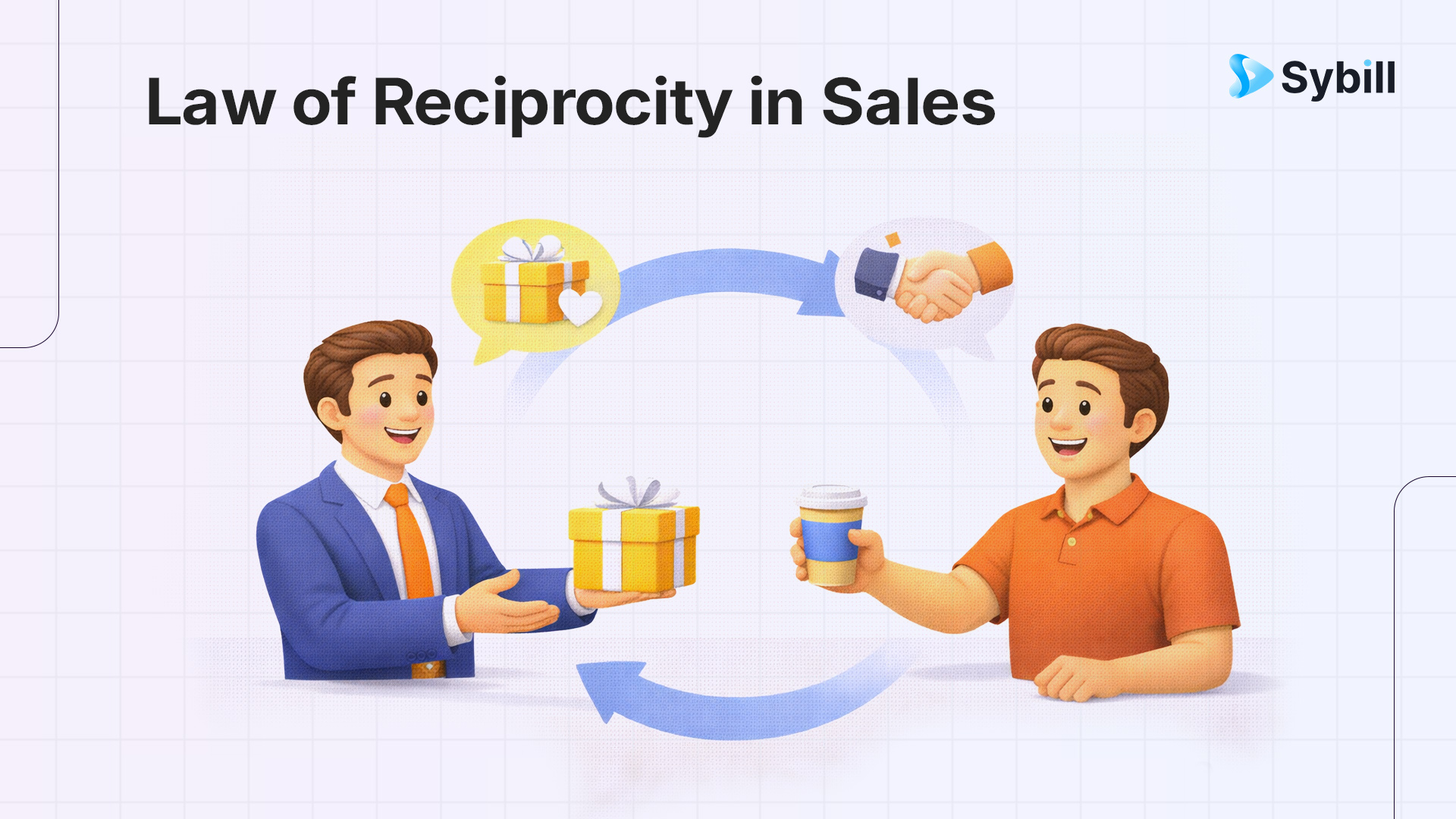
The law of reciprocity is a psychological principle stating that when someone does something valuable for you, you feel obligated to return the favor. In sales, this means giving genuine value first - insights, resources, personalized help, all without demanding immediate returns. When applied authentically, reciprocity builds trust faster, creates goodwill, and naturally encourages prospects to reciprocate with their time, attention, and business. The key? Your giving must be personalized, unexpected, and genuinely helpful, not a thinly disguised sales tactic.
The law of reciprocity in sales is the psychological principle that when you give genuine value to prospects before asking for anything in return — through personalized insights, relevant research, useful content, or strategic introductions — they feel a natural obligation to reciprocate with their time, attention, and ultimately their business. Effective reciprocity in B2B sales means leading with value in every interaction: sharing industry benchmarks during discovery, providing competitive analysis without being asked, sending relevant case studies tailored to their specific challenge, and following up with personalized summaries that demonstrate you listened. AI tools like Sybill amplify reciprocity at scale by auto-generating detailed call summaries and personalized follow-up emails that reference specific buyer concerns, delivering immediate value after every conversation without manual effort.
The best salespeople understand something most reps miss: people don't buy from vendors they barely know. They buy from advisors they trust. And trust isn't built by features, benefits, or clever closing techniques. Trust is built through reciprocity.
Reciprocity is the psychological principle that when someone gives you something of value, you feel obligated to give something back. It's hardwired into human behavior. It's why you feel compelled to buy from the rep who spent an hour giving you free strategic advice. It's why prospects respond to emails from sellers who've already helped them solve a problem.
But when you treat reciprocity like a transaction like you give something small and cheap, then immediately ask for something big in return, then prospects see right through it; because its no reciprocating, it's a trade.
Research shows that sales reps who lead with value and ask questions before pitching products see conversion rates up to 300% higher than those who pitch first. Studies in behavioral psychology demonstrate that even small gestures of goodwill can trigger disproportionately large reciprocal responses. And top-performing sales organizations consistently outperform their peers not because they sell harder, but because they give smarter.
Real reciprocity requires three things: genuine value that helps the prospect regardless of whether they buy, personalization that proves you invested time understanding their specific situation, and patience to let the reciprocal response happen naturally rather than forcing it.
Let's break down how to do it right.
The law of reciprocity - sometimes called the principle of reciprocity or reciprocation is the social norm that people feel obligated to return favors, gifts, or kindnesses. When someone gives you something of value, you experience a psychological pressure to give something back.
This isn't some fringe psychological theory. Robert Cialdini, often called the "Godfather of Influence," documented this principle extensively in his bestselling book Influence: The Psychology of Persuasion. He identified reciprocity as one of six core principles of persuasion that shape human behavior.
As Cialdini describes it: when someone gives you something first, you feel a strong social obligation to reciprocate. This obligation is so powerful that it often leads people to return favors that are larger than what they initially received.
Here's a simple example: If a colleague buys you coffee, you'll likely feel compelled to buy them coffee next time. If a friend helps you move, you'll probably offer to help them with their next project. If someone holds the door open for you, you'll smile and say thank you—maybe even hold the door for the next person.
This isn't conscious calculation. It's instinct. Humans are social creatures who thrive on cooperation and mutual exchange. The law of reciprocity keeps that exchange balanced.
In sales? The same principle applies. When you give something valuable to a prospect—genuine insights, helpful resources, personalized attention—they naturally feel inclined to reciprocate with their time, openness, and eventually, their business.
The science behind reciprocity is rooted in evolutionary psychology and social dynamics. Here's why it's so effective:
Humans are wired to avoid being seen as "takers" or "freeloaders." When someone does something for us, we feel an inherent need to repay that kindness to maintain social equity. This isn't about guilt - it's about social survival. Communities that cooperate and reciprocate thrive; those that don't, fracture.
In sales, this means that when you provide value first, prospects experience a subtle psychological pull to reciprocate. They're more likely to take your call, respond to your email, or consider your proposal because you've already invested in them.
Traditional sales often feels transactional. A rep shows up, pitches a product, and asks for a decision. The prospect's defenses go up because they sense the ask coming.
But when you lead with value, no strings attached, you disarm skepticism. You signal that you're not just there to extract value but to contribute it. This builds trust exponentially faster than any pitch ever could.
Prospects are constantly evaluating whether you're a vendor trying to hit quota or a partner invested in their success. When you give valuable insights or resources upfront, you position yourself as an advisor, not a salesperson. That shift in perception matters. People buy from advisors. They dodge vendors.
Receiving something unexpected and valuable feels good. It creates a positive emotional association with you and your brand. Even if the prospect doesn't buy immediately, they remember how you made them feel. And when they're ready to buy, guess who they'll think of first?
Research shows that the size of the initial gift doesn't have to match the size of the return favor. In one famous study published in the Journal of Applied Social Psychology, researchers tested the impact of giving mints with restaurant bills. Servers who gave one mint saw tips increase by 3.3%. Those who gave two mints? Tips jumped by 14%. And when servers gave one mint, walked away, then came back and said, "For you nice people, here's another mint," tips skyrocketed by 23%.
The lesson? It's not about the value of what you give. It's about the thoughtfulness and personalization behind it.
Get started for free with Sybill to automatically capture insights from every sales conversation and turn them into personalized follow-ups that demonstrate real value without manual effort.
Reciprocity is powerful, but it only works when applied authentically. Here's how to leverage it without crossing into manipulation:
The core of reciprocity is giving first. Not giving-to-get-something-immediately. Just giving. The reciprocation happens naturally afterward, often without you even asking.
What this looks like in practice:
Pro tip: The more personalized and unexpected your gesture, the stronger the reciprocal response. Generic eBooks sent to 10,000 people don't trigger reciprocity. A tailored one-pager that addresses their exact challenge does.
The moment your "gift" feels like a veiled sales pitch, reciprocity dies. Prospects see through thinly disguised lead magnets that are just feature dumps in disguise.
Your value must be immediately useful, even if they never buy from you. Think: insights that help them make better decisions, resources that solve real problems, or introductions that advance their goals.
Bad reciprocity: "Here's a free trial of our software… now let me schedule a 45-minute demo."
Good reciprocity: "I noticed you're exploring ways to reduce churn. Here's a framework three of our customers used to cut churn by 20%. No strings attached. If it's helpful, great. If not, no worries."
Generic gestures don't create strong reciprocal feelings. Personalized, thoughtful ones do.
This is where tools like Sybill become invaluable. By analyzing your sales conversations, Sybill identifies specific pain points, interests, and context about each prospect. You can then use those insights to craft genuinely personalized gestures that feel custom-built for them—not copy-pasted from a template.
Example: Instead of sending a generic case study, send one from their exact industry that addresses the specific objection they raised in your last call. That's reciprocity fuel.
The law of reciprocity works best when there's no pressure. If you give something and immediately ask for something in return, it feels transactional, not generous.
Let the value you've provided sit for a bit. Give your prospect time to process it, use it, and appreciate it. The reciprocal action will come naturally—often in the form of increased engagement, openness to next steps, or referrals.
What NOT to do: "I just sent you that custom analysis. Can we schedule a call tomorrow to discuss pricing?"
What to do instead: "I put together that custom analysis we discussed. Hope it's helpful. Let me know if anything jumps out or if you'd like to dig deeper on any of it."
One of the most powerful applications of reciprocity in enterprise sales is building your champion's buying guide for them. Your champion has to sell your solution internally to other stakeholders—and most of them will default to feature-dumping, which rarely works.
Instead of leaving them to their own devices, create the deck they'll use to pitch your solution. Include:
This isn't just helpful. It's a massive time-saver for your champion. They'll remember that you took their burden off their plate. And that reciprocal goodwill often translates into stronger advocacy and faster deal progression.
Text-based communication is efficient, but it lacks emotional impact. Personalized video messages are unexpected, high-effort gestures that demonstrate you care enough to invest time.
Record a quick 2-3 minute video where you:
The effort signals investment. The personalization triggers reciprocity. And the format itself creates a stronger emotional connection than any email ever could.
One of the most powerful forms of reciprocity is honesty. If your solution isn't the best fit for their needs, tell them. If a competitor's product solves their problem better, admit it.
This sounds counterintuitive, but it works. When you prioritize the prospect's success over your commission, you build trust that lasts far beyond a single sales cycle. They may not buy from you today, but they'll remember your integrity. And they'll come back when the timing is right—or refer you to someone who is a better fit.
Let's look at how reciprocity plays out across different sales scenarios:
SaaS Sales: A sales rep notices a prospect struggling with email deliverability based on their conversation. The rep sends a detailed guide on improving email sender reputation, including specific tools and tactics—none of which involve the rep's product. Two weeks later, the prospect reaches out asking for a demo. Why? Because the rep proved they cared about solving problems, not just closing deals.
Consulting Sales: A consultant offers a free 30-minute strategy session where they diagnose a prospect's go-to-market challenges and provide actionable recommendations. They don't pitch their services. They just help. A month later, the prospect hires them for a six-figure engagement because they've already experienced the consultant's value firsthand.
Enterprise Sales: An AE builds a comprehensive business case for their champion, complete with ROI calculations, stakeholder-specific messaging, and competitive positioning. The champion uses it to sell the solution internally, wins executive approval, and credits the AE for making their job easier. The deal closes faster because the AE removed friction.
Follow-Up Strategy: After a demo, a rep uses Sybill to analyze the conversation and identify key concerns. Instead of sending a generic "Thanks for your time" email, they send a personalized message addressing each concern with relevant case studies and data. The prospect responds within hours, ready to discuss next steps.
Reciprocity is powerful, but it's easy to misuse. Avoid these pitfalls:
Mistake #1: Treating Reciprocity Like a Transaction If your "gift" comes with an expectation of immediate return, it's not reciprocity—it's a trade. And trades don't build trust.
Mistake #2: Offering Generic, Low-Value Gestures A branded pen, a generic white paper, or a boilerplate case study won't trigger genuine reciprocity. The gesture needs to be valuable and personalized.
Mistake #3: Using Reciprocity to Manipulate If your goal is to trick someone into feeling obligated, it's manipulation, not reciprocity. Prospects can sense inauthenticity, and it destroys trust.
Mistake #4: Giving and Then Demanding Recognition "I sent you that resource last week. Did you get a chance to look at it?" feels needy and pressures the prospect. Let your generosity speak for itself.
Mistake #5: Giving to Everyone, Regardless of Fit Reciprocity works best when it's targeted. Giving valuable insights to unqualified prospects wastes your time and dilutes the impact. Focus your giving on prospects who are genuinely a good fit.
One of the biggest challenges with applying reciprocity is that it requires deep knowledge of your prospects. What are their pain points? What do they value? What would actually help them?
This is where Sybill becomes a force multiplier. Sybill listens to your sales calls, analyzes both what's said and what's not, and surfaces the insights you need to personalize your reciprocity gestures at scale.
Here's how Sybill enables better reciprocity:
Reciprocity at scale used to be impossible. With Sybill, you can give personalized, valuable help to every prospect in your pipeline without burning out.
Get started for free with Sybill and start turning sales conversations into personalized reciprocity opportunities.
The law of reciprocity isn't a hack. It's not a sneaky trick to guilt prospects into buying. It's a fundamental human behavior that, when approached authentically, creates genuine value for both parties.
When you lead with generosity, offer real help, and personalize your efforts based on what you know about your prospects, reciprocity works. Prospects feel valued. Trust builds faster. Deals move forward more smoothly.
But the moment reciprocity becomes transactional, when you give only to get - it loses its power. Prospects see through it. The obligation disappears. The relationship sours.
So give genuinely. Give value. Give without expecting immediate returns. And watch as prospects naturally reciprocate with their time, attention, openness, and business.
Because at the end of the day, sales isn't about tricking people into buying. It's about building relationships where both sides benefit. And reciprocity, when done right, is the foundation of those relationships.
Now go forth and give. (Then let Joey sort out whether it's truly selfless.)
Only if it's fake. Reciprocity becomes manipulation when your "gift" is a Trojan horse designed solely to guilt prospects into buying. But when you genuinely want to help, when the value you provide is real and useful regardless of whether they buy, reciprocity is just good relationship-building. The key is intention: Are you giving to help, or giving to manipulate?
Don't ask for reciprocation directly at all. That defeats the purpose. Instead, let the value sit and work on its own. Follow up naturally to continue the conversation, but don't immediately pivot to "So, ready to sign?" The reciprocal action like increased engagement, openness to next steps, referrals, happens organically when there's no pressure. Usually within days or weeks, depending on the sales cycle.
Not every gesture will trigger reciprocation, and that's okay. Some prospects aren't the right fit, aren't ready, or simply won't reciprocate regardless. Reciprocity improves your odds significantly, but it's not magic. Focus your giving on qualified prospects who show genuine interest. And remember: if someone consistently takes value without reciprocating, they're probably not going to be a great customer anyway.