Find us at booth #83, join us for a harbor side happy hour, or catch Gorish’s talk.

Sept, 16-18 > Learn more

%20(1).avif)
Mamta Tainwala

April 27, 2026
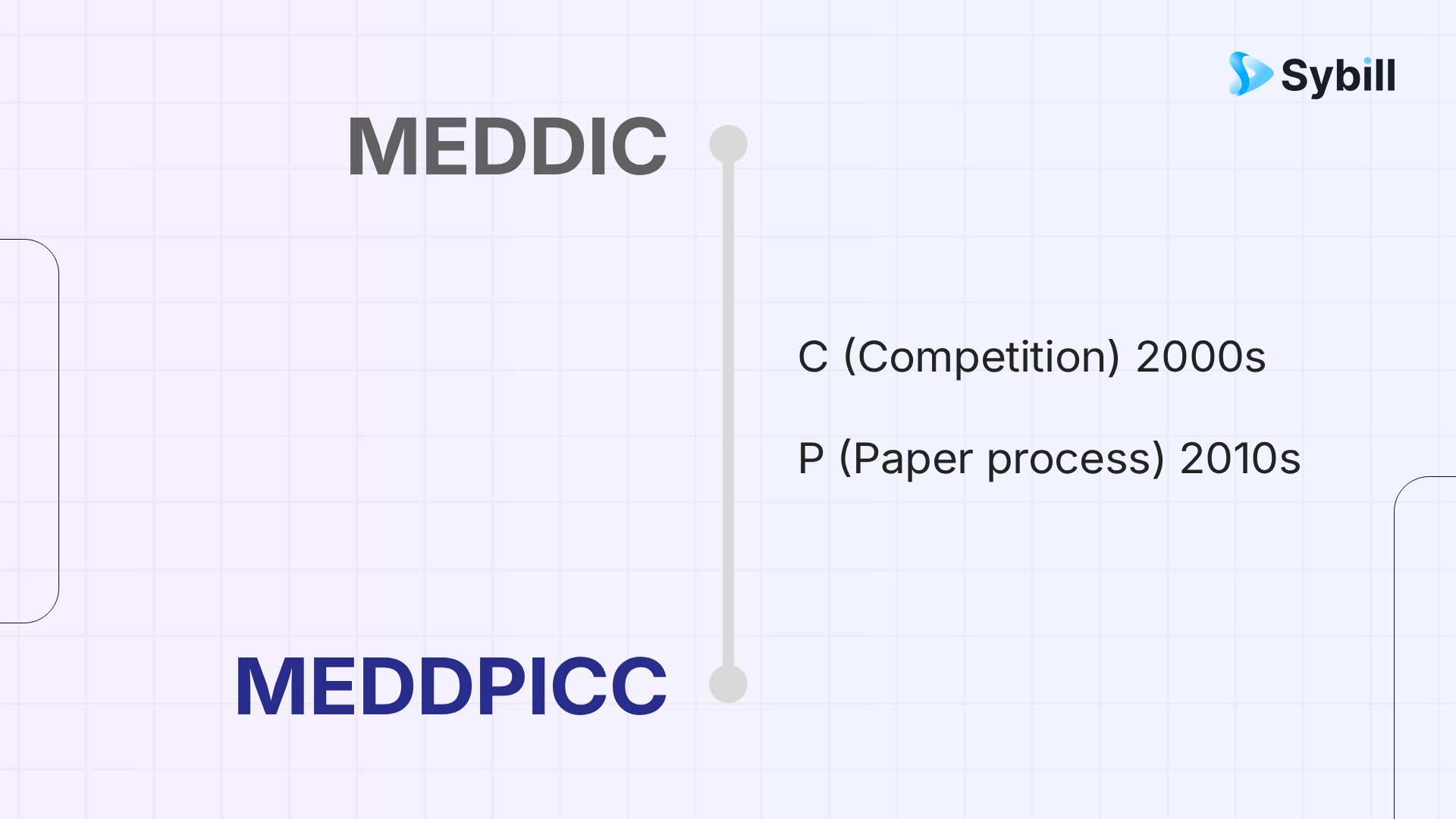

Enterprise sales qualification frameworks exist to solve a fundamental problem: how do you know which deals are worth your time before you're six months into a sales cycle? MEDDIC emerged in 1996 at PTC to answer this question, helping the company grow from $300 million to $1 billion in four years. Nearly three decades later, MEDDPICC has evolved to address the additional complexities of modern B2B sales.
The difference between MEDDIC and MEDDPICC isn't merely two additional letters. It represents the evolution of enterprise buying processes over the past 30 years. Where MEDDIC addressed the core elements of complex sales, MEDDPICC adds critical layers that reflect how deals actually get done in 2026: navigating procurement bureaucracy and understanding competitive dynamics.
MEDDIC is a six-element enterprise sales qualification framework (Metrics, Economic Buyer, Decision Criteria, Decision Process, Identify Pain, Champion) created at PTC in 1996 that helped grow revenue from $300M to $1B, while MEDDPICC adds two critical elements — Paper Process (procurement and legal workflows) and Competition (competitive landscape analysis) — to address the increased complexity of modern B2B buying. Use MEDDIC when your sales cycle is under 6 months, deals close under $100K, and procurement is straightforward; use MEDDPICC when deals exceed $100K, involve 6+ stakeholders, require formal procurement review, or face active competitive evaluation. AI tools like Sybill automate MEDDIC and MEDDPICC field population by extracting qualification signals directly from sales conversations and updating CRM fields without manual rep data entry.
This guide examines the specific differences between these frameworks, explains when each applies to your sales environment, and provides implementation strategies for teams transitioning from one to the other. If you're evaluating which qualification methodology fits your organization, or you're struggling to implement either framework effectively, this analysis will clarify your decision.
MEDDIC stands for Metrics, Economic Buyer, Decision Criteria, Decision Process, Identify Pain, and Champion. Dick Dunkel and Jack Napoli created it at Parametric Technology Corporation in 1996 to bring structure to complex software sales.

The framework addresses a fundamental challenge in enterprise sales: deals that appear qualified based on superficial criteria often stall or die for reasons that weren't visible early in the process. MEDDIC forces sales teams to dig deeper into the factors that actually determine whether a deal closes.
Metrics: Quantifiable measurements that demonstrate the business value your solution delivers. Not vague benefits like "increased efficiency," but specific outcomes like "reduce customer onboarding time from 45 days to 21 days, saving $180K annually in support costs." Metrics create a compelling business case that justifies the investment.
Economic Buyer: The individual with ultimate authority to release funds for the purchase. Not just influence or input, but the actual power to approve budget. In enterprise deals, this is often a VP or C-level executive, not the department manager you've been talking to.
Decision Criteria: The formal requirements and evaluation factors the organization uses to compare solutions. Understanding decision criteria lets you position your strengths against competitors' weaknesses and address concerns before they become objections.
Decision Process: The internal workflow for making the purchase decision. Who needs to be involved? What approvals are required? What's the timeline for each step? Many deals die not because the solution doesn't fit, but because sellers don't understand or navigate the internal process correctly.
Identify Pain: The specific business problem creating enough urgency that the organization will change. What happens if they don't solve it? How urgent is it really? Pain that's acknowledged but not urgent rarely converts to revenue.
Champion: An internal advocate who has power and influence, believes in your solution, and will actively sell on your behalf when you're not in the room. Champions navigate internal politics, address concerns from other stakeholders, and keep deals moving forward.
MEDDIC succeeded because it provided structure without rigidity. Unlike checkbox qualification methods, MEDDIC treated qualification as an ongoing process of understanding rather than a one-time gate. It acknowledged that enterprise sales involves multiple stakeholders, competing priorities, and complex decision-making processes.
The framework scaled across PTC's sales organization because it created a common language. When a sales manager asked "Do we have a champion?" everyone knew exactly what that meant and what level of confirmation was required. This consistency made coaching, forecasting, and deal reviews dramatically more effective.
By the early 2000s, MEDDIC had spread beyond PTC to become the de facto standard for complex B2B sales, particularly in software and technology. Companies implementing MEDDIC typically saw forecast accuracy improve from 60-70% to 85%+ because the framework identified deal risks before they became fatal.
MEDDPICC adds two critical elements to the original framework: Paper Process and Competition. These additions reflect how enterprise buying has evolved and what causes deals to stall in modern sales cycles.
The Paper Process component addresses the legal, procurement, and administrative requirements for finalizing a purchase. In 1996, these processes were simpler and faster. By 2010, they had become major bottlenecks that could add months to sales cycles or kill deals entirely.
Paper Process includes:
Many sellers discover the Paper Process requirement too late. You've negotiated pricing, demonstrated value, secured executive sponsorship, and then the deal disappears into a black hole of procurement bureaucracy for eight weeks. By the time it emerges, priorities have shifted or budget has been reallocated.
Understanding the Paper Process upfront lets you set realistic timelines, identify potential obstacles early, and prepare required documentation before it becomes urgent. For deals with government entities, regulated industries, or large enterprises, the Paper Process often takes longer than the entire sales cycle.
While MEDDIC implicitly considered competition through Decision Criteria, modern sales requires explicit competitive awareness. The Competition component forces sellers to understand:
The "do nothing" option is often your biggest competitor. A prospect might acknowledge pain and see value in your solution, but inertia, risk aversion, or competing priorities mean they never actually buy. Understanding this competitive dynamic early changes how you sell.
Explicit competitive analysis also prevents surprises late in deals. If a competitor has an existing relationship with the economic buyer, you need to know that in month one, not month six. If a competitor is undercutting you on price, you need to shift the conversation to value and total cost of ownership early.
The choice between MEDDIC and MEDDPICC depends on your specific sales environment, deal complexity, and the factors that typically cause your deals to stall or fail.
Your Paper Process is straightforward or negligible. If deals typically involve simple contracts that get signed quickly without extensive legal review, the added complexity of tracking Paper Process doesn't provide value. SaaS companies with standardized terms and short contracts often fit this profile.
Competition isn't a primary differentiator. If you're selling a genuinely novel solution without direct competitors, or if competitive dynamics are obvious and don't require explicit tracking, the Competition component may be unnecessary. This applies to truly disruptive technologies or highly specialized solutions.
Your team is implementing qualification for the first time. MEDDIC's six components are challenging enough for teams new to structured qualification. Adding two more criteria can overwhelm reps and slow adoption. Start with MEDDIC, build competency, then evolve to MEDDPICC if needed.
Deal cycles are under 90 days. Shorter cycles typically involve less complexity in both competitive evaluation and administrative processes. The core MEDDIC components capture what matters without excessive overhead.
You regularly lose deals in procurement or legal review. If contracts frequently stall in legal, procurement takes months to complete vendor onboarding, or signature authority is unclear, you need the Paper Process component to navigate these obstacles proactively.
Competitive dynamics significantly impact outcomes. In crowded markets with multiple viable alternatives, understanding and tracking competition explicitly improves win rates. The Competition component forces reps to develop competitive strategies early rather than reacting late.
You sell to large enterprises or regulated industries. Organizations with complex procurement processes, strict compliance requirements, or multi-layered approval workflows require MEDDPICC's comprehensive approach. Healthcare, financial services, and government sales typically fall into this category.
Forecast accuracy is critical and currently poor. If your forecasts consistently miss because deals that "should close" don't, MEDDPICC's additional rigor often reveals the hidden factors causing slippage. The Paper Process and Competition elements frequently explain unexpected deal delays or losses.
Deal cycles exceed six months. Longer cycles provide time for competitive dynamics to shift and administrative requirements to emerge. MEDDPICC's structure helps manage this complexity throughout the extended timeline.
Understanding what MEDDPICC adds is one thing. Successfully implementing it is another. Here's what changes operationally when you adopt the full framework.
For Paper Process:
For Competition:
These questions need to be woven naturally into discovery conversations, not delivered as an interrogation checklist. The best reps make these inquiries feel like genuine curiosity about helping the prospect succeed rather than qualification box-checking.
Adding Paper Process and Competition to your qualification framework requires corresponding changes in your systems and processes.
Your CRM needs fields for:
More importantly, you need clear definitions of what "completed" means for each component. When can a rep mark Paper Process as "confirmed"? What evidence is required to identify a specific competitor? Without clear standards, data quality deteriorates and the framework becomes theater.
Tools like Sybill can automatically capture MEDDPICC criteria from sales conversations and auto-populate CRM fields without manual data entry. The AI identifies when prospects mention competitors, describe approval processes, or discuss procurement requirements, then updates the appropriate fields automatically.
With MEDDPICC, forecast reviews become more comprehensive but also more predictive. Instead of just asking "what stage is it in?" managers can assess:
This granularity improves forecast accuracy but requires more rigorous deal inspection. Plan for forecast reviews to take 20-30% longer as you discuss the additional criteria, at least until teams internalize the framework.
Both MEDDIC and MEDDPICC fail in predictable ways when implementation is poor. Understanding these failure modes helps you avoid them.
The most common mistake is treating qualification as something you "complete" in one or two discovery calls, then never revisit. In reality, qualification is continuous. Champions leave companies. Competitors enter the evaluation. Paper Processes reveal unexpected requirements.
Successful teams revisit MEDDPICC criteria at each major stage transition and whenever significant time passes. If you qualified a deal three months ago and haven't re-confirmed MEDDPICC elements since, your data is stale.
Reps know managers check MEDDPICC fields, so they fill them out even when the information is superficial or guessed. "Champion: John Smith" doesn't mean you actually have a champion if John hasn't done anything to demonstrate advocacy.
Define clear evidence standards. A champion isn't confirmed until they've taken specific actions: arranged meetings with other stakeholders, shared internal information, or actively defended your solution against objections. Economic Buyer isn't confirmed until you've actually met with them, not just heard their name.
Running through MEDDPICC as a checklist creates defensive, uncomfortable conversations. Prospects don't want to feel like they're being qualified; they want to explore whether your solution fits their needs.
The best reps weave MEDDPICC questions naturally into consultative discovery. They're genuinely curious about the prospect's situation, and MEDDPICC simply structures what they need to understand. The framework guides their thinking, not their script.
Some teams get so focused on achieving perfect MEDDPICC qualification that deals slow to a crawl. Reps spend weeks trying to identify all eight criteria before presenting value or advancing conversations.
Balance thoroughness with momentum. You don't need complete MEDDPICC confirmation to take the next step; you need enough information to proceed intelligently. Perfect is the enemy of good, particularly in qualification.
If you're currently using MEDDIC and considering adding Paper Process and Competition, here's a pragmatic implementation approach.
Before adding complexity, confirm you actually need MEDDPICC. Analyze your last 20 closed-lost deals:
If the answer is "most of them," MEDDPICC makes sense. If procurement is rarely an issue and competitive dynamics are obvious, stick with MEDDIC.
Create clear definitions and evidence requirements for Paper Process and Competition:
Share these standards with the team and get feedback. The definitions need to be specific enough to be useful but not so rigid that they create busywork.
Rather than forcing the entire team to adopt MEDDPICC immediately, pilot with a subset of deals where Paper Process and Competition are clearly relevant. Typically these are your largest, most complex opportunities.
Have reps explicitly track the two new components, capture what they learn, and identify what changes in how they work deals. Use this pilot to refine your definitions and processes before rolling out broadly.
Conduct training on the two new components, focusing on:
Role-play scenarios where Paper Process or Competition information changes how a deal should be approached. Make it concrete and practical, not theoretical.
In deal reviews and coaching sessions, explicitly discuss Paper Process and Competition. Ask reps:
Recognition matters. When a rep identifies a Paper Process requirement early that prevents a last-minute surprise, celebrate it publicly. When competitive intelligence leads to a win, make it visible to the team.
The biggest challenge with comprehensive qualification frameworks like MEDDPICC isn't understanding the concepts. It's consistently capturing the information without adding massive administrative burden to already busy reps.
This is where AI-powered sales tools transform qualification from theory to practice. Conversation intelligence platforms automatically identify when MEDDPICC criteria are discussed in sales calls and populate CRM fields without manual data entry.
When a prospect says "we'll need to go through procurement, which usually takes 6-8 weeks," AI captures that as Paper Process information. When they mention "we're also looking at Salesforce and HubSpot," AI logs the competition. When they describe their approval workflow, AI maps the Decision Process.
This automated capture solves multiple problems:
AI-powered qualification doesn't replace the rep's judgment about strategy and next actions. It eliminates the mechanical task of capturing and organizing information so reps can focus on using insights to win deals.
MEDDPICC isn't a replacement for MEDDIC. It's the natural evolution of the framework to address how enterprise buying has changed over three decades. Paper Process and Competition aren't theoretical additions; they reflect the real obstacles that kill deals in modern B2B sales.
The choice between MEDDIC and MEDDPICC should be driven by your empirical experience. Look at your last 20-30 closed-lost deals. If Paper Process issues and competitive surprises are killing opportunities, adopt MEDDPICC. If these factors are minor compared to the core six MEDDIC elements, don't add complexity unnecessarily.
What matters more than which acronym you use is whether your team actually implements the framework consistently and uses the insights to win more deals. Perfect MEDDPICC qualification that lives only in CRM fields but doesn't change behavior is worthless. Imperfect MEDDIC implementation that surfaces risks early and drives strategic actions beats perfect documentation every time.
Start with clarity on what causes your deals to succeed or fail. Choose the framework that captures those factors. Define clear standards for what "confirmed" means. Train your team thoroughly. Use technology to reduce administrative burden. Coach consistently. And measure whether qualification quality correlates with forecast accuracy and win rates.
The framework is a tool, not a religion. Use it to win more deals, not to win compliance awards.
Ready to implement MEDDPICC without drowning your team in admin work? Discover how Sybill automatically captures qualification criteria from your sales calls and keeps your CRM updated so reps can focus on selling instead of data entry.
Download the blog easily here.
MEDDICC (with double C for Competition) is another common variant. The choice depends on your specific needs. Use MEDDIC for straightforward complex sales, MEDDICC when competition is critical but Paper Process isn't, and MEDDPICC when both competitive dynamics and procurement bureaucracy significantly impact outcomes. Don't get caught up in acronym debates. Focus on which criteria actually predict success or failure in your deals, then track those elements consistently. For most modern enterprise sales, MEDDPICC's comprehensiveness provides the best balance.
Expect 90-120 days for teams to become proficient with MEDDPICC, assuming they have sales experience. The concepts can be taught in a day, but internalizing when and how to ask questions naturally, consistently documenting findings, and using the information strategically requires sustained practice and coaching. Less experienced teams may need 6+ months to achieve consistent adoption. The timeline accelerates significantly when using AI tools that automate data capture, as reps can focus on strategy rather than administrative work.
Yes, but you'll need to streamline the implementation. For shorter cycles, focus on identifying which MEDDPICC elements most frequently cause your deals to fail, then track those obsessively while treating others more lightly. Often this means deep focus on Economic Buyer, Decision Process, and Competition while handling Metrics and Paper Process more efficiently. The framework scales to your needs; don't let perfectionism slow velocity on deals that should close quickly.