Find us at booth #83, join us for a harbor side happy hour, or catch Gorish’s talk.

Sept, 16-18 > Learn more


Richa Sharma

March 30, 2026
.avif)
Have you ever thought of sales as nothing less than running a kitchen like in The Bear? Your reps are the chefs on the line working under pressure, juggling multiple things, and trying to deliver on time. Sales operations Sydney are focused on building systems, tightening processes, and making the chaos scalable. But revenue operations? That has to be Carmy thinking beyond tonight’s dinner rush: aligning front-of-house, back-of-house, sourcing, reviews, and finances into one single rhythm.
Sales operations (SalesOps) focuses exclusively on the sales team — managing CRM hygiene, territory design, quota setting, forecasting, and automating repetitive tasks so reps can spend more time selling. Revenue operations (RevOps) takes a broader view, aligning the entire go-to-market engine — sales, marketing, and customer success — around shared revenue goals, unified data, and seamless handoffs across the full customer lifecycle. The key differences: SalesOps supports tactical efficiency for the sales team (pipeline coverage, sales cycle length, forecast accuracy), while RevOps drives strategic alignment across all customer-facing teams (CAC, LTV, churn, full-funnel conversion). Sales enablement complements both by training reps with the skills, knowledge, and content to execute effectively. High-performing organizations need all three working together — SalesOps builds the process, enablement trains the players, and RevOps ensures the entire revenue system runs as one coordinated machine.
This blog breaks down revenue operations vs sales operations, how sales enablement fits into the chaos, and why high-functioning teams need more than just good ingredients.

Sales operations is the team that helps salespeople do their jobs better, faster, and more efficiently. While sales reps talk to customers and close deals, sales operations handles everything behind the scenes to make that easier. They focus on organizing the sales process, setting fair targets, and ensuring tools like the CRM are working correctly. They also help sales leaders understand what is happening through clear reports and accurate forecasts.
If a rep is stuck in a big deal and needs help with pricing, sales operations steps in. If a region isn’t doing well, they see the data and suggest what to change. They are not making the calls, but making it easier for them to win.
In short, sales operations build the systems that keep your revenue kitchen from catching fire every night.
Revenue operations is the strategy room for your entire customer-facing engine. It doesn’t just look at how the sales team functions; it zooms out. The entire go-to-market motion aligns seamlessly with marketing, sales, and customer success.
There are no silos. No surprises. Just one shared rhythm focused on driving revenue, not departmental wins.
Revenue operations ensures that marketing isn’t just driving leads; they are driving the right leads. That customer success isn’t just retaining clients, but feeding renewals and upsells back into the sales pipeline. It’s the shift from “sales team performance” to “business-wide revenue performance.”
Where sales operations handles the kitchen, revenue operations runs the whole restaurant.
If you are a sales rep or sales leader, you have probably heard these two terms tossed around a lot. They sound similar, but play very different roles in helping you win more deals and grow your business. Let’s break them down:
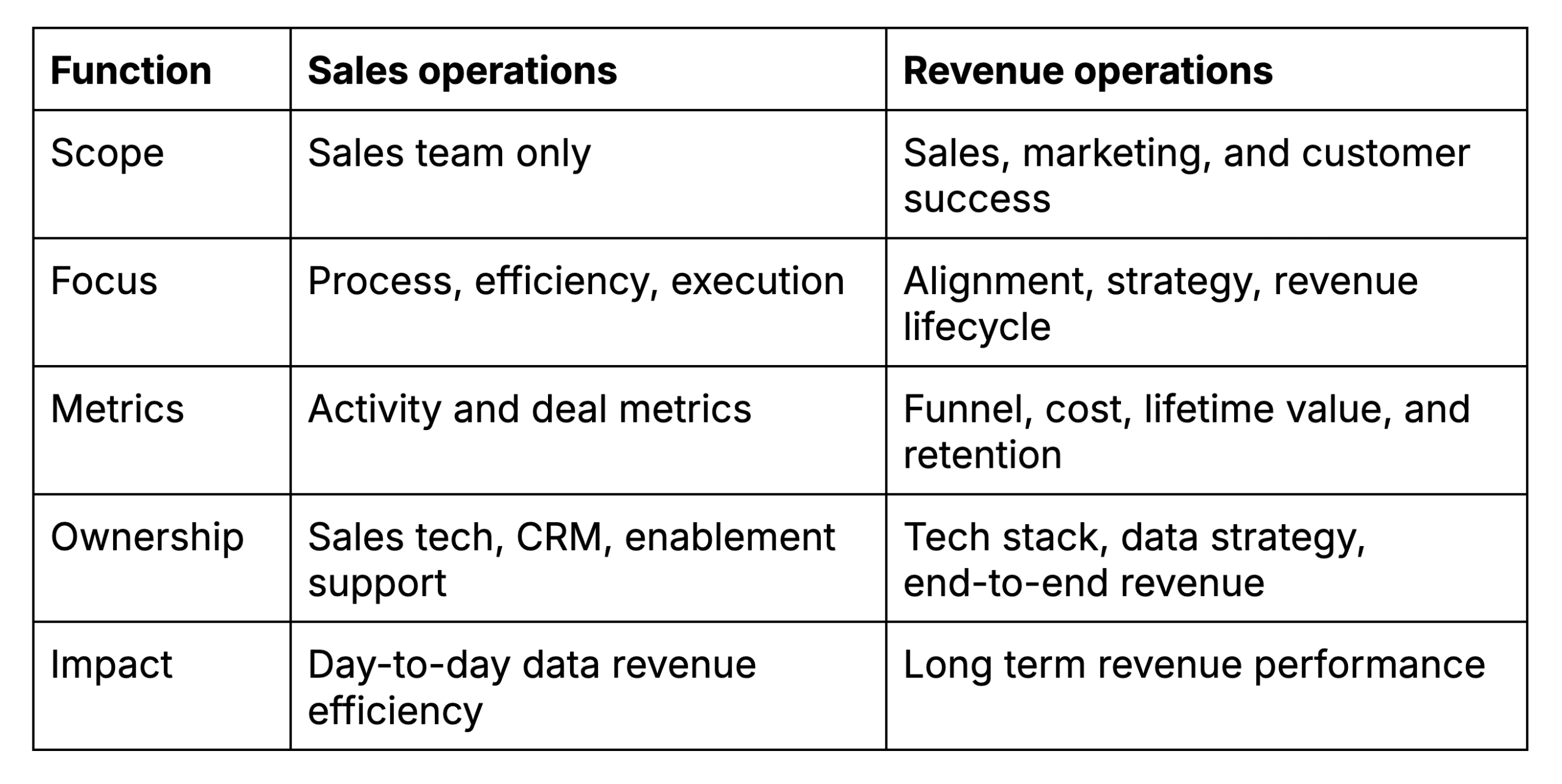
Sales operations support the sales team only. They help the sales team with lead routing, CRM cleanup, compensation plans, territory design, and reporting.
Revenue operations support every go-to-market (GTM) team, including sales, marketing, and customer success. They ensure that all teams are aligned and working toward the same revenue goals.
Think of it this way: SalesOps helps you close deals. RevOps ensures that the entire customer journey, from initial contact to renewal, is seamless, connected, and measurable.
Sales operations focuses on the sales team's day-to-day execution and efficiency. They handle the internal tasks, ensuring that tools function properly, sales data is accurate, and representatives can perform their jobs without unnecessary friction.
Revenue operations focuses on alignment and strategy across teams. Their job is to make sure sales, marketing, and customer success are not working in silos. They bridge the disconnect between teams, enabling the company to run like a well-oiled revenue machine.
For example, SalesOps helps a rep get pricing approval for a deal. RevOps identifies that too many pricing approvals are slowing down the sales cycle and modifies the approval process.
Sales Operations helps reps spend more time selling. They resolve issues such as messy CRM data, inadequate territory planning, or unclear commission plans.
Revenue Operations solves bigger-picture problems. Some of these issues could be:
Remember: SalesOps = Tactical efficiency. RevOps = Strategic alignment.
Your reps are working long hours. Deals are closing. But your customer acquisition cost is rising. Your win rates are dropping. Your best leads never even get a call. SalesOps might see some of it. RevOps considers all of it.
Tracking both means understanding more than just the number of deals closed. It means understanding how deals flow, stall, and scale. In a quota-driven world, that difference is critical.
SalesOps helps you improve your sales metrics. RevOps helps businesses improve their overall revenue engine.
Sales operations typically take care of:
Revenue operations typically take care of:
As a rep, when the sales operation fixes a broken lead assignment or updates the CRM, you feel it immediately. When revenue operations fixes a system-wide issue, like lead scoring alignment, you might overlook the impact immediately. But over time, your pipeline becomes stronger and your conversion rates improve.
A rep might thank sales operations for fixing their CRM. But while sales operations make your job easier today, revenue operations build a stronger revenue system for the future.
Sales enablement is the coach with the playbook.
While sales operations provides tools and strategy, enablement focuses on people. It’s the team that helps reps build skills, know the product, and pitch with precision. Imagine you just hired five new account executives. Sales enablement ramps them fast, trains them on objection handling, and ensures they are using the talk track that closes.
Sales enablement and sales operations partner closely, but they serve different purposes.
Sales enablement helps your representatives sell smarter by providing them with the knowledge, tools, and training they need to succeed. While sales operations might choose the CRM, sales enablement teaches the representative how to utilize it effectively to close sales.
It’s the link between strategy and execution. Without sales enablement, a rep might have the tools, but not the technique to use them effectively.
If you are in sales, you have likely heard both terms. But understanding the difference between sales operations vs sales enablement is key to knowing who supports you and how.
Sales operations build the process. Sales enablement trains the players.
Sales operations is all about structure. It builds the foundation for how your team sells by setting territories, assigning quotas, managing the CRM, and tracking performance. They focus on streamlining the process so reps can spend more time selling and less time dealing with friction.
Sales enablement, on the other hand, is about support. It equips you with the skills, content, and coaching necessary to have more effective conversations and close deals. They create your onboarding program, training materials, pitch decks, and talk tracks. Sybill.ai is a personal coach who guides you with instant, data-driven insights. You get actionable coaching whenever you need it.
In the debate of sales operations vs sales enablement, it’s not about which is more important. They are both critical. Sales operations help you run faster. Enablement enables you to run smarter. Together, they help turn good reps into top performers.
.png)
You can have the best chefs, the freshest produce, and high-end equipment. However, if the kitchen is out of sync with the front-of-house, and marketing is running a promotion that no one has informed the team about, service slips. Fast.
That is the gap between sales operations and revenue operations.
Sales operations keep the engine running. They fix broken workflows, clean up messy tools, and let your reps focus on closing. Revenue operations look at the entire revenue journey. They ensure sales, marketing, and customer success are working toward the same outcome, not just running parallel tracks.
Sales enablement builds muscle. It trains the team, refines the pitch, and gives reps the confidence to execute. High-growth teams don’t scale with effort alone. They scale with alignment, visibility, and tight execution across every function that touches revenue.