Find us at booth #83, join us for a harbor side happy hour, or catch Gorish’s talk.

Sept, 16-18 > Learn more

%20(1).avif)
Mamta Tainwala

February 2, 2026
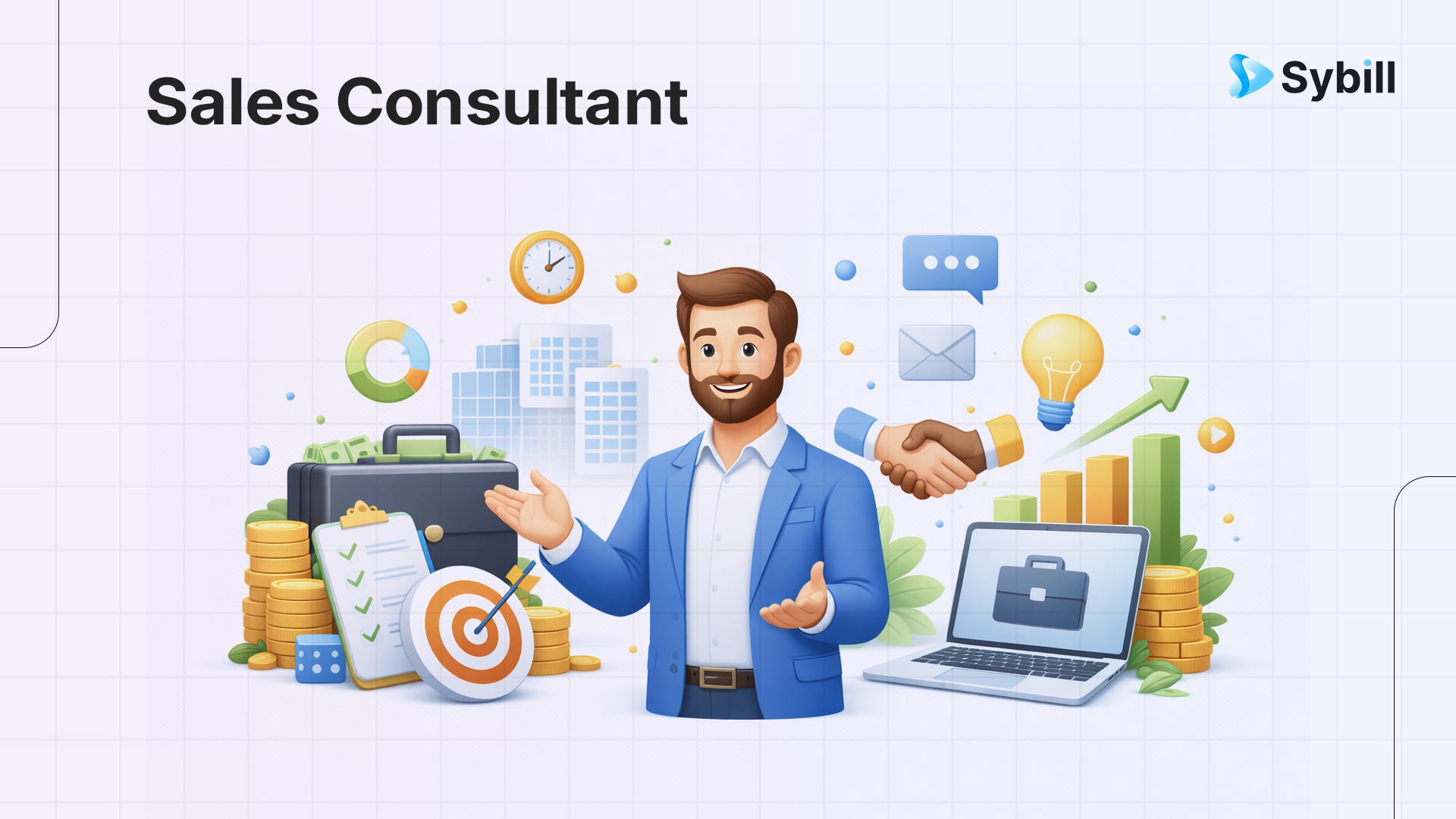
The best sales consultant courses for 2026: RAIN Group's Consultative Selling Program ($2K-$5K, best for enterprise B2B), Sandler Training ($395-$495/month for ongoing reinforcement, ideal for complex sales), and Winning by Design's Foundations course ($1,500+, perfect for SaaS). For self-directed learners: read "The Challenger Sale" and "SPIN Selling," join the Pavilion sales community, and use AI tools to accelerate learning.
The five critical consultative selling skills to master:
(1) Advanced discovery that uncovers real problems,
(2) Strategic questioning that challenges buyer assumptions,
(3) Active listening for verbal and non-verbal cues,
(4) Value-based positioning with specific ROI, and
(5) Collaborative problem-solving that makes buyers partners.
How to get ROI fast: Invest 90 days in deliberate practice - record calls, get feedback, apply one technique at a time. Use Sybill's Ask Sybill feature to analyze every conversation and identify improvement areas instantly. Elite consultative sellers close 40-50% of opportunities versus 25% for average reps, that's an extra $60K+ in annual commission.
Remember that scene in The Wolf of Wall Street where Jordan Belfort asks, "Sell me this pen"?
Yeah, that wouldn't fly in 2026.
Today's buyers aren't looking for slick pitches or aggressive closing tactics. They're drowning in options, terrified of making the wrong choice, and more skeptical than ever. They don't want to be sold to. They want to be understood, guided, and helped.
That's where consultative selling comes in, and why sales consultant courses have become the most valuable investment a sales professional can make right now.
But here's the problem: not all sales training is created equal. Some courses teach outdated tactics that'll make you sound like a used car salesman. Others are so theoretical they're useless in real conversations. And many are just repackaged common sense with a hefty price tag.
So how do you find sales consultant courses that actually move the needle? How do you develop consultative selling skills that close deals in today's market? And what's the fastest way to go from average performer to quota crusher?
Let's dig in.
Before we dive into the best sales consultant courses, let's get clear on what consultative selling actually means, because there's a lot of confusion out there.
Consultative selling isn't just asking a few discovery questions and then launching into your pitch. It's a complete mindset shift from "How do I get this person to buy?" to "How do I help this person make the best decision for their situation?"
At its core, consultative selling means:
Acting as a trusted advisor, not a vendor. You're genuinely focused on the customer's success, even if that means sometimes recommending a competitor or telling them they're not ready to buy yet.
Leading with curiosity, not features. You ask thoughtful, probing questions to understand the real problems beneath the surface problems. You listen more than you talk.
Tailoring solutions to specific needs. Cookie-cutter pitches are dead. Every conversation is customized based on what you've discovered about this particular buyer's challenges, goals, and constraints.
Creating value beyond your product. You share insights, challenge assumptions, and help buyers think differently about their problems, whether they buy from you or not.
Here's why this matters more than ever: According to recent data, 27% of B2B buyers are willing to spend over $500,000 without ever meeting a sales rep in person. But that doesn't mean sales is dead; it means buyers expect more sophistication, more personalization, and more value from every interaction.
The reps who master consultative selling are the ones closing those massive remote deals. The ones still using transactional selling tactics? They're wondering why their pipeline dried up.
Let's be honest: most sales training sucks.
You sit through a two-day workshop, hear some motivational stories, learn a framework with a catchy acronym, and then... nothing changes. You go back to your desk and keep selling the same way you always have.
Why? Because traditional sales training has three fatal flaws:
Many sales consultant training courses are designed by people who haven't carried a quota in years (or ever). They teach models and methodologies that sound great in a conference room but fall apart the moment a real prospect says, "We're happy with our current solution."
You need training from people who are still in the trenches, who know what's working right now, not what worked in 2015.
Enterprise sales is different from mid-market sales. SaaS sales is different from professional services. But most courses teach generic frameworks without helping you adapt them to your specific situation.
The best sales consulting training courses understand that context matters. They help you internalize principles, not just memorize scripts.
Research shows that people forget 70% of what they learn within 24 hours without reinforcement. Traditional one-and-done training workshops don't include ongoing practice, feedback loops, or real-world application. So even good content rarely translates to behavior change.
This is exactly where modern, self-directed learning and AI-powered tools are changing the game. More on that in a minute.
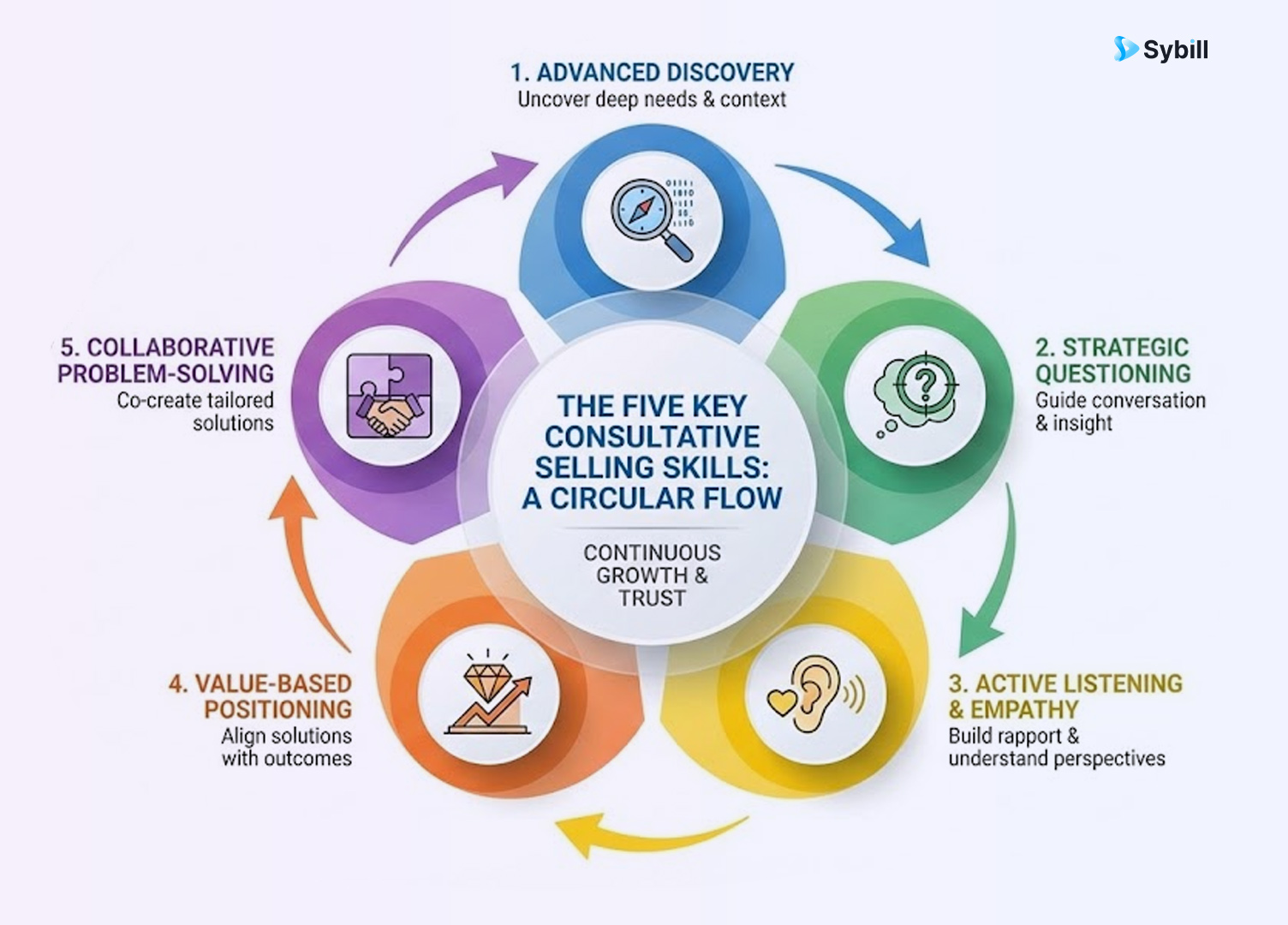
Before you invest in any sales consultant courses, you need to know what skills actually matter. Here are the five capabilities that separate elite consultative sellers from average reps:
Discovery isn't just asking BANT questions and checking boxes. Elite discovery means:
Great discovery takes 30-40% of your sales cycle, but it's what makes everything else easier. Nail discovery, and your demos write themselves. Your proposals practically close the deal for you.
The questions you ask reveal how much you understand your buyer's world. Weak questions make you sound like every other vendor. Strategic questions make buyers think, "Wow, this person really gets our business."
You need to master:
This sounds soft, but it's incredibly tactical. Active listening means catching the subtle cues that reveal what buyers really care about:
Empathy isn't about being nice; it's about understanding buyers' fears, pressures, and constraints so you can address them directly.
Features tell. Benefits sell. But value transforms.
Consultative sellers don't pitch product capabilities. They articulate the specific, measurable impact their solution will have on the buyer's business:
Notice how specific those are? That's not generic value. That's customized value based on what you learned in discovery.
The best consultative sellers don't present solutions; they co-create them with buyers. This means:
When you master this skill, objections disappear because you've already addressed them collaboratively. Deals move faster because buyers are invested in the outcome. And you build relationships that lead to referrals and expansion revenue.
Alright, let's get to what you came here for: which sales consultant training courses actually deliver results?
I've evaluated dozens of programs based on three criteria:
Here are the top options across different categories:
RAIN Group offers one of the most comprehensive consultative selling frameworks in the industry. Their training emphasizes the connection between understanding buyer needs and driving outcomes.
What you'll learn: The RAIN selling methodology (Rapport, Aspirations/Afflictions, Impact, New Reality), advanced discovery techniques, and how to position yourself as a trusted advisor.
Format: Virtual instructor-led sessions combined with self-paced modules
Best for: Mid-market and enterprise B2B sales professionals who need a structured methodology
Investment: Contact for pricing (typically $2,000-$5,000 per person)
Sandler is legendary in sales training for a reason. Their consultative approach flips traditional selling on its head, teaching you to qualify hard and let buyers convince themselves.
What you'll learn: The Sandler Submarine methodology, pain-based selling, overcoming buyer resistance, and building long-term client relationships
Format: Ongoing reinforcement model with weekly sessions, not one-time training
Best for: Sales professionals in complex B2B environments, especially when selling high-value solutions
Investment: $395-$495/month for ongoing access
Why it works: Sandler emphasizes that consultative selling requires a customer-centric approach that builds trust through addressing underlying pain points, not surface-level symptoms.
This course is perfect for sales professionals who want to build a repeatable, scalable sales process grounded in consultative principles.
What you'll learn: How to structure your sales approach, conduct effective discovery, run demos that resonate, and build champions within accounts
Format: Online cohort-based learning with live instruction and peer collaboration
Best for: SaaS and technology sales professionals who want a system, not just tactics
Investment: Starting at $1,500 per person
Topaz focuses specifically on consultative selling with their "Buyer Facilitator Training," which reframes sales as facilitating the buyer's decision-making process.
What you'll learn: How to guide buyers through their evaluation journey, facilitate internal conversations, and position yourself as a subject matter expert
Format: Live coaching sessions with real-time feedback and weekly strategy calls
Best for: Consultants and sales professionals selling complex, high-consideration solutions
Investment: Contact for custom pricing
If you're thinking about becoming a fractional sales leader or consultant yourself, Sales Xceleration offers training that teaches you how to diagnose sales problems and implement consultative methodologies for clients.
What you'll learn: Sales leadership skills, diagnostic frameworks, and how to implement consultative selling strategies across organizations
Format: On-site intensive training
Best for: Experienced sales leaders looking to start consulting practices
Investment: Contact for pricing
Here's the truth: you don't need to spend $5,000 on a course to become a consultative selling expert. Some of the best learning happens through deliberate self-study combined with real-world practice.
Learning happens best in community. Join communities where top performers share what's working:
With so many options, how do you pick the right sales consultant training course? Ask yourself these questions:
If you're new to consultative selling, start with foundational courses that teach core principles. If you're experienced but looking to level up specific skills (like executive selling or competitive displacement), choose advanced specialized training.
Some people thrive in live, interactive environments. Others prefer self-paced learning where they can rewatch content and learn on their own schedule. There's no right answer; pick what works for your brain.
Yes, some courses cost thousands of dollars. But remember: if a $3,000 course helps you close one additional $50,000 deal, it pays for itself 16 times over. Think ROI, not just cost.
That said, you can also develop consultative selling skills through free or low-cost resources if you're disciplined about self-directed learning.
Need results immediately? Focus on tactical courses that teach specific techniques you can apply tomorrow. Have time to invest in long-term development? Consider comprehensive programs with ongoing reinforcement.
The best learning happens when you can immediately apply concepts in real sales conversations. Make sure you have opportunities to practice whatever you're learning, whether that's live deals, role-playing, or recorded call reviews.
Here's my recommendation: Start with free resources (books, podcasts, blogs) to build foundational knowledge. Then invest in one high-quality course that aligns with your specific needs and learning style. Supplement with ongoing peer learning in sales communities.
And here's the secret weapon most sales professionals miss...
Get started for free with Sybill to accelerate your consultative selling skills through AI-powered insights from every sales conversation.
Here's what's changed in the last two years: you now have access to AI tools that can dramatically accelerate your development as a consultative seller.
Think about it: traditional sales training gives you frameworks and best practices, but then you're on your own to figure out how to apply them in real conversations. You don't get immediate feedback. You don't know if your discovery questions were effective. You can't easily identify patterns across your deals.
That's where AI-powered sales tools create an unfair advantage.
Imagine having a sales coach who listens to every single call, analyzes what worked and what didn't, and gives you specific feedback on how to improve.
That's exactly what Sybill's Ask Sybill feature does.
After every sales conversation, you can ask questions like:
Sybill analyzes both verbal and non-verbal cues from your calls and gives you actionable insights that help you get better at consultative selling with every conversation.
But here's where it gets really powerful: Sybill doesn't just analyze individual calls. It helps you learn from patterns across your entire book of business.
You can ask:
This kind of meta-analysis used to require expensive conversation intelligence platforms and weeks of manual review. Now you get it instantly, allowing you to improve faster than any course alone could enable.
When you combine quality sales consultant courses with AI-powered feedback loops, your development accelerates exponentially:
This is how top performers are pulling away from the pack. They're not just learning theory. They're using AI to turn every sales conversation into a personalized coaching session.
Okay, you're convinced that consultative selling is critical and you're ready to invest in developing these skills. But where do you start?
Here's a practical 90-day plan to transform your consultative selling abilities:
Week 1-2: Mindset Shift and Assessment
Start by honestly assessing your current approach. Record three of your sales calls (with permission) and review them with a critical eye:
Action items:
Week 3-4: Learn a Framework
Choose one consultative selling methodology and commit to learning it deeply. Whether it's SPIN, Challenger, Sandler, or another approach, go all-in on understanding the principles.
Action items:
Week 5-6: Deliberate Practice
Now it's time to apply what you've learned in real sales conversations. But don't just wing it, be intentional.
Action items:
Week 7-8: Peer Learning
Find an accountability partner: another sales rep who's also working on consultative selling skills. Meet weekly to:
Action items:
Week 9-10: Pattern Recognition
By now, you've had dozens of consultative selling conversations. It's time to step back and identify patterns.
Action items:
Week 11-12: Scale What Works
Take the techniques that are working and systematize them so they become second nature.
Action items:
Pro tip: At the end of 90 days, record three more sales calls and compare them to your Month 1 recordings. You'll be shocked at how much you've improved.
As you develop your consultative selling skills, watch out for these common pitfalls:
The biggest mistake is consuming tons of training content without actually changing your behavior. Information without application is just entertainment.
Fix: For every hour you spend learning, spend two hours practicing. Make a rule: you can't move to the next module or chapter until you've used what you learned in at least three real conversations.
New consultative sellers often think asking open-ended questions means letting buyers ramble. But effective discovery requires active guidance. You're not a reporter taking notes; you're a consultant diagnosing problems.
Fix: Learn to interrupt politely and redirect. "That's helpful context. Let me dive deeper on what you mentioned about X..." Being consultative doesn't mean being passive.
Some reps overcorrect and become so consultative that they never ask for the business. They build great relationships but forget to drive deals forward.
Fix: Remember that the best way to serve your buyer is to help them make a decision. Consultative selling involves providing customized solutions while still being willing to ask for commitment.
Consultative selling requires adapting to context. A first discovery call looks different from a stakeholder alignment call, which looks different from a business case review.
Fix: Develop different frameworks for different call types. Not every call requires the same depth of discovery or the same consultative approach.
Elite consultative sellers pay attention to what buyers say and how they say it. Hesitation, excitement, confusion, skepticism; these cues tell you where to probe deeper or when to change your approach.
Fix: Practice noticing micro-expressions and tone shifts. Use behavior AI to go beyond surface-level interactions and understand what prospects are really thinking.
Consultative selling has many components. Trying to improve all of them simultaneously is overwhelming and ineffective.
Fix: Focus on one skill at a time. Spend a month getting really good at strategic questioning. Then focus on value-based positioning. Then work on collaborative problem-solving. Sequential mastery beats scattered improvement.
[Visual Cue: Illustrated infographic showing the six common mistakes with red X marks and their corresponding fixes with green check marks] Alt text: Common consultative selling mistakes to avoid including learning without applying, passive discovery, forgetting to close, treating calls the same, ignoring cues, and trying to master everything at once
As we look ahead, how sales professionals develop consultative selling skills will continue to evolve dramatically.
We're moving from periodic training sessions to continuous, AI-powered coaching. Every call becomes a learning opportunity. Every deal provides insights that make you better.
Tools like Sybill already analyze buyer engagement, surface objections you missed, and suggest follow-up strategies based on what worked in similar deals. This trend will only accelerate.
The future consultant seller will use AI to:
Generic training is dying. The future is hyper-personalized development plans based on your specific strengths, weaknesses, and sales context.
Imagine logging into a learning platform that already knows:
Then it serves up micro-learning modules targeting exactly what you need to improve next, delivered right before the calls where you'll need those skills.
It sounds futuristic, but VR-based sales training is already here. Soon, you'll be able to practice difficult consultative selling scenarios in immersive simulations that feel like real conversations, getting unlimited reps without risking real deals.
The best news? As technology improves, access to world-class consultative selling training is becoming democratized. You no longer need a Fortune 500 training budget to learn from the best.
Between online courses, communities, podcasts, and AI-powered tools, any motivated sales professional can develop elite-level consultative selling skills from anywhere in the world.
The playing field is leveling. The question is: will you take advantage?
Consultative selling isn't just a set of techniques. It's a fundamental shift in how you show up for buyers, how you add value, and how you build your career.
The gap between average reps and elite performers has never been wider. Technology and buyer expectations are evolving fast, and the reps who invest in developing genuine consultative selling skills are the ones who'll thrive.
So here's my challenge to you: commit to one action from this guide within the next 24 hours.
Maybe that means:
Whatever you choose, the key is taking that first step. Because here's the truth: sales consultant courses don't make you better. Applying what you learn from those courses makes you better.
The best time to invest in your consultative selling skills was five years ago. The second-best time is right now.
Get started for free with Sybill and transform every sales conversation into an opportunity to level up your consultative selling skills.
Your future quota-crushing self will thank you.
While there's no single "best" certification, the most respected credentials include: Certified Professional Sales Person (CPSP) from the National Association of Sales Professionals, Sandler Certification, RAIN Group Certification, Challenger Sale Certification. However, certifications matter far less than proven results. Most buyers and employers care more about your track record of consultatively selling complex solutions than credentials. Focus on developing genuine skills, not collecting certificates.
You can understand the principles in a few weeks, but mastering consultative selling takes 6-12 months of consistent practice. Think of it like learning a language: you can learn grammar quickly, but fluency requires immersion and repetition. The key is deliberate practice. Sales professionals who actively work on specific techniques and get feedback (from managers, peers, or AI tools like Sybill) develop mastery much faster than those who just attend training and hope it sticks.
In many ways, online courses are more effective than traditional in-person training. It allows you to learn at your own pace. Spend time on concepts that are harder for you without feeling peer pressure. Secondly, you can learn during times that work for your schedule. Third, reinforcement is easier with on-demand content. You can revisit specific modules right before challenging calls or when you encounter new situations. That said, in-person training offers benefits too: live feedback, networking with peers, and immersive focus without distractions. The ideal approach often combines both: online learning for content consumption and skills development, with periodic live sessions for practice and feedback.