Find us at booth #83, join us for a harbor side happy hour, or catch Gorish’s talk.

Sept, 16-18 > Learn more

%20(1).avif)
Mamta Tainwala

March 30, 2026
If your reps are still juggling follow ups, CRM fields, and meeting prep between calls, you do not need another dashboard. You need an extra pair of hands that actually gets work done. That is the heart of the Sybill vs Gong question. Sybill behaves like an AI sales assistant that prepares your meetings, writes follow ups, fills the CRM, and creates the collateral reps keep promising to make. Gong is revenue intelligence that gives leaders deep visibility, forecasting, and coaching insights. Both are valuable. The right choice depends on whether your team needs action at the rep level or analytics at the leadership level.
Sybill and Gong serve different sides of the revenue equation. Sybill is an AI sales assistant focused on rep-level execution — it prepares pre-call briefs, writes follow-up emails, autofills CRM fields, and creates buyer-requested collateral like mutual action plans, giving sellers back hours of admin time per week. Gong is revenue intelligence focused on leadership-level visibility — it records and analyzes conversations at scale, provides forecasting, pipeline analytics, coaching scorecards, and risk detection dashboards for CROs and RevOps. The key difference: Sybill optimizes for seller output today (less admin, faster follow-ups, cleaner CRM), while Gong optimizes for leadership analytics and forecast accuracy. Many teams use both — Gong for quarterly forecasting and manager visibility, Sybill for daily deal execution. If choosing one, pick Sybill when rep productivity and deal velocity are the priority, or Gong when forecast accuracy and cross-team analytics come first.
Choose Sybill if you want more selling time this quarter. Choose Gong if you want more analytics and forecasting clarity for the next QBR. Many teams end up mixing the two, with Gong for leadership reporting and Sybill for day-to-day execution.
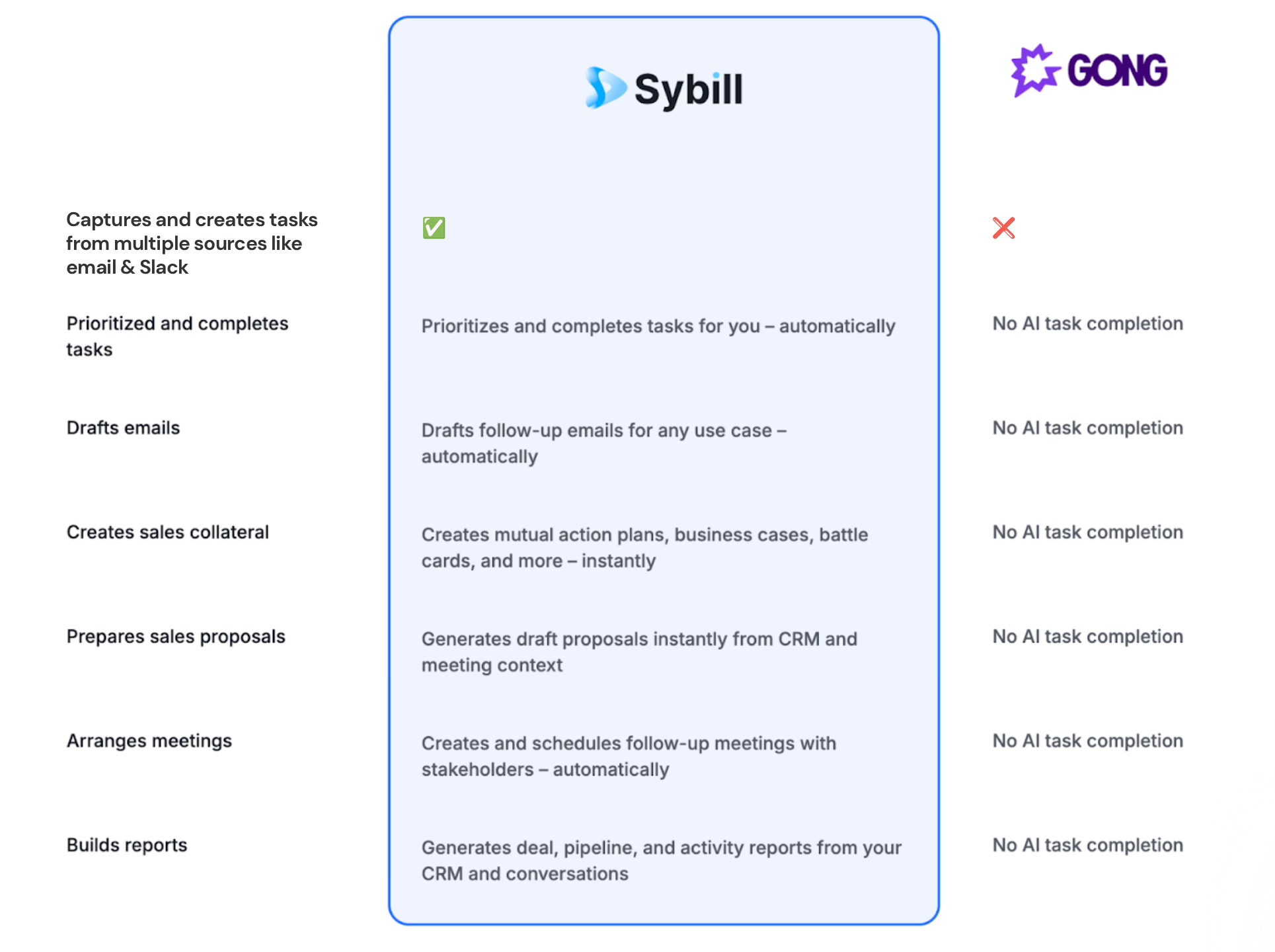
Sellers start the day with pre-call briefs that pull information from past calls, email threads, and CRM notes. They head into meetings with talking points, likely objections, and the next steps that move deals forward. After the call, Sybill writes the follow up, updates the CRM, and creates the artifacts buyers ask for, like a mutual action plan, a summary doc, or a quick battle card. That loop repeats across every opportunity, which means more consistent execution and fewer dropped balls.
Gong shines when leaders need to understand pipeline health at scale. The platform records and analyzes conversations, highlights risk patterns, and rolls activity into forecasts, dashboards, and coaching views. If your biggest pain is forecast accuracy or manager visibility, Gong is a strong answer.
Sybill tends to win with automation that helps sellers feel in the moment. It gets the unglamorous work done. Less manual CRM entry. Fewer blank page stares after calls. More high quality touches in less time. When reps spend more minutes in conversation and fewer minutes in admin, you feel it in the number.
Gong tends to win with forecasting, analytics depth, and coaching at scale. It gives CROs and RevOps a clear way to compare teams, track initiatives, and inspect risk across the quarter.
With Sybill
Your AE opens a brief that already knows who is on the call and what they care about. In the meeting, Sybill answers deal questions and captures tasks. After the call, the email is drafted, the CRM is updated, and a short summary lands in Slack. The mutual action plan is ready before the buyer asks.
With Gong
Your AE knows the call was recorded and will be scored. Managers can coach and spot trends during pipeline reviews. The insights inform enablement and forecasting decisions. For reps who already have strong personal workflows, this is additive. For reps who struggle with admin, it does not remove the work by itself.
Sybill often fits teams that want a product-led path. You can start small with individual licenses, skip platform fees, and see value quickly because the product writes emails, fills CRM fields, and creates collateral on day one. Gong is usually an enterprise-style decision with platform fees, paid implementation, and a larger rollout plan. If you want a faster path to visible time savings, Sybill is the lighter lift.
Plenty of companies keep Gong for leadership analytics while rolling out Sybill to reps for daily execution. Leaders get roll-ups. Reps get real help. If that is your plan, decide where each tool is the source of truth to avoid double work. A simple rule of thumb works well. Gong for forecasting meetings. Sybill for everything that touches the buyer day to day.
Is Sybill a replacement for Gong?
For many seller workflows, yes. Sybill covers meeting prep, follow ups, CRM hygiene, and cross-deal questions that help reps see patterns faster. Large orgs sometimes keep Gong for forecasting and analytics, then use Sybill to remove manual work for AEs.
Can I start with Sybill and add Gong later?
Absolutely. Teams often begin with Sybill to unlock time savings, then evaluate whether leadership needs deeper forecasting. If they do, layering Gong is straightforward.
What about coaching and enablement?
Sybill’s summaries, talk tracks, and collateral make coaching more practical, since managers comment on concrete artifacts and reps ship better follow ups. If you need programmatic coaching metrics across every team, Gong provides robust analytics.
Bring one late-stage deal and one early-stage deal. Put Sybill on both and watch how much work disappears. Then put Gong on your next forecast call and see whether your managers get the clarity they want. Your choice will be obvious after that.
If you are optimizing for leadership visibility, Gong is a strong choice. If you are optimizing for seller output today, Sybill will feel like you hired an extra teammate. Most teams need both visibility and output. Start where the pain is sharpest, measure time saved and deals advanced, then decide whether you need more analytics on top.