Pipeline, Forecasting & RevOps

10 Tips for Effective Sales Pipeline Management

If you work in sales, “pipeline” is probably the most used word in your day.

“What’s in your pipeline?”
“We need more pipeline.”
“That deal’s still in the pipeline?”

It appears in every forecast call, every QBR, every Slack thread about targets, every conversation when leadership asks “Are we on track this quarter?”

The 10 most effective tips for sales pipeline management are: define clear stage criteria with exit requirements, enforce consistent data hygiene through automation not willpower, review pipeline weekly with evidence not opinions, remove stalled deals ruthlessly to maintain forecast accuracy, track conversion rates between stages to identify bottlenecks, align pipeline stages to your buyer's journey not your internal process, use AI tools like Sybill to auto-capture deal signals from conversations, multi-thread every opportunity above your average deal size, set next-step dates on every open deal, and measure pipeline velocity not just pipeline volume. The single highest-impact change most teams can make is automating CRM updates from sales calls with AI so pipeline data reflects reality instead of what reps remember to log.

But here is the truth most teams quietly feel and rarely say out loud:
A lot of “pipeline management” is simply noise.

Deals sit in stages they don’t really belong in.
Forecasts become optimistic guesses.
Follow‐ups are inconsistent because reps are juggling so many tasks.

And then at the end of the quarter everyone is surprised.

Effective sales pipeline management is what turns that kind of chaos into something predictable, coachable, scalable. It is not just a dashboard in your CRM. It is the operating system for your revenue engine.

Let us start by clearing up some terminology that often gets mixed up.

Sales Pipeline ≠ Sales Funnel

People often use “pipeline” and “funnel” interchangeably, but they are not the same. And if you treat them as though they are the same, your strategy gets fuzzy fast.

What is a Sales Pipeline?

A sales pipeline is a visual, structured view of the deals your team is working on right now and where they are in your sales process.

Think of it as a board that answers questions such as:

  • Which stage is each opportunity in?
  • What is the potential value of those deals?
  • Which deals are likely to close this month, next month or later?
  • Where are deals getting stuck?

Pipelines are highly actionable. They are built for day-to‐day selling:

  • “Who do I follow up with today?”
  • “Which deals need an executive sponsor looped in?”
  • “Why are so many deals stuck in the ‘proposal sent’ stage?”

What is a Sales Funnel?

A sales funnel zooms out.

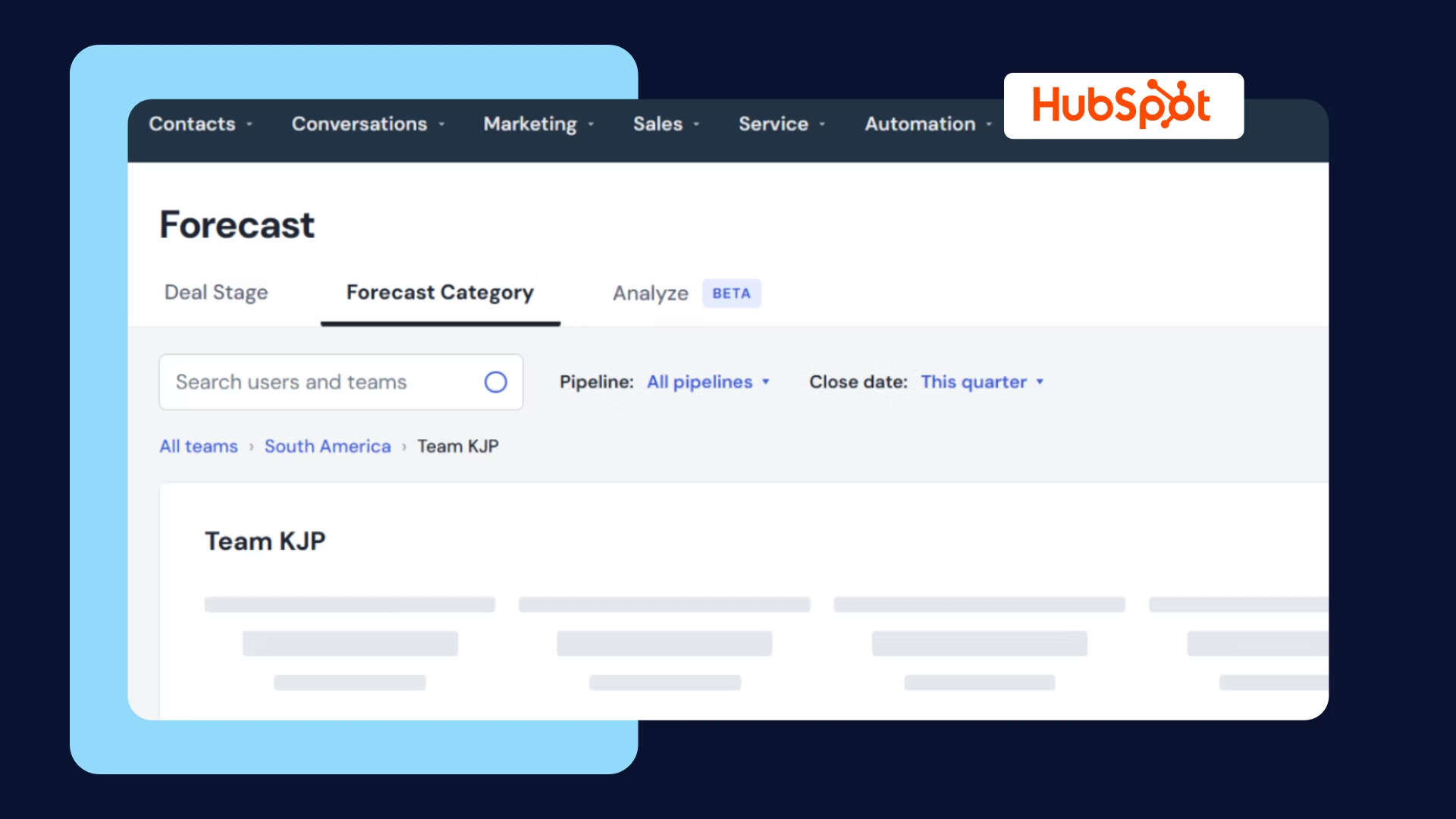
Instead of focusing on individual deals and their stages, it looks at conversion rates as prospects move from awareness → interest → consideration → decision. For example, check out this guide from HubSpot on sales pipelines and funnels for more detail.

It answers questions like:

  • How many leads do we need at the top of the funnel to hit this quarter’s target?
  • What percentage of MQLs turn into SQLs?
  • Where in the journey are we losing people?

If the pipeline is your daily cockpit, the funnel is your strategic blueprint.

  • Funnel = “Do we have enough volume and conversion to hit our long‐term revenue goals?”
  • Pipeline = “What should I and my team actually do today to move deals forward?”

You really need both. But this blog is about the pipeline, the thing sales teams live inside every single day.

Stages of a Sales Pipeline (and How They Connect to the Funnel)

Every company will name its stages a bit differently, but most healthy pipelines follow a similar backbone. For example, here is one well-structured view of pipeline management. (sybill.ai)

Here’s a straightforward version you can adapt to your own world:

  1. Lead / Prospecting
    • You have identified someone who might be a fit. Maybe they filled out a form, attended a webinar, replied to an outbound sequence, or were referred.
  2. Qualification
    • You have had some sort of discovery conversation or early interaction.
    • You are figuring out: Is there a real problem? Do they have budget, authority, a timeline, and a compelling reason to act?
  3. Proposal / Demo
    • You are actively showing how your solution solves their problem, through demos, tailored proposals or proof of concept.
    • There is momentum. They are seriously evaluating your solution.
  4. Negotiation / Evaluation
    • You are ironing out details: pricing, scope, legal, procurement, security, implementation.
    • Other stakeholders may join. This is where deals often slow down or go dark if not managed proactively.
  5. Closed (Won or Lost)
    • The outcome is clear. Either you win the deal and hand it to onboarding/CS, or you lose it and log why. That “why” is gold for future improvements.

Meanwhile, the funnel describes how many people drop off between these stages:

  • Top of Funnel (TOFU): Traffic, leads, awareness.
  • Middle of Funnel (MOFU): Qualified opportunities exploring seriously.
  • Bottom of Funnel (BOFU): Late stage buyers making a decision.

The magic happens when you connect both:

  • Your funnel tells you how healthy your system is overall.
  • Your pipeline shows you what’s happening deal by deal.

How to Build a Healthy Sales Pipeline

Before we jump into the 10 tips, let us ground ourselves in what a healthy pipeline actually looks like.

A solid pipeline is not just “big”. It is:

  • Structured: Clear stages, clear exit criteria. Everyone knows what it means for a deal to be in “Qualified” vs “Negotiation”.

  • Realistic: No zombie deals that have been sitting untouched for 90+ days.

  • Balanced: A mix of early, mid and late‐stage deals, so future quarters are not a panic.

  • Data-backed: You are not relying on vibes, you are using metrics like win rate, cycle length, and stage conversion.

  • Action-oriented: Reps know what to do next. Managers know where to coach.

To build a pipeline like that, you need:

  1. Clear definitions for each stage.

  2. A qualification framework that everyone uses.

  3. A CRM you actually trust.

  4. A habit of regular pipeline reviews.

  5. Tools that reduce admin work rather than add to it.

Now let’s get into the practical stuff: 10 tips for managing your pipeline so it feels less like chaos and more like a controllable machine.

1. Prioritize Leads Based on Fit and Urgency

Not all leads deserve the same amount of attention.

Some are actively shopping and need you this week. Others are just curious and maybe will buy in a year (or never). Treating them all the same will exhaust your team and clog your pipeline.

Start with a Clear ICP

Define your Ideal Customer Profile (ICP):

  • Company size
  • Industry
  • Tech stack
  • Use case
  • Pain points you solve best

Then, map your leads against that ICP. The closer the fit, the higher the priority.

Add a Sense of Urgency

A high-fit lead with low urgency is still valuable, but they should not crowd the top of your call list.

Look for signals like:

  • A triggering event (funding, leadership change, new regulation, tool they rely on going away)
  • An active initiative (“We need a new sales engagement stack by Q2”)
  • Time‐bound problems (“We are missing forecasts every quarter”)

Combine fit and urgency into a simple scoring model. Your CRM can help with this, but even a basic numeric score (e.g., 1–100) is better than leaving it entirely to gut feeling.

2. Implement Data-Driven Lead Nurturing Rather Than Hopeful Follow-Ups

Here is a painful stat: a large chunk of salespeople never send a single follow up after the first touch. That is wild when you think how hard it is to get a qualified lead in the first place. (superoffice.com)

Yet, most deals don’t close after one demo or one email. They move forward because you stay present and add value over time.

Use Behavior, Not Just Time, to Trigger Follow-Ups

Instead of “I follow up every 3 days,” try:

  • Follow up when a prospect reopens your proposal

  • Follow up if they replay a demo recording or forward it internally

  • Follow up if they click a pricing link or visit your case studies page

Your marketing automation or sales engagement tools can help trigger these.

Let AI Do the Heavy Lifting

The reality is that reps are juggling back-to-back calls, internal meetings and Slack pings. Manually drafting perfect follow-ups after every call is unrealistic.

This is where AI tools come in:

  • Tools like Sybill (AI meeting and follow-up assistant) can generate personalised follow-up emails in your own tone of voice based on the actual meeting conversation, not generic templates. They can also pull in key pain points, next steps and commitments mentioned on the call, so your follow-up feels sharp and specific.

  • Such tools help you send more follow-ups, faster. And your pipeline stops leaking deals just because someone got too busy.

3. Befriend Your CRM (It’s Your Pipeline’s Source of Truth)

A pipeline lives and dies inside your CRM.

If your CRM is half-filled, full of duplicates, and missing next steps, your “pipeline” view is basically fiction. You are flying blind. (Outreach)

Make the CRM Work for Reps and Not Against Them

Reps hate CRMs when they feel like:

  • Extra admin work

  • A place they update only to satisfy leadership

  • A reflection of reality not being live but outdated

To flip that:

  • Use a CRM with a visual pipeline view (like Pipedrive, HubSpot CRM or Salesforce dashboards) so that when reps open it they see value.

  • Template key fields and workflows so that reps are not guessing what fields to fill and when.

  • Maintain a clear definition for each stage (with exit criteria). No more “it’s in proposal because I sent them a deck once.”

Automate CRM Hygiene Where Possible

A lot of CRM laziness comes from the fact that updating it manually is a drag.

Here AI again helps:

  • Tools like Sybill can auto-generate deal notes and update CRM fields based on what was said in the call, so your pipeline stages and fields stay fresh without reps spending 30 minutes on data entry.

When the CRM reflects reality, pipeline reviews become powerful instead of detective work.

4. Identify Bottlenecks With Regular Pipeline Reviews

Even the prettiest pipeline will start to rot if you never inspect it.

Regular pipeline reviews are where you see the truth:
Which deals are real. Which ones are stale. Which stages are black holes.

Look at Time in Stage, Not Just Stage Name

It is not enough to know which stage deals are in. You also need to know how long they have been there. (Sopro)

Questions to ask:

  • How many deals have been in “Evaluation” for more than 30 days?

  • What’s the average time from Demo → Proposal → Close for won deals?

  • Where do lost deals most often stall before they disappear?

This tells you where your bottlenecks are:

  • If demos don’t turn into proposals, your discovery might be weak or your demo not landing.

  • If proposals linger with no decision, your champion may be under-powered or value story not sticking.

  • If everything stalls at legal/procurement, you may need better commercial templates or earlier stakeholder alignment.

Make Reviews About Strategy, Not Blame

A good pipeline review is:

  • Forward-looking: “What needs to happen next week?”

  • Specific: “Who is our champion here? What is their internal business case?”

  • Collaborative: Managers coach; reps strategise. No one is just giving status.

Over time you will start to notice patterns, and that is where real optimisation happens.

5. Optimise Your Qualification Process (So Junk Does Not Flood the Pipeline)

If you let every “slightly interested” conversation become an opportunity your pipeline will look big and be fake.

Qualification is where you decide:
Is this a real potential deal or just a nice conversation?

Choose a Framework and Stick to It

Whether it is BANT, MEDDIC, SPICED or something home-grown, pick a qualification framework and operationalise it. For example see this article on sales pipeline management strategies for ideas. (superoffice.com)

Examples of qualification fields:

  • Problem / Pain: What is broken today?

  • Impact: What happens if they do nothing?

  • Budget: Is there budget now or does it need to be created?

  • Authority: Who is signing off, and have we met them?

  • Timeline: When do they want this solved?

Bake Qualification Into Your CRM and Calls

Do not treat qualification as a mental checklist. Put it into your process:

  • Add required fields in your CRM for early stages.

  • Use AI-based call intelligence (like Sybill, or other tools) to automatically capture answers to qualification questions from your calls, so you are not frantically typing during discovery.

The goal is to move fewer but better opportunities into the pipeline. That way your win rates go up and your team spends time where it matters.

6. Align Sales and Marketing Around the Same Pipeline

Drama between marketing and sales is older than most CRMs.

Marketing says: “We are sending you leads.”
Sales says: “They are junk.”
Leadership says: “Our pipeline isn’t growing fast enough.”

Behind that tension is often a simple issue: no shared definition of quality. (Mural)

Define Hand-Off Points Clearly

Agree on:

  • What counts as an MQL (Marketing Qualified Lead)?

  • When does an MQL become an SQL (Sales Qualified Lead)?

  • What must be true (company size, job title, intent signals) before SDRs or AEs pick it up?

Document it. Share it. Make it part of your onboarding.

Share Funnel and Pipeline Data

Instead of fighting over anecdotes (“those webinar leads were bad”), share data:

  • MQL → SQL conversion rates

  • SQL → Opportunity conversion

  • Opportunity → Closed-Won by source or campaign

When both teams see the same reality it is much easier to refine messaging, targeting and process together. Suddenly “pipeline” becomes a shared project rather than a tug-of-war.

7. Balance Short-Term Wins With Long-Term Pipeline Health

A lot of teams live quarter‐to‐quarter. All the energy goes into this quarter’s number and anything that won’t close soon is neglected.

You can hit a target that way. You just cannot do it repeatedly without burning out your future pipeline.

Build a Two-Speed Pipeline Strategy

Think of your pipeline as having two tracks:

  1. Short-Term Deals


    • Late-stage opportunities likely to close this month or quarter.

    • Need focused attention: multi-threading, executive alignment, tailored proposals, tight follow-ups.

  2. Long-Term Opportunities


    • High-fit accounts who are not ready yet.

    • Need strategic nurturing: content, check-ins around key dates, building relationships over time.

Use your CRM to segment these:

  • Create views or tags for “This Quarter”, “Next Quarter”, “Later”.

  • Adjust outreach cadence accordingly.

Your goal is to never end a quarter staring at an empty early-stage pipeline. If you are closing deals now and actively nurturing deals for the future, your pipeline stops feeling like a roller coaster and starts to feel like a flywheel.

8. Use Metrics to Guide Decisions Rather Than Just Opinions

If you are not measuring your pipeline, you are guessing.

Key pipeline metrics to track:

  • Win Rate: Of all opportunities created, what proportion turn into closed‐won?

  • Average Deal Size: Helps forecast revenue more accurately.

  • Sales Cycle Length: How long from first touch or opportunity creation to close?

  • Stage-to-Stage Conversion: Where do deals most often drop off?

  • Pipeline Coverage: Ratio of pipeline value to quota (for example 3× coverage).

These are not “nice to know” numbers. They shape strategy. (Nimble)

Turn Metrics Into Actions

Some examples:

  • If win rate is low, revisit qualification and messaging.

  • If deals always slow at legal, bring legal in earlier or adjust commercial terms.

  • If your cycle length is very long, you may need better internal champions, clearer ROI stories, or simpler pricing.

Ideally your CRM or revenue intelligence tool surfaces these metrics automatically so you are not building spreadsheets every week.

9. Customise Your Pipeline to Your Industry and Motion

There is no universal “right” pipeline. A 3-stage pipeline for a self-serve SaaS product is very different from a 9-month enterprise deal with RFPs and pilots.

Trying to copy someone else’s pipeline without adapting it to your motion is a recipe for confusion. (Floworks)

Examples of Differences

  • SaaS with PLG (product-led growth) motion


    • Stages may revolve around trial activation, product usage milestones, stakeholder alignment, expansion.

    • You might have explicit stages for “Trial Setup”, “Pilot Success Plan”, “Proof of Value Achieved”.

  • Traditional B2B SaaS with Top‐Down Sales


    • More emphasis on discovery, stakeholder mapping, business case development, negotiation.

  • E-commerce / Transactional Sales


    • Faster cycles, fewer stages, more focus on conversion and repeat purchases.

Adapt, Then Standardise

Customising does not mean every rep does whatever they want.

Instead:

  • Design a pipeline that reflects how your buyers actually buy.

  • Limit stages to those that represent meaningful changes in buyer commitment.

  • Document what must be true for a deal to enter and exit each stage.

Once customised, keep it consistent. If you keep renaming stages every quarter your historical data becomes useless.

10. Train and Empower Your Sales Team (Your Pipeline Is Only as Strong as Its Users)

The best pipeline structure, CRM setup and tools will not help if your team does not know how to use them or does not buy into them. (sybill.ai)

Make Pipeline Management a Skill Not Just a Task

Train reps on:

  • How to run great discovery that fills in qualification fields naturally

  • How to document meetings in a way that moves deals forward

  • How to identify risk in their own pipeline (single-threaded deals, long-in-stage, no clear next step)

  • How to use tools like Sybill or other AI assistants to review calls, understand buyer signals, and improve messaging

Pipeline reviews then become coaching opportunities:

  • Listen to a snippet from a stalled deal’s last call.

  • Use AI-driven insights to highlight when buyer interest spiked or dropped.

  • Turn each stuck opportunity into a small lesson: Was the problem unclear? Was the next step vague? Was the stakeholder not senior enough?

Let AI Be the Assistant Not the Boss

Tools like Sybill, Gong or your CRM’s built-in AI features should not replace judgment. They should surface insights, reduce admin, and free sellers to do what humans do best: build trust, ask smart questions, guide buyers.

When reps see tools actually making their lives easier (summarising calls, generating follow-ups, updating CRM fields) they are much more likely to keep your pipeline clean without feeling like they are working a second job as a data-entry clerk.

Can Effective Pipeline Management Really Boost Sales Performance?

Short answer: yes. And not just by a little.

A well-managed pipeline:

  • Reduces deal leakage: fewer opportunities fall through the cracks because every deal has a clear owner, next step and strategy.

  • Shortens sales cycles: when you are proactive with stakeholders, objections and process, deals move faster.

  • Improves forecast accuracy: leadership trusts the numbers, reps aren’t sandbagging or guessing.

  • Improves rep productivity: reps spend less time wondering “what do I do next?” and more time actually selling.

  • Creates a better buyer experience: prospects feel guided, not run around. The process feels intentional not chaotic.

Over time, strong pipeline discipline compounds. Your team learns where they win, where they lose and why. You refine your ICP, your messaging and your motion. And the same volume of leads begins to produce more, and more predictable revenue.

Tools to Power Up Your Sales Pipeline

You do not need a massive tool stack to manage a pipeline. But the right tools absolutely make it easier.

Here are some categories and examples:

1. Revenue Intelligence Platforms (e.g., Gong)

Platforms like Gong help you:

  • Record and analyse sales conversations

  • Identify patterns in winning vs. losing deals

  • See how often competitors come up, what topics resonate and which parts of your sales talk track lose attention

They are powerful for coaching, trend-spotting and understanding what is really happening inside your pipeline conversations.

2. AI Sales Assistants (e.g., Sybill)

Sybill acts like a personal AI assistant for sellers:

  • Automatically generates meeting summaries and deal notes

  • Drafts follow-up emails in your own writing style

  • Suggests CRM updates based on what was discussed in the call

  • Helps you quickly revisit key moments from past meetings when prepping for the next one

Instead of spending 20-30 minutes per call on admin, you let the AI take care of it, and your pipeline stays fresh.

3. CRM Platforms (e.g., Pipedrive, HubSpot, Salesforce)

CRMs like Pipedrive, HubSpot CRM and Salesforce:

  • Give you a visual pipeline

  • Track interactions and activities

  • Help you forecast revenue based on stage, amount and historical conversion

  • Provide reports on win rates, cycle length and stage performance (HubSpot Blog)

They are the backbone of your pipeline. Everything else plugs into them.

The Bottom Line: Pipeline Management Is Never “Set and Forget”

A sales pipeline is not a one-time project. It is a living system.

Markets change. Your product evolves. Your team grows.
Your pipeline needs to evolve with all of that.

If you remember nothing else from this blog, remember this:

  1. Define your stages clearly. Everyone should know what each stage means and what must happen to move forward.

  2. Be ruthless about qualification. A smaller but accurate pipeline beats an inflated fantasy one.

  3. Use tools to reduce admin instead of adding to it. Automate what you can, especially follow‐ups, summaries and CRM updates.

  4. Review your pipeline regularly. Look for bottlenecks, stuck deals and patterns, not just numbers.

  5. Invest in your team. A great process plus a well-coached team is where the real leverage lies.

Ready to Make Pipeline Management Less Painful?

If your reps are spending too much time typing notes, writing follow-ups and updating fields but not enough time selling, your pipeline will always feel messy.

It does not have to.

When you combine structure, tools, discipline and coaching, you turn pipeline management into a competitive advantage.

So start today.

‍

Get started with Sybill

Accelerate your sales with your personal assistant

Get Started Free

Frequently Asked Questions

How do you effectively manage a sales pipeline?

Keep your CRM updated, qualify every opportunity, run regular pipeline reviews, and use data to spot risks early. Prioritise high-fit deals, maintain clear next steps, and automate follow-ups and notes so nothing slips through the cracks.

What is sales pipeline management?

It is the process of tracking, organising, and guiding deals through each stage of your pipeline so you can forecast accurately, prioritise effectively, and keep opportunities moving toward a close.

What makes a good sales pipeline?

Clear stages, accurate data, strong qualification, balanced early-to-late stage opportunities, and consistent follow-up. A good pipeline reflects reality, not wishful thinking, and helps the team focus on the right deals.

Get started with Sybill

Once you try it, you’ll never go back.