Find us at booth #83, join us for a harbor side happy hour, or catch Gorish’s talk.

Sept, 16-18 > Learn more

%20(1).avif)
Mamta Tainwala

June 19, 2026
%20(6).png)
The Agoge Sequence is a multi-touch, multi-channel cold outreach cadence created by Sam Nelson that combines email, LinkedIn, and phone touchpoints with deep personalization and strategic persistence. Named after the rigorous training system of ancient Sparta, it replaces generic, high-volume blasting with a structured framework designed to turn cold prospects into engaged opportunities.
If you give up after one follow-up, like 44% of sales reps do, the persistent ones beat you to the deal. It takes an average of eight strategic touches to land a meeting with a prospect, and the Agoge Sequence gives those touches a purpose instead of leaving them to chance.
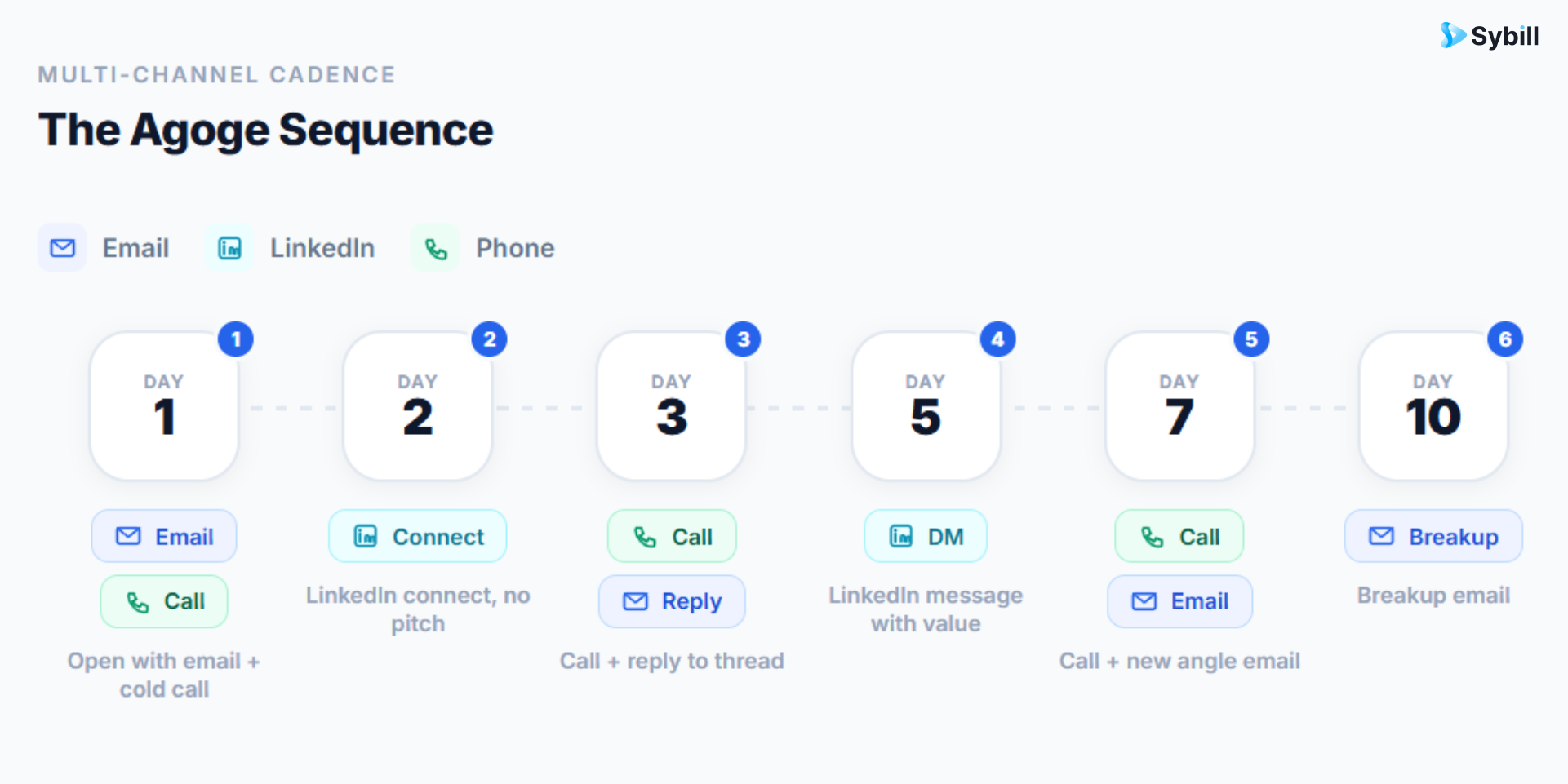
The Agoge Sequence is a high-impact sales outreach strategy that helps reps cut through inbox noise and convert cold prospects into engaged opportunities. It is a multi-channel, multi-touch approach centered on strategic persistence and personalization, where every touchpoint is purposeful and moves the prospect closer to a conversation.
Crucially, the Agoge Sequence does not mean sending more emails. It means sending targeted messages that build momentum across multiple interactions and channels. Reps who execute it well achieve higher response rates and book more meetings while keeping every touch personalized and professional. Unlike generic cadences that lack structure, the sequence treats outreach as a deliberate campaign rather than a numbers game.
The Agoge Sequence was created by Sam Nelson, a sales thought leader and outbound prospecting expert who developed the framework during his time at Outreach. He named it after the Agoge, the disciplined training regimen of ancient Sparta, to reflect a structured yet flexible approach to outreach.
Nelson replaced guesswork with a repeatable system, teaching reps not just what to do at each touch but why and how to do it effectively. The result is a process that combines creativity, structure, and persistence to create meaningful conversations, which is why the Agoge Sequence has become a widely referenced standard for outbound sales enablement.
The Agoge Sequence differs from traditional cold outreach by replacing generic, one-size-fits-all messaging with a structured, personalized, multi-channel campaign where every touch has a defined goal. Traditional outreach is typically a couple of cold emails and a hopeful phone call with no consistency or sequencing logic.
Traditional outreach is like throwing spaghetti at the wall and hoping something sticks. It lacks structure, consistency, and personalization, so prospects ignore it. The Agoge Sequence, by contrast, plans each touch with intent, uses multiple channels to reach prospects where they actually respond, and combines research and persistence to convert cold leads into warm opportunities.
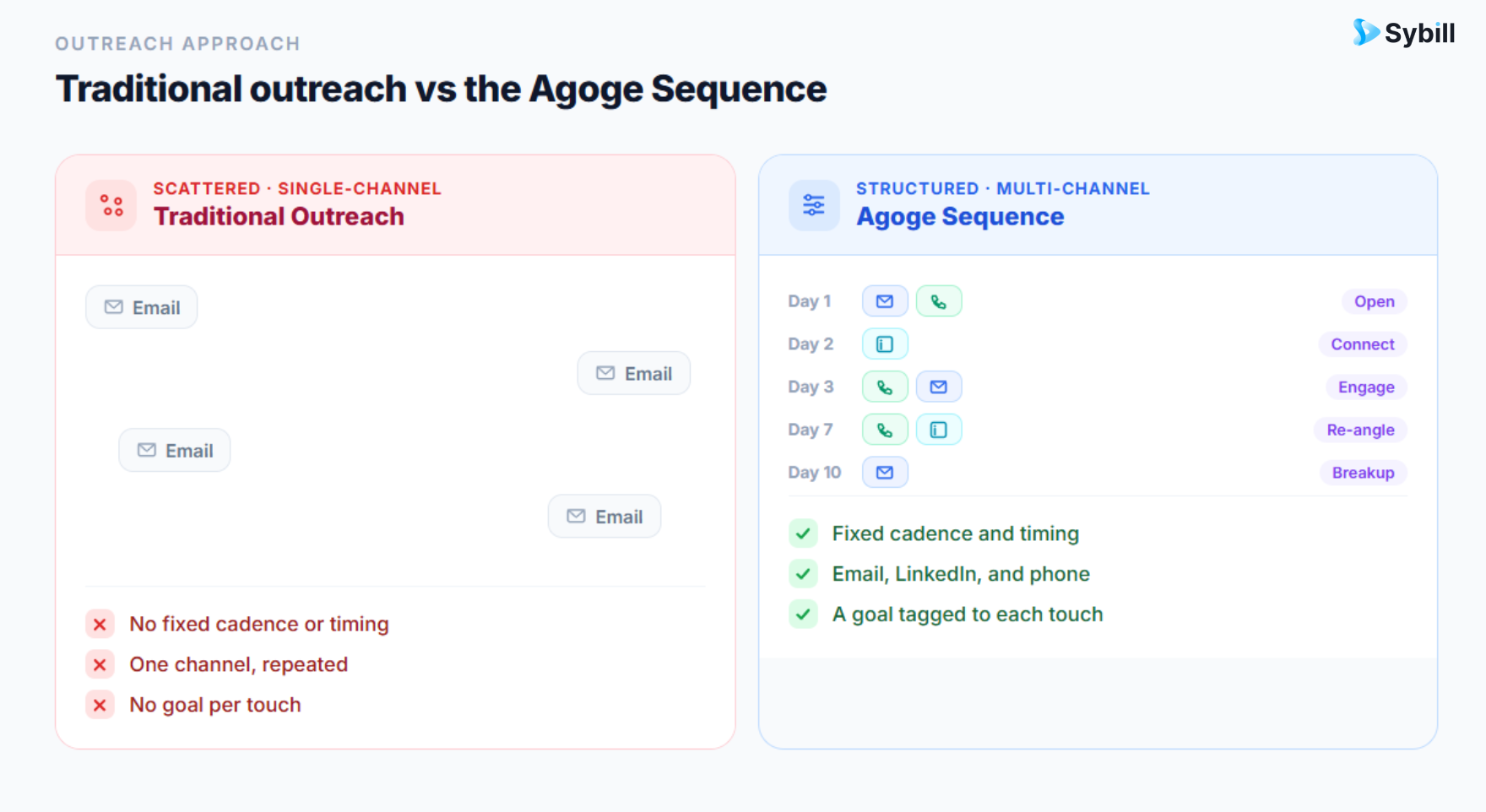
The Agoge Sequence consists of six core touchpoints, each with a specific goal and channel: the attention grabber, the value bomb, the gentle nudge, the call, the social proof, and the closing touch. Together they move a prospect from first awareness to a booked meeting.
Goal: Spark curiosity and capture attention. Channels: Email + LinkedIn.
This is your opening move, and it needs to land. Show that you have done your homework with a short, personalized email referencing something specific, such as a recent achievement, company news, or a shared interest.
Pro tip: Pair this email with a LinkedIn profile visit or connection request to create familiarity.
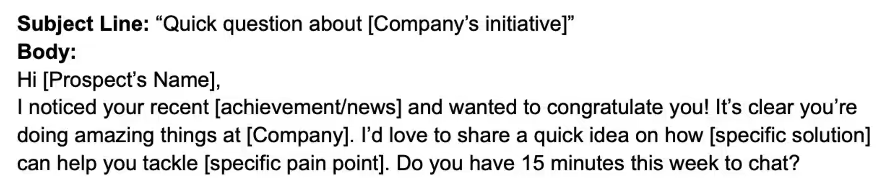
Goal: Establish credibility by offering something valuable. Channels: Email + LinkedIn InMail.
Now that you have their attention, deliver value upfront. Send a relevant resource such as an ebook, case study, blog, or exclusive insight tied to their challenges. This positions you as a helpful resource rather than another salesperson.
Pro tip: Avoid attaching large files. Link to your content so prospects can click through easily.
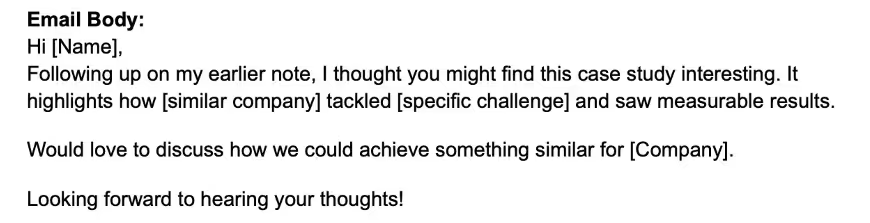
Goal: Keep the conversation alive without being pushy. Channels: LinkedIn comment + follow-up email.
This stage is subtle persistence. Engage with their LinkedIn activity by commenting on a recent post or sharing their content, then send a short email referencing that post and tying it back to your solution.
Pro tip: Be genuine in your engagement. Prospects can tell when you are just going through the motions.

Goal: Move from digital to direct communication. Channel: Phone.
By now the prospect is familiar with you, so make it personal. Use the call to build on earlier interactions, referencing the resources you shared and the insights you gathered about their needs.
Pro tip: If cold calling makes you nervous, practice your pitch and keep notes handy. Confidence is essential.

Goal: Build trust and establish credibility. Channels: Email + LinkedIn.
Nothing moves the needle like social proof. Share success stories, testimonials, or statistics that show how you delivered value for similar companies. Keep it short and relevant to the prospect's industry or role.
Pro tip: Always include a clear call to action so the prospect can respond easily.
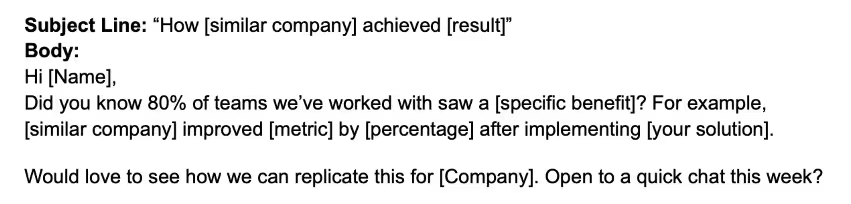
Goal: Get a response or close the loop. Channels: Email + voicemail.
This is your final play. If you have not heard back, use this touch to prompt action or gain clarity on whether the prospect is interested. Be professional but direct, and do not be afraid to ask if it is time to move on.
Pro tip: Pair this email with a voicemail reiterating the key points. The double nudge often prompts a response.

Get started for free with Sybill
Stop rebuilding your Agoge cadence from memory after every call. Sybill's Magic Summary captures what each prospect actually cares about, and CRM Autofill keeps every touchpoint logged automatically. Get started for free with Sybill →
You run the Agoge Sequence effectively by combining deep research, smart automation, consistent follow-up, and engagement tracking. Precision, personalization, and persistence determine whether the cadence books meetings or gets ignored.
Personalization is the cornerstone of the sequence, and you cannot personalize without knowing your prospect. Review their recent LinkedIn posts and job updates, check Crunchbase for funding or acquisition news, and search their company name with terms like "press release" to surface fresh hooks. Always favor specific, relevant observations over generic compliments.
Automation tools help you manage prospects across stages, but they should never make you sound generic. Use dynamic fields to auto-fill names, companies, and recent achievements; pre-schedule your touchpoints across email, LinkedIn, and phone; and keep the core message contextual. Supersellers offload the grunt work too, using Sybill's deal summaries to cut CRM entry time so they can focus on strategy.
80% of sales require at least five follow-ups, yet 44% of reps give up after one. Repetition builds recognition, so even when a prospect does not reply immediately, your persistence keeps you top of mind. Different channels also produce different outcomes: a prospect who ignores email may respond to a LinkedIn message or a well-timed call.
The sequence is adaptable, so track how prospects respond and refine accordingly. Monitor email opens and clicks with tools like HubSpot, watch LinkedIn profile views and interactions, and note verbal cues from calls. Use that data to pivot, for example by switching subject lines or value propositions when a prospect opens but does not reply.
In 2026, most high-performing B2B teams cluster around 8 to 12 touches rather than the original full-length sequence, reserving the longest cadences for enterprise targets. The shift reflects tighter deliverability standards and a move toward trigger-based personalization over rigid day-by-day timelines.
The single biggest factor in whether the sequence works is the quality of your contact data before touch number one. A clean, verified list keeps your sending domain healthy and your touches landing; a dirty list causes bounces, domain flags, and dead touchpoints regardless of how good your copy is. Phase out channels that are not getting traction by the later touches, and lean into triggers like job changes, funding rounds, and new hires instead of fixed dates.
Sybill improves the Agoge Sequence by giving reps the real-time insight and automation needed to execute every touch with precision. Instead of guessing what a prospect cares about, reps act on what was actually said and felt in each conversation.
Here is how supersellers use Sybill to run a sharper Agoge Sequence: Magic Summary surfaces nonverbal sentiment and meeting takeaways so you know how your message is landing; personalized email follow-ups draft your next touch in your own voice using real call context; and CRM Autofill populates your CRM with actionable insights from every touchpoint, so your sequence never misses a beat. According to Sybill CEO Gorish Aggarwal, the goal is to make Sybill the post-conversation execution layer that turns insight into the next right action automatically.
The Agoge Sequence is a multi-touch, multi-channel cold outreach cadence created by Sam Nelson that combines email, LinkedIn, and phone with personalization and strategic persistence to convert cold prospects into engaged opportunities.
Sam Nelson invented the Agoge Sequence during his time at Outreach. He named it after the Agoge, the disciplined military training system of ancient Sparta.
The original framework runs roughly 15 touches across channels, but most teams in 2026 run 8 to 12 touches for mid-market deals and reserve longer cadences for enterprise accounts. Email is only one channel within the sequence, alongside LinkedIn and phone.
No. The Agoge Sequence is about targeted, personalized messaging across multiple channels, not high-volume blasting. Each touch has a specific goal designed to build momentum toward a conversation.
Yes, when paired with clean contact data and trigger-based personalization. Deliverability and data quality matter more than touch count, so teams now lean on signals like funding rounds and job changes rather than fixed-day timelines.
A normal cadence is often single-channel and unstructured, while the Agoge Sequence is a deliberate multi-channel campaign where every touch is researched, personalized, and assigned a clear objective.
The Agoge Sequence is a multi-touch, multi-channel cold outreach cadence created by Sam Nelson that combines email, LinkedIn, and phone with personalization and strategic persistence to convert cold prospects into engaged opportunities.
Sam Nelson invented the Agoge Sequence during his time at Outreach. He named it after the Agoge, the disciplined military training system of ancient Sparta.
The original framework runs roughly 15 touches across channels, but most teams in 2026 run 8 to 12 touches for mid-market deals and reserve longer cadences for enterprise accounts. Email is only one channel within the sequence, alongside LinkedIn and phone.