Find us at booth #83, join us for a harbor side happy hour, or catch Gorish’s talk.

Sept, 16-18 > Learn more


Mamta Tainwala

June 15, 2026
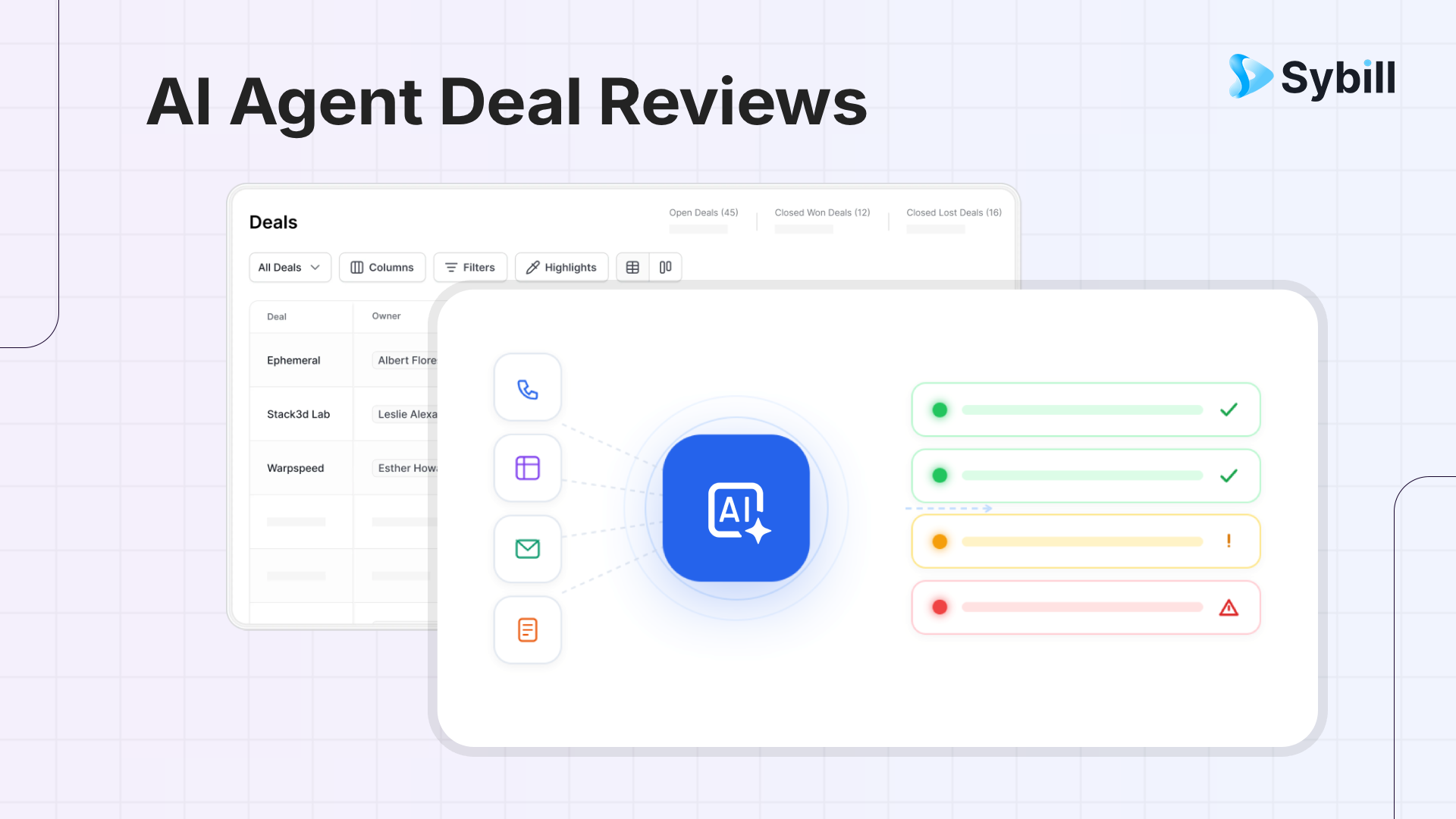
An AI deal review agent is a system that evaluates the health, qualification status, and risk profile of deals in your pipeline automatically, without waiting for a manager to call a review meeting or a rep to manually compile an update.
It pulls from the sources where deal reality actually lives: call recordings, CRM fields, email threads, and meeting notes. It applies a qualification framework to what it finds. And it delivers a structured assessment of which deals are on track, which are at risk, and specifically why, with evidence from real interactions rather than self-reported rep data.
The output is not a formatted version of what your CRM already shows. It is an independent read of the deal based on what was actually said and done, not just what was logged.
For sales managers, that distinction matters enormously. The gap between what a CRM shows and what is actually happening in a deal is often where pipeline surprises come from. An AI deal review agent closes that gap by working from primary sources.
Gorish Aggarwal, CEO of Sybill AI, recommends this as one of the highest-value agent use cases for sales teams entering the agent space: "Take a rubric that you have for your deal qualification framework within your company. Your data is already within Sybill or your emails or other sources. Get those MCPs connected over to your Claude and then ask your Claude to say which of these deals are qualified and which ones are not based on this rubric." The infrastructure to do this is already in place for most teams. The missing piece is the agent that runs the review systematically.
Pipeline reviews fail for a predictable set of reasons, none of which are the manager's or rep's fault. They are structural problems that no amount of process improvement fixes without automation.
Data is self-reported. The pipeline review is only as accurate as the last time a rep updated the CRM, which is often not recent and often optimistic. The review discusses what reps believe is happening, filtered through their own perspective on the deal.
Coverage is incomplete. A manager with eight direct reports and forty active deals cannot meaningfully review every deal every week. Reviews get prioritized by deal size or vocal reps, and quieter deals slip without early warning signals being noticed.
Preparation is manual. Before a pipeline review meeting, someone has to pull the data, organize it by stage, cross-reference it against last week's state, and identify what has moved and what has not. That preparation takes hours, and it still produces a backwards-looking picture.
Pattern detection does not happen. The signals that predict deal outcomes, such as champion disengagement, multi-threading absence, stalled next steps, and competitor mentions with no response, require looking across many data points simultaneously. Humans doing manual reviews catch some of these signals some of the time. A well-built agent catches all of them every time.
An AI deal review agent does not replace the manager's judgment in the review conversation. It replaces the manual preparation and data aggregation that precede that conversation, and it surfaces the signals the human review would miss.
A well-designed deal review agent handles three distinct functions, each of which addresses a different failure mode in manual reviews.
The agent applies a structured qualification framework to each active deal and produces a gap analysis: which criteria are met, which are missing, and what specific evidence supports each assessment.
For teams using MEDDPICC, this means the agent evaluates each deal across all eight dimensions: Metrics, Economic Buyer, Decision Criteria, Decision Process, Identify Pain, Champion, Competition, and Paper Process. It does not ask whether the rep believes each dimension is covered. It looks at what was actually said in calls and emails and determines whether the evidence exists.
A deal where the rep has marked "champion identified" in the CRM but no call recording contains a conversation with anyone above the individual contributor level is flagged as having an unverified champion claim. A deal marked as "late stage" with no documented decision criteria is flagged as qualification risk regardless of the close date.
This is the difference between a framework that is aspirationally used and one that is actually enforced.
Beyond qualification gaps, the agent monitors for behavioral signals that predict deal outcomes independent of the formal qualification framework. These are the patterns that experienced managers recognize intuitively but cannot track systematically across a full pipeline.
Signals the agent can detect from call recordings and email thread analysis:
Champion disengagement: the contact who was previously active in calls and emails has stopped responding or attending. The last three emails to them have gone unanswered. They did not attend the last two calls.
Multi-threading absence: every interaction has been with a single contact, with no evidence of broader organizational engagement. For deals of a certain size or complexity, single-threaded deals have a significantly higher risk of going dark.
Competitor insertion late in the process: a competitor was mentioned for the first time in a late-stage call, suggesting the evaluation may have been reopened or a new stakeholder is involved.
Stalled next steps: a specific next step was agreed in the last call, but no follow-up has been sent, no meeting has been scheduled, and the CRM has not been updated in two weeks.
Sentiment shift: the language and tone of the buyer in recent calls is noticeably different from earlier calls. Questions that were enthusiastic are now procedural. Engagement that was proactive is now reactive.
None of these signals require a human to manually review individual call recordings. The agent surfaces them across the full pipeline in a single pass.
Before a pipeline review meeting, the agent assembles a structured briefing that gives the manager everything they need to have a productive conversation with each rep, without spending time on data gathering.
The briefing includes, for each deal: current stage and close date, qualification status against the framework, the two or three most significant risk signals if any, what has happened since the last review (new calls, emails sent, CRM updates), and a suggested line of inquiry for the manager to pursue with the rep.
The manager walks into the review meeting already oriented. The conversation is about judgment and action, not data retrieval.

Building a deal review agent requires four components working together. Teams using Sybill can shortcut several of these because the data infrastructure is already in place.
This is the most important file in the deal review agent setup. It defines the qualification framework the agent applies, the data sources it pulls from for each dimension, what evidence counts as "met" versus "unverified" versus "missing," and how to format the output.
A MEDDPICC skill file would specify, for each dimension:
Metrics: Look for quantified business impact in call recordings and emails. A deal with no specific numbers attached to the pain is unverified on Metrics, regardless of what is in the CRM.
Economic Buyer: Look for any call recording or email thread that includes someone with budget authority, defined as VP level or above or explicitly identified as the budget holder. A deal where every interaction has been at the individual contributor or manager level is flagged as Economic Buyer unverified.
Decision Criteria: Look for explicit statements about what the buyer needs the solution to do or prove before making a decision. "We need to see X" or "the key requirement is Y" counts. Absence of this in any call or email flags Decision Criteria as missing.
Champion: Look for evidence of internal advocacy. A champion is not just a friendly contact. It is someone who has explicitly stated they are selling the solution internally, attended internal meetings on your behalf, or provided access to stakeholders they did not have to provide.
The skill file specifies this level of evidence criteria for all eight dimensions. The agent reads it before every deal assessment and applies it consistently.
For teams not using MEDDPICC, the same structure works for BANT, SPICED, or any custom framework. The skill file format is framework-agnostic.
Each active deal should have a memory file containing the current deal state: stage, close date, key stakeholders and their roles, qualification status across each dimension, open questions from the last call, and the history of significant moments in the deal.
The agent reads these files before each assessment pass and writes back to them after. Over time, the memory file for each deal becomes a running log of the deal's progression, with each review adding a new entry. By the time a deal reaches late stage, the memory file contains a complete history of every signal, gap, and development from first contact onward.
For Sybill users, this deal memory is assembled automatically. Every call captured via Magic Summary, every field updated via CRM Autofill, and every task logged via AI Tasks feeds the deal context layer that the review agent draws from. The memory files exist and are current without any additional manual effort.
The deal review agent runs on a defined schedule. For most teams, a weekly cadence works well: a full pipeline review every Monday morning, with a lighter mid-week check on deals that showed risk signals in the Monday review.
For deals in late stage or with active risk signals, a more frequent cadence is appropriate. An event-based trigger that fires whenever a new call is recorded for a flagged deal adds a real-time layer on top of the weekly schedule.
The heartbeat also governs when pipeline meeting prep is generated. If pipeline review meetings happen every Thursday, the agent generates the briefing document on Wednesday evening, assembled from everything that has happened that week.
The output format matters as much as the analysis. An agent that produces a useful assessment in a format the manager cannot quickly act on creates friction that reduces adoption.
The most effective format for deal review output has three layers:
Pipeline summary: a one-line status for every deal in the pipeline, color-coded by health (on track, needs attention, at risk), sortable by stage and close date. The manager can scan the full pipeline in two minutes.
Deal deep dives: for any deal flagged as needs attention or at risk, a structured breakdown with the specific evidence behind each flag. Not "champion engagement is low" but "last three emails to primary contact have gone unanswered over 12 days. Last call where primary contact engaged actively was 19 days ago."
Suggested questions: for each flagged deal, one or two specific questions the manager should ask the rep in the review. These are generated from the gap analysis and are designed to probe the specific area of concern, not generic pipeline questions.

For teams using Sybill, the deal review infrastructure is built into the platform and does not require building a custom agent from scratch.
Deal inspection surfaces qualification gaps and risk signals across the pipeline automatically, pulling from call recordings and CRM data. The assessment is not based on what reps logged. It is based on what was said in calls, cross-referenced with deal stage and expected progression.
Ask Sybill lets managers run natural language queries across the full deal history: "which deals in late stage have not had a call in the last two weeks," "which deals are missing an economic buyer," "show me all deals where a competitor was mentioned in the last month." The answers come from real call and email data, not CRM self-reports.
Buyer intelligence adds the organizational pattern layer: not just what is happening in individual deals, but what buyers across all accounts care about, what objections are appearing most frequently, and how buyer behavior is shifting across segments.
Sales plays closes the loop: for deals showing specific risk signals or qualification gaps, it surfaces guidance from past deals that faced the same situation, drawn from what worked in previous wins.
For teams building a custom qualification agent on top of Sybill, the MCP connector makes call intelligence and deal context available to external agent setups. The qualification skill file you define runs against data that Sybill has already captured and structured.
For more on running effective pipeline reviews with AI, see how to do a deal inspection as a sales manager, how to identify at-risk deals before they slip, and the complete guide to sales pipeline review meetings.
Using CRM data as the only source. CRM data reflects what reps logged, not what happened. An AI deal review that only reads CRM fields is slightly faster than a manual review but has the same blind spots. The value comes from cross-referencing CRM data with call recordings and email threads, which is where the real deal signals live.
Applying the framework without defining evidence criteria. "Champion identified" means nothing unless the skill file defines what counts as a verified champion. Without evidence criteria, the agent applies the framework labels without the rigor that makes them meaningful.
Running reviews without writing back to memory. Each review pass should update the deal memory files with the current assessment. If the agent does not write back, the next review starts from the same position as the last one and cannot detect patterns that develop over time.
Treating all risk signals equally. Not every flag requires the same urgency. A deal where the last email went unanswered for five days is different from a deal where the champion has been silent for three weeks and a competitor was mentioned in the last call. The output format should communicate severity, not just presence.
Only reviewing late-stage deals. Risk signals are most actionable when detected early. A deal that is two weeks into discovery and already showing multi-threading absence or unclear pain is easier to recover than one in late stage with the same signals. Weekly reviews should cover the full pipeline, not just deals approaching close.
What is an AI deal review agent?
An AI deal review agent is a system that automatically evaluates deals in your pipeline against a qualification framework, detects behavioral risk signals from call recordings and emails, and produces structured assessments for managers and reps, without requiring manual data compilation.
How does an AI agent qualify deals?
The agent applies a skill file that defines the qualification framework (MEDDPICC, BANT, SPICED, or custom) and the evidence criteria for each dimension. It reads call recordings, email threads, and CRM data to determine whether each criterion is met, unverified, or missing, based on actual evidence rather than rep self-reports.
What risk signals can an AI deal review agent detect?
Common signals include champion disengagement, absence of multi-threading, late-stage competitor insertion, stalled agreed next steps, and sentiment shifts in buyer language across calls. The agent detects these by processing call recordings and email threads, not by reading CRM fields.
How is an AI deal review different from a standard pipeline review?
A standard pipeline review is based on CRM data that is self-reported and often stale. An AI deal review pulls from primary sources (call recordings, emails) and applies a consistent framework independently of what the rep has logged. It also covers the full pipeline rather than the deals that happen to come up in conversation.
Do I need to build a custom agent or can I use Sybill?
For most sales teams, Sybill's deal inspection, Ask Sybill, and buyer intelligence features cover the core deal review workflow without requiring a custom agent build. Teams wanting a custom qualification rubric on top of Sybill's data can use the MCP connector to bring call intelligence into an external agent setup.
How often should an AI deal review run?
Weekly for the full pipeline, with event-based triggers for deals showing active risk signals. Late-stage deals or deals with high risk flags may warrant mid-week checks. The cadence should match the velocity of your sales cycle.
The reason pipeline reviews produce surprises is that the data they are based on is already old by the time the meeting happens. The rep updated the CRM three days ago. The last call was a week ago. The signal that would change the conversation is sitting in a call recording nobody has reviewed.
An AI deal review agent eliminates the staleness by running the review continuously against live data. The pipeline picture on Thursday morning reflects what happened in Tuesday's call. The risk signal from Monday's email thread is already flagged. The manager walks into the review with a current read, not a historical one.
That is the difference between a pipeline review that confirms what you expected and one that actually changes what you do next.
See how Sybill's deal inspection works or get started for free to run your first AI-assisted pipeline review.
An AI deal review agent is a system that automatically evaluates deals in your pipeline against a qualification framework, detects behavioral risk signals from call recordings and emails, and produces structured assessments for managers and reps, without requiring manual data compilation.
The agent applies a skill file that defines the qualification framework (MEDDPICC, BANT, SPICED, or custom) and the evidence criteria for each dimension. It reads call recordings, email threads, and CRM data to determine whether each criterion is met, unverified, or missing, based on actual evidence rather than rep self-reports.
Common signals include champion disengagement, absence of multi-threading, late-stage competitor insertion, stalled agreed next steps, and sentiment shifts in buyer language across calls. The agent detects these by processing call recordings and email threads, not by reading CRM fields.