
Find us at booth #83, join us for a harbor side happy hour, or catch Gorish’s talk.

Sept, 16-18 > Learn more

%20(1).avif)
Mamta Tainwala

June 2, 2026
.png)
A sales pipeline review meeting is a recurring 1:1 between a sales manager and a rep to assess the health of active deals, identify risks, remove blockers, and agree on specific next actions that advance pipeline toward close. The best pipeline reviews run 30 minutes, follow a consistent agenda, focus on 3 to 5 priority deals rather than the entire pipeline, and end with written commitments that both manager and rep can reference the following week. The worst ones run 60 minutes, devolve into status updates on every open opportunity, produce no actionable outcomes, and make reps dread the meeting.
The difference between those two outcomes is not the manager's coaching ability. It is the structure. A strong framework turns pipeline reviews from interrogation sessions into the most valuable 30 minutes of the rep's week. A weak one wastes everyone's time while creating the illusion of pipeline management.
This guide provides the agenda, the framework, the specific questions to ask, and a practical approach to eliminating the prep work that makes pipeline reviews slow and painful.
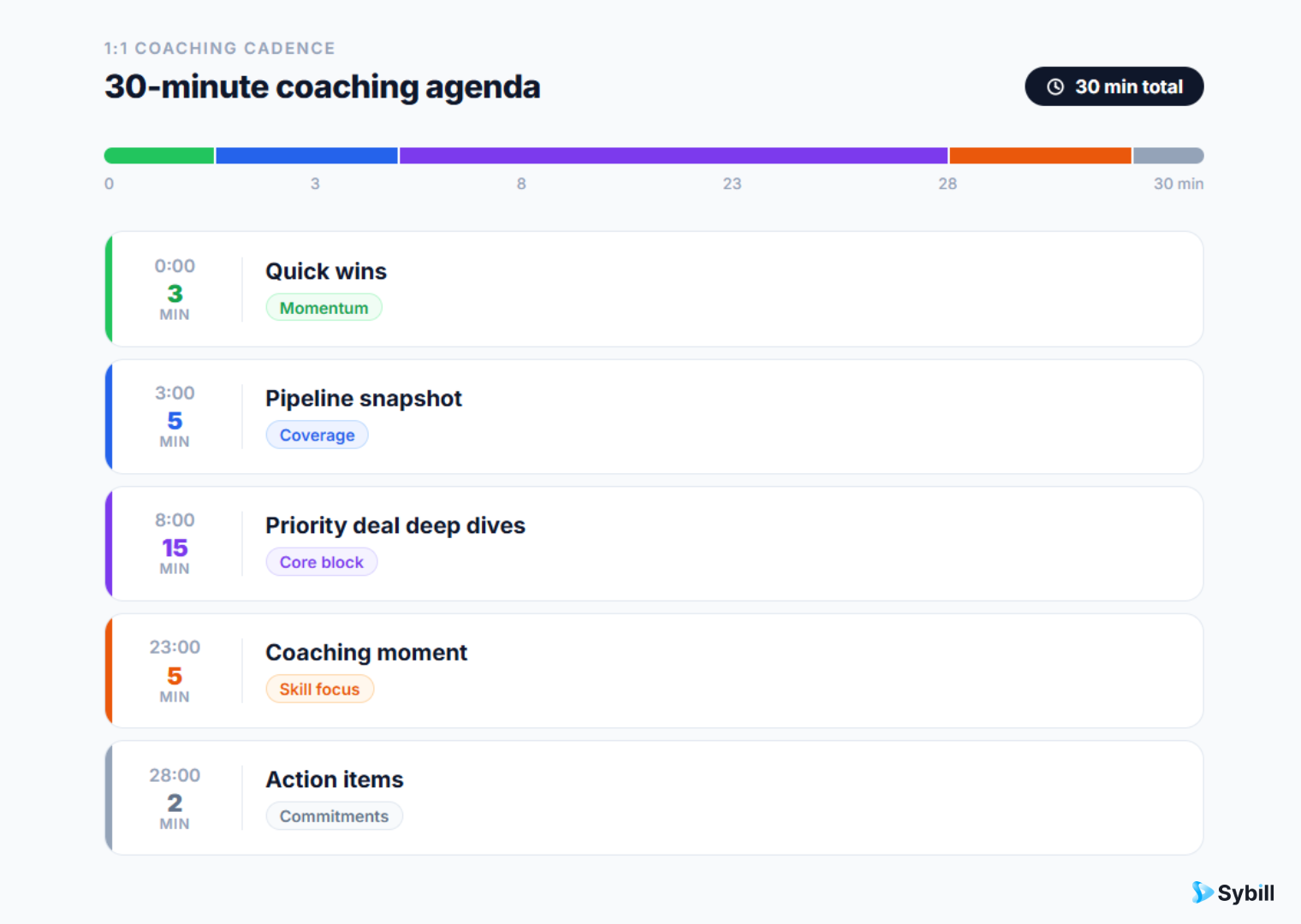
This agenda works for weekly 1:1 pipeline reviews between a manager and an individual rep. It is designed to be repeatable, meaning the same structure every week, so both parties know what to prepare and what to expect.
Start with momentum. What closed since the last review? What moved forward? Which deals advanced a stage? What commitments from last week were completed?
This is not filler. It sets the tone. Pipeline reviews that open with interrogation ("Why hasn't this deal closed yet?") create defensiveness. Reviews that open with recognition ("You moved Acme to negotiation, walk me through what unlocked that") create collaboration.
Keep this to 3 minutes. Acknowledge progress, then move forward.
Pull up the pipeline view and assess the macro picture before diving into individual deals. The rep should have current pipeline data ready, but if your team uses CRM Autofill to populate deal fields automatically after every call, the data is already accurate without any prep.
Cover four numbers in 5 minutes:
Total pipeline value versus quota. Is there enough pipeline to hit the number? The standard benchmark is 3x to 4x pipeline coverage for the quarter. If coverage is thin, the conversation shifts from "which deals to close" to "where are new opportunities coming from?"
Stage distribution. Are deals clustered at the top (lots of early-stage, nothing close to close) or the bottom (heavy commit, thin creation)? Clustering signals a timing problem that needs to be addressed now, not at end of quarter.
Pipeline movement since last review. Which deals progressed? Which stalled? Which are new? A pipeline that looks identical week over week is a pipeline that is not being worked.
Deals past expected close date. Every deal sitting past its original close date needs a reality check. Is it genuinely delayed, or is it dead and nobody wants to say so?
This is the core of the meeting. Select 3 to 5 deals for detailed review. Not every deal. Not a status update on 20 opportunities. Three to five deals that need strategic attention.
Which deals to prioritize: Deals closest to close that need something specific to get across the line. Deals that have stalled (no activity in 14-plus days). Deals where the rep is uncertain about next steps. Deals at risk based on buyer engagement signals. New high-value deals that need a solid strategy from the start.
For each priority deal, work through the qualification evidence framework below.
Every pipeline review surfaces a coaching opportunity. It might be how the rep handles a specific objection pattern, how they navigate multi-stakeholder deals, how they qualify budget, or how they advance deals past a specific stage.
Pick one coaching theme per review. One. Not three feedback points that the rep will forget before the next call. Identify the specific skill gap, reference a specific deal or call where it appeared, and agree on what the rep will do differently in the next opportunity.
If your team records calls with conversation intelligence, the coaching moment can reference a specific call excerpt rather than a vague impression. "On the Acme call, the buyer raised implementation concerns twice and you moved past both. Let us work on a response framework for that objection" is actionable coaching. "Be more consultative" is not.
End with explicit, written commitments. Every priority deal reviewed should have a clear next action, owner, and deadline. The manager should also have specific commitments if they agreed to help (making an introduction, joining a call, escalating an issue).
Write these down during the meeting. Not after. If action items are captured in your CRM or deal workspace automatically, even better. The action items from this week's review are the first thing you check in next week's review.
The priority deal deep dives in Block 3 are where pipeline reviews either generate value or waste time. The difference is the questions the manager asks.
Most managers default to status questions: "Where does this deal stand?" "What is the next step?" "When will it close?" These questions produce status updates, not insights. The rep tells you what you could have read in the CRM. Neither of you learns anything new.
Better questions force the rep to assess deal health against qualification evidence rather than recite activity.
This question reframes deal health from what the rep has done (sent an email, scheduled a demo, submitted a proposal) to what the buyer has done (responded, attended, engaged stakeholders, shared internal timelines). Buyer action is the only reliable indicator of deal momentum. Rep activity without buyer reciprocity is motion without progress.
If the answer is "they have not done anything," that is the most important signal in the review. A deal where the buyer has gone silent is not "in progress." It is at risk.
This question tests whether the rep has identified and confirmed a champion, and whether that champion is actively working on the rep's behalf inside the buyer's organization. "The VP of Sales likes our product" is not champion confirmation. "The VP of Sales shared our proposal with procurement and scheduled a call with their CFO to discuss budget" is.
If the rep cannot name a specific person who is actively advancing the deal internally, the deal lacks the internal engine it needs to close.
This is the question reps avoid and managers must ask. Every deal has risks. Reps who say "nothing, it is going great" are either not seeing the risks or not willing to name them.
Push for specifics: Is there a competing priority? A stakeholder who has not been engaged? A budget cycle mismatch? A procurement process nobody has mapped? An incumbent vendor relationship? A technical requirement that has not been validated?
Naming risks is not pessimism. It is deal management. Every named risk becomes a specific action item. Unnamed risks become quarter-end surprises.
Close dates in CRM are often aspirational rather than evidence-based. This question forces the rep to justify the timeline with buyer-confirmed data points.
Credible evidence includes: the buyer confirmed a decision timeline in a call, a procurement process with defined stages and dates has been shared, budget is approved for the current fiscal period, or a specific event (contract expiration, board meeting, product launch) creates a deadline.
Weak evidence includes: "they said they want to move fast," the rep set the date based on when they need it to close for quota, or "it has been in this stage for a while so it should close soon."
If the close date is not backed by buyer evidence, update it. A pipeline built on accurate close dates is worth 10x a pipeline padded with optimistic ones. This is why teams that use MEDDPICC or similar qualification frameworks and populate the criteria from actual call data through CRM Autofill produce dramatically more accurate forecasts.
This question shifts the manager's role from evaluator to enabler. Pipeline reviews should not just assess deal health. They should produce specific managerial actions that remove blockers.
Common manager actions: joining a call with a senior stakeholder, making a warm introduction to a decision-maker, providing competitive positioning guidance, escalating a procurement issue, or approving a custom pricing structure. If the manager walks out of the review without commitments of their own, the review was one-directional.
The agenda and questions above work. The reasons pipeline reviews still fail are structural, not tactical.
The single biggest pipeline review failure is reviewing deals based on data that does not exist. CRM fields are empty. Call notes are sparse or missing. The manager asks about MEDDPICC qualification status and the rep says "let me check my notes." Deal stage was last updated three weeks ago. Next steps say "follow up" with no specificity.
This turns the pipeline review into a data collection exercise. The manager spends 15 minutes asking questions that should have been answered by the CRM, and the rep spends 15 minutes reconstructing conversations from memory. The actual strategic discussion never happens.
The fix is not asking reps to be more disciplined about CRM updates. The fix is automating the data capture so it happens after every call without rep effort. When Sybill's CRM Autofill writes 30-plus structured fields after every call and email, including qualification criteria, pain points, next steps, stakeholder data, and competitive mentions, the pipeline review starts from a foundation of accurate data rather than spending half the meeting building it.
Managers who review 15 to 20 deals in a 30-minute meeting are reviewing none of them. They are skimming status updates and moving on. No deal gets the strategic attention it needs.
The discipline is selection. Pick 3 to 5 deals that need attention based on the criteria in Block 3: close proximity, stalled activity, rep uncertainty, risk signals, or strategic importance. Cover those thoroughly. Trust that the CRM data is accurate for the rest (which circles back to Failure 1: the data has to actually be there).
Action items agreed in a pipeline review are worthless if nobody checks on them the following week. The most common pattern: manager and rep agree on specific next actions, both walk out motivated, the week happens, next review starts from scratch without referencing prior commitments.
Build accountability into the agenda. Block 1 (Quick Wins) should include a check on last week's action items. Were they completed? If not, why? This creates a weekly accountability loop where commitments carry forward until they are resolved.
Sybill's deal workspace and AI Tasks feature track action items from calls automatically. Commitments made during or after a pipeline review are captured and visible the following week without anyone manually logging them.
Pipeline reviews that feel like performance evaluations destroy trust and reduce information quality. Reps who feel interrogated learn to present deals optimistically, hide risks, and avoid discussing stalled opportunities. The manager gets a distorted picture of the pipeline and cannot help because they do not know where help is needed.
The fix is structural: start with wins (Block 1), end with "what do you need from me" (Question 5), and frame risk discussions as collaborative problem-solving rather than blame identification. "What could kill this deal and what should we do about it?" is a fundamentally different question than "Why is this deal not closing?"
The traditional pipeline review suffers from a preparation problem. Reps spend 30 to 60 minutes before each review updating CRM fields, reviewing their own call notes, and preparing deal summaries. Managers spend 15 to 30 minutes scanning the pipeline and preparing questions. That is 45 to 90 minutes of combined prep for a 30-minute meeting.
AI collapses this prep to near zero.
When every call produces a structured Magic Summary and CRM Autofill writes qualification criteria, pain points, next steps, and stakeholder data into every deal record automatically, both the rep and the manager walk into the review with current, accurate data already in the system. No prep session required. No memory reconstruction. No data entry sprint before the meeting.
Ask Sybill takes this further. A manager can query across all of a rep's deals before the review: "Which deals have gone quiet in the last two weeks?" "Where is budget unconfirmed?" "Which deals are missing an identified champion?" These queries produce the priority deal list for Block 3 in seconds rather than requiring manual pipeline scanning.
The result is a pipeline review where both participants spend 100% of the time on strategic deal discussion and coaching rather than splitting time between data gathering and actual analysis. The meeting becomes what it was always supposed to be: the most valuable 30 minutes of the rep's week.
Weekly 1:1 reviews are the standard for most B2B sales teams. Thirty minutes per rep, same day each week, same agenda structure. Consistency matters more than frequency. A weekly review that both manager and rep trust and prepare for is better than a daily check-in that feels like micromanagement.
Bi-weekly reviews work for experienced reps with shorter sales cycles and consistent performance. The risk is that two weeks is long enough for a deal to stall completely without intervention. If you go bi-weekly, supplement with async pipeline updates (a Slack summary or CRM-triggered alert) in the off weeks.
Team pipeline reviews should be rare and purpose-specific. Group reviews where each rep gives a status update while the rest of the team checks email are universally hated and almost always unproductive. Salesforce's own sales leadership guidance recommends 1:1 reviews over group sessions. If you run team reviews, limit them to monthly or quarterly strategic sessions focused on pipeline health trends, not individual deal walkthroughs.
Duration: Thirty minutes is the target. If you consistently need more than 30 minutes, you are either reviewing too many deals or your deal data is too sparse and the meeting is doubling as a data collection exercise. Both problems have structural solutions.
The biggest obstacle to great pipeline reviews is not the agenda. It is the data. When CRM fields are empty, reviews become interrogation sessions. When deal data is accurate and current, reviews become strategic coaching conversations.
Sybill updates 30-plus CRM fields after every call. Ask Sybill surfaces priority deals, risk signals, and qualification gaps in seconds. Your next pipeline review starts from a foundation of evidence, not memory.
Start free with Sybill and see what pipeline reviews look like when the data is already there.
A sales pipeline review meeting is a recurring 1:1 between a sales manager and a rep to assess active deal health, identify risks, remove blockers, and agree on specific next actions. The best pipeline reviews run 30 minutes, follow a consistent agenda, focus on 3 to 5 priority deals, and end with written action items. They are distinct from forecast reviews, which focus on predicting revenue outcomes for a specific period.
Weekly is the standard cadence for most B2B sales teams. Thirty-minute 1:1 sessions on the same day each week with a consistent agenda produce the best results. Bi-weekly reviews work for experienced reps with short sales cycles, but the gap increases the risk of deals stalling without intervention. Group pipeline reviews should be rare (monthly or quarterly) and focused on trends, not individual deal walkthroughs.
Five questions surface real deal health beyond status updates: What has the buyer done since our last review? Who on their side is actively championing this deal? What could kill this deal? What specific evidence supports your close date? What do you need from me to advance this deal? These questions test buyer momentum, internal advocacy, risk awareness, forecast accuracy, and manager enablement respectively.
Reps should have current CRM data for all active deals, with particular attention to the 3 to 5 deals most likely to be discussed (close proximity, stalled, uncertain, at risk, or strategically important). Managers should scan the pipeline for stage changes, stalled deals, and overdue close dates. Teams using Sybill's CRM Autofill and Ask Sybill can skip most prep because deal data is always current and cross-deal queries surface priority deals in seconds.
A pipeline review covers all active deals regardless of stage and focuses on deal execution: advancing deals, removing blockers, and coaching reps. A forecast review focuses on deals expected to close within a specific period and predicts revenue outcomes. Pipeline reviews happen weekly in 1:1s. Forecast reviews typically happen weekly or bi-weekly with leadership. The pipeline review feeds the forecast review: accurate pipeline data produces accurate forecasts.
AI eliminates the two biggest pipeline review failures: missing data and excessive prep time. CRM Autofill writes structured deal data (qualification criteria, pain points, next steps, stakeholders) after every call, so pipeline data is always current. Cross-deal querying surfaces priority deals, risk signals, and qualification gaps in seconds. Together, these reduce combined prep time from 45-plus minutes to under 5 minutes and ensure the review focuses on strategic discussion rather than data reconstruction.
A sales pipeline review meeting is a recurring 1:1 between a sales manager and a rep to assess active deal health, identify risks, remove blockers, and agree on specific next actions. The best pipeline reviews run 30 minutes, follow a consistent agenda, focus on 3 to 5 priority deals, and end with written action items. They are distinct from forecast reviews, which focus on predicting revenue outcomes for a specific period.
Weekly is the standard cadence for most B2B sales teams. Thirty-minute 1:1 sessions on the same day each week with a consistent agenda produce the best results. Bi-weekly reviews work for experienced reps with short sales cycles, but the gap increases the risk of deals stalling without intervention. Group pipeline reviews should be rare (monthly or quarterly) and focused on trends, not individual deal walkthroughs.
Five questions surface real deal health beyond status updates: What has the buyer done since our last review? Who on their side is actively championing this deal? What could kill this deal? What specific evidence supports your close date? What do you need from me to advance this deal? These questions test buyer momentum, internal advocacy, risk awareness, forecast accuracy, and manager enablement respectively.








